Bob Schwartz

Tag: First Amendment

“Texas professor reinstated after firing over Palestine talk says ‘I didn’t do anything wrong’.” The First Amendment lives, on the 239th anniversary of the signing of the U.S. Constitution.
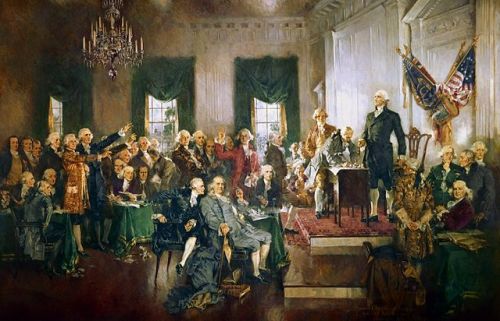
239th anniversary of the signing of the Constitution in 1787

The U.S president is making a BIG DEAL of the 250th anniversary of the Declaration of Independence. This is bizarre. The Declaration set off a revolution against a TYRANT and tyranny, so it is ironic that this comes from a tyrant or at least a tyranny wannabe.

The real anniversary we should be celebrating every year is the signing (1787) or ratification (1788) of the U.S. CONSTITUTION and its added BILL OF RIGHTS. This is a president who has done everything but publicly burn a copy of the Constitution, along with copies of any inconvenient laws. Soon we may see American history that identifies some of the founders and signers as “too woke” who should be eliminated from our schools. Thankfully, there are still judges, including those appointed by this president (see below), who are sworn to uphold the Constitution and the laws. The Constitution, The Bill of Rights, and the First Amendment live.


Texas professor reinstated after firing over Palestine talk says ‘I didn’t do anything wrong’

Timothy Pratt
The Guardian
Thu 14 May 2026

Texas philosophy professor Idris Robinson said he was breathing a bit easier this week nearly halfway through what he called “the most stressful month of fatherhood so far”.

That’s because Robinson was faced with losing his paycheck from Texas State University beginning 31 May, along with his academic affiliation, after he was fired for a talk he gave in another state on what he called “the liberation of Palestine”. The incident would have made it nearly impossible for him to find another job teaching – all with a 16-month-old son at home.

But then Trump-appointed district court Judge Alan Albright ruled in his favor this week and ordered Texas State to continue paying him for another year or until his lawsuit against the school reaches an outcome, whichever comes first. The state “put Dr. Robinson’s career in grave danger by violating his First Amendment rights”, Albright wrote in his decision.

“It’s the right decision,” Robinson said in an interview. “I didn’t do anything wrong. I do my job and I do it well.”

The complaint, reported by the Guardian in March, alleges that the school violated Robinson’s constitutional rights by ending his contract after a 2024 talk he gave in North Carolina on Palestine and Israel. A fight broke out before he could finish the talk. Neither Robinson nor anyone else at the event mentioned his job at the university.

Toward the end of the hour-long hearing on Tuesday, Albright highlighted that “the state really hasn’t made an effort to argue that the speech that the plaintiff gave [wasn’t] in some role or another a motivating factor” in the university’s decision to terminate his contract, according to Yarden Azoulay Katz, a member of Robinson’s legal team who attended.

The decision in favor of continuing to pay Robinson is a “shot across the bow for many universities who have violated free speech rights”, said Zach Greenberg, director of Faculty Legal Defense at the Foundation for Individual Rights and Expression (Fire), an organization with local counsel involved in the case. “It bodes well for academic freedom.”

The university’s termination of Robinson’s contract was “an adverse action, carried out for an unlawful reason”, said Samantha Harris, his attorney. The judge’s decision not only made Robinson’s near future a lot brighter – “it also showed there’s a substantial likelihood of success with regard to Dr Robinson’s claim of first amendment retaliation,” said Harris, who has worked on such claims for two decades.

Prior to this incident, Robinson had four years of stellar performance reviews, according to the complaint.

Robinson pointed out that others in academia have been disciplined for speech on Palestine, as well as other subjects, such as Charlie Kirk’s killing.

“I hope [the judge’s decision] sets a precedent – so people see they can stand up and fight, see things out to the end,” he said.

The philosopher, who has recently published a book, The Revolt Eclipses Whatever the World Has to Offer while fighting the university’s actions, has centered much of his research on societies in conflict and revolution.

He believes the US is in its third “Red Scare”, after those prior to the first world war and after the second world war, which focused on perceived threats from communism. “Repression around speech is part of the new Red Scare,” he said. “Being a Black, leftist philosopher, I’m a target.”

“But it’s not just ‘F this communist’, or ‘F this terrorist’. It’s also good old-fashioned racism,” he added – noting that online harassment after his case went public has included such comments as: “I hope this [N-word]’s whole family commits suicide.”

A few weeks ago, someone texted his wife: “Idris f’d up.” He has no idea how they got her number.

Nonetheless, he said, “I’m still taking up space in their minds – so I’m winning.”

Robinson also allowed that the experience has had a chilling effect on his scholarship. He wrote two chapters about Israel and Palestine in his new book after Texas State began its disciplinary proceedings – and “deliberately avoided using the words ‘Israel’ or ‘Palestine’ and instead referred vaguely to ‘the holy land’ … to avoid further scrutiny”, he noted in an affidavit accompanying the lawsuit.

Robinson emphasized that the talk that apparently led Texas State to discipline him “wasn’t about me giving my opinion … it was about my analysis of what’s right in front of me, about trying to clarify this world historical event” of 7 October and its aftermath. Then, he said, “everyone made this big mess about a talk I didn’t even finish”.

And though the days leading up to this week’s hearing were stressful, he said, “it’s nowhere near as stressful as being a father in Gaza who can’t feed or protect his children”.

While the lawsuit takes its course, Robinson said he’d like to “concentrate on philosophy”– including a book on Austrian-British philosopher Ludwig Wittgenstein, the mid-20th-century thinker on logic, language and political thought.

As for Albright’s decision: “I hope it helps other academics who have been facing disciplinary actions to fight on. Even in a state like Texas, you can win.”


The Man Who Could Kill Democracy

McCutcheon v FEC

Today the Supreme Court hears arguments in the case of McCutcheon and Republican National Committee v. Federal Election Commission, an attack on the constitutionality of limits on individual contributions to federal elections. Just as the Court found in Citizens United that corporations have a First Amendment right to unlimited campaign contributions, so Alabama businessman Shaun McCutcheon would have that extended to people (since, as Mitt Romney pointed out, corporations are people too, ergo, people are corporations—at least for election money).

Mr. McCutcheon seems to be a decent and hardworking person, a loyal American, and he is of course entitled not only to his opinion but to his pursuit of it in the courts. But Mr. McCutcheon could conceivably be known as the man who killed American democracy, or at least the one nominally identified with its murder. Yes, he would have the heirs to Abraham Lincoln as his accomplices or co-conspirators, but his fingerprints would be on the weapon.

Is that hyperbole? Before Citizens United, it might have seemed so. But beyond theory, we now have proof that Big Money has a distorting effect on Big Democracy. A contortionate, twisted beyond recognition effect. There is reason to believe that if individual limits are lifted, the effect might go beyond injury to mortal blow.

You can read the submitted briefs here. After the arguments, you can listen to them here.

The questions presented on appeal are these:

Federal law imposes two types of limits on individual political contributions. Base limits restrict the amount an individual may contribute to a candidate committee ($2,500 per election), a national-party committee ($30,800 per calendar year), a state, local, and district party committee ($10,000 per calendar year (combined limit)), and a political-action committee (“PAC”) ($5,000 per calendar year). 2 U.S.C. 441a(a)(1) (current limits provided). Biennial limits restrict the aggregate amount an individual may contribute biennially as follows: $46,200 to candidate committees; $70,800 to all other committees, of which no more than $46,200 may go to non-national-party committees (e.g., state parties and PACs). 2 U.S.C. 441a(a)(3) (current limits provided) (see Appendix at 20a (text of statute)). Appellants present five questions:

1. Whether the biennial limit on contributions to non-candidate committees, 2 U.S.C. 441a(a)(3)(B), is unconstitutional for lacking a constitutionally cognizable interest as applied to contributions to national-party committees.

2. Whether the biennial limits on contributions to non-candidate committees, 2 U.S.C. 441a(a)(3)(B), are unconstitutional facially for lacking a constitutionally cognizable interest.

3. Whether the biennial limits on contributions to non-candidate committees are unconstitutionally too low, as applied and facially.

4. Whether the biennial limit on contributions to candidate committees, 2 U.S. C. 441a(a)(3)(A), is unconstitutional for lacking a constitutionally cognizable interest.

5. Whether the biennial limit on contributions to candidate committees, 2 U.S.C. 441a(a)(3)(A), is unconstitutionally too low.

Without going into the arguments so well-developed in the written briefs, and in the oral arguments today, one point should be stressed. The First Amendment is central to American democracy, but it has never been absolute. It could be of course, and we would be free to destroy the reputations of others, or talk freely about overthrowing the government, or republish the words of others without penalty, or yell fire in that crowded theater. Instead, as an exercise in social priorities, we argue about balance, though sometimes the argument for the good of the many and “democracy” is cover for what’s good for me and mine.

If the Court agrees that both the base limits (the per election money) and the aggregate limits (cumulative over two years) are unconstitutional on their face, anyone with money can attempt to influence public opinion and the action of public officials to the full extent that money can. And it can. Some say that this would simply level the playing field—the same way that everybody having guns would level the playing field, insuring that only the bad guys would get shot. Funny how the First and Second Amendments can work so well together.

In the worst case, where we may be speaking about McCutcheon as we do about Citizens United, only more so, there is still an answer. Simple but not easy:

Get smart.
Vote.

Without casting aspersions too wide, it does seem that a number of Americans really don’t do their homework on public issues. As far as voting, our abysmal turnout numbers tell the tale. But if Americans did do their homework and did vote, we really could have a pragmatic, centrist, reasonable and successful country—instead of an extremist-obstructed one based more on blustery ideology and vaguely-veiled self-interest. We can hope.

NASCAR Follows NRA Off the Roof

NRA 300
The National Rifle Association jumped off the public relations roof in the wake of Newtown and the legislative attempts to curb gun violence.

Which is fine. The First Amendment guarantees the right of individuals or groups to jump off any rhetorical roof, so long as no one is harmed (except maybe for the jumper). There is money to be made and power to be gained by taking extreme or contrarian positions, sometimes the louder and more insistent the better.

But as your parents advised you—though you may have willfully ignored the advice—just because Johnny jumps off the roof doesn’t mean you should do the same.

As recently as last September, the NRA sponsored a NASCAR race, the NRA American Warrior 300 in Atlanta.

Today it was announced that the NRA will be sponsoring a NASCAR Sprint Cup race at Texas Motor Speedway this April, to be called the NRA 500.

Something happened between September and April: Newtown, Sandy Hook, twenty children slaughtered.

The NRA believes that if anything happened, it only makes it more important than ever to pretend that nothing happened, or to pretend that whatever happened can’t be prevented by any proposed measures, or to pretend that what happened is being unfairly used to threaten their existence and the Second Amendment. The NRA believes it has the support of millions, and that its obstruction is massively appreciated, all national polls to the contrary. It believes that even if it is jumping off some roof, there is a safety net to catch it.

NASCAR may believe that it will be caught by that same safety net, since many NASCAR fans are also gun owners, if not NRA members. NASCAR may feel it is caught between a rock and a hard place: damned if they continue to work with the NRA, damned if they don’t. Of course, even many NRA members are skeptical, some embarrassed, by the NRA’s current extremism and obstruction. On top of that, the NRA PR safety net, even if it does still exist, is probably big enough for just one.

Maybe an NRA race this April won’t be such a big deal for NASCAR. But maybe it will be. If it is, NASCAR shouldn’t expect that there will be a net to catch it. We will know in the days to come whether this is a brilliant move, just business as usual, or a thud.