Bob Schwartz

Tag: elections

Alternate history: What if the presidential losers were winners?

If you are a fan of alternate history, you should first of all be reading Philip K. Dick’s The Man in the High Castle and watching the series on Amazon (no spoiler: the U.S. lost World War II). For something else different, there’s this:

What if the major party losers for President actually won the election?

There are a few glitches, thanks to an untimely assassination and resignation, a loser later becoming a winner, a winner later becoming a loser, and a seriously messed up vote count. To avoid this, I’ve eliminated those losers who at one time did get to be President, by hook or crook.

Adlai Stevenson
Barry Goldwater
Hubert Humphrey
George McGovern
Walter Mondale
Michael Dukakis
Bob Dole
Al Gore
John Kerry
John McCain
Mitt Romney

Practice saying this, alternate historians. President Stevenson. President Goldwater.

If you really want to get far out, add prominent third-party losers to the mix.

President Wallace? To put that one in perspective, George Wallace got 46 electoral votes in 1968, compared to just 52 for Goldwater in 1964 and 49 for Jimmy Carter in 1980.

And, of course, there’s President Ross Perot. He ran twice, didn’t win any electoral votes, but provided the model for any billionaire third-party candidates in the future. As if such a thing could ever happen again.

Veterans Day: The Annual Shame of a Nation

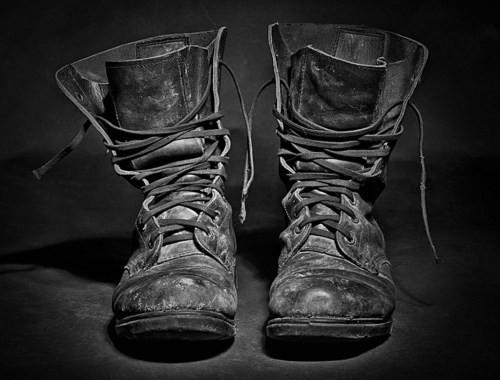
Veterans Boots

Failure to take full and proper care of veterans is not a Democratic or Republican shame. The only reason to focus on Republicans here is that last night, in their debate, on the eve of Veterans Day, only four passing mentions of veterans were made during two hours.

The debate was formally about the economy, but since every one behind the podiums is practiced at changing the subject, there’s no reason some or all of them couldn’t have just said: The economy is an important topic, but just tonight, this particular night, I’d like to focus my time exclusively on veterans matters.

Here’s what one of them might have said:

There is enough responsibility to go around for getting this nation involved in military conflicts. It doesn’t matter what party started it or finished it or didn’t finish it. It doesn’t matter whether it was a great idea or a terrible idea or whether it is too soon to tell. As a nation, we do what we do, and we have to pay the price and keep our promises. In the case of military service, that promise is to spare no expense or effort to not only make combatants whole, or whole as humanly possible, but to elevate their service to priority status in our national consciousness and commitments.

That’s why I’m going to spend whatever minutes I have on this national debate platform tonight to talk specifically about immediate solutions to veterans issues, rather than casting blame or blowing hot air. I also call upon the millionaires and billionaires supporting us and trying to influence the election to divert just a little of that money to nonpartisan efforts such as Iraq and Afghanistan Veterans of America to start solving the problem. Of course, making this a government first priority would be nice too. Because if it comes down to a choice between any of us actually getting the nomination, which is admittedly a long shot for most of us anyway, and the comfort and well-being of those men and women we’ve flag-wavingly asked to fight on our behalf, I’d rather ask that those veterans be made whole than that I be President.

I know. Dream on.

McCutcheon: Is This the Electoral Apocalypse? (Maybe Not)

SupremeCourtJustices_2012_032620121

Six months ago I wrote a post called The Man Who Could Kill Democracy about the case of McCutcheon v. Federal Election Commission. McCutcheon was asking the Supreme Court, on free speech grounds, to lift federal limits on aggregate campaign contributions. By a 5-4 decision, the Court today agreed.

In that post I wrote:

The First Amendment is central to American democracy, but it has never been absolute. It could be of course, and we would be free to destroy the reputations of others, or talk freely about overthrowing the government, or republish the words of others without penalty, or yell fire in that crowded theater. Instead, as an exercise in social priorities, we argue about balance, though sometimes the argument for the good of the many and “democracy” is cover for what’s good for me and mine.

Today’s decision finds that limits on what an individual can give to a single candidate is allowable under the First Amendment as a way to prevent corruption (that is, you shouldn’t massively buy a single election on a quid pro quo, one hand washing the other basis). But restrictions on what an individual may give in aggregate offends the First Amendment (that is, you are free to try to buy as many elections as your wealth allows).

The majority opinion of Justice Roberts was joined in by Justices Scalia, Kennedy and Alito; Justice Thomas concurred, but believes that all limits on campaign finance are impermissible under the First Amendment. Justice Breyer filed a dissent, in which Justices Ginzburg, Sotomayor, and Kagan joined.

Justice Breyer writes in his dissent:

Today a majority of the Court overrules this holding. It is wrong to do so. Its conclusion rests upon its own, not a record-based, view of the facts. Its legal analysis is faulty: It misconstrues the nature of the competing constitutional interests at stake. It understates the importance of protecting the political integrity of our governmental institutions. It creates a loophole that will allow a single individual to contribute millions of dollars to a political party or to a candidate’s campaign. Taken together with Citizens United v. Federal Election Comm’n, 558 U. S. 310 (2010), today’s decision eviscerates our Nation’s campaign finance laws, leaving a remnant incapable of dealing with the grave problems of democratic legitimacy that those laws were intended to resolve.

So is this it, the electoral apocalypse? In the earlier post before the decision I wrote:

Get smart.
Vote.

Without casting aspersions too wide, it does seem that a number of Americans really don’t do their homework on public issues. As far as voting, our abysmal turnout numbers tell the tale. But if Americans did do their homework and did vote, we really could have a pragmatic, centrist, reasonable and successful country—instead of an extremist-obstructed one based more on blustery ideology and vaguely-veiled self-interest. We can hope.

That’s still it. If we have an aware, informed, moral, discerning electorate that votes, there is hope that in spite of McCutcheon (and Citizens United and whatever other shoes the Supreme Court has yet to drop), we can maintain what Justice Breyer calls “democratic legitimacy.” Without that, despite what Imagine Dragons sing, the apocalypse may not be followed by a new age, but by some back to the future America of the overpowered and the underpowered.

If you believe that America has a problem in any of those areas—awareness, information, morality, discernment, voting—then do whatever you can. Don’t blame nice Mr. McCutcheon, or nice Justices Roberts, Scalia, Kennedy, Alito, and Thomas (even if they are wrong). And if you are hand-wringing, which is admittedly hard to avoid, do it only for a moment; it is unattractive and useless. Then get busy.