The Bible and the Working Man (1946): The Bible and Christianity promote unionization
“Although mechanical changes have been great since Biblical times…modern workers still have the basic job of providing for their families….organizing together has helped them achieve brotherhood and gain the fruits of their toil…it has helped build the communities and the nation in which they live, for 25 years…most religious denominations have recognized this and declared themselves in support of unionization and collective bargaining…there should be no gap between the working man and his church!”
The Congress of Industrial Organizations (CIO) was one of the two umbrella organizations representing American unions. The other was the American Federation of Labor (AFL), which merged with the CIO, forming the AFL-CIO.
In 1946 the CIO created a comic book leaflet, making the case that unionization was promoted by the Bible and by Christianity. The CIO explains:
“Since the beginning of religious history, the struggle for social justice has been the special concern of the prophets of God. To God’s militants, justice is no abstraction. It is measured by everyday conduct, by the relation between the rich and the poor, the employer and his employees, the state and its citizens.
“The early church began as a movement which sprang from the people. With few exceptions its members came from the ranks of the needy and oppressed. However, since before the days of Jesus of Nazareth, the church has periodically lapsed and forgotten its responsibility to bring glad tidings to the poor. These lapses have not been the monopoly of any faith. Catholic, Protestant and Jew alike are influenced by the world around them. The building of a grander church house has often seemed more important than whether the congregation had enough to eat. But those who place the needs of men and women above pomp and ceremony have then been stirred into renewed activity to bring God’s kingdom on earth.
“Today the age-old struggle continues. Perhaps it always will. Perhaps it is a part of the struggle between good and evil in the heart of every man. But we in the labor movement believe that all men must share in the good things of this life, and that God wills it so.
“Because of this conviction, we made this study which we present to you in pictures, because pictures are a familiar and popular way of spreading ideas. We hope that this presentation of the struggle for justice from Genesis to Revelations will be a source of greater inspiration to those who read it. It is our desire thus to stimulate a more vivid understanding of man’s duty toward his fellow man.”
The comic book leaflet can be found here. The pages are included below. Since it is not easy to read all of the text on those pages, excerpts of text are also included below.
Page 1
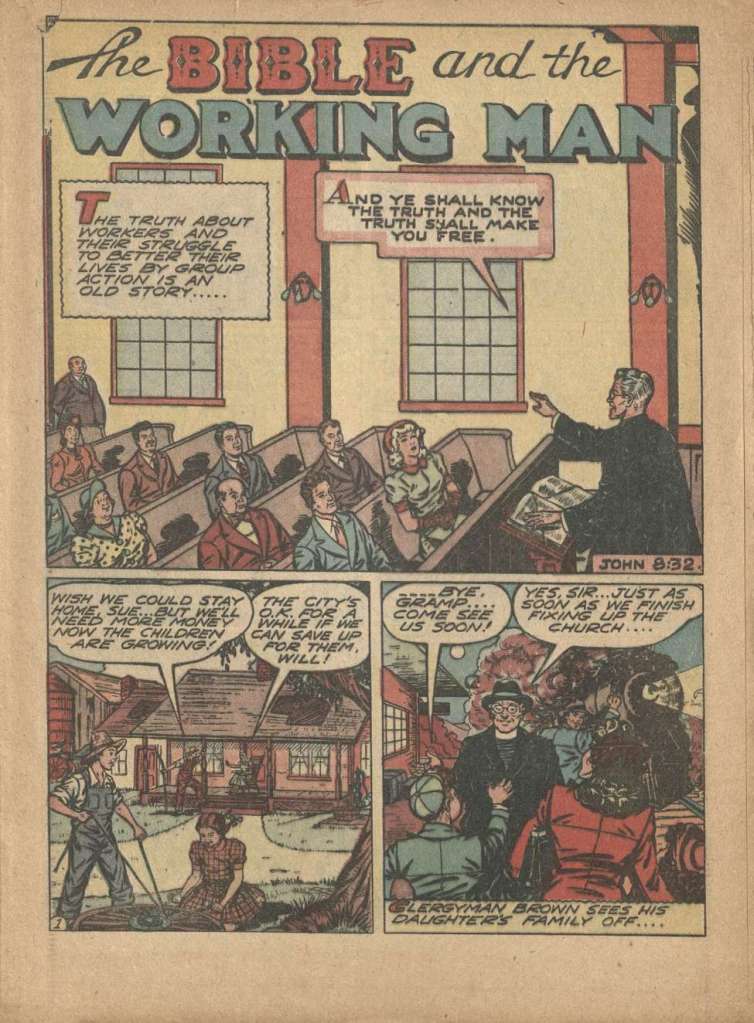
THE BIBLE AND THE WORKING MAN
“The truth about workers and their struggle to better their lives by group action is an old story…”
“And ye shall know the truth and the truth shall make you free.” — John 8:32
Page 2
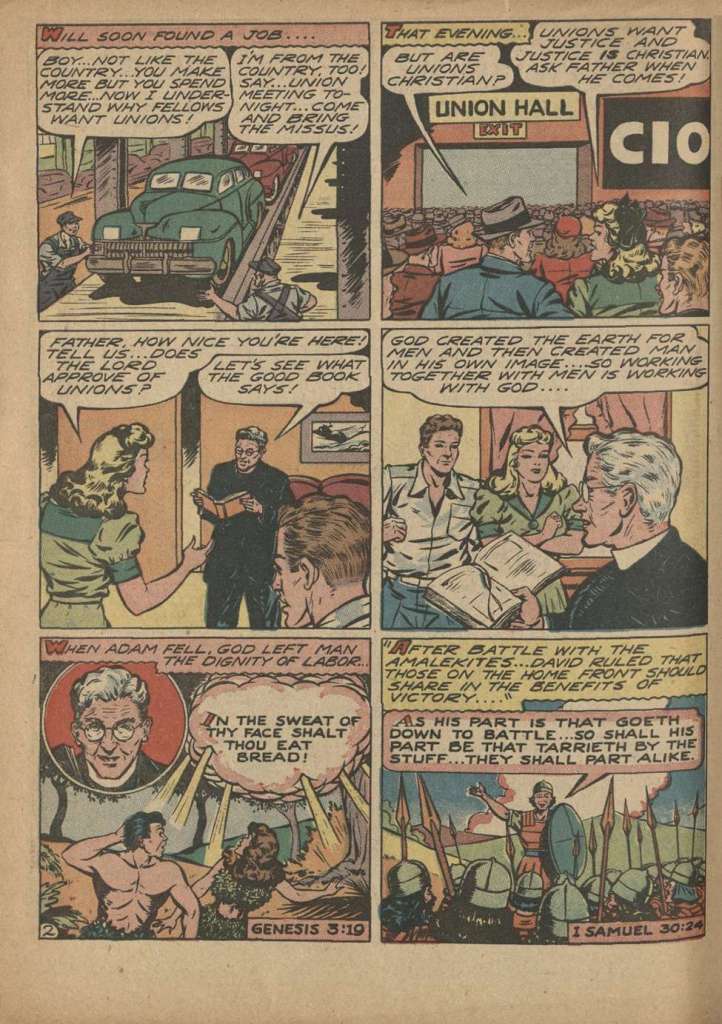
“But are unions Christian?”
“Unions want justice and justice is Christian. Ask father when he comes!”
“Father, how nice you’re here! Tell us…does the Lord approve of unions?”
“Let’s see what the Good Book says!”
“God created the earth for men and then created man in his own image…so working together with men is working with God…”
“When Adam fell, God left man the dignity of labor…”
“In the sweat of thy face shalt thou eat bread!” — Genesis 3:19
“After battle with the Amalekites…David ruled that those on the home front should share in the benefits of victory….”
“As his part is that goeth down to battle…so shall his part be that tarrieth by the stuff…they shall part alike.” — I Samuel 30:24
Page 3
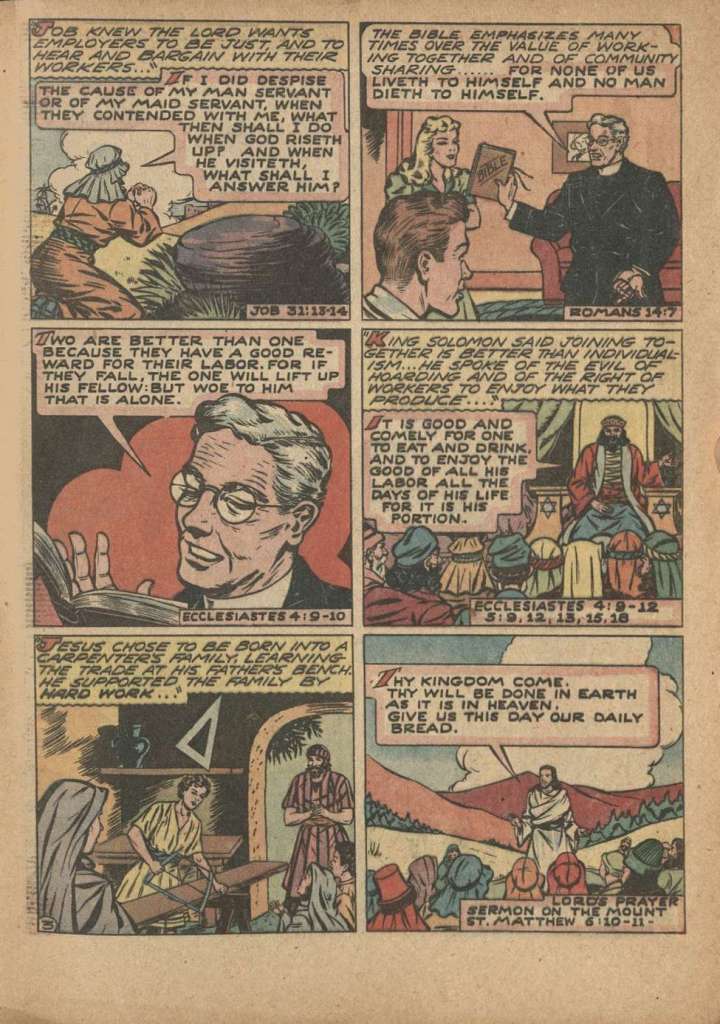
“Job knew the Lord wants employers to be just, and to hear and bargain with their workers…”
“If I did despise the cause of my man servant or of my maid servant, when they contended with me, what then shall I do when God riseth up? And when he visiteth, what shall I answer him?” — Job 31:13-14
“The Bible emphasizes many times over the value of working together and of community sharing…for none of us liveth to himself and no man dieth to himself.” — Romans 14:7
“Two are better than one because they have a good reward for their labor. For if they fall, the one will lift up his fellow: but woe to him that is alone.” — Ecclesiastes 4:9-10
“King Solomon said joining together is better than individualism…he spoke of the evil of hoarding and of the right of workers to enjoy what they produce…”
“It is good and comely for one to eat and drink, and to enjoy the good of all his labor all the days of his life for it is his portion.” — Ecclesiastes 4:9-12; 5:9,12,13,15,18
“Jesus chose to be born into a carpenter’s family, learning the trade at his father’s bench. He supported the family by hard work…”
“Thy kingdom come, thy will be done in earth as it is in heaven. Give us this day our daily bread.” — Lord’s Prayer, Sermon on the Mount, St. Matthew 6:10-11
Page 4
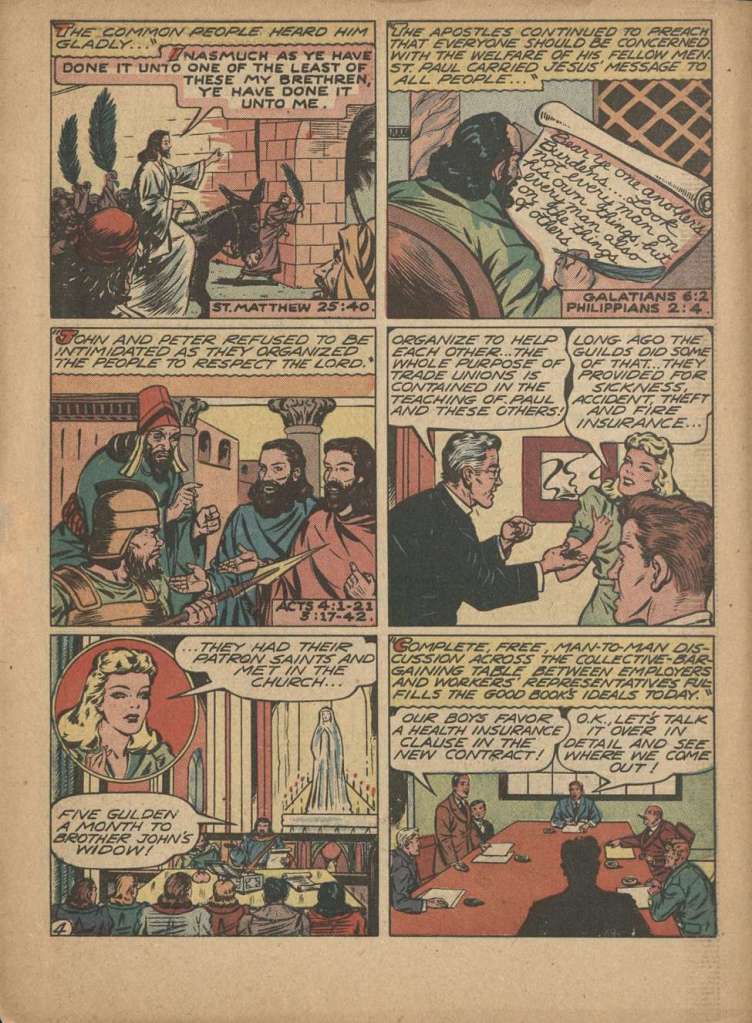
“Inasmuch as ye have done it unto one of the least of these my brethren, ye have done it unto me.” — St. Matthew 25:40
“The Apostles continued to preach that everyone should be concerned with the welfare of his fellow men. St. Paul carried Jesus’ message to all people…”
“Bear ye one another’s burdens…look not every man on his own things, but every man also on the things of others.” — Galatians 6:2 / Philippians 2:4
“John and Peter refused to be intimidated as they organized the people to respect the Lord.” — Acts 4:1-21; 5:17-42
“Organize to help each other…the whole purpose of trade unions is contained in the teaching of Paul and these others!”
“Long ago the guilds did some of that…they provided for sickness, accident, theft and fire insurance…”
“Complete, free, man-to-man discussion across the collective-bargaining table between employers and workers’ representatives fulfills the Good Book’s ideals today.”
Page 5
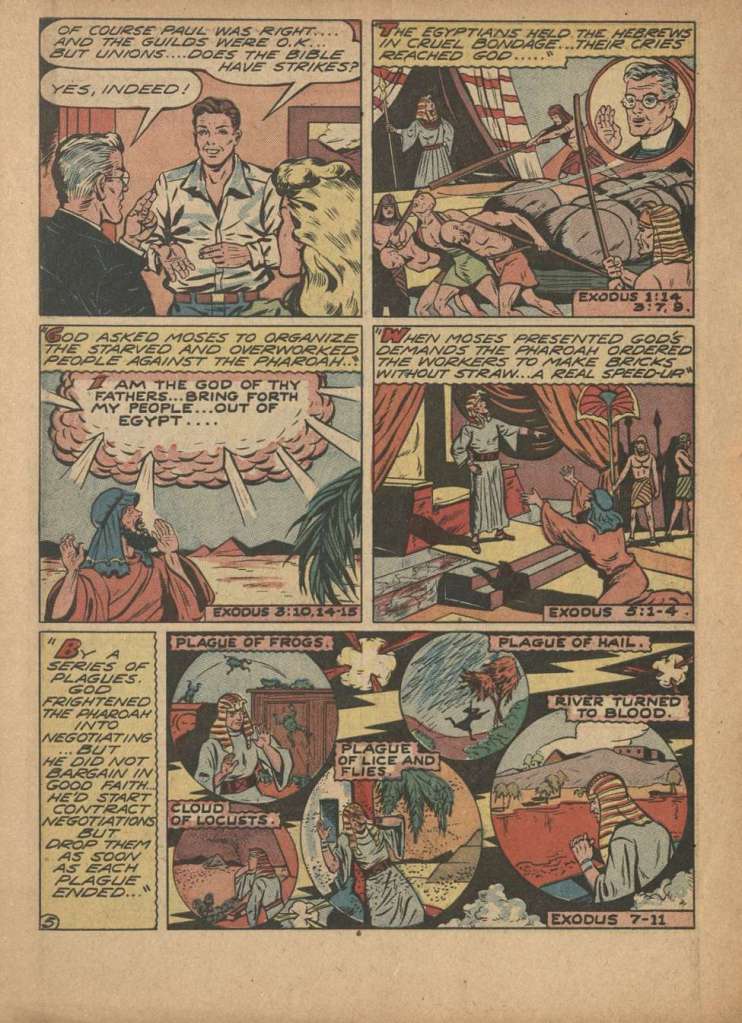
“Of course Paul was right…and the guilds were O.K….but unions….does the Bible have strikes?”
“Yes, indeed!”
“The Egyptians held the Hebrews in cruel bondage…their cries reached God….” — Exodus 1:14; 3:7,9
“God asked Moses to organize the starved and overworked people against the Pharaoh…”
“I am the God of thy fathers…bring forth my people…out of Egypt….” — Exodus 3:10, 14-15
“When Moses presented God’s demands the Pharaoh ordered the workers to make bricks without straw…a real speed-up.” — Exodus 5:1-4
“By a series of plagues, God frightened the Pharaoh into negotiating…but he did not bargain in good faith…he’d start contract negotiations but drop them as soon as each plague ended…”
Page 6
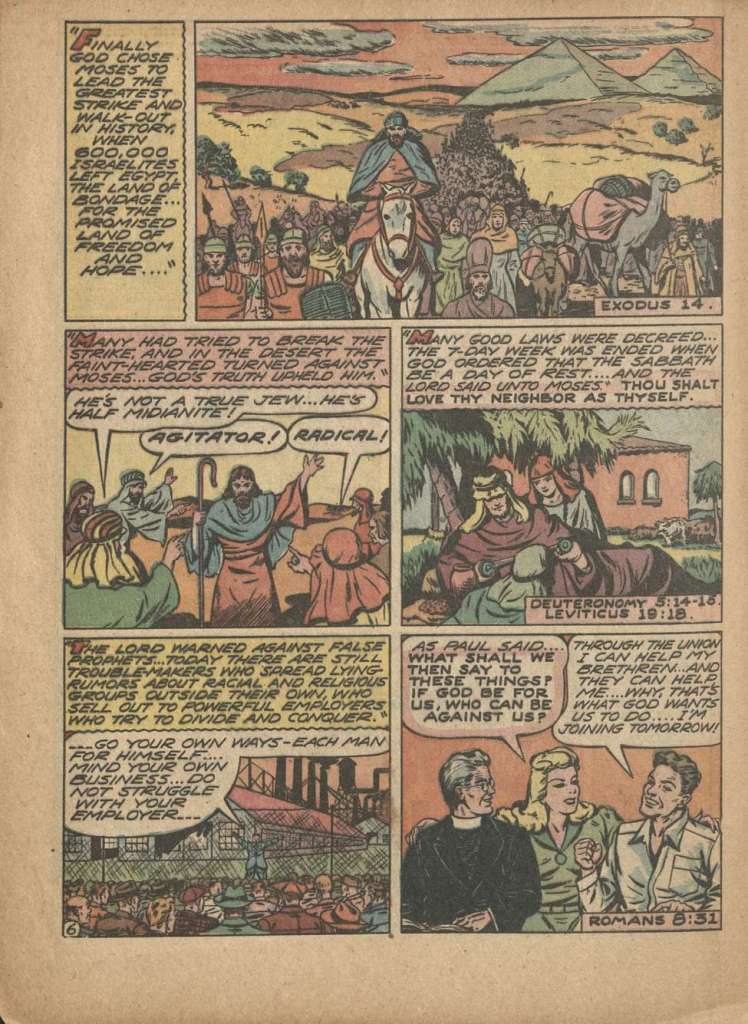
“Finally God chose Moses to lead the greatest strike and walk-out in history, when 600,000 Israelites left Egypt, the land of bondage…for the promised land of freedom and hope….” — Exodus 14
“Many had tried to break the strike, and in the desert the faint-hearted turned against Moses…God’s truth upheld him.”
“Through the union I can help my brethren…and they can help me….why, that’s what God wants us to do….I’m joining tomorrow!” — Romans 8:31
Page 7
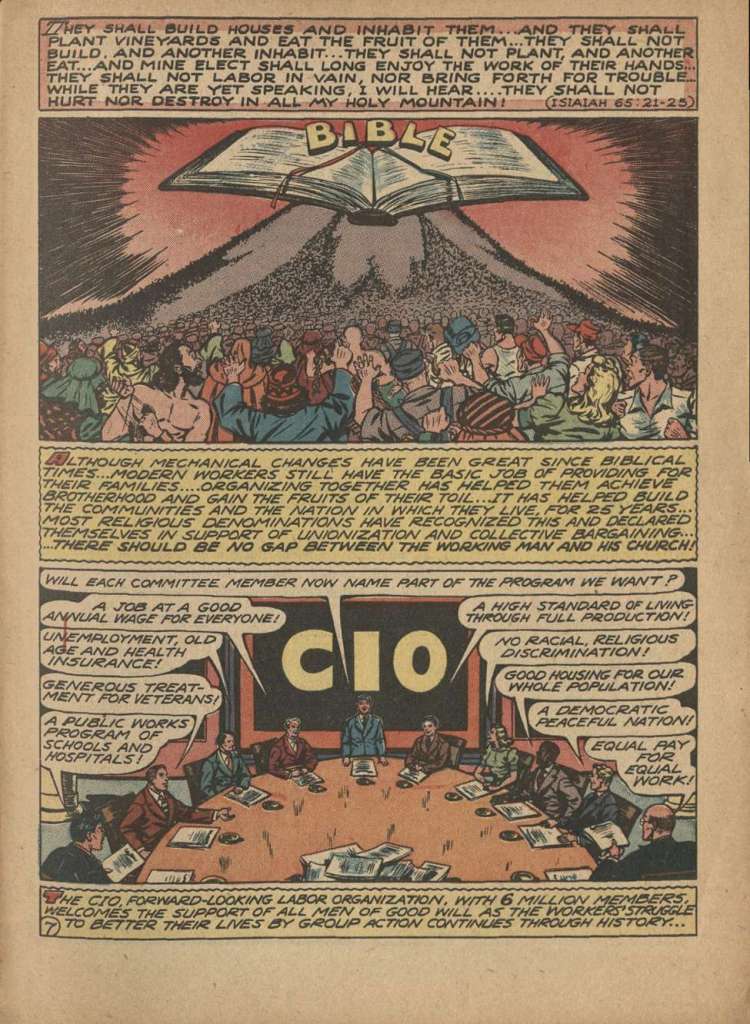
Although mechanical changes have been great since Biblical times…modern workers still have the basic job of providing for their families….organizing together has helped them achieve brotherhood and gain the fruits of their toil…it has helped build the communities and the nation in which they live, for 25 years…most religious denominations have recognized this and declared themselves in support of unionization and collective bargaining…there should be no gap between the working man and his church!
“Will each committee member now name part of the program we want?”
- A job at a good annual wage for everyone!
- Unemployment, old age and health insurance!
- Generous treatment for veterans!
- A public works program of schools and hospitals!
- A high standard of living through full production!
- No racial, religious discrimination!
- Good housing for our whole population!
- A democratic peaceful nation!
- Equal pay for equal work!
Page 8
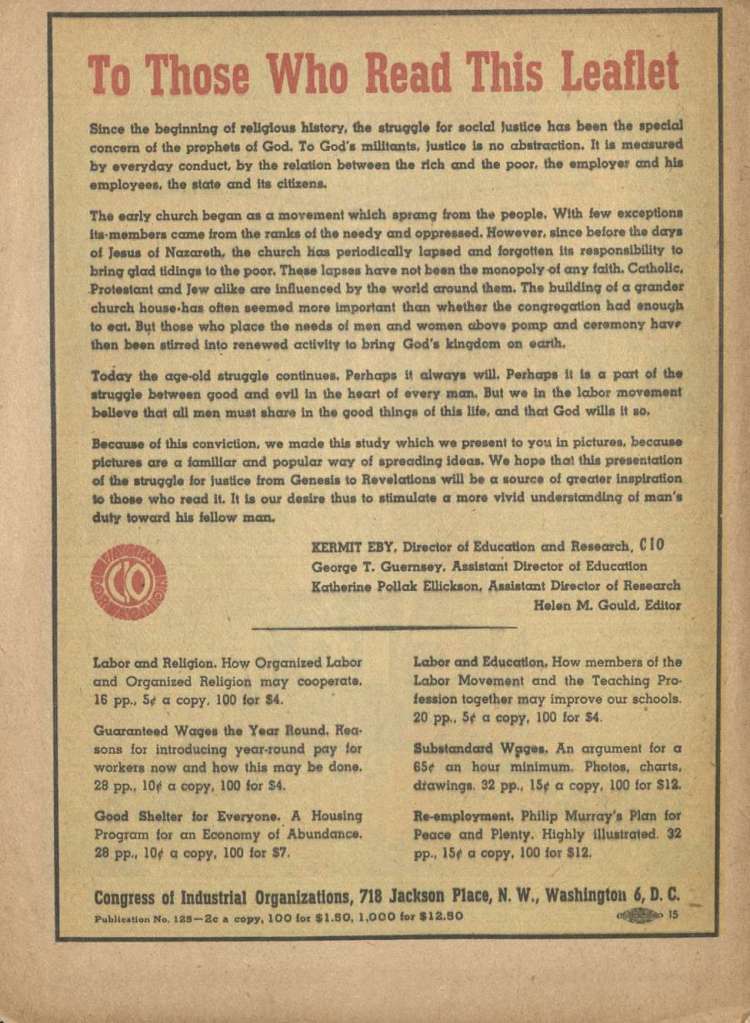
Since the beginning of religious history, the struggle for social justice has been the special concern of the prophets of God. To God’s militants, justice is no abstraction. It is measured by everyday conduct, by the relation between the rich and the poor, the employer and his employees, the state and its citizens.
The early church began as a movement which sprang from the people. With few exceptions its members came from the ranks of the needy and oppressed. However, since before the days of Jesus of Nazareth, the church has periodically lapsed and forgotten its responsibility to bring glad tidings to the poor. These lapses have not been the monopoly of any faith. Catholic, Protestant and Jew alike are influenced by the world around them. The building of a grander church house has often seemed more important than whether the congregation had enough to eat. But those who place the needs of men and women above pomp and ceremony have then been stirred into renewed activity to bring God’s kingdom on earth.
Today the age-old struggle continues. Perhaps it always will. Perhaps it is a part of the struggle between good and evil in the heart of every man. But we in the labor movement believe that all men must share in the good things of this life, and that God wills it so.
Because of this conviction, we made this study which we present to you in pictures, because pictures are a familiar and popular way of spreading ideas. We hope that this presentation of the struggle for justice from Genesis to Revelations will be a source of greater inspiration to those who read it. It is our desire thus to stimulate a more vivid understanding of man’s duty toward his fellow man.

























 Bob Schwartz