The epic of American education goes on, success and failure, part triumph, part tragedy. Today’s chapter is the release of a report from ACT about the college readiness of American high school students. The ACT, along with the SAT, is the test used by colleges to determine admission of individual students. In various states, one or the other test predominates; college-bound or college-aspiring students take at least one, at least once.
States and school districts are increasingly using these scores as a standardized measure of just how well (or poorly) they are doing—so much so that some states are now paying for and requiring all students, college track or not, to take the tests.
Today’s ACT report could generously be characterized as equivocal (the ACT press release headlines: “ACT Points to Improvement Efforts and Calls for More Action”) but that is sugar coating. You will see the report covered both nationally and locally; you can read the state numbers and see whether and how they are being spun or faced head on. You can also read the report yourself.
You will come across a small collateral matter that is meant to explain, not excuse, the drop in scores in some places. Previously, those students that had been granted extra time to take the test as an accommodation for disabilities (10% of ACT takers) were not included in the aggregate score; now they are. ACT had not revealed this before, and it is now a mini-tempest of its own. States, districts and disability advocates call this previous exclusion discriminatory and inappropriate. For whatever reason, the fact is that this cohort did score lower than average, something—one might speculate—that ACT knew, and kept out of the statistics so that they would not look quite so bad.
They look bad. Here are some highlights from the ACT press release:
ACT Points to Improvement Efforts and Calls for More Action, Especially for Underserved Students
IOWA CITY, Iowa—College and career readiness problems persist among U.S. high school graduates, with the majority ill-prepared for success at the next level, according to the latest edition of nonprofit ACT’s yearly report, The Condition of College & Career Readiness 2013. ACT, however, points to solutions and ongoing efforts that could help improve student readiness in the future.
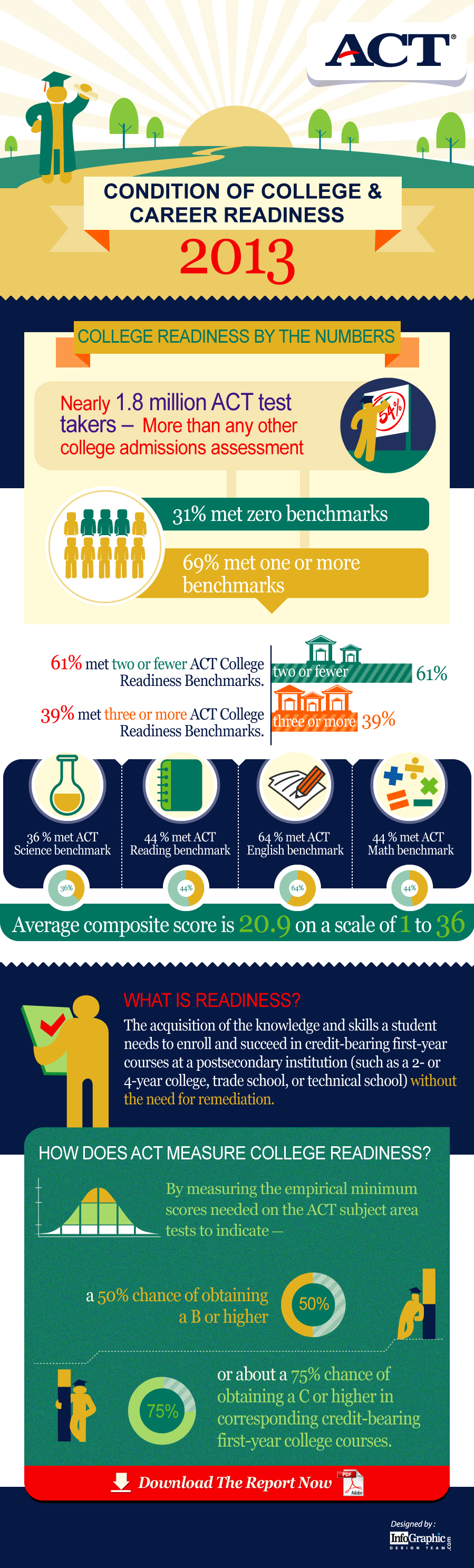
Only 39 percent of ACT-tested 2013 graduates met three or more of the four ACT College Readiness Benchmarks. Conversely, 31 percent of graduates did not meet any of the benchmarks. ACT research suggests that students who don’t meet the benchmarks are likely to struggle in relevant first-year courses at two- and four-year colleges, which increases their risk of not succeeding in college. “Once again, our data show that high school success and college readiness are not necessarily the same thing,” said Jon Whitmore, ACT chief executive officer. “Too many students are likely to struggle after they graduate from high school. As a nation, we must set ambitious goals and take strong action to address this consistent problem. The competitiveness of our young people and of our nation as a whole in the global economy is at stake.”
The research-based ACT College Readiness Benchmarks specify the minimum score students must earn on each of the four subject tests that make up the ACT® college readiness assessment (English, math, reading, and science) to have about a 75 percent chance of earning a grade of C or higher in a typical credit-bearing first-year college course in that subject area. ACT research suggests that students who meet the benchmarks are more likely than those who do not to persist in college and earn a degree….
Largest, Most Diverse Group of Test Takers Ever
The ACT report examines the ACT scores of a record 1.8 million students, 54 percent of the U.S. graduating class. It was the largest and most diverse group of graduates ever to take the ACT, the nation’s leading college entrance exam, and also likely the broadest in terms of academic preparation. This is due in part to an increase in the number of states and districts that administer the ACT to all students, not just those who were preparing to go to college. This year’s report includes 29 states in which 50 percent or more of graduates took the ACT and 12 states in which 90 percent or more took the assessment. As more students take the ACT, the data obtained from scores better reflect the entire U.S. graduating class, providing a glimpse of the emerging educational pipeline.
The national college-readiness level of 39% is, like most national aggregates, a bit misleading. In some states, that readiness level according to the ACT is about 18%.
Aside from the “steps are being taken” happy mantra, there is something good to say. In state after state, for the first time since standardized test scores have been the centerpiece of our education policy, the tests are being made appropriately stringent, playing scholastic hardball rather than softball or T-ball. This has caused scores to drop, even in some of the most sought-after school districts. Admitting you have a problem may be the first step, but admitting the actual depth of the problem is the second. As today’s ACT report indicates, we are indeed in deep.





 Bob Schwartz