Bob Schwartz

Tag: civil rights

In case you have forgotten what civil disobedience looks like

Above is a photo of Martin Luther King Jr. being arrested in Atlanta for taking part in a sit-in. Below is an excerpt from Dr. King’s Letter from a Birmingham Jail, where he was being imprisoned for taking part in nonviolent demonstrations against segregation.

You will not hear much mention of Dr. King from those cracking down on campus protests these days. It is inconvenient, because they would then have to make some fine distinctions between demonstrating for civil rights and demonstrating for human rights. Silence combined with force is easier.

It should not be necessary to explain the role of nonviolent protest and civil disobedience in American and world history. But apparently, the current thinking is that protesting this way proves that your cause is unworthy and wrongheaded. It is implied that if protestors don’t remove their campus encampments by a deadline, they are obviously illegitimate. Just as the civil rights movement was unworthy, wrongheaded and illegitimate to some.


From Letter from a Birmingham Jail

In no sense do I advocate evading or defying the law, as would the rabid segregationist. That would lead to anarchy. One who breaks an unjust law must do so openly, lovingly, and with a willingness to accept the penalty. I submit that an individual who breaks a law that conscience tells him is unjust, and who willingly accepts the penalty of imprisonment in order to arouse the conscience of the community over its injustice, is in reality expressing the highest respect for law.

Of course, there is nothing new about this kind of civil disobedience. It was evidenced sublimely in the refusal of Shadrach, Meshach and Abednego to obey the laws of Nebuchadnezzar, on the ground that a higher moral law was at stake. It was practiced superbly by the early Christians, who were willing to face hungry lions and the excruciating pain of chopping blocks rather than submit to certain unjust laws of the Roman Empire. To a degree, academic freedom is a reality today because Socrates practiced civil disobedience. In our own nation, the Boston Tea Party represented a massive act of civil disobedience.

We should never forget that everything Adolf Hitler did in Germany was “legal” and everything the Hungarian freedom fighters did in Hungary was “illegal.” It was “illegal” to aid and comfort a Jew in Hitler’s Germany. Even so, I am sure that, had I lived in Germany at the time, I would have aided and comforted my Jewish brothers.


Unleashing the Dogs of Hate

Birmingham

You will be forgiven for mistakenly thinking that this post about Trump was written today. IT WAS WRITTEN AND PUBLISHED IN MARCH 2016, TWO-AND-A-HALF YEARS AGO. At the time, many public people—including responsible politicians of both parties and the media—treated Trump’s pathology as a joke or a temporary symptom that would quickly pass. They should have been shouting in protest and we should have been scared. Are we scared yet?

“Cry ‘Havoc!’, and let slip the dogs of war”
William Shakespeare, Julius Caesar, Act 3, Scene 1

This time it is the dogs of hate. Enabled and emboldened by Donald Trump. He is so arrogant and ignorant of history that he probably believes he can control them. That with one word from him they will attack. That with another word from him they will stop.

Of course, that isn’t how it works.

There has long been an undercurrent of hate and intolerance in this country, no different than anywhere else at any other time. It has its outcroppings in repressive laws and unembarrassed public behavior. We have taken measures as a majority to dull its practical effect and, hopefully, to change hearts and minds.

Donald Trump is the latest—but not the last—to try to harness that dark energy for his own ambition.

But that is always playing with fire or dynamite. Haters gonna hate. And when allowed or encouraged, haters gonna take that hate out on others. Others, for example, at political rallies. Others who they blame for whatever is wrong in the country or in their lives.

No one knows where this all goes. When the dogs of hate, under the banner of legitimate politics, have been set loose.

John Lewis clarifies comments on Bernie Sanders

UNITED STATES - FEBRUARY 11: Rep. John Lewis, D-Ga., and Rep. Charlie Rangel, D-N.Y., behind him, arrive for a news conference at the DNC where members of the Congressional Black Caucus PAC endorsed Hillary Clinton for president, February 11, 2016. (Photo By Tom Williams/CQ Roll Call)

John Lewis is the latest elder statesperson to have experienced some difficulties in speaking on behalf of Hillary Clinton.

First it was former Secretary of State Madeleine Albright, who apologized for seeming to suggest that young women who didn’t support Hillary were going to “a special place in hell.”

Then it was feminist pioneer Gloria Steinem, who apologized for saying that young women were flocking to Bernie Sanders because that is where the boys are.

Now it is the turn of civil rights era leader and legend John Lewis. On Thursday he suggested that he knew the Clintons from way back in the movement days, but he had never seen nor heard from this Bernie Sanders guy.

Today he apologized for misspeaking.

”If you take a look at a transcript of my statement, you will find I did not say that I met Hillary and Bill Clinton when I was chairman of SNCC in the 1960s. My point was that when I was doing the work of civil rights, led the Voter Education Project and organized voter registration in the South in the 1970s, I did cross paths with Hillary and Bill Clinton in the field. They were working in politics, and Bill Clinton became attorney general of Arkansas in the 1970s as well. That began a relationship with them that has lasted until today.”

As for Bernie Sanders:

“I was responding to a reporter’s question who asked me to assess Sen. Sanders’ civil rights record. I said that when I was leading and was at the center of pivotal actions within the Civil Rights Movement, I did not meet Sen. Bernie Sanders at any time. The fact that I did not meet him in the movement does not mean I doubted that Sen. Sanders participated in the Civil Rights Movement, neither was I attempting to disparage his activism. Thousands sacrificed in the 1960s whose names we will never know, and I have always given honor to their contribution.”

In fact, Bernie Sanders had been involved in the movement almost as early as John Lewis was. Sanders’ sacrifice included going to jail for trying to desegregate the University of Chicago dorms.

Everyone is entitled to zealously support preferred candidates, and zeal sometimes crosses over into exaggeration. But when icons like Albright, Steinem and Lewis get caught overreaching so far that they are forced to furiously backpedal, especially all in one week, you have to wonder what exactly is going on.

The Promise of and Lessons from the Hong Kong Protests

Albert Einstein Institute

The Hong Kong pro-democracy protests appear to be over—for now. The protest leaders have surrendered, and the official plan to have Beijing approve candidates for Hong Kong’s highest office remains in place. The result is disappointing but not surprising. Facing off against the world’s biggest and most powerful non-democracy is by definition quixotic.

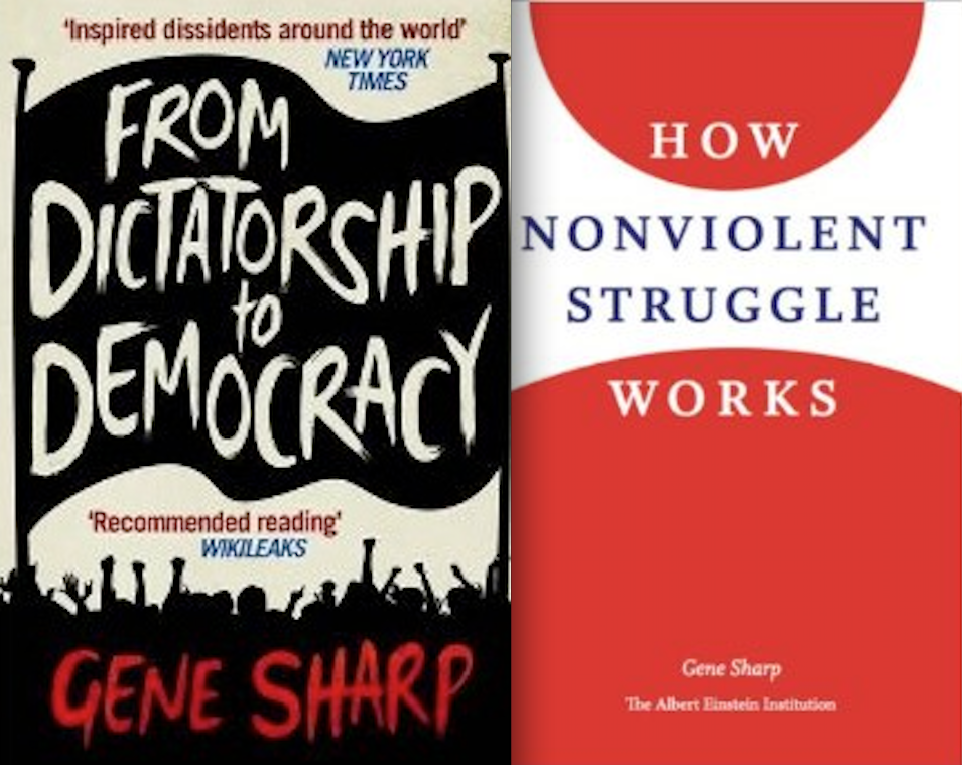
Yet for those of us in the U.S. and elsewhere who admire the thousands who engaged in this nonviolent movement, there are lessons to be learned and practiced. As pointed out here before, thinkers such as Gene Sharp at the Albert Einstein Institution have spent lifetimes mapping the path to nonviolent change. Here are a few of the lessons:

Be organized and disciplined. If you watched the news coverage of the Hong Kong events, you got to see an orderly and colorful tent city that served as a base, along with protestors carrying the symbolic (and also colorful) umbrellas, which served double-duty as a shield against police force.

Be specific. Movement goals can range in size and scope, from the ouster of a president to, as in Hong Kong, the right to select candidates for an election, as promised in an agreement. In the U.S., both the civil rights movement and the Vietnam War movement had such specific goals. In civil rights, it was piece by piece in a bigger picture: desegregation of public transport, desegregation of restaurants, voting rights, etc. Vietnam was specific and absolute: get out. The recent Occupy movements in the U.S., on the other hand, seemed to be all over the map, even when their complaints were justified. We are now seeing a bit of that in the Ferguson movement. The general discontent over the treatment of black citizens by police and justice is justified, but the power of the protests is diluted by uncertainty about what is being requested. (Possible answer: The St. Louis county prosecutor, having made an unprecedented mess of the criminal charging and grand jury process, can convene another grand jury and do it properly the next time. That’s probably as unlikely as Beijing giving in, but it would be something specific to ask for.)

Be informed. One of the other things you might notice about the Hong Kong protest is that protestors could speak knowledgeably about why they were protesting and what they wanted. Not to keep picking on our Occupy movement, but if you asked a hundred protestors about what it is they wanted, you might well have gotten a hundred different answers.

Be patient. Perseverance furthers. The U.S. civil rights movement took decades to achieve its goals, though some would argue that in fact the spirit of those goals is still far from being reached. Globally, movements for change are like the tides, in and out, high and low. Just this week, former Egyptian President Hosni Mubarek was cleared of criminal charges in the deaths of protestors at Tahrir Square four years ago. Today, in terms of democracy, Egypt looks different than but the same as it did then. Perseverance can further, but it is no guarantee. Even without certainty, though, organized, disciplined, specific, informed, patient nonviolence remains the best that can be done.

Notes for a George Zimmerman Sermon

Pulpit
This is Sunday, the day after the night before when the George Zimmerman verdict was reached and announced.

There will be countless sermons preached in churches today about the meaning of the crime, the trial and the verdict. The quick take of the media has focused on black churches for obvious reasons. In a case easily seen as having a racial component, the anger and frustration has been color-blind, but members of the black communities have reason to have special interest, if not to take it personally.

That still leaves a large number of churches that are not predominantly black. or more broadly, not non-white, or more plainly, white churches. This isn’t a monolith, nor is this an easy case and verdict to digest. There will be pastors who openly question how well justice was done, others who distance themselves from judgment, and maybe others who find a vindication of something in the verdict. Many more will not touch it at all, either because it has nothing to do with what goes on in church or because even if it does, the right words aren’t yet found to be spoken.

Whatever the identity of those in the pulpits or the pews, here are a few points that might belong in a George Zimmerman sermon.

The laws written by people and the higher laws (whether you call them the laws of God or something else) are two different things. Human imperfection extends to our inability to do perfect justice. Not only is it impossible to do perfectly, it is impossible for people to conceive of how it would be done perfectly in some other “better” realm. If there is a heaven or heaven/hell combination, exactly what are those trials like and what do the statures and rules of evidence look like? Whether you picture the 10 laws, or the 613 laws, or however many laws and interpretive regulations being litigated against you or those you love or despise, how does that case go?

There are some suggested solutions that are widely preached but, let’s say, inconstantly practiced. If we admit we don’t know everything, can’t build everything, can’t “correctly” judge everything, then we might be stuck with just some one-size-fits-all answer: forgive. This doesn’t mean, in the case of George Zimmerman, giving up on changing the laws, or not pursuing further legal tactics such as a federal civil rights suit or a civil wrongful death suit, or being friendly to George Zimmerman if you see him on your street or on your tv screen. Those are the worldly things we should feel free to pursue if that is what’s in our hearts. But in our hearts, where those higher laws are supposed to find a home, we are better off working on the compassion and forgiveness stuff. Especially with a tragic death, when we are the living, still capable of making things better.

Imperfection. Compassion. Forgiveness. Especially in light of this case. Oh God, that is so hard to take.