Bob Schwartz

Tag: Chogyam Trungpa

“If somebody doesn’t begin to provide some kind of harmony, we will not be able to develop sanity in this world at all.”
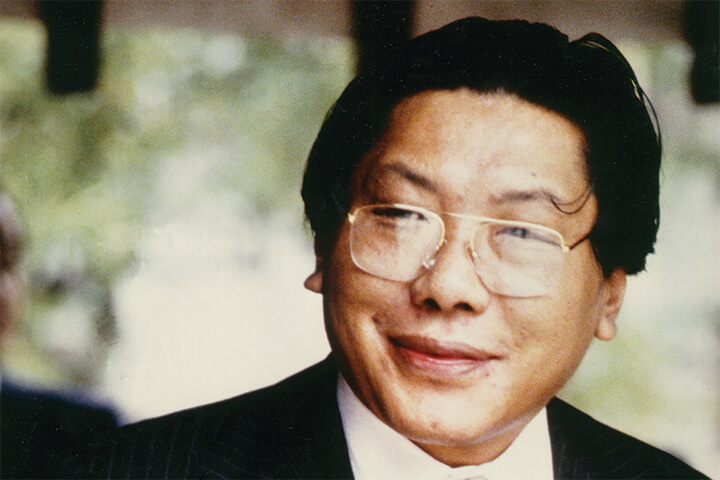
“If somebody doesn’t begin to provide some kind of harmony, we will not be able to develop sanity in this world at all. Somebody has to plant the seed so that sanity can happen on this earth.”
Chogyam Trungpa Rinpoche


Always maintain only a joyful mind.

If someone punches you in the mouth and says, “You are terrible,” you should be grateful that such a person has actually acknowledged you and said so. You could, in fact, respond with tremendous dignity by saying, “Thank you, I appreciate your concern.” In that way his neurosis is taken over by you, taken into you, much as is done in tonglen practice. There is an immense sacrifice taking place here. If you think this is ridiculously trippy, you are right. In some sense the whole thing is ridiculously trippy. But if somebody doesn’t begin to provide some kind of harmony, we will not be able to develop sanity in this world at all. Somebody has to plant the seed so that sanity can happen on this earth.

Training the Mind and Cultivating Loving-Kindness – Chogyam Trungpa


An opportunity to feature the song Make the Madness Stop (1968) by The Free Design.


The Free Design were one of the most inventive pop vocal groups of the late ’60s and early ’70s, transcending run-of-the-mill AM radio fare with intricate harmonies and arrangements that called on expanded instrumentation, uncommon time signatures, and advanced compositional touches. From 1967 to 1973, the band produced seven albums of their specific brand of pop sounds, one that appeared naïve and light on the surface, but held depth in its layers of precise production and emotionally unguarded musical themes. Perhaps too advanced for mainstream tastes, the Free Design would linger in commercial obscurity for their initial period of activity, producing only one charting single in their time while contemporaries like the Beach Boys and the Association dominated the airwaves and the charts. The group’s legacy would live on, however, as new generations of fans were blown over by their complex musicality and fearless sincerity. Artists like Beck, Stereolab, Belle and Sebastian, and Cornelius all cited the Free Design’s influence on their music, and the renewed interest in the band was enough for them to reconvene in 2001 for the album Cosmic Peekaboo.

Jason Ankeny, Rovi


Make the Madness Stop by The Free Design

Follow the way that leads between madness and madness
Flowers on both sides, each side has weeds and gladness and sadness

Pathways are green and black and white and yellow and crimson
Walk on the rainbow flooded by both sides’ truths and opinion

Deplete we must the store of hate immense
And grouping groping nonsense

Honesty and purity, beauty and sincerity
Doesn’t that sound corny?
Wish that I were corny

Walk the way of love, eyes open
Fly the skies above with hope and heart and sense
Blow your mind but not completely
Make the madness stop
“In my thoughts I visualize a grand whatever.”

As you read this message from Chogyam Trungpa, from his book Training the Mind and Cultivating Loving-Kindness, you will find his unique way of talking about practice and wisdom in relatable conversational ways.

This is about a concept that is hard for even the best teachers to put in a short and easy form. Hard because, on top of its complexity, it refers to an aspirational experience and not just a concept. So this very brief excerpt can’t possibly do it justice.

But his description of how we think about our thoughts is worth passing on, even if the antidote is treated by Trungpa and others at greater length and with more clarity. I recognize myself and maybe you will too.


Seeing confusion as the four kayas
Is unsurpassable shunyata protection.

As you continue to practice mindfulness and awareness, the seeming confusion and chaos in your mind begin to seem absurd. You begin to realize that your thoughts have no real birthplace, no origin, they just pop up as dharmakaya*. They are unborn. And your thoughts don’t go anywhere, they are unceasing. Therefore, your mind is seen as sambhogakaya. And furthermore, no activities are really happening in your mind, so the notion that your mind can dwell on anything also begins to seem absurd, because there is nothing to dwell on. Therefore, your mind is seen as nirmanakaya. Putting the whole thing together, there is no birth, no cessation, and no acting or dwelling at all—therefore, your mind is seen as svabhavikakaya. The point is not to make your mind a blank. It is just that as a result of supermindfulness and superawareness, you begin to see that nothing is actually happening—although at the same time you think that lots of things are happening.

Realizing that the confusion and the chaos in your mind have no origin, no cessation, and nowhere to dwell is the best protection. Shunyata** is the best protection because it cuts the solidity of your beliefs. “I have my solid thought” or “This is my grand thought” or “My thought is so cute” or “In my thoughts I visualize a grand whatever” or “The star men came down and talked to me” or “Genghis Khan is present in my mind” or “Jesus Christ himself manifested in my mind” or “I have thought of a tremendous scheme a for how to build a city, or how to write a tremendous musical comedy, or how to conquer the world”—it could be anything, from that level down to: “How am I going to earn my living after this?” or “What is the best way for me to sharpen my personality so that I will be visible in the world?” or “How I hate my problems!” All of those schemes and thoughts and ideas are empty! If you look behind their backs, it is like looking at a mask. If you look behind a mask, you see that it is hollow. There may be a few holes for the nostrils and the mouth—but if you look behind it, it doesn’t look like a face anymore, it is just junk with holes in it. Realizing that is your best protection. You realize that you are no longer the greatest artist at all, that you are not any of your big ideas. You realize that you are just authoring absurd, nonexistent things. That is the best protection for cutting confusion.

Chogyam Trungpa

*kaya: Literally, “body.” The four kayas refer in this text to four aspects of perception. Dharmakaya is the sense of openness; nirmanakaya is clarity; sambhogakaya is the link or relationship between those two; and svabhavikakaya is the total experience of the whole thing.

**shunyata: “Emptiness,” “openness.” A completely open and unbounded clarity of mind.


Readings for the Day of National Healing

Medicine Buddha Mandala

Here are readings for the Day of National Healing from Ocean of Dharma: The Everyday Wisdom of Chogyam Trungpa, a recommended collection of very brief excerpts from his talks and texts. The image above is of the Medicine Buddha.

THE FUTURE IS IN OUR HANDS

We hold the threshold of the future of the world in our hands, on our path. When we say this, we are not dreaming. We are not exaggerating. We hold a tremendous hope, maybe the only hope for the future dark age.

We have a lot of responsibilities, and those responsibilities are not easy to fulfill. They won’t come along easily, like an ordinary success story. They have to be stitched, painted, carved, step by step, inch by inch, minute by minute. It will be manual work. There will be no automatic big sweep, or solution.

When something good is done in the world, it is usually difficult. It is manual, rather than automatic. When something bad is done, usually that is automatic. Evil things are easy to catch, but good ones are difficult to catch. They go against the grain of ordinary habitual tendencies.

PLANNING FOR THE FUTURE

Humans are the only animals that try to dwell in the future. You don’t have to purely live in the present situation without a plan, but the future plans you make can only be based on the aspects of the future that manifest within the present situation. You can’t plan a future if you don’t know what the present situation is. You have to start from now to know how to plan.

CONVERSING WITH OUR NEGATIVITY

You can always count on the fact that our aspect of viciousness or apelike quality will reflect back to us. Then we can either project it onto somebody else or we can reflect and realize the situation within ourselves. Quite precisely, when you are in that particular state of mind, there is a kind of conversation going on. You may try to tell yourself to calm down and not worry. But then the undercurrent of the force of the projection tries to pierce through again and again. There is always this conversation going on with one’s own negativity. The neurotic aspect of mind is always willing to fall into either the extreme of left or right. The right extreme is anger, the masculine extreme. The left is passion, the feminine extreme. This symbolism is true and universal—a cosmic symbol, which happens with all of life. These symbols are not based on Indian, Buddhist, or Tibetan stories at all. These are utterly cosmic principles, as far as the symbolism is concerned.

WORK WITH THE PRESENT SITUATION

The buddhist tradition teaches the truth of impermanence, or the transitory nature of things. The past is gone and the future has not yet happened, so we work with what is here—the present situation. This actually helps us not to categorize or theorize. A fresh, living situation is taking place all the time, on the spot. This noncategorical approach comes from being fully here, rather than trying to reconnect with past events. We don’t have to look back to the past in order to see what people are made out of. Human beings speak for themselves, on the spot.