I Ching about Trump tariffs on China
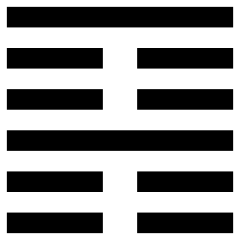
The I Ching, the venerable Book of Changes, is estimated to have first been composed around 1000 BCE. About 3,000 years ago.
The point is that China and its constituent states have been managing very complex and difficult governmental and social situations for millennia. Those who are leading contemporary China may face a lot of current challenges, as their ancestors have faced so many other challenges. They know their way around difficulties and difficult people. They have managed, starting in 1949, to build the world’s second largest economy. They have done it, by the way, paying close attention the I Ching. The Trump administration would do well to do the same.
Asking the I Ching about Trump tariffs on China it says:
52
Gen • Keeping Still
Mountain above
Mountain below
NAME AND STRUCTURE
The attribute of Mountain is stillness. When Mountain is doubled, it is extremely still.
From the very beginning of Chinese culture, ancient sages emphasized keeping still. Keeping still is not keeping merely the body still but the mind and spirit as well, and is called “sitting in stillness” or “nourishing the spirit.” While sitting still in a lotus posture, one is shaped like a mountain. Sitting in stillness, or in meditation as Westerners call it, is a self-disciplinary training. While doing this, one is able to control the mind and the breath, to be introspective about one’s shortcomings and to cultivate inner strength and virtue. Mencius says, “I am skillful in nourishing my imperishable noble spirit.” When one is in a state of stillness, one is oblivious to one’s surroundings. This is the highest stage of nonattachment. In such a state there is no fault in one’s being. It is believed that when Heaven is about to confer a great mission on a person, it first exercises his or her mind and spirit with discipline. Keeping still is meant to prepare one’s mind and spirit to progress when the time comes.
Commentary on the Decision
Mountain.
It is keeping still.
Keep still when it is time to keep still.
Remain active when it is time to remain active.
When action and resting do not miss their time,
Their way becomes promising and brilliant.
SIGNIFICANCE
Keeping Still expounds the truth of knowing when and where to stop before one’s action goes too far. The key to success is to advance when it is time to advance and to stop when it is time to stop. Every action should accord with the time and situation. Never act subjectively and blindly. Keeping still means to be tranquil and stable. It is a phase of advancement. Advance and stillness complement each other. Keeping still is preparing oneself for a new advance. All the lines of this gua take images of different parts of the body to indicate particular times and situations.
When King Wen abolished slavery and reestablished the Jing land system, people were shocked, as if a thunderstorm had struck. Those who were liberated were happy, but not the slave owners—especially those who were close to the tyrant. Dangerous counterattacks were anticipated. King Wen retreated, sitting in stillness to contemplate the situation and foresee the future. The Duke of Zhou describes King Wen’s different stages and moods of stillness. Eventually his honesty and sincerity brought good fortune.
The Complete I Ching, Master Alfred Huang






 Bob Schwartz