Bob Schwartz

Tag: Buddha

The Day the Buddha Woke Up
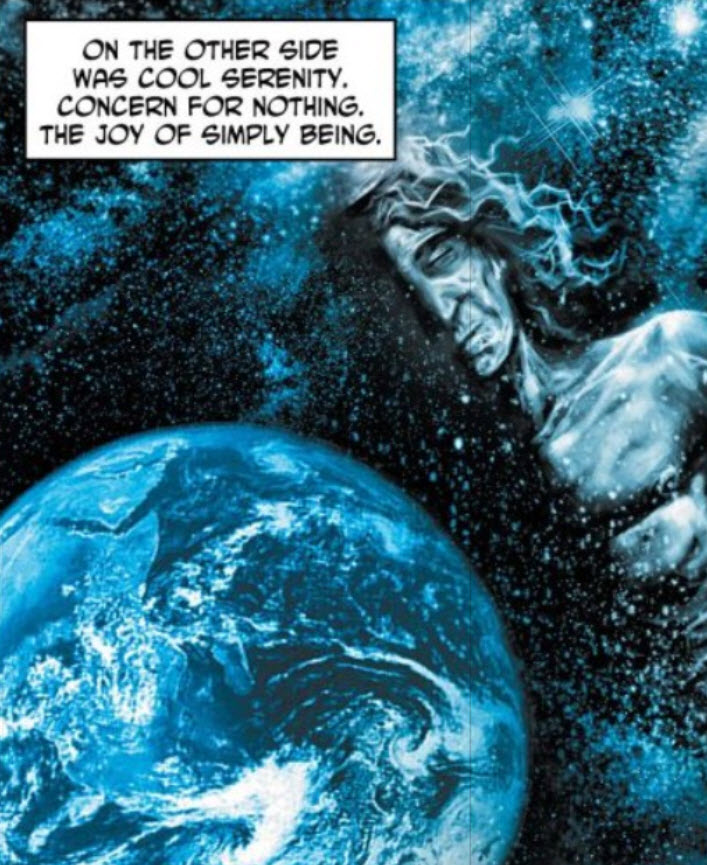
Buddha Comic Bodhi

December 8 is Bodhi Day, the day on which the Buddha’s enlightenment is traditionally celebrated.

The English word “enlightenment” is so packed with meaning that it might be better to just go back to what the Buddha is reported to have said: I am awake.

This is useful because it leads to the two questions: woke up from what and woke up to what?

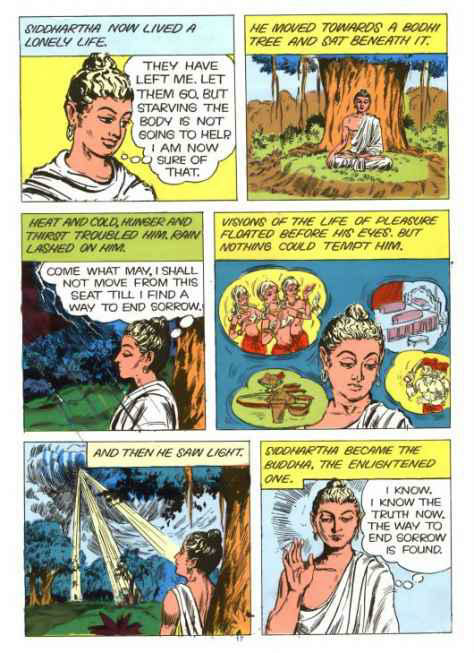
The Buddha, sitting there under the Bodhi tree, woke up from a journey. Born a royal son, he had fled a life of accidental privilege to answer ultimate questions about suffering and death—the very same questions that consume religious lives of all kinds. He believed that if he tried a, b, and c (such as extreme asceticism), he would discover some secret x, y, and z. There was some kind of magic formula, and all he had to do was learn it. That sort of magic is still at the heart of much of our religion.

He woke up to discover that there was no magic, not in such an instrumental sense. Nothing was different. Suffering and death would not go away, no matter what efforts we make. The best and worst aspects of life would go on, with and without us. Great fortunes would be made and lost. Great structures would be built and then destroyed, by cataclysms natural and human. Love would be here and gone.

But this: He could see something in all of that that made sense of all of that. There is no big plan in which we are players, active or passive, though we could and do make and execute our own little plans. There are just things, relationships between those things, and change, and of all those of a singular piece. We can and do overlay that with all of our very complicated details and distinctions, which is after all a definition of the life we live. But if we discover that underlying existence, we just might choose to live differently. And in that living differently, make change and wake others up. And on and on.

None of that eliminated suffering and death for the Buddha, as it won’t for anyone. He grew old and tired and, legend has it, died from being given spoiled food. He had told his followers what he had discovered, none of which involved magic. It was all about the infinite depth of the ordinary. For him, there was no more a kingdom in the clouds than the kingdom he had left behind when he started his journey. There was just what is. Strive on with diligence, he told those followers at the last.

© 2025 Bob Schwartz

Cherishing Trump as your spiritual friend

When I see ill-natured people,
Overwhelmed by wrong deeds and pain,
May I cherish them as something rare,
As though I had found a treasure-trove.
Eight Verses for Training the Mind

“You have heard that it was said, ‘Love your neighbor and hate your enemy.’ But I tell you, love your enemies and pray for those who persecute you, that you may be children of your Father in heaven. He causes his sun to rise on the evil and the good, and sends rain on the righteous and the unrighteous. If you love those who love you, what reward will you get? Are not even the tax collectors doing that? And if you greet only your own people, what are you doing more than others? Do not even pagans do that? Be perfect, therefore, as your heavenly Father is perfect.
Matthew 5:43-48

It’s hard. Exercise is hard. Training for any discipline is hard. Mind training and transformation are hard. Treasuring adversity and loving our enemy are hard.

There is so much and so many we find to reject and resist and oppose. So much anger and disgust and dislike, just at the sight of a face and the sound of a voice.

How can we cherish that? As a treasure trove? As a spiritual friend?

There must be a reason that our traditions teach us to treasure adversity and love our enemy.

Maybe think of it as weight lifting or resistance training. Heavier weights and increased resistance are how we build strength.

Looking in the public realm, many of us can quickly identify those who are “ill-natured people, overwhelmed by wrong deeds and pain.” Trump would probably be at the top of most lists.

Keep in mind that there is no being undeserving of our compassion—yes, even Trump and his minions. In that situation, with those people, exercising that compassion will make it stronger, more constant, more universal. If it was good enough for the Buddha and Jesus, it might be good enough for us.

© 2025 Bob Schwartz

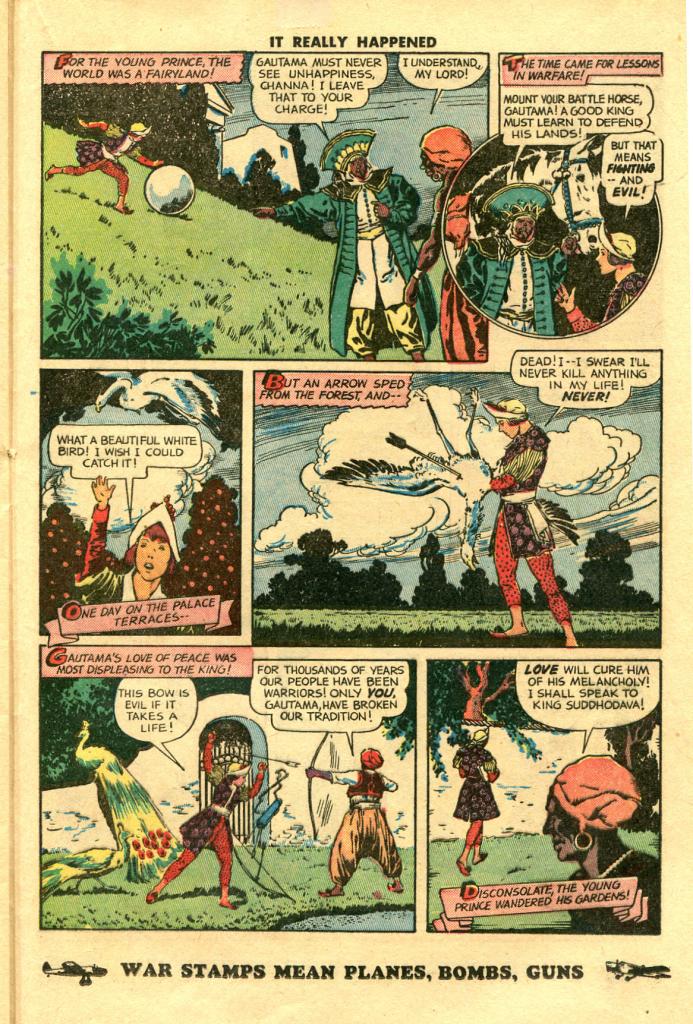
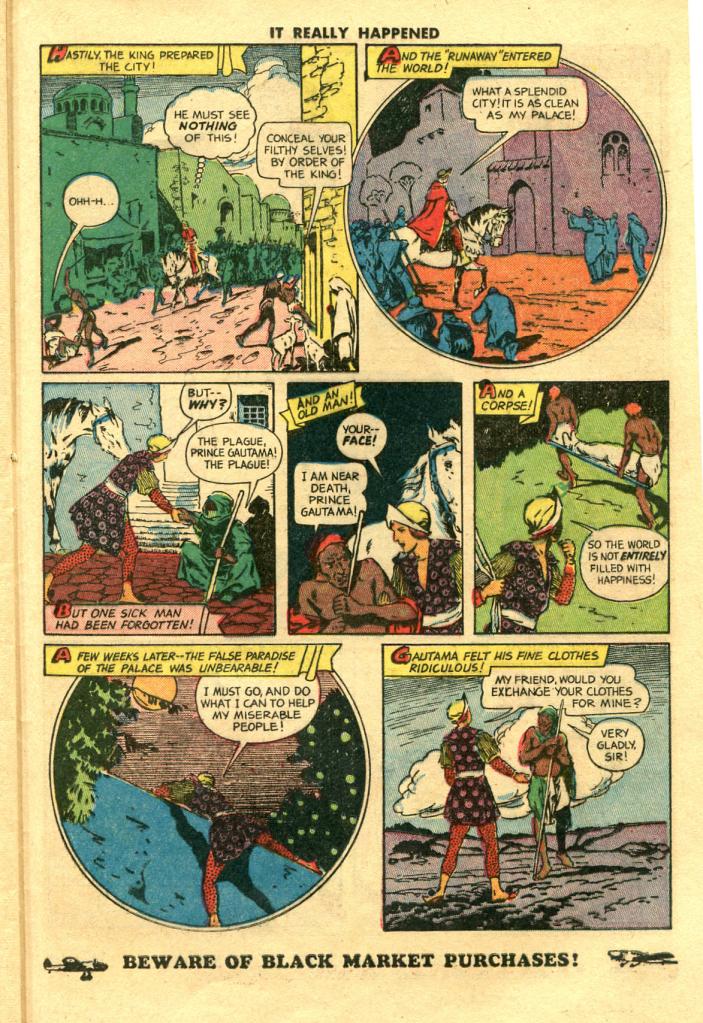
Gautama Buddha, the Beggar Prince (1944)

It Really Happened (1944)

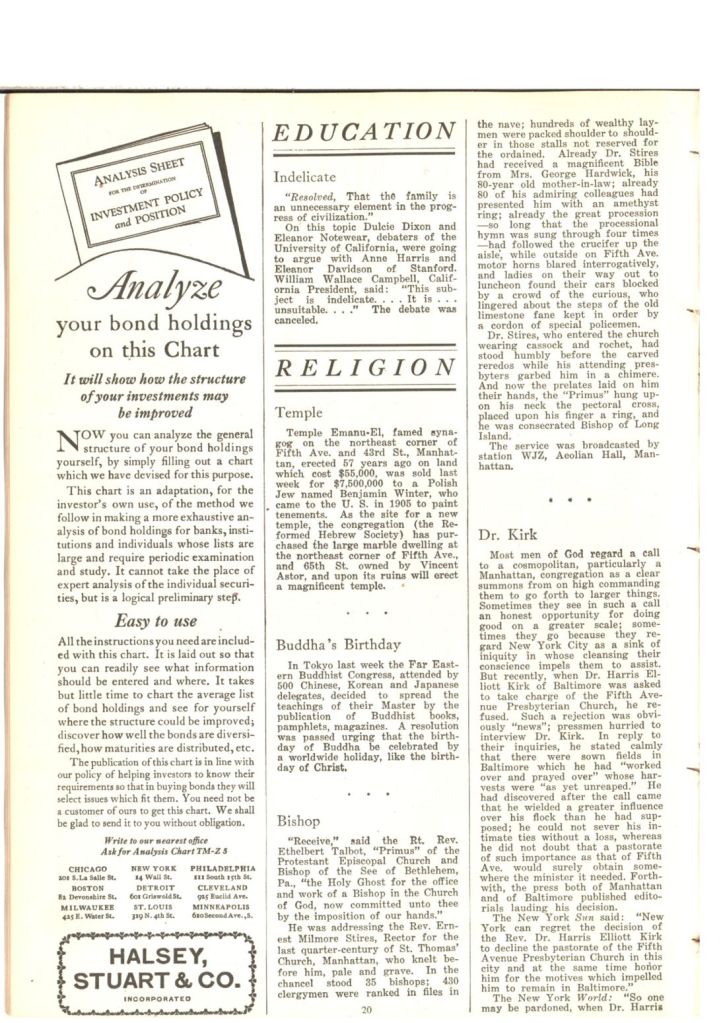
Bodhi Day, Part 2: Time Magazine, December 7, 1925, reports on Buddha’s Birthday

That isn’t Buddha on the cover of Time Magazine, December 7, 1925 issue (99 years ago). It is Jose R. Capablanca, then world chess champion, who had recently lost some matches in a Moscow tournament.

Buddha did appear in the magazine, with this in the Religion section:


Buddha’s Birthday

In Tokyo last week the Far Eastern Buddhist Congress, attended by 500 Chinese, Korean and Japanese delegates, decided to spread the teachings of their Master by the publication of Buddhist books, pamphlets, magazines. A resolution was passed urging that the birthday of Buddha be celebrated by a worldwide holiday, like the birthday of Christ.


As a cultural archaeologist, with an inordinate love of old magazines, I would like to post every page of the issue. Instead, I have selected just one full-page ad. This is for the Five-Foot Shelf of Books, aka The Harvard Library, compiled by legendary academic Charles W. Eliot, who was president of Harvard for forty years. The Shelf/Library contained “418 masterpieces” in fifty volumes.

In promoting this as the perfect Christmas gift, the headline says “It took twenty centuries to make this Christmas gift for you” and closes with “BOOKS—The finest gift of all”.

The good news: The complete Shelf/Library, later known as the Harvard Classics, is widely available for free online.The better news: Books are still the finest gift of all.

Bodhi Day

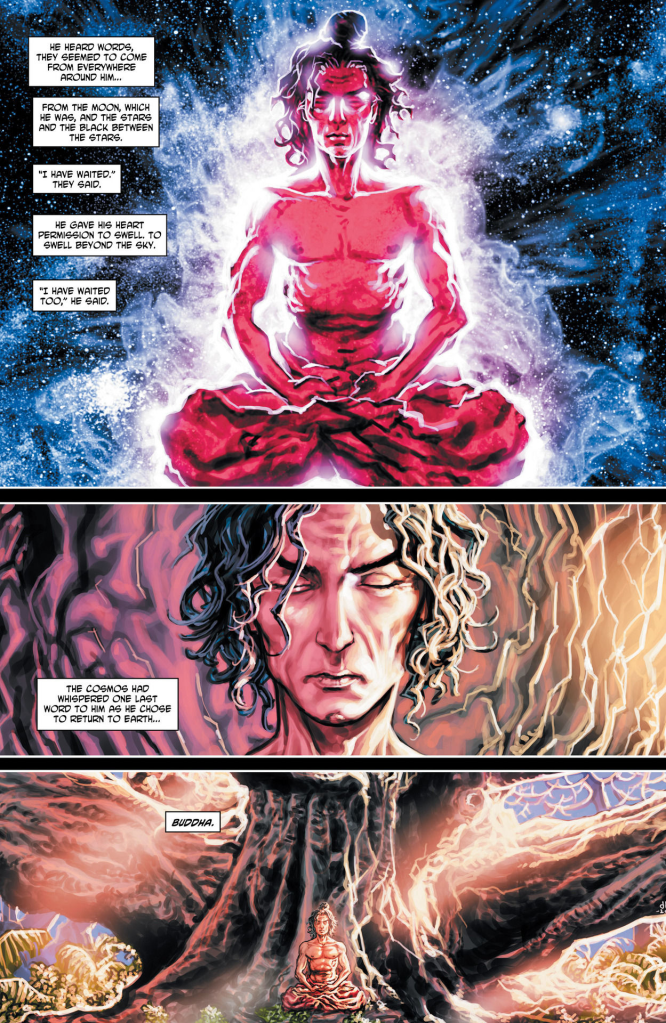
Buddha, written by Deepak Chopra, art by Dean Hyrapiet

Following yesterday’s Tomorrow is Bodhi Day, today is Bodhi Day.

From the Dhammapada, Chapter 3, The Mind:


The Mind

The restless, agitated mind,
Hard to protect, hard to control,
The sage makes straight,
As a fletcher the shaft of an arrow.

Like a fish out of water,
Thrown on dry ground,
This mind thrashes about,
Trying to escape Māra’s* command.

The mind, hard to control,
Flighty—alighting where it wishes—
One does well to tame.
The disciplined mind brings happiness.

The mind, hard to see,
Subtle—alighting where it wishes—
The sage protects.
The watched mind brings happiness.

Far-ranging, solitary,
Incorporeal and hidden
Is the mind.
Those who restrain it
Will be freed from Māra’s bonds.

For those who are unsteady of mind,
Who do not know true Dharma,
And whose serenity wavers,
Wisdom does not mature.

For one who is awake,
Whose mind isn’t overflowing,
Whose heart isn’t afflicted
And who has abandoned both merit and demerit,
Fear does not exist.

Knowing this body to be like a clay pot,
Establishing this mind like a fortress,
One should battle Māra with the sword of insight,
Protecting what has been won,
Clinging to nothing.

All too soon this body
Will lie on the ground,
Cast aside, deprived of consciousness,
Like a useless scrap of wood.

Whatever an enemy may do to an enemy,
Or haters, one to another,
Far worse is the harm
From one’s own wrongly directed mind.

Neither mother nor father,
Nor any other relative can do
One as much good
As one’s own well-directed mind.

Translated by Gil Fronsdal

*Māra: The personification of evil in Buddhism and often referred to as the Buddhist “devil” or “demon”. According to some accounts of the Buddha’s enlightenment experience, when the he sat under the bodhi tree, vowing not to rise until he attained liberation from the cycle of rebirth, he was approached by Māra, who sought to dissuade him from his quest. When he refused, Māra sent his minions to destroy him, but their weapons were transformed into flower blossoms.


Following is an outline of Buddhism, found in The Basic Teachings of the Buddha (2007) by Glenn Wallis. Wallis is a far-reaching, creative and iconoclastic scholar of Buddhism, as reflected in his later work, such as A Critique of Western Buddhism (2019), which is available to read and download free.


HABITAT
1. We are like ghosts sleepwalking in a desolate and dangerous domain.
DE-ORIENTATION
2. We remain transfixed there, enchanted by pleasure and flamboyant speculation.
3. The most enthralling belief of all is that of supernatural agency.
4. There is a safeguard against this bewitchment: knowing for yourself.
RE-ORIENTATION
5. The means of “knowing for yourself” is immediately available: it is the sensorium.
6. But the modes of perception are miragelike, and the perceived like a magical display.
7. And there is no self, no integral perceiver, behind those modes of perception.
8. To hold on to the miragelike perceiver, the phantom self, is a stultifying burden.
MAP
9. When we reflect on these propositions, four preeminent realities become obvious,
10. as do the emergence and cessation of our incessant “worlding.”
DESTINATION
11. Our genuine refuge from this whirlwind of worlding is to be unbound;
12. to eradicate infatuation, hostility, and delusion. Eradicated, quenched, unbound.
13. Binding is concomitant with the fabricated.
14. Unbinding is concomitant with the unfabricated.
GOING
15. Cultivation of present-moment awareness is the means to conspicuous unbinding.
16. Application of this awareness in daily life is concomitant with living as a buddha: awakened.

Glenn Wallis


Tomorrow (December 8) is Bodhi Day? What should I post?

December includes three notable religious holidays.

Christmas, commemorating the birth of Jesus. It is a major holiday, one of the two most important Christian holidays, and one that has become a secular celebration, especially in America.

Hanukkah, commemorating the retaking and rededication of the Temple in Jerusalem. Religiously, it is a minor holiday, not even included in the Hebrew Bible. Traditionally, it has become a cultural and social counterbalance to Christmas, especially in America.

Bodhi Day isn’t about the birth of a significant person or about the military victory over a religious oppressor. It is about a man who sat under a tree and ultimately woke up, or, as it is usually put, attained enlightenment.

I never rely on AI to do my writing, but I have given my friend Claude a chance to concisely explain Bodhi Day observances:


Bodhi Day (also known as Rohatsu in Japanese tradition) commemorates the day when Siddhartha Gautama attained enlightenment and became the Buddha. It’s typically observed on December 8th in the Mahayana tradition, though some traditions follow different calendars.

Here’s how Bodhi Day is observed in different parts of the world:

Japan (Rohatsu):

  • The day marks the end of a weeklong sesshin (intensive meditation retreat) in Zen monasteries
  • Practitioners often meditate through the night, mirroring the Buddha’s enlightenment experience
  • Traditional decorations include strings of colored lights, representing the stars the Buddha saw upon enlightenment

Southeast Asian Countries:

  • In countries like Thailand and Sri Lanka, the enlightenment is actually celebrated as part of Vesak Day in May
  • Temples are decorated with flowers and lights
  • Devotees participate in meditation sessions and listen to dharma talks
  • Food offerings are made to monks and sharing meals with the community is common

United States and Western Countries:

  • Buddhist temples and centers often hold special meditation sessions
  • Some practitioners decorate small ficus trees (similar to the Bodhi tree) with lights
  • Educational programs about the Buddha’s enlightenment are organized
  • Many observe the day with a traditional breakfast of milk and rice, recalling the offering made to the Buddha by Sujata

China and Taiwan:

  • Known as Laba Festival (腊八节)
  • Traditionally celebrated with Laba congee, a special porridge made with various grains and dried fruits
  • Temples hold ceremonies and offer free congee to visitors
  • Many people visit temples to make offerings and pray for blessings

Modern Observances:

  • Some Buddhists maintain a more contemplative practice, spending the day in meditation
  • Many practitioners dedicate themselves to acts of kindness and compassion
  • Some observe the day by reading Buddhist texts or sutras
  • Virtual meditation sessions and teachings have become common, especially in recent years

The focus across all these observances remains on the core meaning of the Buddha’s enlightenment – the realization that freedom from suffering is possible through understanding and practicing the dharma.

Claude


Each year I wonder what to say about Bodhi Day, the Buddha, and Buddhism. With a day to go, I still don’t know.

But tomorrow I will.

Bodhi Day

“Bodhi literally means ‘awakening’, but is commonly translated as ‘enlightenment’. It denotes the awakening to supreme knowledge, as experienced by the Buddha as he sat under the Bodhi Tree at the age of 35.”
Buddhist Translation Society

Today is Bodhi Day, marking the enlightenment of the Buddha. It is not merely a reminder of something that happened. It is an inspiration for what can happen. Difficult, not necessarily achievable, but possible. Or maybe not only achievable but actual.

Millions of words have been spoken by, attributed to or written about the Buddha.

Here are a few.


If the mad mind stops, its very stopping is bodhi.
Śūraṅgama Sutra, Buddhist Text Translation Society


It is said that soon after his enlightenment the Buddha passed a man on the road who was struck by the Buddha’s extraordinary radiance and peaceful presence. The man stopped and asked, “My friend, what are you? Are you a celestial being or a god?”

“No,” said the Buddha.

“Well, then, are you some kind of magician or wizard?” Again the Buddha answered, “No.”

“Are you a man?”

“No.”

“Well, my friend, then what are you?” The Buddha replied, “I am awake.”

Teachings of the Buddha, Jack Kornfeld


The morning of the Buddha’s enlightenment at the foot of the bodhi tree, he was so surprised. He had been meditating for the whole night. In the early morning, at the moment when he saw the morning star, he declared, “How strange! Everyone has the capacity to be awake, to understand, and to love. Yet they continue to drift and sink on the ocean of suffering, life after life.”
Sutra on the Middle Way, Thich Nhat Hanh


The back of your hand is affliction, and the palm of your hand is bodhi. Realizing bodhi is just like flipping your hand from back to palm. When you turn affliction around, it’s bodhi. Afflictions are the same as bodhi. Birth and death are the same as nirvana. If you understand, then afflictions are bodhi. If you don’t understand, then bodhi is affliction. Bodhi isn’t outside of afflictions, and there are no afflictions outside the scope of enlightenment. And so I very often cite the analogy of water and ice. If you pour a bowl of water over a person’s body, even if you use a lot of force, you still won’t hurt the person. However, if the bowl of water has turned into ice and you hit the person in the head with it, the person may very well die. Bodhi is like the water; afflictions are like the ice. If you melt ice, it becomes water; when you freeze water, it becomes ice.
Flower Adornment Sutra, Buddhist Text Translation Society

Happy Buddhaday to

The celebration of Vesak, also called Buddha Day, varies in detail from place to place around the world, from Buddhism to Buddhism, from Buddhist to Buddhist. This year it is May 18 or May 19 or another date. It is the Buddha’s birthday or the date of his enlightenment or the date of his death or all of them.

As a birthday, this is a Buddhaday poem. Sing the song and eat some cake.


Happy Buddhaday to

how many candles
on the Buddhaday cake
not one
not two

©

Wake Up! It’s Bodhi Day.

Bodhi Day is December 8, marking the enlightenment of the Buddha.

bodhi. In Sanskrit and Pāli, “awakening,” “enlightenment”.
—Princeton Dictionary of Buddhism

If the mad mind stops, its very stopping is bodhi.
—Śūraṅgama Sutra

Friend, wake up! Why do you go on sleeping?
The night is over— do you want to lose the day
the same way?
—Kabir, version by Robert Bly

Deepak Chopra’s Buddha, Written by Deepak Chopra and Joshua Dysart, Art by Dean Ruben Hyrapiet


Buddha Bemidbar (In the Wilderness)

Buddha Bemidbar (In the Wilderness)

Moses is missing
In his place
Siddhartha sits.

Israelites are numbered
Can he free them?

The way in the wilderness
Is unpassable.
Can they pass it?

Too dark to sea
The waters give way
To dry ground
As if they were not there
From the beginning.

Walk on
The mountain next.