Bob Schwartz

Tag: Bible

Trump’s Easter Tweet: Do Not Thrust Aside the Alien

It is April 1. Trump’s Easter tweet today is inspired by the Bible:

As it says in the Book of Malachi: “I will draw near to you for judgment; I will be swift to bear witness against those who thrust aside the alien, and do not fear me, says the Lord of hosts.”

No, no, not really. Trump did attend church on Easter, but his actual tweets were different than the one above:

Border Patrol Agents are not allowed to properly do their job at the Border because of ridiculous liberal (Democrat) laws like Catch & Release. Getting more dangerous. “Caravans” coming. Republicans must go to Nuclear Option to pass tough laws NOW. NO MORE DACA DEAL!
— Donald J. Trump (@realDonaldTrump) April 1, 2018

Mexico is doing very little, if not NOTHING, at stopping people from flowing into Mexico through their Southern Border, and then into the U.S. They laugh at our dumb immigration laws. They must stop the big drug and people flows, or I will stop their cash cow, NAFTA. NEED WALL!
— Donald J. Trump (@realDonaldTrump) April 1, 2018

These big flows of people are all trying to take advantage of DACA. They want in on the act!
— Donald J. Trump (@realDonaldTrump) April 1, 2018

Books for Passover and Easter

Passover

If you are celebrating Passover or just interested in it, you are familiar with the Haggadah—the book used as a roadmap for the seder meal and rituals that take place on the first couple of evenings of Passover.

There are widely adopted traditions for the seder that include the retelling of the Exodus story and the eating of symbolic foods. But the exact content and form of the seder have long been flexible, and this variety is reflected in different Haggadot. There are hundreds of versions.

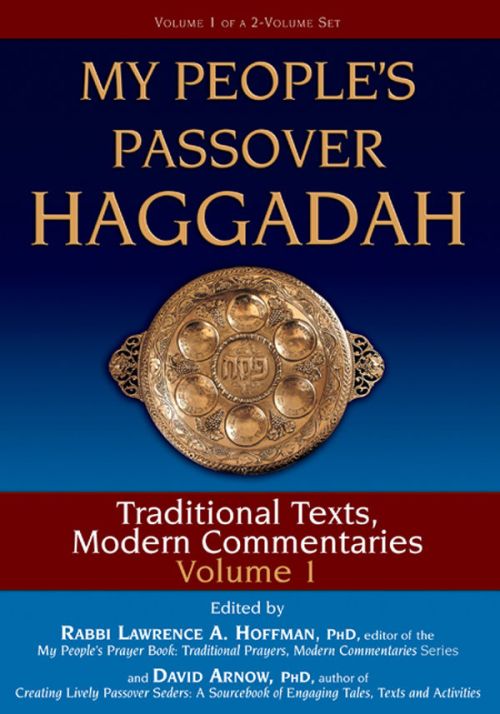
For the Passover observant and the P-curious, I recommend a deeper dive than the typical Haggadah—a set of books from Jewish Lights entitled My People’s Passover Haggadah: Traditional Texts, Modern Commentaries – Volume 1 and Volume 2.

From the editors:

In two volumes, this empowering resource for the spiritual revival of our times enables us to find deeper meaning in one of Judaism’s most beloved traditions, the Passover Seder. Rich Haggadah commentary adds layer upon layer of new insight to the age-old celebration of the journey from slavery to freedom—and makes its power accessible to all.

This diverse and exciting Passover resource features the traditional Haggadah Hebrew text with a new translation designed to let you know exactly what the Haggadah says. Introductory essays help you understand the historical roots of Passover, the development of the Haggadah, and how to make sense out of texts and customs that evolved from ancient times.

Framed with beautifully designed Talmud-style pages, My People’s Passover Haggadah features commentaries by scholars from all denominations of Judaism. You are treated to insights by experts in such fields as the Haggadah’s history; its biblical roots; its confrontation with modernity; and its relationship to rabbinic midrash and Jewish law, feminism, Chasidism, theology, and kabbalah.

No other resource provides such a wide-ranging exploration of the Haggadah, a reservoir of inspiration and information for creating meaningful Seders every year.

These are a bit bulky for the seder table itself. But they are the sort of books you would read if you wanted to understand why people are sitting at the seder table in the first place and why the traditions are so broad and sometimes so misunderstood. If Passover is just going through the motions, any seder and any Haggadah will do. If Passover is one piece of a much bigger picture to be investigated, these enlightening commentaries are what you need.

Easter

Close to each other. Very close. Passover begins tonight on Friday March 30. Easter is this Sunday April 1.

The calendar isn’t all that’s close. The Jewish story and the Christian story, in general and in the context of these particular holidays, are essentially and inextricably linked. The nature of those stories and those connections is the source of faith, enlightenment, misunderstanding, mistrust, even hatred and violence. Among Jews and Christians.

Any big moment on the Jewish and Christian calendars (and these holidays qualify) is an opportunity not just for ritual celebration but for study. How well do we—Jews, Christians, others—understand the texts and traditions outside the comfortable conventions of our belief and practice? Not just understanding that will confirm our faiths, allowing us to nod our heads and pat ourselves on our collective backs, but new and even startling understanding that might shake us and even make us uncomfortable. Everything we know about Judaism or Christianity, about the Bible, about history, may not be wrong, but maybe we could benefit from another open and learned perspective.

The second edition of the The Jewish Annotated New Testament was published last year; any and every Jew or Christian should read at least a little of it. So should everyone else who wants to know something about the foundations of this consequential moment in scripture, history and religion. Believers and nonbelievers may think they know what they’re dealing with. Many don’t.

The editors explain:

It is almost two millennia since the earliest texts incorporated into the New Testament were composed. For the most part, these centuries have seen a painful relationship between Jews and Christians. Although Jewish perceptions of Christians and Christian perceptions of Jews have improved markedly in recent decades, Jews and Christians still misunderstand many of each other’s texts and traditions. The landmark publication of this book is a witness to that improvement; ideally, it will serve to increase our knowledge of both our common histories and the reasons why we came to separate…

The Jewish Annotated New Testament represents the first time a gathering of Jewish scholars wrote a complete commentary on the New Testament. It reached a wide Jewish and Christian audience, and in doing so it has begun to increase both Jewish literacy of the New Testament and Christian awareness of the New Testament’s Jewish context. It has become widely used in colleges, universities and seminaries, as well as in Jewish, Christian, and joint Jewish-Christian study groups. Many Christian clergy and religious educators from different Christian denominations and church settings have told us that they have integrated the insights of this book into their preaching and devotion. Because of this volume, we have been told numerous times, sermons have been corrected, anti-Jewish teaching and preaching have been avoided, and Christians in churches and classrooms and Bible studies have learned more about Jesus and his followers. Jewish readers have told us how the volume has encouraged them to read the New Testament for the first time, to begin to consider the complex relationship between Judaism and Christianity, and how better to understand both their Christian neighbors and their own Jewish history….

For Christian readers The Jewish Annotated New Testament offers a window into the first-century world of Judaism from which the New Testament springs. There are explanations of Jewish concepts such as food laws and rabbinic argumentation. It also provides a much-needed corrective to many centuries of Christian misunderstandings of the Jewish religion.

For Jewish readers, this volume provides the chance to encounter the New Testament–a text of vast importance in Western European and American culture–with no religious agenda and with guidance from Jewish experts in theology, history, and Jewish and Christian thought. It also explains Christian practices, such as the Eucharist.

The Jewish Annotated New Testament, Second Edition is an essential volume that places the New Testament writings in a context that will enlighten readers of any faith or none.

 

What If President Dennison Is Our National Karma?

Billy Bush (BB) and David Dennison (DD)

A man reaps what he sows.
Galatians 6:7

Karma: A term used to refer to the doctrine of action and its corresponding “ripening” or “fruition”, according to which virtuous deeds of body, speech, and mind produce happiness in the future (in this life or subsequent lives), while nonvirtuous deeds lead instead to suffering.
Princeton Dictionary of Buddhism

When I experience the presidency of David Dennison, I wonder how we got here. One answer that won’t go away is that it is the sum of everything we have done and are doing as an American society—or everything we haven’t done and aren’t doing.

This isn’t to say that we are somehow being punished for transgressions, or that socially and culturally we haven’t done some admirable and adaptive things. It is just to say that some elements (not picking on social media, just using it as an example) have the potential to take us down the wrong road, and that when you add up the elements with potential for future misdirection, and the choices we have made, maybe it should not be surprising that we woke up one day—literally—to discover that the most unlikely human being in the world was the leader of the most powerful nation in the world.

So maybe the best response is to look at every one of those elements and choices, and mindfully consider whether they might have played a part in getting to this point. That might not rid us of Dennison soon, or of our national karma, or of our weird political harvest, but at least we will have the open-eyed, open-hearted hope of getting it right the next time.

Abraham Joshua Heschel: “I am an optimist against my better judgment.”

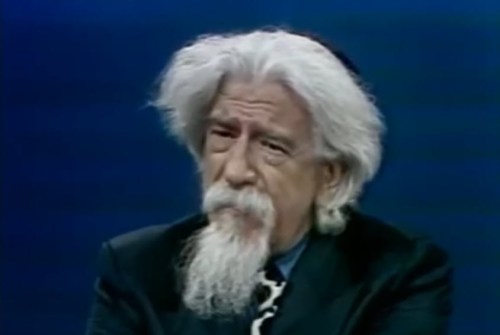
If you have the time—and you should make the time—please watch this half-hour interview of Abraham Joshua Heschel from 1972, shortly before he died.

It doesn’t matter whether you believe in God, the Bible or religion. That such a person might grace the world and our lives is testament to the human possibility. Few of us will reach that height, but just knowing that there is such light among us should inspire us dimmer bulbs.

“I am an optimist against my better judgment,” he says. On our better days, so should we all try to be.

Shutdown Shabbat

Whatever the disparate historical origins of the two [creation] accounts, the redaction gives us first a harmonious cosmic overview of creation and then a plunge into the technological nitty-gritty and moral ambiguities of human origins.
Robert Alter, The Five Books of Moses

Much of the federal government has shut down today—it has ceased from its work. And it is Shabbat when, based on the story of creation in the Torah, people are asked to cease from their everyday work because this day is different and set apart.

It is an opportunity to see if that story of creation offers any insights into the government situation. (It is tempting but ungracious to suggest that one particular person who could use those insights—any insights—turn to the Bible for wisdom—any wisdom. But that’s not happening, even on Shutdown Shabbat.)

The creation story in Genesis 2 radically switches focus. When the six days of cosmic creation are over, there is the familiar seventh day break:

And God completed on the seventh day the task He had done, and 3 He ceased on the seventh day from all the task He had done. And God blessed the seventh day and hallowed it, for on it He had ceased from all His task that He had created to do. (Genesis 2:3-4)

But with the big picture, high-concept work done, the detailed tasks begin. God, as they say, is in the details:

On the day the LORD God made earth and heavens, no shrub of the field being yet on the earth and no plant of to cease from their everyday the field yet sprouted, for the LORD God had not caused rain to fall on the earth and there was no human to till the soil, and wetness would well from the earth to water all the surface of the soil, then the The LORD God fashioned the human, humus from the soil, and blew into his nostrils the breath of life, and the human became a living creature. And the LORD God planted a garden in Eden, to the east, and He placed there the human He had fashioned. And the LORD God caused to sprout from the soil every tree lovely to look at and good for food, and the tree of life was in the midst of the garden, and the tree of knowledge, good and evil. Now a river runs out of Eden to water the garden and from there splits off into four streams. The name of the first is Pishon, the one that winds through the whole land of Havilah, where there is gold. And the gold of that land is goodly, bdellium is there, and lapis lazuli. And the name of the second river is Gihon, the one that winds through all the land of Cush. And the name of the third river is Tigris, the one that goes to the east of Ashur. And the fourth river is Euphrates. And the LORD God took the human and set him down in the garden of Eden to till it and watch it. (Genesis 2:5-15)

Robert Alter notes:

As many modern commentators have noted, the first Creation account concludes with the summarizing phrase in the first half of this verse: “This is the tale [literally, these are the begettings] of the heavens and the earth when they were created,” these two paired terms, “heavens” and “earth,” taking us back in an envelope structure to the paired terms of the very first verse of the Creation story. Now, after the grand choreography of resonant parallel utterances of the cosmogony, the style changes sharply….In this more vividly anthropomorphic account, God, now called YHWH ’Elohim instead of ’Elohim as in the first version, does not summon things into being from a lofty distance through the mere agency of divine speech, but works as a craftsman, fashioning (yatsar instead of bara’, “create”), blowing life-breath into nostrils, building a woman from a rib. Whatever the disparate historical origins of the two accounts, the redaction gives us first a harmonious cosmic overview of creation and then a plunge into the technological nitty-gritty and moral ambiguities of human origin. (emphasis added)

This, on Shutdown Shabbat, is a root of the problem. The story suggests that even God, who could reportedly talk his way into any grand scheme, had to stop talking, roll up his sleeves, and do the difficult work, “plunge into the technological nitty-gritty and moral ambiguities.”

Those who have somehow ended up in exalted positions of power are urged to use Shabbat, especially this one, to contemplate morality, their actions, and the effect those actions have on human beings. The powerful might rather be golfing, but there’s plenty of other time to do that. This is Shutdown Shabbat.

Today’s Torah: Slavery Might Be Right Around the Corner

A section of this week’s Torah portion (Vayigash, Genesis 44:18-47:27) is described even by sympathetic commentators as “unusual”, “troubling”, and “brutal”, though one commentator admits it is “ironic or poetic justice.”

Joseph is the sharp CEO of Egypt. (Sharp dealing runs in the family; recall that his father Jacob cheated his uncle Esau out of the family birthright.) He has now brought not only his family but all the Jews down to Egypt.

The new arrivals enjoy a relatively good life, while the native Egyptians are suffering through a disastrous famine, the famine foretold by Joseph himself. To solve the dire situation, Joseph has the desperate Egyptians turn over all money and land to Egypt and the Pharaoh, and then gives them seed and assigns them land to farm so they don’t starve. The Egyptians, we are told, were grateful. This is most kindly characterized as serfdom, but is most commonly described as slavery. The poetic justice is that the Jews themselves were later trapped in the slavery plan that Joseph devised.

Are there any interesting lessons here?

If you are a regular reader of the Torah, you recognize that some of the most iconic figures are not depicted as paragons. Incidents of cheating and lying are found among the patriarchs. Then there’s Joseph’s enslavement of the Egyptians. Some commentators face this head on, while others are apologists, contextualizing the miscreant behavior as all part of a bigger, better plan. But cheating, lying and cruelty are still just that, no matter the actor.

Another lesson? In hard times for the common people, it’s good to be the Pharaoh, or the Pharaoh’s right hand man, or the family and friends of the Pharaoh or the Pharaoh’s right hand man. Otherwise, slavery might be right around the corner.

Do Justice. Love Kindness. Walk Humbly.

Whether you are faithful, less so, or not so at all, you probably recognize the value of a compass.

The Roy Moore situation seems one of the many these days where some people, for various reasons, seem to have lost their compass or even thrown it away.

For people of any faith or none, the words of Micah 6:8 can be one such compass. Nowhere in the Bible is there a more compact directional message. The Jewish Study Bible says, “This didactic saying is one of the most influential and often quoted sayings in prophetic literature. It was considered as a possible compendium of all the mitzvot.”

So for Roy Moore, the people of Alabama, the people of America, here it is:

He has told you, O mortal, what is good;
and what does the LORD require of you
but to do justice, and to love kindness,
and to walk humbly with your God?
Micah 6:8 (NRSV)

Random Torah: The Continuing Conjunction in Leviticus 9

Today’s Random Torah chapter (Leviticus 9) is helpful for bible students, students of translation, all writers and all lovers of language. All you need to look at is the very first verse.

In Hebrew the first verse is:

וַֽיְהִי֙ בַּיּ֣וֹם הַשְּׁמִינִ֔י קָרָ֣א משֶׁ֔ה לְאַֽהֲרֹ֖ן

(Vayehi bayom hash’mini kara moshe l’aharon)

Two reputable translations render it this way:

On the eighth day Moses called Aaron and his sons (New Jewish Publication Society)

On the eighth day Moses summoned Aaron and his sons (New Revised Standard Version)

But Robert Alter and a number of traditional translations (including the King James) show that something is lost in translation:

And it came to pass on the eighth day, that Moses called Aaron (King James)

Or as Alter has it:

And it happened, on the eighth day, that Moses called to Aaron (Alter, The Five Books of Moses)

Alter notes:

And it happened. This formula (wayehi) is characteristically used to mark the beginning of a unit of narrative.

It is hard to know why so many translations leave this out and jump right into the story (“On the eighth day”). But this omission is more significant than it seems.

Beginning writers are often taught never to start a sentence with a conjunction. Like many rigid rules of writing, it can rob creativity and meaning.

“And” in this verse is what might be called a continuing conjunction. If you are a fan of TV series, you get this. Episodes begin with a “previously on” prologue, followed by the implicit “and now this.” Everything that happened before is still present, and now this is happening.

It’s true that as a writer I have a tendency (sometimes edited out when excessive) to start sentences with conjunctions. And I do recognize the habit. But if it’s good enough for Leviticus, it should be good enough for you or me.

Rosh Hashanah: Tashlich

On the first day of Rosh Hashanah, the custom of tashlich is to throw bread into a body of water, casting your sins away. (When no natural body of water is available, a well or even a bucket has been known to do.)

A passage from Micah is recited:

What god can compare with you; taking fault away,
pardoning crime,
not cherishing anger for ever
but delighting in showing mercy?
Once more have pity on us
tread down our faults
to the bottom of the sea
throw all our sins.
Micah 7:18-19, Jerusalem Bible translation

Fault, crime, anger, sins. Ourselves and others. Pardoning, mercy, pity. Hard for ourselves and others. And as delightful as ducks and fish eating bread on the lake.

Selichot, Angels and Heschel

I lit a candle
For the care of those
In the storm’s way
The light answered:
It is up to you.

The Jewish High Holy Days—the Days of Awe—begin with Rosh Hashanah, the New Year, on Wednesday evening, September 20. In preparation for that, on Saturday night, September 16, are the prayers and contemplation of Selichot.

I’ve written before about a controversial Selichot prayer, Machnisei Rachamim (Conveyers of Compassion):

Conveyers of compassions, obtain our mercy before the Master of compassion,
Makers of prayer, make our prayer heard before the Hearer of prayer.
Makers of wailing, make our wail heard, before the Hearer of wailing.
Conveyers of tears, convey our tears before the King who yields to tears.
Strive to raise up supplication, raise up supplication and plea,
Before the King, high and exalted. The King, high and exalted.

The controversy is theological and has gone on for centuries, with the prayer being redacted and even deleted among some Jewish communities and traditions. Machnisei Rachamim asks angels to serve as intermediaries for prayer, and some claim that this is wholly inconsistent with the Jewish theology of an unintermediated and direct line between Jews and God. One contemporary rabbi who opposes it claims that its continued recitation is a symptom of Judaism becoming “too spiritual.”

Rather than weighing in on this dispute, and being a Jew who is probably “too spiritual” for some (that is, whether it is angels, saints or bodhisattvas, humankind needs all the spiritual help it can get), I turned to the greatest of modern Jewish theologians, Abraham Joshua Heschel, for some thoughts on angels. I found this story he told, which is not only about angels, but about the Torah portion read on the second day of Rosh Hashanah—the akeda, the binding of Isaac.

At a Vietnam War protest in 1967, Heschel talked about being a child in Poland, learning about the akeda from his rabbi. Heschel said:

“Isaac was on the way to Mt. Moriah with his father. There he lay on the altar, bound, waiting to be sacrificed. My heart began to beat very fast. I actually sobbed with pity for Isaac. Behold, Abraham now lifted the knife and how my heart froze within me with fright. Suddenly the voice of the angel was heard, ‘Abraham, lay not thine hand upon the lad for now I know that thou fearest God.’ And here I broke into tears and wept aloud. ‘Why are you crying?’ asked my rabbi. ‘You know that Isaac was not killed.’ I said to him, still weeping, ‘But rabbi, suppose the angel had come a second too late!’ The rabbi comforted me and calmed me by telling me that an angel cannot ever come too late.”

And then Heschel said: “An angel cannot come too late, my friends, but we, made of flesh and blood, we may come too late”