Bob Schwartz

Tag: Barack Obama

Pete Rose And The Healthcare Decision
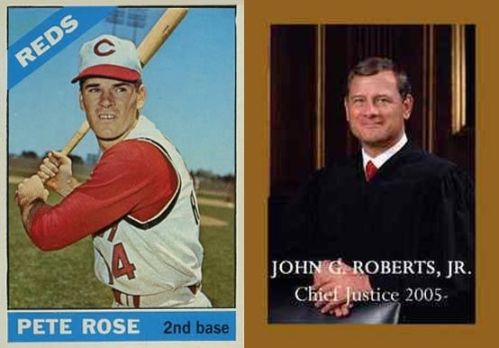
It looks as if the Supreme Court will issue its decision on the Affordable Care Act (aka Heritagecare) this week. An unreported story is the relationship of this to baseball legend Pete Rose.

There has probably been more betting on the outcome of this legal question than any before, at venues such as Intrade. Presumably the bettors include some number of lawyers; with more than a million lawyers in the U.S., what are the odds of that?

Major League Baseball has so far banned Pete Rose from the Hall of Fame because he bet on games. Not games he or his team were involved in, just games. Ever since the Black Sox scandal almost a century ago, baseball has had a zero tolerance rule on gambling by anyone in the sport.

The courts and the bar associations that regulate the practice of law have well developed and strict rules of conduct for lawyers. Obviously illegal gambling is just that— illegal—and clearly out of bounds. Gambling addictions that affect practice have also taken a prominent place in the rules of professional responsibility.

But it doesn’t appear that reasonable and prudent legal gambling of any kind is an ethical problem for lawyers. Unless, that is, there is some kind of Pete Rose issue about it. Specifically: Can lawyers responsibly and ethically bet on court decisions with which they have absolutely no relationship? The answer awaits investigation, and maybe some law review articles.

As for the case itself, they say that only fools predict difficult Supreme Court decisions. So a fool rushes in:

1. The Court will have the law stand or fall as a whole and not pick and choose. There is no severability clause. The court can appropriately say that with such an integrated and complex piece of legislation, if Congress got it wrong constitutionally, it is up to Congress to get it right.

2. If it falls on the basis of the mandate, as widely expected, the reasoning of the majority is going to be a sight to behold and study. A principle of jurisprudence at every level is to decide legal issues as narrowly as possible, unless there is an intention to make a bold legal statement. When the Supreme Court speaks, the bolder the statement, the more far-reaching the impact. In a three-branch democracy, any statement about the limits of powers is very loud and long-echoing.

3. We may not have nine opinions, but we may have an almost complete set of concurring and dissenting opinions. For those who have never read dissents in Supreme Court opinions, be aware that in difficult and controversial cases, it is not unheard of or inappropriate for dissenting Justices to politely but clearly state that the majority is in all respects wrong (see the four dissents in Bush v. Gore).

And now, the bottom line. Intrade traders have placed their bets, and they say the chances of “The US Supreme Court to rule individual mandate unconstitutional before midnight ET 31 Dec 2012” are 76.5%. Judging by the comments on the site, the bettors are some combination of knowledgeable thinkers and anti-Obama ideologues. Intrade and those analysts willing to go out on a limb are right. The mandate will be found wanting, with strenuous disagreement among the Justices. And on the basis of non-severability, so will the entire Affordable Care Act.

Or, then again, maybe not.

Barack and Mitt: The Most Unpopular Candidates in American History


This is an unprecedented Presidential campaign. Just ask the Social Security Administration.

The SSA keeps track of baby names, a database that goes back to 1879. It just released its list of the 1000 most popular male and female names for 2011—Jacob to Armani to Ethen (sic), Sophia to Francesca to Damaris. None of that necessarily matters for the Presidential race.

What does matter is this: Never in American history have both major party candidates for the Presidency had names that were not among the 1000 most popular—ever.

In 2008 it was easy to surmise that one name (not John) had never made it to the Top 1000, and Barack still hasn’t. But this year’s race includes two overwhelmingly unpopular names.

Romney’s real first name Willard has made appearances on the chart: the last time in 1989 when it was #966, and it reached its highest position in 1915 (#58). But that isn’t the name he has ever used. The name Mitt is nowhere to be found.

The Presidential names (including candidates) you think might not make the list do. Woodrow, last seen in 1983 (#954), went from #234 in 1911 to #44 in 1913, Wilson’s first year in office. Ike bounced around the middle to bottom of the pack from the 19th century on, but at least it is on the list, finally falling off the Top 1000 in 1957 (while Ike was still in office). Rutherford always struggled, giving up in 1905 at #910. Even Newt had its day (though not much of one), appearing near the bottom between 1880 and 1907.

But no Barack. And no Mitt.

Does this have any consequence? As for any correlation between electoral success and relative name popularity—at the time of election or at some significant life stage for voters—there is no consistent pattern, no seeming name advantage.

All we know is this: There has never been an election between two candidates with such unusual and unpopular names. Just one more element in an election unlike any other.

The First [Description Here] President

You’re every President
It’s all in you.
(apologies to Ashford & Simpson and Chaka Khan)

It all began when Maya Angelou dubbed Bill Clinton “the first black President.” This proved awkward when the real first black President, Barack Obama, took office. But when politics meets media, too much is never enough, and so the meme took hold.

This week Barack Obama was cover-featured in Newsweek as “The First Gay President.” That was followed today by Dana Milbank in the Washington Post suggesting that Obama may be, in a way, the first female President. Previous coverage had tagged Obama “The First Jewish President.”

To keep things actual, President Obama is not Jewish, or gay, or female. He has indeed been known to wear a kipa. He has not been known to wear a halo, rainbow or any other color.

Keeping it further factual, he is also the first biracial President, the first Hawaiian President, the first Grammy-winning President, and so on. If you’re positively inclined, you might also add that he may be the first 21st century President, if you relegate George W. Bush to a prior century’s worldview. If negatively inclined, there are plenty of choices: the first non-American President, the first Muslim President, the first Socialist/Communist President, etc.

Why stop there? Neither politics nor media is always that tethered to reality, so let your imagination run wild (i.e., make stuff up). Simply choose a descriptor and plug it in. Warning: No matter how whimsical and fantastic the results may seem, some of those who oppose Barack Obama will likely pick up on them and treat them as real. Please whimsicize responsibly.

Likeability and Political Forgiveness


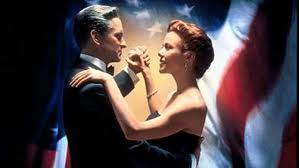
In the most charming of political romantic comedies, The American President, an incandescently beautiful lobbyist (Annette Bening) chastises the handsome and liberal President (Michael Douglas), though not to his face:

The President has critically misjudged reality. If he honestly thinks that the environmental community is going to whistle a happy tune while rallying support around this pitifully lame mockery of environmental leadership just because he’s a nice guy and he’s done better than his predecessors, then your boss is the Chief Executive of Fantasyland.

The President is a very nice guy. He overhears this tirade, which leads to their meeting cute, having sex in the White House, splitting up, getting back together, and living happily ever after, romantically and politically. All is forgiven.

Everyone agrees that likeability matters. There is an apparent likeability gap between President Obama and Mitt Romney. Under normal circumstances, relative likeability is a solid predictor of Presidential outcomes. But these are anything but normal times. There are plenty of world-class doctors who are personality challenged, and given the choice between the one you would have a beer with and the one who can keep you alive, there isn’t much choice.

Still, likeability provides something that other characteristics cannot: room for forgiveness. That is why likeability matters, in politics and elsewhere. Everyone screws up, and the willingness of others to get over or past that is essential. Without denying his substantial talents and achievements, Bill Clinton survived on his likeability more than once. In the much darker and non-romantic comedy Primary Colors, based on Joe Klein’s roman a clef about pre-Presidential Bill Clinton, the candidate’s close friend and no-bullshit confidant, played by Kathy Bates, sums up the Peck’s Bad Boy of politics:

Now what kind of shit is that, Jack? Oh, excuse me. I forgot. It’s the same old shit. The shit no one ever calls you on, ever. Because you are so completely fucking special! Because everyone was always so proud of you. Me, too. Me, the worst.

Likeability matters because it makes you special, at least long enough to get beyond the worst of it. As President Obama confessed early on, he is not a perfect man, and would not be a perfect President. He hasn’t been, but who can be? The judgment depends on just how badly imperfect you are and how much people will forgive. That’s the well we all go to, and likeability keeps the well filled—at least for a while. Mitt Romney is not a perfect man or a perfect candidate. At some point, he will likely have to go to the well of likeability and forgiveness. We wonder whether there will be anything there when he does.