Bob Schwartz

Tag: 9/11

It May Not Be Politically Correct to Talk About It, But Is Donald Trump Mentally Healthy?

Donald Trump says he saw something that nobody else did: people in Jersey City cheering as the Twin Towers fell on 9/11.

From the Washington Post:

Republican presidential candidate Donald Trump says he saw people cheering the Sept. 11 attacks across the river in New Jersey — a claim officials strongly deny.

Trump first told the story Saturday at a rally in Birmingham, Alabama, as he pressed the need for greater surveillance, including monitoring certain mosques, in the wake of the Paris attacks.

“I watched when the World Trade Center came tumbling down. And I watched in Jersey City, New Jersey, where thousands and thousands of people were cheering as that building was coming down. Thousands of people were cheering,” Trump said Saturday at a rally in Birmingham, Alabama.

Trump repeated the assertion Sunday in an interview with George Stephanopoulos on ABC’s “This Week,” as Stephanopoulos explained to Trump that police had refuted any such rumors at the time.

“It did happen. I saw it,” said Trump. “It was on television. I saw it.”

“There were people that were cheering on the other side of New Jersey, where you have large Arab populations. They were cheering as the World Trade Center came down,” he said.

“I know it might be not politically correct for you to talk about it,” he added, “but there were people cheering as that building came down, as those buildings came down. And that tells you something.”

It comes down to two possibilities.

One is that Trump is just saying stuff and making up stuff for political benefit. Pretty outrageous stuff, but it’s been working for him so far. There have long been internet rumors to this effect, but every possible objective source—police, news media, even Republican politicians—deny it ever happened. But it is a rumor that is a definite winner among certain constituencies.

Or. There is something creepily genuine about Trump’s profession of belief in this. He saw it on television, he says, even though it was never on television. Which means that maybe, just maybe, Donald Trump has a problem. A psychological one. People do and say all kinds of things that cross all kinds of lines—ethical, moral, criminal—without having mental illness. On the other hand, it would not be that surprising for someone who has skated for so long on the edge of saying whatever is needed—very successfully and profitably—to cross a boundary to the place where things that never happened do appear to have happened. All evidence to the contrary.
What Fear and an Abundance of Caution Look Like

On Tuesday, a few days after Paris, a woman on a Spirit Airlines flight waiting to leave BWI panicked when she saw a man, apparently Middle Eastern, watching a news report on his phone. She went to the back of the plane with her child, reported the man, and then he and three others were taken off the plane, questioned, and released.

You might have missed this underreported incident, so here is an extended excerpt from the Baltimore Sun report:

The four people removed Tuesday morning from a Spirit Airlines flight from BWI to Chicago amid concerns about a threat were released without charges after being questioned, Maryland Transportation Authority police said.

A female passenger told the flight crew she saw suspicious activity, which turned out to be someone watching a news report on a smartphone, said Sgt. Jonathan Green, a spokesman for the authority’s police department, which patrols the airport.

“Everything added up to create a situation where she felt concerned,” Green said of the witness. “Everything was done in the interest of safety.”

Spirit Flight 969 was taxiing before takeoff when the passenger alerted a flight attendant, Spirit Airlines said.

“Out of an abundance of caution, the plane returned to the gate,” the airline said.

Officers removed three men and a woman from the flight, Green said. He said those passengers included a married couple, who were traveling with a family member, and a male passenger sitting near them.

Green declined to identify the people removed, including whether they were of Middle Eastern descent, as several other passengers described them….

Moments later, the pilot told passengers over the intercom that the plane was returning to the gate.

“We get back, and two police officers come onto the plane,” Farella said. The officers asked three men and a woman to follow them off the plane, she said. All of the passengers were evacuated later so the plane could be searched, Farella said.

Transportation Security Administration rescreened all of the baggage on the flight, including the bags of the four passengers who were pulled off, said TSA spokesman Mike England. “No threat was found,” he said.

One of the mantras that has been repeated after 9/11—but goes back to the world wars—is if you see something, say something. But this has never meant: If you see anything, say anything.

Under the most normal circumstances (if there is such a thing) different people are more or less fearful of different things. And under those circumstances, when that fear seems very irrational and ungrounded in reality, we might even label it neurotic or pathological. As in paranoia.

When circumstances change, as with actual or perceived terror threats, the measuring stick changes. We not only allow for heightened vigilance; we encourage it.

A lot of people carry around a bit of fear and a bit of intolerance and prejudice. Sometimes they are self-aware about it, sometimes not. Most manage to keep it in check, because life goes on, and because expressing those fears and prejudices is not universally acceptable.

Events like Paris take the lid right off that container. It isn’t surprising that ordinary people have trouble figuring out just how far to go with it. But we do expect experts—airline security, police—to bring some discernment to the situation.

In this case, it is hard to see how a man watching a phone constitutes even the tiniest evidence of a problem. If the woman told someone that was all she saw, the airline and the police should have exercised their own discretion, right then. And if the woman misreported what she saw, we might think she was misperceiving because of her own fear or actually just making things up.

The worst conclusion to reach, but one we’ve already lived through with 9/11, is that anytime a Middle Eastern type is reported to be doing anything that in any way could be construed by anybody as troubling, it will be the subject of suspicion, investigation, and detention.

Which isn’t surprising. Which will be familiar not only to Middle Eastern types, but to black people as well. And which isn’t an abundance of caution. It is just plain old prejudice.

Stamping Eid al-Adha


The relationship between American society and Islam is complicated.

At this point in history, there are few sentences that could be more absurdly understated. In so many spheres, that relationship is, to be polite, messed up beyond all reason.

There is a long and growing list of events and phenomena that contribute to and reflect those complications. How the world’s largest or second-largest religion (depending on accounting) became so toxic in the world’s most tolerant democracy is a story still being written. No doubt having a black President whose father was a Muslim, who spent part of his youth in the world’s most Muslim country, and whose middle name is Hussein is the latest part of that.

The Postal Service, out of a sense of decency and diversity and political realities, rushes in where others fear to tread. This is itself a complicated thing.

October 26 is Eid al-Adha (“Feast of the Sacrifice”), the major holiday on the Muslim calendar.

Islam shares many stories with its Abrahamic precursors, Judaism and Christianity, though some of the scripture is added to or modified. So it is with the story of Ibrahim (Abraham) and his son Ishmael (Isaac). Ibrahim and Ishmael are said to have built the Kaaba, the building in Mecca that is the centerpiece of the commanded pilgrimage—the hajj. Ibrahim was also told in a dream to sacrifice his son as a sign of obedience to Allah and, as in the Old Testament, was stopped only at the last moment when Ishmael was replaced by a sacrificial sheep.

Eid al-Adha marks the end of the annual pilgrimage and Ibrahim’s faithful near-sacrifice of his son. (For discussion elsewhere, the question of how this deep and fascinating father-son sacrifice in the Old Testament—see, e.g., Kierkegaard’s Fear and Trembling—is not on the Jewish calendar, but became such a central event of the Christian and Muslim calendars.)

Some think that the Postal Service should not be in the business of commemorating religious holidays and people, given the wall—the admittedly porous wall—between church and state. The Mother Teresa stamp issued in 2010 is just one of those flash points. The Postal Service explains:

Following the announcement of the Mother Teresa stamp, groups such as the Freedom from Religion Foundation objected to the Postal Service’s seeming violation of its own guidelines.

“We received numerous letters saying that we should not be doing religious stamps,” says Terry McCaffrey, manager of stamp development. “But we are honoring her for her humanitarian work, not for being a member of a religious order.”

After all, McCaffrey asks, to what extent should religious inspiration disqualify an otherwise worthy subject?

Over the years, many religious figures have been depicted on stamps in recognition of their contributions to society, independent of their personal motivations or beliefs. Stamp honorees have included Dr. Martin Luther King, Jr., for leading the struggle for civil rights, Father Edward Joseph Flanagan for his work with delinquent and homeless boys, and Padre Félix Varela for his advocacy for the immigrant poor.

Still, the signs of protest for Mother Teresa were stronger than with most stamps.

As for minority religions, the Postal Service shies away (but see Hanukkah below). No Buddhism, for example. Interestingly and somewhat surprisingly, the Postal Service did dip its toe in Mormon waters. In December 2005, it gave a nod to the 200th anniversary of Joseph Smith’s birth, not with a stamp, but with the much less substantial cancellation mark. Note below that the Postal Service did not issue this postcard; that is privately produced. The only government involvement is the cancellation mark. Also notable is that given it was holiday season, this postcard includes a Madonna stamp to go along with the Joseph Smith cancellation.

Holidays provide a little bit of cover for the Postal Service. Instead of unacceptably eliminating Christmas, the Postal Service went to religious inclusiveness and diversity. So we have a Hanukkah stamp for Judaism—even though Hannukah is a relatively minor holiday on the Jewish calendar.

A few years ago, we were offered a Muslim stamp for the Eid feasts:

This stamp commemorates the two most important festivals — or eids — in the Islamic calendar: Eid al-Fitr and Eid al-Adha, and features the Arabic phrase “Eid mubarak” in gold calligraphy on a blue background. Eid mubarak translates literally as “blessed festival,” and can be paraphrased “May your religious holiday be blessed.”

Employing traditional methods and instruments to create this design, calligrapher Mohamed Zakariya of Arlington, VA, working under the direction of Phil Jordan of Falls Church, VA, chose a script known in Arabic as “thuluth” and in Turkish as “sulus.”

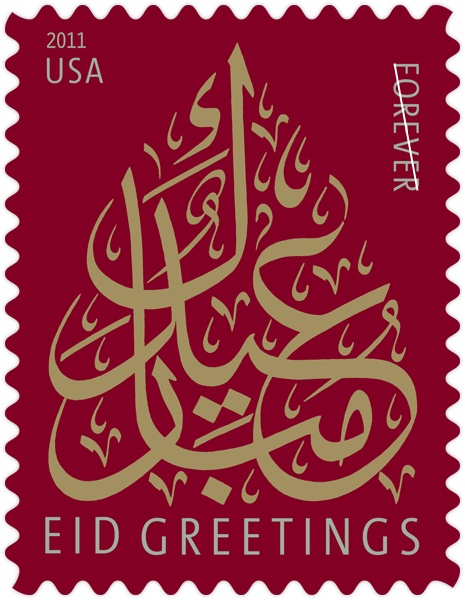
As shown above, the Postal Service modified the Eid stamp in 2011, keeping the exquisite calligraphy, changing the color from blue to red, and issuing it as a Forever® stamp:

The U.S. Postal Service® commemorates the two most important festivals — or eids — in the Islamic calendar: Eid al-Fitr and Eid al-Adha. On these days, Muslims wish each other Eid Mubarak, the phrase shown in calligraphy on the stamp. Eid Mubarak translates literally as “blessed festival” and can be paraphrased “May your religious holiday be blessed.” This Eid stamp features gold calligraphy against a reddish background.

Saying that the original Eid stamp was issued “a few years ago” is imprecise. It was actually issued on September 1, 2001—ten days before 9/11. It seems that this small step in the direction of recognition and tolerance got lost in some twisted history that as a country we are still trying to straighten out.

The stamp is available for purchase from the Postal Service. And even if you are not among the 1.7 billion people celebrating Eid al-Adha next week, it is still a beautiful addition to any piece of mail—and a beautiful statement.