Bob Schwartz

Trump enablers try to recant. But America won’t forgive or forget.
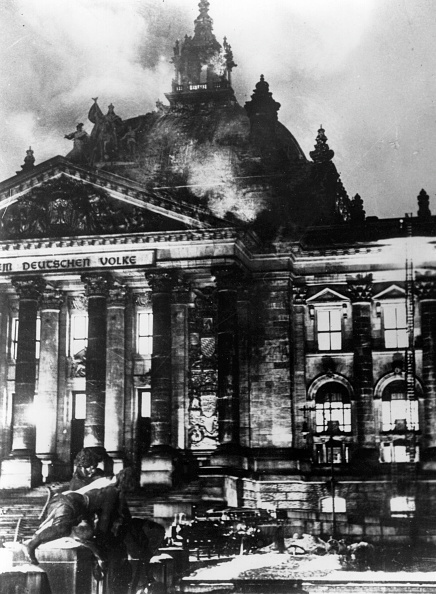
Reichstag Fire, 1933

After historic tragedies and debacles, those complicit by participation or silence try by various degrees to distance themselves from responsibility. Most infamously in modern history, leaders and citizens in Nazi Germany characterized themselves as bystanders or as “just following orders.”

The Trump administration has not been a Nazi regime and the tragedy is not as deep and dark. On the other hand, it has been far from benign, and its malignancy has been glaring and obvious from the start. Yesterday’s storming of the U.S. Capitol by Trump supporters is just one instance, but it is one that finally got the attention of even the most ardent enablers.

So we saw one after another trying to say, in essence, this is not the man, the fearless leader that I know and love, so respectfully, I am maintaining my distance. Lindsay Graham offered this:

“Trump and I, we had a hell of a journey. I hate it being this way. All I can say is, count me out. Enough is enough. I tried to be helpful.”

Believing that this, or Mike Pence’s attempt to suddenly look like a responsible and trustworthy American leader, is enough to erase four years of American hell is a ludicrous idea. These people are free to repent and make their peace with their God; we hope they do. But if they believe we will allow them a seat at the table of public wise men, they will have to be satisfied to stand on the sidelines with the other miscreants and fools. Or in their own hell. Again, that is up to them and their God.

No, these people were not just bystanders or following orders. They made deals with the devil. Now it is time for them to pay up.

If religion has failed (the Dalai Lama says so) should we reform it or abandon it?

“It is possible to live without religion, but can one live without love and compassion? The answer is no.”

No less a religious eminence than the Dalai Lama says that religion has failed us. From A Call for Revolution:

When I call on you to bring on the Revolution of Compassion, I am not speaking to you in the name of an ideology. I do not believe in ideologies – those systems of preconceived ideas that are applied to reality and the means by which political parties in power impose authority. Ideology is all the more dangerous because it permeates all sectors of society. Not only can you no longer discern it, your world view is unconsciously shaped by it.

Nor do I speak to you about the Revolution of Compassion as a Buddhist, as the Dalai Lama, or as a Tibetan. I am addressing you as a human being, asking you to never forget that you too are, first and foremost, a human being, before you are American, European, African, or a member of a particular religious or ethnic group. These characteristics are secondary: do not let them dominate. If I say ‘I am a monk’ or ‘I am a Buddhist’ or ‘I am a Tibetan’, these are subordinate realities to the fact that I am above all a human being….

In November 2015, after the Paris terrorist attacks, I faced up to the failure of religion. Every religion persists in cultivating that which divides us, instead of uniting us around what brings us together. None has succeeded in creating a better human being, or a better world. That is why now, in 2017, I have no qualms about telling you that there is an urgent need to go beyond religion. It is possible to live without religion, but can one live without love and compassion? The answer is no.

If that is so, and increasing numbers of people young and old believe it, where does that leave religion?

Should religion be reformed? Or should we, as so many already have, abandon religion?

It is unnecessary to highlight those failings. When people who claim faith ignore or encourage the worst, sometimes even in the name of those faiths, exactly what good can those faiths be?

So the question remains. Do we try to persuade the nominally faithful to pay more attention and fidelity to their principles, including the principle of compassion? Or do we shake the religion dust from our boots and move on?

Pink in the foreground orange in the back

Pink in the foreground orange in the back

Flowers near the window pink
distant ones orange
bees and hummingbirds will visit
one the other both or neither
how vast and empty
the space between them all

© Bob Schwartz

New Year

The new year ends a year of sorrow
spring finds everything fresh
mountain flowers laugh with green water
cliff trees dance with blue mist
bees and butterflies seem so happy
birds and fishes look lovelier still
the joy of companionship never ends
who can sleep past dawn

Cold Mountain (Hanshan), c. 9th century
Translated by Red Pine (Bill Porter)

Flowers

Flowers

What is the difference between
dried flowers and
dead flowers?

© Bob Schwartz

Shadow

Shadow

A butterfly leaves
A colorless shadow
In the white sun
Through the window
A familiar shape
And flutter of wings
Also the real thing

© Bob Schwartz

I Ching for Christmas 2020

“This hexagram equates dispersion with success and great religious and political ceremonies. It reminds us that when things seem to fall apart, this may benefit us by pushing us toward needed changes.”
Margaret J. Pearson, The Original I Ching

The I Ching is free with its Christmas gifts, if you ask.  Of course it will be honest with its insights because it knows no other way. Here is what it said for today.

HEXAGRAM 59
WIND/WOOD OVER WATER
HUAN • DISPERSING


The Complete I Ching by Taoist Master Alfred Huang

The wind blows over the water and disperses the waves. Penetrating and breaking the blockage leads to dispersion.

DECISION
Dispersing.
Prosperous and smooth.
The king arrives at the temple.
Favorable to cross great rivers.
Favorable to be steadfast and upright.

COMMENTARY ON THE DECISION
Dispersing.
Prosperous and smooth.
The firm comes without hindrance.
The yielding is at the proper place.
It goes out to meet its similarity above.
The king arrives at the temple.
He is in the central place.
Favorable to cross great rivers.
The merit comes from mounting on the wood.

COMMENTARY ON THE SYMBOL
The wind moves over the water.
An image of Dispersing.
In correspondence with this,
The ancient king offers sacrifice to the Lord of Heaven
And establishes temples.

SIGNIFICANCE
The gua takes the image of the wind moving over the water to demonstrate the act of dispersing people’s resentment. During the time of dispersing, having a leader with wisdom and foresight is crucial. The king approaching his temple gives us an image of his connection with the spiritual world. Crossing great rivers signifies the hardship and difficulty of the work. Steadfastness and uprightness should be the virtue of a great leader. He has self-confidence, so he is able to live and work in peace.

During King Wen’s sitting in stillness he meditated upon joyfulness and dispersion. After people had been joyful, their energy dispersed, and their focus was scattered. At such a time, a leader with wisdom and foresight was needed. He arrived at his temple and communicated with the deity. His sincerity and trustworthiness encouraged people to work in full cooperation and with unity of purpose.


The Original I Ching by Margaret J. Pearson

When the wind blows over deep water, any objects on its surface are driven apart. Times when things fall away from each other can be frightening. Such an image of extreme fluidity seems an unlikely correlation with times when great rulers built temples and took the time to make sacrifices. Yet this hexagram equates dispersion with success and great religious and political ceremonies. It reminds us that when things seem to fall apart, this may benefit us by pushing us toward needed changes. By precluding a return to an earlier situation, dispersal forces us to persist in a new direction. At such a time we need to make sacrifices and to draw near to sources of spiritual and moral strength. Doing so is not a mark of weakness but of nobility. Even the greatest leaders have faced times when everything seemed to fall apart. They needed rituals at such times, to seek guidance and to gather their followers together. Then they could initiate great changes, ones worthy of persistence.

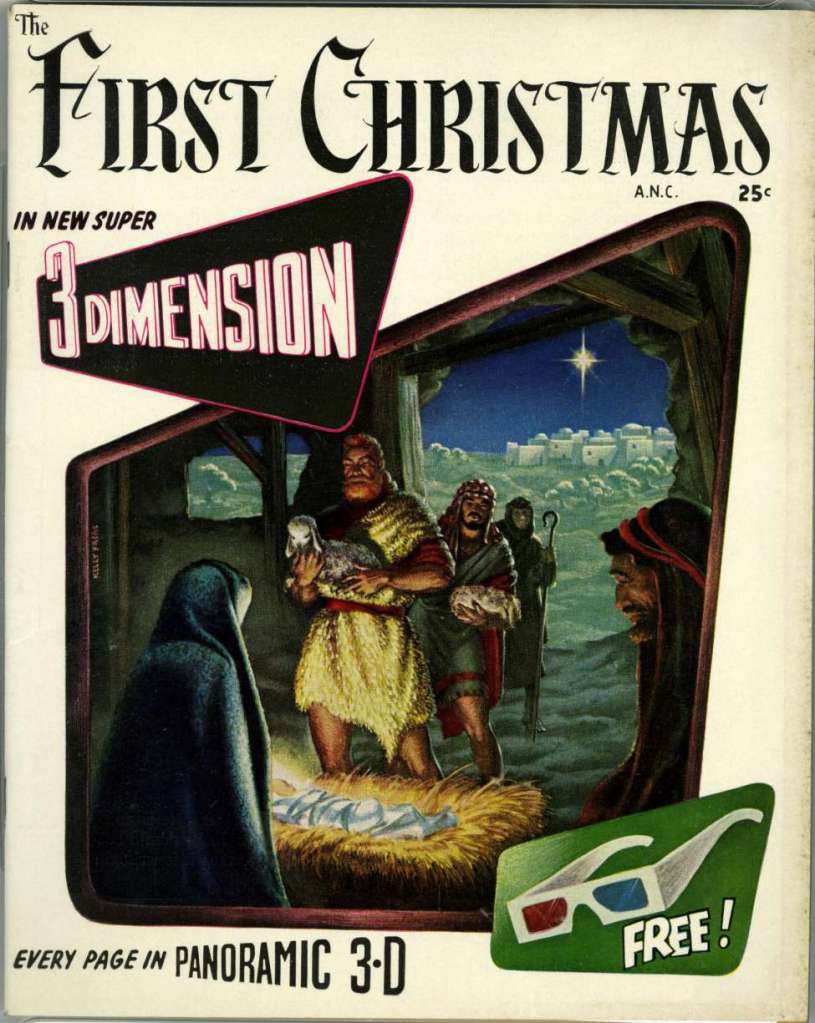
Christmas in 3D

In the 1950s 3D pictures were all the rage. Except for some sci and sci-fi visionaries, they couldn’t see that by 2020 people would have virtual reality headsets.

Things were simpler then. So if you wanted the experience of 3D, all you needed was a comic book and a pair of cheap 3D glasses with plastic red and blue lenses. No electricity or computing needed. (Speaking of visionaries, only a few in the 1950s could see that by the 1960s people would be widely taking 5D pills, but that’s another story.)

Following is a page from a 1953 comic book, The First Christmas in New Super 3 Dimension. Find or make a pair of 3D glasses and you are there!

Christmas: If you don’t like someone’s story, write your own.

“If you don’t like someone’s story, write your own.”
Chinua Achebe

This is a season of stories. Every season is a season of stories, but this one in particular. There is a Jewish story about a band of rebels who reclaim and rededicate their Temple. There is the Christian story of a child born to teach and to save everything.

Those stories are told and interpreted in different ways from different perspectives. The stories may enlighten and uplift people. They may also lead to unanswered questions and unresolved conflicts, some of them damaging and tragic.

The thought from novelist Chinua Achebe is not limited to writers. We are all storytellers. Joan Didion wrote “We tell ourselves stories in order to live.” You may or may not believe the various stories about Christmas and its aftermath and consequences. You are not only free to choose from the stories. You are free and encouraged to tell your own.

Some will properly note that this can be problematic. There are such things as facts and we cannot tell those facts away. Gravity operates everywhere on our planet and you cannot tell it away. But if you want to tell stories about animals defying gravity or about people defying gravity or breaking the bounds of gravity, those are both facts and visions. All parts of stories you might tell. Still, not acknowledging gravity as you actually stand on the precipice of a high cliff, without wings, parachute or rocket pack, is dangerous.

So embrace and tell the versions of the Christmas story, and be enlightened and uplifted by them. This Christmas begs us to believe in a new possibility that begins with something as simple as the birth of a baby. Tell your own stories if you are so inclined. No one should stop you.

If you don’t like someone’s story, write your own.

Hanukkah 2020: More Light!

More light!

The famous story is that on his deathbed, the German poet, novelist, playwright, and scientist Johann Wolfgang von Goethe (1749-1832) exclaimed:

Mehr Licht! (More light!)

This is such a remarkable and memorable display of a spiritually enlightened final moment.

Except…

Historians now suggest that Goethe was merely asking that the shutters in his room be opened.

Oh well.

Each of the eight nights of Hanukkah, we light a head candle (shamas) and an increasing number of candles, from one to eight. That’s a total of 45 candles, 45 flames. That’s a lot of fire. That’s a lot of light.

Imagine if Hanukkah lasted a year and we had 365 nights, adding a candle each night. A really big menorah. We would be lighting a total of 67,160 candles—366 on the last night alone. That’s a lot of light.

Hanukkah will be over in a week. After that, feel free to keep lighting candles, figuratively or metaphorically. More candles. More light. Less darkness cursing.

Happy Hanukkah!