As U.S. Nears 800,000 Virus Deaths, 1 of Every 100 Older Americans Has Perished
Seventy-five percent of people who have died of the virus in the United States — or about 600,000 of the nearly 800,000 who have perished so far — have been 65 or older.
Note that those reported numbers are below actual. Months ago, experts said that reporting remains imperfect, and that the number had already exceeded 1,000,000 covid deaths.
I also woke to read articles by presumably intelligent and principled people saying that covid restrictions had long been overreaching, and that “outside the world inhabited by the professional classes in a handful of major metropolitan areas” Americans don’t care about covid and are getting on with their lives.
From all reports, I am sure that many of those older Americans who died were not part of “the elites.” I am sure that some of them adhered to recommended restrictions and that some wouldn’t and didn’t. I am sure that none of them can comment because all of them are dead. I am sure that absent those restrictions and interventions the deaths would be higher, much higher.
I’ve learned this over my life. Intelligent and principled people don’t necessarily say and do the right or good thing in every circumstance. A quality shared in so many traditions is humility, that is, even if you think you are intelligent and principled, you have to let it go and admit to others and to your deity that you may very well be wrong. In this ongoing crisis, where here in my state, not an elite one, there are 60 or so covid deaths a day, and there are no ICU beds, and at least half the people act as if there is no covid, we could use more active compassion, and more humility among those who think they are smarter than a diabolical virus. Because they are not.
Thomas Merton died on this date in 1968. It was an untimely and unusual death, and happened on the anniversary of his entering the monastery in 1941.
He was traveling in Asia at the time. We are fortunate to have not only his many books, but also seven volumes of his journals. At that moment, he was intensifying his long-time interest in Asian religions, particularly Buddhism.
Merton readers and students—and there are millions—see in his later writings and testimony of others suggestions that at the time of his death he was planning to leave the monastery and pursue (return to) a more worldly life. If I ever participated in that speculation, maybe a more mature spiritual life has made me realize the question is pointless. Not just because we will never know, but because for someone as spiritually rich and talented as Merton, and so generous with his spiritual wealth, doubts and all, it is beside the point.
Here is the last journal entry before he died:
December 8, 1968. Bangkok
A Dutch abbot who is staying with an attaché of the Dutch Legation came around to the hotel yesterday and we went to Silom Road again, to find Dom Leclercq and others who had arrived. Most of the delegates were arriving today and I will go to the Red Cross place where we are supposed to stay and where the meeting is to be held. It is 30 kilometers out of Bangkok. The Dutch abbot was trying to talk me into participating in a TV interview but I am not sure it is such a good idea, for various reasons. And first of all I find the idea very distasteful. The suggestion that it would be “good for the Church” strikes me as fatuous as far as my own participation is concerned. It would be much “better for the Church” if I refrained.
It is good to have a second time round with these cities. Calcutta, Delhi, and now Bangkok. It now seems quite a different city. I did not recognize the road in from the airport, and the city which had seemed, before, somewhat squalid, now appears to be, as it is, in many ways affluent and splendid. What has happened, of course, is that the experience of places like Calcutta and Pathankot has changed everything and given a better perspective in which to view Bangkok. The shops are full of good things. There is a lot to eat. Lots of fruits, rice, bottles, medicines, shirts, shoes, machinery, and meat (for non-Buddhists). And the stores near the Oriental Hotel are really splendid. So too is the Oriental itself. I have a fine split-level dwelling high over the river, and you enter it through an open veranda on the other side, looking out over the city.
I went to Silom Road, walked into the French Foreign Missions place and found it deserted. I wandered around in the rooms looking at the titles of books on the shelves: [Sir Walter) Scott’s Marmion, André Maurois, along with Edward Schillebeeckx, a set of Huysmans, I forget what else-lots of magazines from Études to Paris-Match. Finally Fr. Leduc appeared, and presently-he told me to wait-the superior, P. Verdier, came in with Abbot de Floris, who is running the meeting, and Fr. Gordan. They said there was mail for me; it turned out to be a letter from Winifred Karp, the young girl who stayed with the nuns at the Redwoods, forwarded from Calcutta. I have a hunch some of my mail will be getting lost in this shift.
The flight over Malaysia: dark-blue land, islands fringed with fine sand, aquamarine sea. Lots of clouds. It was a Japan Air Lines plane. They made me weigh my hand luggage, which put me overweight for the economy class allowance, so instead of just paying more for nothing I paid the difference for a first-class ticket, thus covering it with the bigger baggage allowance. And had a very comfortable ride, overeating, drinking two free, and strong, Bloody Marys, and talking to a diplomatic courier for the State Department, who by now is getting ready to fly on to Karachi in Pakistan on the night Pan Am plane.
This evening I took a walk through Bangkok, down past the Post Office and into Chinatown. A Chinese Buddhist temple was all lit up and having some kind of fair, preparing a stage for a show, food for a banquet, and booths were selling all kinds of trinkets, lights, and incense. I went in and wandered around. There were hundreds of kids playing. Older people happy and fairly busy preparing whatever it was. Perhaps something to do with the king, whose birthday was yesterday. The city is full of flags, signs saying “Long live our noble King” and huge pictures of Phumiphol Aduldet himself, now as a Thai general and now as a bhikkhu in the lotus posture.
Last night I had a good Hungarian dinner at Nikas No. 1 (where, however, I seem to have been grossly shortchanged) and went on to see an Italian movie about some criminals in Milan, a quasi-documentary. It was not bad, very well filmed, and worth seeing.
Today is the Feast of the Immaculate Conception. In a little while I leave the hotel. I’m going to say Mass at St. Louis Church, have lunch at the Apostolic Delegation, and then on to the Red Cross place this afternoon.
History is a story of vulnerabilities and opportunities.
Humans are humans, with their natures and tendencies. These can be transcended and modified, but some are deep and abiding. We are, for example, not always inappropriately selfish and seeking comfort.
Those natures and tendencies exist in environments, personal and social. Depending on the circumstances of the moment, these can leave people vulnerable to all sorts of forces, some dark. History is clear that these vulnerabilities can be the ground for all kinds of phenomena, especially when the social environment is more extreme and challenging.
Here we are.
Opportunities for transcendence and transformation, for at least realizing where those natural vulnerabilities might lead, if not resisting them, what are they and where are they?
They are widely available. But. If we are to avoid falling prey to those forces, or if we are to escape in case they are here already, there are a few steps.
Admit that there’s a problem—not just in the circumstances but in ourselves, that we are human and that we are vulnerable.
Realize that there are those who are trying to exploit those vulnerabilities, ostensibly to make things better, even to turn back the clock to a time when things were better, but actually because few things are more human than wanting to dominate and make your ideology the rule of the land.
Try to find and follow a path of transcendence and transformation. This is tricky. Not so long ago, the Nazis were successful at exploiting the vulnerabilities of the German people. But they knew that the Church doctrine of transcendence and transformation, including compassion, was an obstacle. So they co-opted what the Church stood for, leaving Christians feeling comfortable being complicit in the worst perfidy.
Admit the natural human vulnerabilities, realize the unrelenting efforts to exploit those vulnerabilities, try to transcend and transform. That’s it.
We consider Hanukkah a “minor” Jewish holiday. Unlike major holidays such as Rosh Hashanah, Yom Kippur and Sukkot, there is no mention of the celebrated events (such as the eight days of oil lamp light) in the Hebrew Bible. However, the books of First and Second Maccabees are historically precise and existed by the time the Jewish biblical canon was established. Yet they were left out of the Hebrew Bible, so the only way to read these books is to find them in Christian Bibles. Why?
In part this is due to the “real” story not fitting well into the rabbinic Judaism that evolved and that for the most part still dominates Jewish life. It is not surprising that a story of revolution, political power plays, Jewish dynastic autocracy, and rejection of divine intervention has been supplanted by a story of light and miracles (especially in a Christmas-intensive society).
As Daniel R. Schwartz writes: “Thus, all in all there is little “Judaism” in this book [First Maccabees]”
More from Daniel R. Schwartz (Professor of Jewish History, Hebrew University of Jerusalem) in The Jewish Annotated Apocrypha:
The book is clearly meant to convince its readers that the Hasmonean family, particularly Simon and his descendants, should rule Judea. This is made clear both by the structure of the book and by specific passages that proclaim that the Hasmoneans were chosen to rule or had earned the right to rule; the focus on the Simonide line comes through especially at the end of Mattathias’s deathbed speech, in ch 14, and in the book’s conclusion.
The book’s argument that it is the Hasmoneans who brought about the salvation of Israel is based on two main theses. First, foreign rulers are terrible and perfidious, and the Judeans’ neighbors hate them and want to annihilate them (whether they are doing well or doing poorly, that is, always), so the Judeans are in need of such salvation. Second, dependence on God’s providence will not solve anything. The latter thesis is emphasized in several pointed contrasts of the Hasmoneans to Judean pietists:
1. At the very end of ch 1 we read of some pious Jews (not necessarily members of any particular group) who are killed because they refuse to violate Jewish law; immediately thereafter, ch 2 introduces Mattathias and his sons and reports the beginning of their armed rebellion.
2. At 2.29–41 we read of pious Jews who refuse to defend themselves on the sabbath, and so are killed; immediately thereafter we read that Mattathias and his men decided to defend themselves if attacked on the sabbath.
3. At 7.8–16 we read that naïve pietists believe the promise of a Seleucid general and a wicked Jew that they have only peaceful intentions, and they are killed forthwith, while the open-eyed Judas and his men see through the general’s lies.
Since we know, from Qumran and rabbinic literature, that there was plenty of pietistic criticism of the Hasmoneans (although there is no firm basis for identifying the pious mentioned in 1 Maccabees as Qumranites or proto-rabbis in particular), it is easy to understand the book as responding by arguing that piety cannot solve the Jews’ problems in the real world. Correspondingly, the book makes no claims about any miracles or divine intervention helping the Hasmoneans, never refers to “God” or “the Lord,” and, after the first few chapters, has only a few references to prayer or to “Heaven”….
Thus, all in all there is little “Judaism” in this book, and although Flavius Josephus, as a historian, used it extensively (in the twelfth and thirteenth books of his Antiquities, perhaps also in his Jewish War), there is little evidence for acquaintance with the book by Jews in antiquity. The rabbis ignored it altogether, unless Rabbi Akiba was thinking of it, among other books, when he proscribed the reading of “external books” (m. San. 10.1). The book was much used in Christian tradition, especially as providing models for depictions of the crusaders who, in their way, fought for the liberation of the Holy Land. But in Jewish literature prior to the modern period, there is next to nothing to speak of, apart from the medieval Josippon. This is to be expected from a book that was so distant from what would become rabbinic Judaism. Indeed, in the nineteenth century, in the early years of modern Judaic studies, Abraham Geiger argued that the work was a Sadducean work, that is, it reflects the type of Judaism against which Pharisaic-rabbinic Judaism arose. Geiger’s argument derived from various points, such as 1 Maccabees’s lack of belief in an afterlife, angels, and providence, denial of which are said by Josephus or other sources to have characterized the Sadducees. Geiger also argued from the fact that our book ends up by justifying John Hyrcanus’s rise to power; Josephus reports that John joined the Sadducees and abolished Pharisaic law. While Geiger’s characterization of the work as Sadducean might nevertheless be too specific (and his characterization of 2 Maccabees as Pharisaic has even less to recommend it), in general Geiger’s assessment was correct. Instead, however, of characterizing 1 Maccabees as Sadducean, it seems more warranted to characterize it as “statist” (as opposed to “diasporic”).
The book should thus be understood as a work bespeaking the point of view of a Jewish state—a state that was, on the one hand, justified by the firm belief that gentiles and their rulers are inveterately hostile, and one that was, on the other hand, made possible by activist and pragmatic heroes who took their fate into their own hands and sought to establish sovereign statehood rather than waiting for God to send a Messiah to do so. As such, it is natural that the book became popular in modern Zionist literature and is a reflection of the degree to which Zionism deviates from diasporan and religious Judaism. To the extent that Zionism, especially since the Holocaust, is based on a lack of trust both in gentiles and in God, 1 Maccabees fits right in.
People reports that there are 144 new Christmas movies scheduled this season on Netflix, Hallmark, Lifetime, etc.
When the Christmas TV movie phenomenon began years ago, it was an occasional holiday thing. Once Hallmark established that it was a crowd pleaser and audience magnet, it expanded its roster and then other channels jumped in.
Like any genre TV, conventional themes and plots are acted by familiar faces. The most extraordinary version combines royalty with the holiday. Often a prince—maybe responsible and a widower, maybe a playboy—falls in love with a commoner in unlikely circumstances.
The line above, “What do you know about the royal family of Aldovia?”, is asked of an aspiring reporter in A Christmas Prince on Netflix. She is flown to Aldovia to cover the possible abdication of the heir to the throne. If you’ve seen this or any of its type, you know the rest.
Do not try to book a flight to Aldovia or Cordinia or Calpurnia or Madelvia. None of these kingdoms exist on real maps. They exist in the sweet world of small obstacles, comfortable lives, whirlwind romanc, and happy endings, all wrapped in the warmth of Christmas.
I won’t say that we need these, that I need these, these few hours away from media that serve up some pretty disagreeable programming, both in the news and in the dark dramas (and in the very dark dramas in the news). But I want these hours away in Aldovia or Cordinia or Calpurnia or Madelvia. You might too.
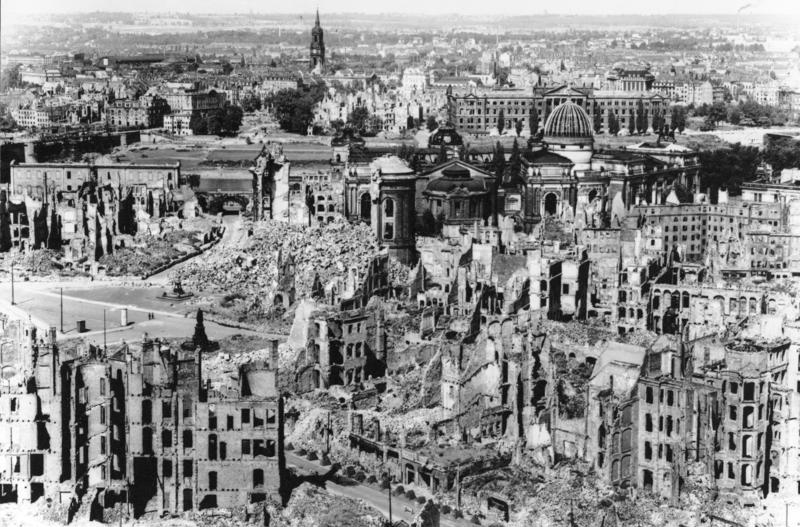
Kurt Vonnegut was a gifted and productive writer. Yet after witnessing the firebombing of Dresden in World War II, it took him decades to include the experience in a book.
When I got home from the Second World War twenty-three years ago, I thought it would be easy for me to write about the destruction of Dresden, since all I would have to do would be to report what I had seen. And I thought, too, that it would be a masterpiece or at least make me a lot of money, since the subject was so big.
But not many words about Dresden came from my mind then—not enough of them to make a book, anyway. And not many words come now, either, when I have become an old fart with his memories and his Pall Malls, with his sons full grown….
Over the years, people I’ve met have often asked me what I’m working on, and I’ve usually replied that the main thing was a book about Dresden.
I said that to Harrison Starr, the movie-maker, one time, and he raised his eyebrows and inquired, “Is it an anti-war book?”
“Yes,” I said. “I guess.”
“You know what I say to people when I hear they’re writing anti-war books?”
“No. What do you say, Harrison Starr?”
“I say, ‘Why don’t you write an anti-glacier book instead?’”
What he meant, of course, was that there would always be wars, that they were as easy to stop as glaciers. I believe that, too.
And even if wars didn’t keep coming like glaciers, there would still be plain old death.
Vonnegut did write that novel about Dresden, the unforgettable and indescribable Slaughterhouse-Five. In it, he included a sort of mantra, a verbal punctuation, that appears more than a hundred times: So it goes.
When I see reports, or fail to see reports, about the continuing losses in the American war against covid, those words pop up: So it goes.
Dresden was a horror that killed 25,000 people, for no good strategic reason. Covid has killed about a million Americans, many of those deaths preventable through more disciplined public policies and behaviors. So it goes.
So it goes, because it is now obvious that given the differences among Americans in their will to fight the virus, instead of each other, we will be trudging through this mess indefinitely, with victories here, losses there, death and sickness everywhere. And it appears that nothing is going to change that.
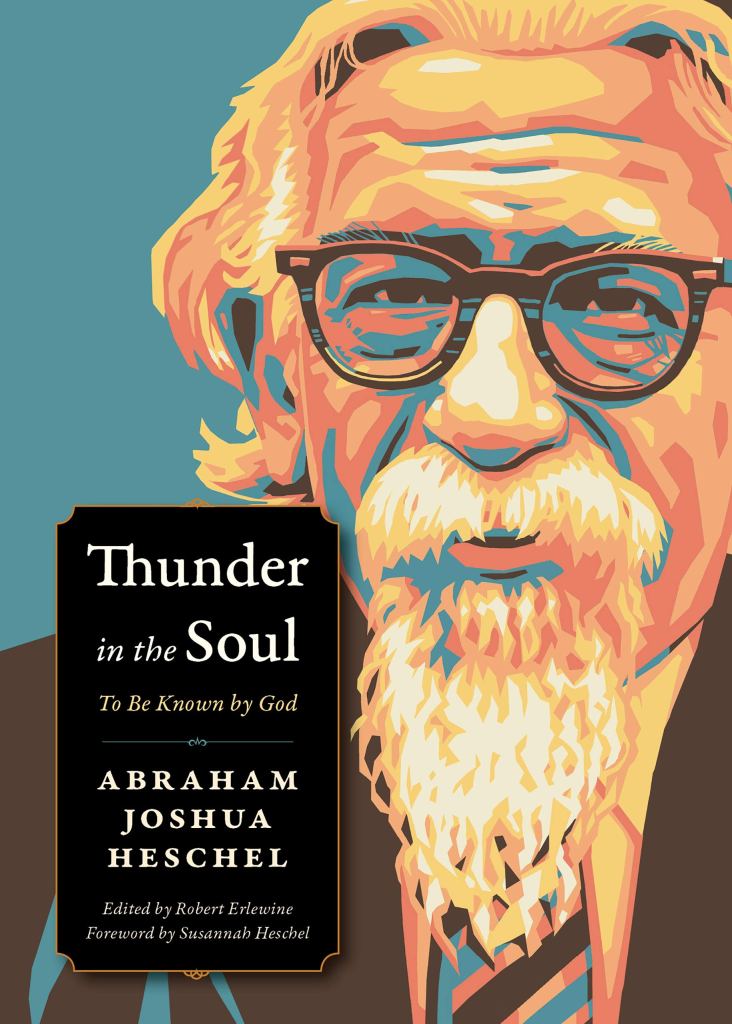
Scholar and author Susannah Heschel, daughter of Abraham Joshua Heschel, has written an introduction to a recent collection of her father’s work, Thunder in the Soul: To Be Known by God.
Here she writes about his religious view of lying and gullibility in America, a problem that apparently is still with us:
That our religiosity must be authentic to who we are as individuals is an old Hasidic teaching from Menachem Mendel, the rebbe of Kotzk, about whom my father wrote a two-volume book in Yiddish. The Kotzker rebbe, a complex and highly original thinker, insisted on truth, sincerity, and authenticity and loathed mendacity. My father wrote that book toward the end of his life, during the years he was active against the war in Vietnam. That war made him sick: he was outraged over the lies of American politicians and the callousness of a government killing thousands of innocent civilians. Yet why were Americans deceived by falsehoods of their government? The lies of politicians were abhorrent, but so was the gullibility of Americans. This was a religious problem, my father felt; people can want to be deceived. Do not deceive, the Kotzker rebbe insisted, and that also means do not deceive oneself by being gullible.
35 If the sign of life is in your face He who responds to it Will feel secure and fit As when, in a friendly place, Sure of hearty care, A traveler gladly waits. Though it may not taste like food And he may not see the fare Or hear a sound of plates, How endless it is and how good!
The Tao Te Ching, a foundational text of Taoism, is a very brief book—81 verses—that is one of the most translated and read in the world. And one of the most valuable.
Witter Bynner (1881-1968), a poet and translator, created an English language version in 1944 that is more a poetic interpretation than translation. It was the first version I read though (a dozen more since), and so its elegance has stuck with me for a lifetime.
The image he uses of “the sign of life in your face” does not appear in any other translation of the verse. He took poetic liberties. Yet once you read it, you are sure to look for that sign of life in your face or in the faces you meet.
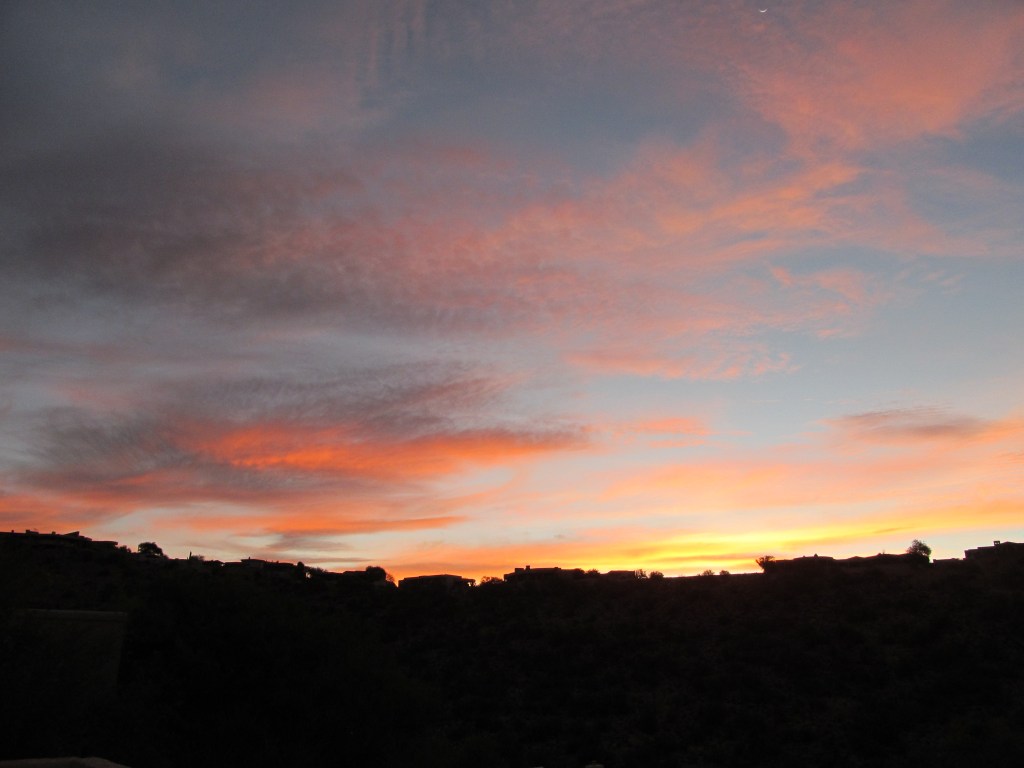
This appears to be a wall of dirt rock and greenery. Pull back and wait. The ridge is steep but climbable. The sun rises spectacularly over it. The wall is not a wall.






 Bob Schwartz