“Today is the eighth day and tomorrow is the thirteenth!”
Simply go beyond rational thinking and you will reach a point where you will not know what to do. Inquire there. Who is it [who inquires]? You will know him intimately when you have broken your walking stick and crushed ice in a fire. Now, how do you achieve this intimacy? Today is the eighth day and tomorrow is the thirteenth!*
*This sentence seems probably to be Bassui’s way of indicating transcendence of logical thinking.
Died on the twentieth day of the second month, 1387, at the age of sixty-one
Look straight ahead. What’s there? If you see it as it is You will never err.
When Bassui was about thirty-one years of age, he heard the running of water in a brook and was enlightened. Thereafter, he spent most of his days in a hut in the mountains. When people heard of the solitary monk and gathered to hear “the word, he would flee. In spite of his longing for solitude, Bassui did not turn his back on the simple people, but taught them Zen in words they could understand. He often warned his followers against the dangers of drinking, and forbade them to taste “even a single drop.” On the margin of his portrait he wrote, I teach with the voice of silence.”
Just before his death Bassui turned to the crowd that had gathered around and said the words above. Repeating them in a loud voice, he died.
Scholar and novelist Theodore Roszak is most famous for the book The Making of a Counterculture (1969), his appreciation, analysis and hope for a nascent alternative society. In 1972, he compiled a cornucopia of the most creative visions of that culture in Sources: An anthology of contemporary materials useful for preserving personal sanity while braving the great technological wilderness (out of print, no digital version available).
From the Introduction:
What are these sources for? I suppose for the only revolution I can see within this technocratic order still strong with contrived consensus: an accelerating disaffiliation and internal restructuring which will in time become the new society shaped and tested within the shell of the old.
CONTENTS
I. PERSON
Thomas Merton. Rain and the Rhinoceros John Haines. “Poem of the Forgotten” Kilton Stewart. Dream Exploration Among the Senoi Carlos Castenada. The Psychedelic Allies Meher Baba. Undoing the Ego MANAS. The Mists of Objectivity Abraham H. Maslow. I-Thou Knowledge Michael Glenn. Radical Therapy: A Manifesto Denise Levertov. “During the Eichmann Trial: When we look up”
II. BODY
Norman O. Brown. The Resurrection of the Body Kay Johnson. Proximity Paul Goodman. Polarities and Wholeness: A Gestalt Critique of “Mind,” “Body,” “External World” Michael McClure. Revolt Charlotte Selver. Awaking the Body Pablo Neruda. “To the Foot from Its Child” Dennis Saleh. “The Psychology of the Body”
III. COMMUNITY
Martin Buber. The Organic Commonwealth Stanley Diamond. The Search for the Primitive George Woodcock. Not Any Power: Reflections on Decentralism Murray Bookchin. A Technology for Life E. F. Schumacher. Buddhist Economics Bill Voyd. Drop City Peter Marin. The Free People Patsy Richardson. No More Freefolk Wendell Berry. “To a Siberian Woodsman” Gary Snyder. “Amitabha’s vow”
IV. WHOLE EARTH
Anonymous. “Smokey the Bear Sutra” Edward Hyams. Tools of the Spirit Joseph Epes Brown. The Spiritual Legacy of the American Indian E. F. Schumacher. An Economics of Permanence Gary Snyder and Friends. Four Changes Ecology Action. The Unanimous Declaration of Interdependence The Berkeley Tribe. Blueprint for a Communal Environment Theodore Roszak. “Novum Organum” Kenneth Rexroth. From “The Signatures of All Things”
V. TRANSCENDENCE
R. D. Laing. Transcendental Experience Herbert Marcuse and Norman O. Brown. Mystery and Mystification: An Exchange Herbert Marcuse. Love Mystified: A Critique of Norman O. Brown Norman O. Brown. A Reply to Herbert Marcuse Lancelot Law Whyte. Morphic Man Dane Rudhyar. The Zodiac as a Dynamic Process Ronald V. Sampson. The Vanity of Humanism Harold C. Goddard. William Blake’s Fourfold Vision Alan Watts. Tao Kathleen Raine. “The World” Theodore Roszak. “Loyalty”
You may not be familiar with most of the authors, though you will be richer for knowing them. Some are essential (such as Thomas Merton, poet Gary Snyder and others). Some may be a bit more of their time, but creative and provocative and worth knowing. You may (hopefully not) dismiss this as tired nonsense circulating in the old days that has been proven silly and wrong, now favored and promoted only by nostalgic older people. It wasn’t wrong and isn’t silly.
We are, if you haven’t noticed, stuck. If it was obvious fifty years ago or five years ago, it is undeniable now. We are stuck, and if we are stuck while time moves forward, we are moving backward. If you think we have all the ideas and strategies we need to actually move forward, think again.
I’ve quoted Bobby Kennedy quoting Tennyson’s Ulysses before, and will for all my days. You should know it too:
Come, my friends, ‘T is not too late to seek a newer world. Push off, and sitting well in order smite The sounding furrows; for my purpose holds To sail beyond the sunset, and the baths Of all the western stars, until I die.
May 1 represents three different things, depending on who and where you are.
For ages it has been a celebration of spring, including dancing around the Maypole.
It is International Workers’ Day, a labor holiday celebrated around the world, where it is sometimes known simply as Labor Day.
It is Law Day in America.
The spring thing is obvious. International Workers’ Day and Law Day require a little history.
In 1886, a general labor strike was planned for May 1 in Chicago, to promote adoption of the 8-hour work day. It is estimated that 300,000 or more showed up in Chicago, and thousands more around America. A further demonstration was planned for Chicago’s Haymarket Square a few days later on May 4. Clashes there between police and anarchists led to death and destruction, in what is called the Haymarket Square Riot. Nine defendants were arrested for their alleged involvement, and six were ultimately hanged. Since then, May 1 has been International Workers’ Day.
In 1921, at the height of America’s first Red Scare, May 1 was designated Loyalty Day. Then in 1957, during another Red Scare, President Eisenhower declared May 1 Law Day, a celebration of the rule of law—something America needs now as much as ever.
Take your choice on May 1: Celebrate spring, celebrate workers, celebrate the rule of law. Why not all three?
If it keeps on rainin’, levee’s goin’ to break If it keeps on rainin’, levee’s goin’ to break When the levee breaks, I’ll have no place to stay
When the Levee Breaks was written and recorded by Memphis Minnie and Kansas Joe McCoy in 1929, echoing the Great Mississippi Flood of 1927. In 1971 Led Zeppelin reworked it for the Led Zeppelin IV album, creating one of their most accomplished tracks.
It came to mind at the time of the Hurricane Katrina disaster. It brings to mind an ancient global flood story, that of forty days of rain meant to destroy the world and (almost) all of its inhabitants.
What the song now brings to mind, lyrics and dirgeful blues, is the news of that same world. It is raining, metaphorically. Not that the sun isn’t shining somewhere, sometime, dry and pleasant. But it looks like it’s also going to be raining, has been, apparently will be, for time to come. We have to believe the levee holds.
Cryin’ won’t help you, prayin’ won’t do you no good No, cryin’ won’t help you, prayin’ won’t do you no good When the levee breaks, mama, you got to move
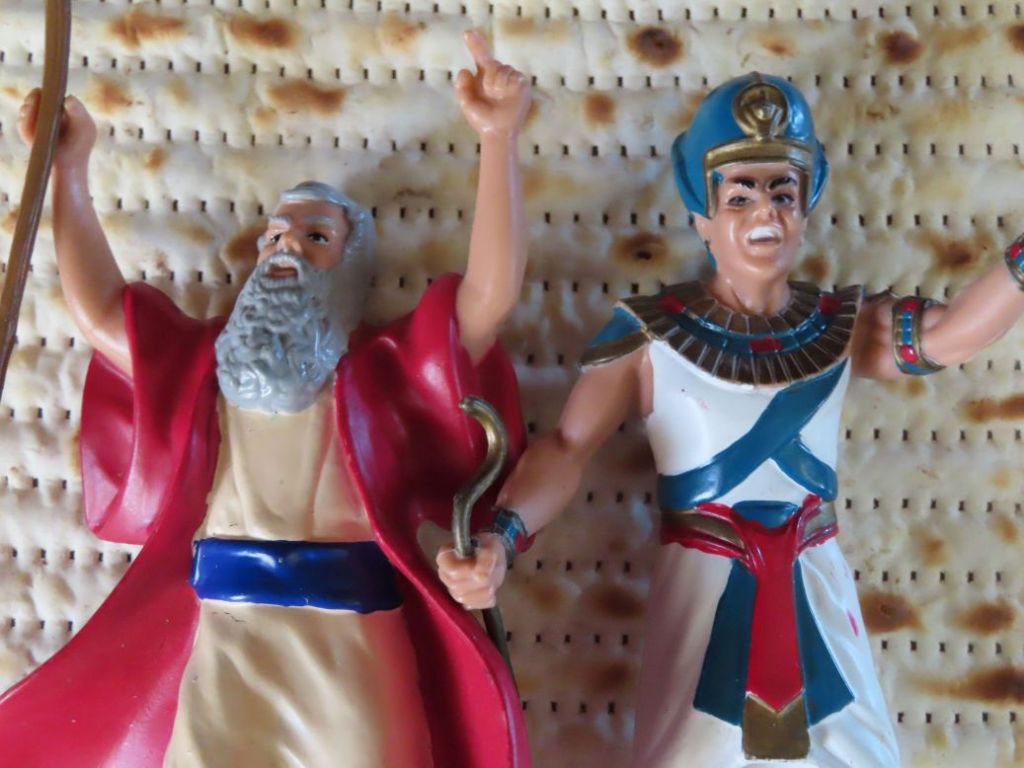
Passover is over. Leftover matzo is begging to be eaten. The superhero (supervillain) action figures of Moses and Pharaoh that sit on the mantle for the holiday are taken down.
I have combined the two. Shown are celebrity photos I’ve taken of the two stars of Passover on a matzo background. Please enjoy.
JOB Explain it to me. I talked to my friends, I talked to God, but I didn’t get an answer. The good prosper, the bad prosper, the good suffer, the bad suffer. You’ve talked with God up close. Do you have any ideas?
MOSES I am as in the dark as you. You can’t win an argument with God. I’ve learned that. Sometimes I felt like a glorified secretary taking dictation. I didn’t know why God even needed me. Why not just make a general announcement to everybody? So, no, I don’t have an answer for you.
JOB I got pretty far with God, just not far enough. God chastised my friends for being know-it-alls. Between me and God, I didn’t win but I didn’t lose. In the end, I said let’s agree to disagree, and that was that. I got everything back, but that really didn’t make up for what I went through. You know how it is, though. You want some kind of reasonable principled explanation, but never get one.
MOSES I never got one. The question we’ve got to ask, you, me, your know-it-all friends, all those I led who look up to me, is whether there is an explanation at all, and if there is one, whether we are owed one. You and me, we are both famous, maybe me a little more than you, and I think when we get through all the fine and fancy words—a lot of words—maybe nobody knows anything.
The evidence mounts that Russia has committed and will continue to commit war crimes in Ukraine. The rhetoric of outrage grows louder, insisting that Putin and others be held accountable, tried and convicted.
Here’s something else.
Russia has ruined and will continue to ruin Ukraine, leaving behind a scorched earth that will take at least a generation to fix.
Here’s the difference.
There is small chance, or none, that there will ever be a court in which a case is made (despite plenty of evidence), the criminals voluntarily surrender to the court’s jurisdiction (they would then be tried in absentia), and the criminals forced to suffer punishment if convicted.
There is a certainty that Ukraine, even if Russia left today, would lie in devastating ruins. Ruination that progresses every day in this interminable war.
One is a noble wish and hope. The other is a fact.
Rhetoric has its place, especially in terrible times. But it is not without drawbacks. A call for action may be necessary but not sufficient. Sufficient action and outcomes give body to rhetoric. In the case of war crimes, if we are candid and practical, we should not be expecting outcomes that match the outrage. The mismatch may only make the champions of freedom look ineffectual, just as the reliance on sanctions has proven less effective than promised.
From the start, there have been no “good” choices for the West, as in choices that did not carry uncertain costs, risks and outcomes. In choosing, we should at least be honest about what are the certain outcomes. War crimes trials are unlikely. The decimation of Ukraine is now.
In the legendary town of Chelm, the men are fools who think they are wise.
Chelm is actually a real town in Poland, a city of around sixty-seven thousand today. Ruth von Bernuth writes in How the Wise Men Got to Chelm:
Chelm has played the role of the foolish shtetl par excellence since the end of the nineteenth century. The tales of its so-called wise men, a sprawling repertoire of stories about the intellectual limitations of the perennially foolish residents of this venerable Jewish town, have come to constitute the best-known folktale tradition of eastern European Jewry.
There are many Chelm stories, most famously retold by Isaac Bashevis Singer, who had an affinity for these “wise men.” His story The Elders of Chelm & Genendel’s Key begins:
It was known that the village of Chelm was ruled by the head of the community council and the elders, all fools. The name of the head was Gronam Ox. The elders were Dopey Lekisch, Zeinvel Ninny, Treitel Fool, Sender Donkey, Shmendrick Numskull, and Feivel Thickwit. Gronam Ox was the oldest. He had a curly white beard and a high, bulging forehead.
Since Gronam had a large house, the elders usually met there. Every now and then Gronam’s first wife, Genendel, brought them refreshments—tea, cakes, and jam.
Gronam would have been a happy man except for the fact that each time the elders left, Genendel would reproach him for speaking nonsense. In her opinion her highly respected husband was a simpleton.
Once, after such a quarrel, Gronam said to his wife, “What is the sense in nagging me after the elders have gone? In the future, whenever you hear me saying something silly, come into the room and let me know. I will immediately change the subject.”
Genendel thought a moment and suddenly exclaimed, “I have it.”
“Well?”
“When you say something silly, I will come in and hand you the key to our strongbox. Then you’ll know you’ve been talking like a fool.”
“When you say something silly, I will come in and hand you the key to our strongbox. Then you’ll know you’ve been talking like a fool.”
Gronam was so delighted with his wife’s idea that he clapped his hands. “Near me, you too become clever.”
Soon a problem arose requiring Gronam’s wisdom:
A few days later the elders met in Gronam’s house. The subject under discussion was the coming Pentecost, a holiday when a lot of sour cream is needed to eat with blintzes. That year there was a scarcity of sour cream. It had been a dry spring and the cows gave little milk.
The elders pulled at their beards and rubbed their foreheads, signs that their brains were hard at work. But none of them could figure out how to get enough sour cream for the holiday.
Suddenly Gronam pounded on the table with his fist and called out, “I have it!”
“What is it?”
“Let us make a law that water is to be called sour cream and sour cream is to be called water. Since there is plenty of water in the wells of Chelm, each housewife will have a full barrel of sour cream.”
“What a wonderful idea,” cried Sender Donkey.
“A stroke of genius,” shrieked Zeinvel Ninny.
“Only Gronam Ox could think of something so brilliant,” Dopey Lekisch proclaimed.
Treitel Fool, Shmendrick Numskull, and Feivel Thickwit all agreed. Feivel Thickwit, the community scribe, took out pen and parchment and set down the new law. From that day on, water was to be called sour cream and sour cream, water.
Of course:
That Pentecost there was no lack of “sour cream” in Chelm, but some housewives complained that there was a lack of “water.” But this was an entirely new problem, to be solved after the holiday.
Gronam Ox became famous all over the world as the sage who—by passing a law—gave Chelm a whole river and many wells full of sour cream.
Are we fools like the wise men of Chelm? We are if our confidence in our wisdom precludes the possibility of our foolishness. We laugh at the absurdity of proclaiming water to be sour cream and at those who foolishly agree. We need enough humility and doubt to avoid being a laughingstock or worse. We need someone to hand us a key when we have been talking like a fool.
The whitefish came from Brooklyn (of course first from the sea) where it was (dead already) lost in a fog of hardwood smoke.
Golden skin head tail and especially eyes I pulled delicious flesh from bones (bones once essential for it now objectionable to me). It may not have gone to heaven I am there as it sits on the plate. May its memory be a blessing.
Note: For some reason sensitive about such things, I contemplated whether or how to illustrate this poem. Pescatarians would be okay, but what about vegetarians and vegans? Considered were photos of a live fish or even a Canadian stamp. But the poem itself is about my carefully dissecting a caught and processed fish, so I might as well not post it at all. Which I have, and have pictured the package. Difficult waters to navigate.






 Bob Schwartz