Rock and roll was bad enough for millions of American racists. Music that evolved from black sources (“race music” as it was called) infected young people, becoming the dominant sound of pop culture by the 1960s. (For a picture of this, see John Waters’ Hairspray). The haters eventually mostly gave in, at least expressly, as rock melded into other genres. Rock was everybody’s and anybody’s music, color deaf and blind.
But early on, black artists tried to reclaim the music, as messages started to creep in. In 1971, Marvin Gaye defied the Motown get-along ethos with the album What’s Going On. It was filled with protest tracks, epitomized by the cry “Make me wanna holler/throw up both my hands”. Just a few years later came the musical explosion.
This month marks the 50th year of the birth of hip-hop in 1973. By 1982 the message became The Message by Grandmaster Flash: “Don’t push me ’cause I’m close to the edge/I’m trying not to lose my head”. Today hip-hop is the dominant musical genre and style in the world. It not only took over culture. It made millionaires and billionaires out of black artists and entrepreneurs.
In 1990 Public Enemy released Fear of a Black Planet, including Fight the Power:
Elvis was a hero to most, but he Never meant shit to me, you see, straight outRacist—that sucker was simple and plain Motherfuck him and John Wayne! ‘Cause I’m Black and I’m proud, I’m ready, I’m hyped, plus I’m amped Most of my heroes don’t appear on no stamps Sample a look back; you look and find nothing But rednecks for 400 years, if you check “Don’t Worry Be Happy” was a number-one jam Damn, if I say it, you can slap me right here Get it—let’s get this party Started right, right on, c’mon! What we got to say? Power to the people, no delay Make everybody see, in order to Fight the powers that be
Fear of a black planet. Fear. Hip-hop disturbed millions of Americans in 1990. It disturbs millions of Americans even more in 2023. While there are areas that have little to do with black culture, listening to contemporary music—just as with rock and roll—this is a black planet.
Makes racists wanna holler, throw up both their hands.
By the time of the Republican National Convention in July 2024, Trump will have been multiply indicted, tried at least once, and very possibly convicted at least once. By the time of the election in November, more trials will have happened, along with more possible convictions.
Two scenarios for the Republican nomination, assuming that Trump has managed to win the requisite delegates by the time of the convention:
Trump gets the nomination and is the party’s presidential candidate. In the election, some number of Republicans will not vote for him, though they will not vote for a Democrat, and instead will simply not vote for president. Some number of Republican-leaning independents will do the same, while others of them may actually reluctantly vote for the Democratic candidate. This is close to assuring that Trump will lose.
Trump is somehow denied the nomination, as the party doesn’t want to be known for running an indicted or convicted felon for president. Lawyers and party operatives are secretly working on this scenario, since attempting to deny a nomination puts the party (not for the first time in the Trump era) in unprecedented territory. Chaos would ensue. A not-Trump candidate would have to be nominated, some number of delegates will walk out, Trump will run as an independent and get plenty of votes, etc. This is close to assuring that Republicans will again lose the presidency.
Experts will say that scenario #1 is easier and lower risk and it is the choice the party will make. Who knows? Trump may yet pull it off, as he has before (except in 2020 and 2022).
I predict scenario #2. It does involve a level of party mechanics that, as noted, the lawyers and operatives are secretly conjuring. How exactly do you tell someone who has the requisite delegates that, party rules be damned, you can’t be our nominee? But enough hard-headed Republicans, so far willing to wear the Trump brand, don’t want the party known for generations as the one that put forward an authoritarian coup leader—essentially a traitor—as their standard bearer. Anyway, if Trump couldn’t win as an incumbent in 2020, before his criminal character was glaringly spotlighted, how could he win in 2024? If the party is going to lose the presidency anyway, wouldn’t they like to go down with dignity and decency intact—or at least on the way to being recovered?
Literary people associate the title “The Bonfire of the Vanities” with a 1987 bestselling novel by Tom Wolfe, as movie mavens associate it with the 1990 box office bomb based on the book.
Michael Dirda wrote in the Washington Post about Savanarola and the original bonfire in 1497:
For approximately four years, from 1494 to 1498, a Dominican monk and preacher was first the conscience, then the virtual king of Florence. His admirers, indeed followers, included the Neoplatonic philosopher Pico della Mirandola, the young Machiavelli and the painter Botticelli. His two greatest enemies were just as eminent: Piero de’ Medici, that feckless son of Lorenzo the Magnificent and heir to his father’s dictatorship of the city, and that charming arch-sensualist Pope Alexander VI, among the most notorious of the notorious Borgias. The simple monk himself would pass into legend as the scourge of the rich and corrupt, a fanatical moralist, an accused heretic and, finally, a martyr.
Nowadays, though, people tend to recognize the name Girolamo Savonarola (1452-1498) chiefly because he instituted the original “bonfire of the vanities.” In 1497, this crusading prior of San Marco (blessed with paintings by Fra Angelico) berated the Florentines over the fripperies they wore, the salacious books they read, the provocative paintings they hung on their walls, the gold and silver jewelry that flashed even in the half-light of the sacred cathedral, all the gaudiness, luxury and lasciviousness of their sinful lives. Away with these snares of the devil! And so, rather than celebrate the last day before Lent with a lewd carnival, Savonarola called for the faithful to cast their “vanities” onto a great pyramid of holy fire. And they did.
I am looking at my bookshelves, thinking of the books and other media I have collected, read, watched, listened to, studied, and I am considering (safely) torching them. I don’t earnestly mean that. But maybe I do.
The Book of Ecclesiastes (aka Kohelet) is a favorite of mine in the Hebrew Bible, up there with Genesis and Job. In Hebrew it begins:
Hevel, hevel, amar kohelet, hacol havelim.
The famous King James translation:
Vanity, vanity, says the preacher, all is vanity.
But the Hebrew hevel is a mystery and challenge to translators, who have tried a number of English words, including:
So what exactly would a bonfire of the vain, absurd, futile, senseless, meaningless look like for me?
If Savanarola reminds you of some of the current high-profile figures trying to claw us back to a less enlightened time, you’ve got that right. With some appropriate conditions, people as a whole should be able to share in whatever is on offer. (Did Boticelli really not want us to see The Birth of Venus more than five hundred years later?)
But as individuals, even the best of it may not be the best for us at any given time. I don’t have to actually set fire to these books as long as I watch my use of and attachment to them. Discern.
When the mat cushion and me Were less worn I might think the man who sat Breathing sweet sandalwood Would arise different better. Now the man sitting legs folded Is the man who stands legs straight The man who sleeps Is the man who wakes No more or less.
The certitude that everything has been written negates us or turns us into phantoms. Jorge Luis Borges, The Library of Babel
The Library of Babel by Jorge Luis Borges is an illuminating insight into AI. That may not be (probably isn’t) immediately obvious. The story is by no means didactic or directly germane to the topic, as are the proliferating texts about the specific applications, opportunities and implications of AI. Consider it obliquely but brightly enlightening about the meaning of AI. That may be a reach, but worth reaching for.
Below is a brief excerpt from the story. Any excerpt does disservice to the genius of Borges, maybe here more than most. This is meant to offer a taste; please read the whole in one of his collections, such as Labyrinths.
The universe (which others call the Library) is composed of an indefinite and perhaps infinite number of hexagonal galleries, with vast air shafts between, surrounded by very low railings. From any of the hexagons one can see, interminably, the upper and lower floors. The distribution of the galleries is invariable. Twenty shelves, five long shelves per side, cover all the sides except two; their height, which is the distance from floor to ceiling, scarcely exceeds that of a normal bookcase….
There are five shelves for each of the hexagon’s walls; each shelf contains thirty-five books of uniform format; each book is of four hundred and ten pages; each page, of forty lines, each line, of some eighty letters which are black in color. There are also letters on the spine of each book; these letters do not indicate or prefigure what the pages will say….
This much is already known: for every sensible line of straightforward statement, there are leagues of senseless cacophonies, verbal jumbles and incoherences. (I know of an uncouth region whose librarians repudiate the vain and superstitious custom of finding a meaning in books and equate it with that of finding a meaning in dreams or in the chaotic lines of one’s palm. . . They admit that the inventors of this writing imitated the twenty-five natural symbols, but maintain that this application is accidental and that the books signify nothing in themselves….
Five hundred years ago, the chief of an upper hexagon came upon a book as confusing as the others, but which had nearly two pages of homogeneous lines. He showed his find to a wandering decoder who told him the lines were written in Portuguese; others said they were Yiddish. Within a century, the language was established: a Samoyedic Lithuanian dialect of Guarani, with classical Arabian inflections. The content was also deciphered: some notions of combinative analysis, illustrated with examples of variation with unlimited repetition. These examples made it possible for a librarian of genius to discover the fundamental law of the Library. This thinker observed that all the books, no matter how diverse they might be, are made up of the same elements: the space, the period, the comma, the twenty-two letters of the alphabet. He also alleged a fact which travelers have confirmed: In the vast Library there are no two identical books. From these two incontrovertible premises he deduced that the Library is total and that its shelves register all the possible combinations of the twenty-odd orthographical symbols (a number which, though extremely vast, is not infinite): in other words, all that it is given to express, in all languages. Everything: the minutely detailed history of the future, the archangels’ autobiographies, the faithful catalogue of the Library, thousands and thousands of false catalogues, the demonstration of the fallacy of those catalogues, the demonstration of the fallacy of the true catalogue, the Gnostic gospel of Basilides, the commentary on that gospel, the commentary on the commentary on that gospel, the true story of your death, the translation of every book in all languages, the interpolations of every book in all books.
When it was proclaimed that the Library contained all books, the first impression was one of extravagant happiness. All men felt themselves to be the masters of an intact and secret treasure. There was no personal or world problem whose eloquent solution did not exist in some hexagon. The universe was justified, the universe suddenly usurped the unlimited dimensions of hope. At that time a great deal was said about the Vindications: books of apology and prophecy which vindicated for all time the acts of every man in the universe and retained prodigious arcana for his future. Thousands of the greedy abandoned their sweet native hexagons and rushed up the stairways, urged on by the vain intention of finding their Vindication. These pilgrims disputed in the narrow corridors, proffered dark curses, strangled each other on the divine stairways, flung the deceptive books into the air shafts, met their death cast down in a similar fashion by the inhabitants of remote regions. Others went mad. . . The Vindications exist (I have seen two which refer to persons of the future, to persons who perhaps are not imaginary) but the searchers did not remember that the possibility of a man’s finding his Vindication, or some treacherous variation thereof, can be computed as zero….
The methodical task of writing distracts me from the present state of men. The certitude that everything has been written negates us or turns us into phantoms. I know of districts in which the young men prostrate themselves before books and kiss their pages in a barbarous manner, but they do not know how to decipher a single letter. Epidemics, heretical conflicts, peregrinations which inevitably degenerate into banditry, have decimated the population. I believe I have mentioned the suicides, more and more frequent with the years. Perhaps my old age and fearfulness deceive me, but I suspect that the human species — the unique species — is about to be extinguished, but the Library will endure: illuminated, solitary, infinite, perfectly motionless, equipped with precious volumes, useless, incorruptible, secret. I have just written the word “infinite.” I have not interpolated this adjective out of rhetorical habit; I say that it is not illogical to think that the world is infinite. Those who judge it to be limited postulate that in remote places the corridors and stairways and hexagons can conceivably come to an end — which is absurd. Those who imagine it to be without limit forget that the possible number of books does have such a limit. I venture to suggest this solution to the ancient problem: The Library is unlimited and cyclical. If an eternal traveler were to cross it in any direction, after centuries he would see that the same volumes were repeated in the same disorder (which, thus repeated, would be an order: the Order). My solitude is gladdened by this elegant hope.
Above: Mega Cavern in Louisville, Kentucky. Once planned as a fallout shelter for 50,000 people, which would make it the largest civil defense shelter in America. This is a recreation of what it would have been like.
The first and only time atomic or nuclear weapons were deployed was in August 1945, with America dropping the first atomic bombs (nuclear fission) on Hiroshima and Nagasaki. Thermonuclear weapons (nuclear fusion, hydrogen bombs) have been tested—once frequently, now not at all—but never used.
Nuclear weapons are very much still with us. Nine countries have them: United States, Russia, France, China, the United Kingdom, Pakistan, India, Israel, and North Korea. The global stockpile is almost 13,000 weapons, less than the 60,000 during the Cold War, but still enough to end life in this world.
The passage of time and other challenges have put this on the cultural back burner. Real threats keep coming (climate, AI, etc.). We talk about the possibility of Russia using strategic nuclear weapons, but what does that really mean to most people today? The atomic bomb was last used almost 80 years ago; the last nuclear tests were about 30 years ago.
Christopher Nolan’s new movie Oppenheimer contemplates the complexities of ultimate weapons and warfare as scientific and moral challenges, for individuals and societies. Renewed interest and attention aren’t likely to have substantial effect on our policies and global relationships. Politics and tribalism cloud our minds and culture, as Oppenheimer’s story highlights.
If you do want to explore beyond Oppenheimer, read The Making of the Atomic Bomb (1986, revised 2012) by Richard Rhodes. The definitive book, awarded the Pulitzer Prize, the National Book Award, and the National Book Critics Circle Award. Long (1499 pages, 2749 footnotes) but perfectly readable and compelling storytelling.
The National Museum of Nuclear Science & History was established in 1969 as an intriguing place to learn the story of the Atomic Age, from early research of nuclear development through today’s peaceful uses of nuclear technology. Visitors can explore how nuclear science continues to influence our world. The museum strives to present, through permanent and changing exhibits and displays, the diverse applications of nuclear science in the past, present, and future along with the stories of the field’s pioneers.
The upcoming exhibit at the museum, At Play in the Atomic Age is a playfully serious supplement to Oppenheimer:
The toys of the Atomic Age reflect the times and culture of their day. The Atomic Age was born with the Manhattan Project and blasted into the public’s consciousness in 1945. Almost as soon as the public became aware of the existence of the bomb, all things “atomic” became marketable. The promise of a technological future and the threat of nuclear war is reflected in the toys, games, music, and books produced. Their makers sought to provide children with the tools to help them to relate to the world around them and prepare them for a potentially bright but uncertain future.
A few examples of kids “playing” in the Atomic Age:
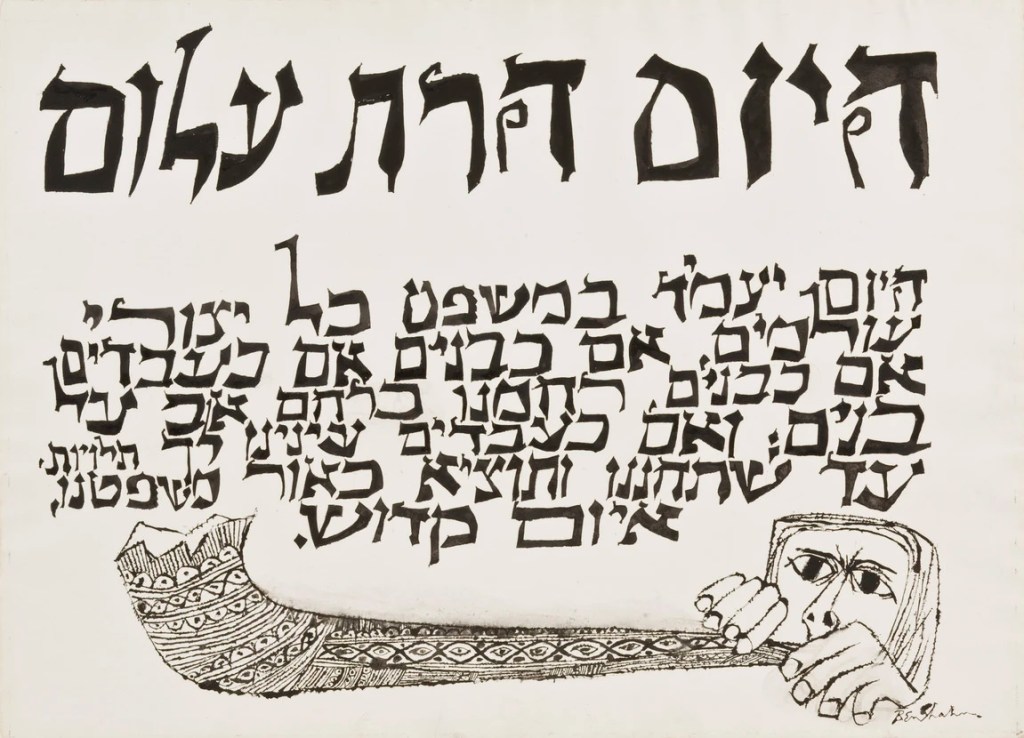
Each week it is the Jewish tradition to read a portion of the Torah (Five Books of Moses) along with a selection from the prophets. This week the haftarah (prophetic reading) is the beginning of the book of Isaiah (1:1-27).
Isaiah is perhaps the best-loved of the prophetic books. It is cited more than any other prophetic text in rabbinic literature, and more haftarot are taken from Isaiah than from any other prophetic book containing the work of literary prophets. (Haftarot are the prophetic readings chanted in synagogue on the Sabbath, holidays, and fast days.)….Not only rabbinic Judaism but also Christianity and Western culture have emphasized the book of Isaiah. First-time readers of Isaiah are often surprised to find that a well-known expression, a famous quotation, or even a favorite song comes from or is based on Isaiah. Jewish Study Bible
While Isaiah is a complex book, as are many of the prophetic texts, the message in 1:11-17 is simple and powerful, for believers and nonbelievers, especially for anyone who claims to be listening to God, either directly or through a prophet. God and humanity don’t want empty gestures. Not if those praying hands are dirty, even bloody. “Cease to do evil. Learn to do good, seek justice.”
11 “Why need I all your sacrifices?” says the LORD. “I am sated with the burnt offerings of rams and the suet of fatted beasts, and the blood of bulls and sheep and he-goats I do not desire. 12 When you come to see My face, who asked this of you, to trample My courts? 13 You shall no longer bring false grain offering, it is incense of abomination to me. New moon and sabbath call an assembly— I cannot bear crime and convocation. 14 Your new moons and your appointed times I utterly despise. They have become a burden to me, I cannot bear them. 15 And when you spread your palms, I avert My eyes from you. Though you abundantly pray, I do not listen. Your hands are full of blood. 16 Wash, become pure, Remove your evil acts from My eyes. Cease doing evil. 17 Learn to do good, seek justice.
Why need I all your sacrifices? This is not a pitch for the abolition of sacrifice but rather an argument against a mechanistic notion of sacrifice, against the idea that sacrifice can put man in good standing with God regardless of human behavior. The point becomes entirely clear at the end of verse 15, when the prophet says that it is hands stained with blood stretched out in payer that are utterly abhorrent to God. Thus, the grain offering is “false” (or “futile”) because it is brought by people who have oppressed the poor and failed to defend widows and orphans.
Your hands are full of blood. This shocking detail is held back until the end of these two lines of poetry: the palms lifted up in prayer are covered with blood, and that is why God averts His eyes, because He can’t bear looking at them. It should be noted that Isaiah’s outrage, as it is spelled out in verse 17, is not chiefly with cultic disloyalty, as it would be for the writers in the school of Deuteronomy, but with social injustice—indifference to the plight of the poor and the helpless, exploitation of the vulnerable, acts represented here as the moral equivalent of murder.