A canopy of clouds covered dawn. I started to walk away as a hint of light tinted the dark blanket. I was frozen eyes open. By minute the red rolled over the gray. Afire. A miracle.
If you don’t appreciate everything You can’t appreciate anything
“The question that imposed itself was: Could the activity of thinking as such, the habit of examining whatever happens to come to pass or to attract attention, regardless of results and specific content, could this activity be among the conditions that make men abstain from evil-doing or even actually “condition” them against it?”
When I confront the stubborn presence of regressive right-wing political and social initiatives in America (Trumpism, etc.), I might want to say that there are too many not smart/stupid people. I don’t say that, first because it is harsh, second because some number of those people seem smart/not stupid.
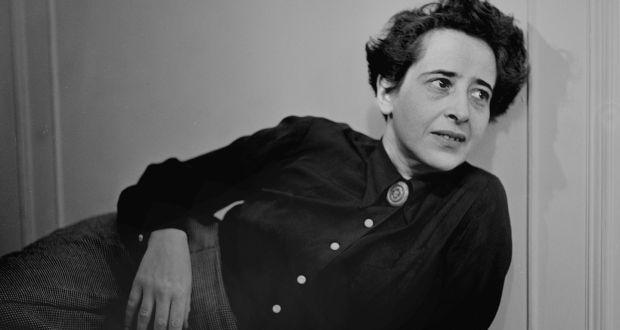
This brings me again to the brilliant political philosopher Hannah Arendt, who once covered and wrote about the trial of Adolf Eichmann for his role in the Holocaust. She proposed, in a phrase that has continued to cause trouble for her, decades after her death, “the banality of evil”. Put simply, thoughtlessness is a source of some extreme evildoing.
For me, that is an enlightening explanation of so much that we see, not only in history, but now. The antidote to the poison? Thinking, really thinking.
Thinking is the subject of Arendt’s final and unfinished work, The Life of the Mind. Following is from the Introduction.
Factually, my preoccupation with mental activities has two rather different origins. The immediate impulse came from my attending the Eichmann trial in Jerusalem. In my report of it I spoke of “the banality of evil.” Behind that phrase, I held no thesis or doctrine, although I was dimly aware of the fact that it went counter to our tradition of thought—literary, theological, or philosophic—about the phenomenon of evil. Evil, we have learned, is something demonic; its incarnation is Satan, a “lightning fall from heaven” (Luke 10:18), or Lucifer, the fallen angel (“The devil is an angel too”—Unamuno) whose sin is pride (“proud as Lucifer”), namely, that superbia of which only the best are capable: they don’t want to serve God but to be like Him. Evil men, we are told, act out of envy; this may be resentment at not having turned out well through no fault of their own (Richard III) or the envy of Cain, who slew Abel because “the Lord had regard for Abel and his offering, but for Cain and his offering he had no regard.” Or they may be prompted by weakness (Macbeth). Or, on the contrary, by the powerful hatred wickedness feels for sheer goodness (Iago’s “I hate the Moor: my cause is 2 hearted”; Claggart’s hatred for Billy Budd’s “barbarian” innocence, a hatred considered by Melville a “depravity according to nature”), or by covetousness, “the root of all evil” (Radix omnium malorum cupiditas). However, what I was confronted with was utterly different and still undeniably factual. I was struck by a manifest shallowness in the doer that made it impossible to trace the uncontestable evil of his deeds to any deeper level of roots or motives. The deeds were monstrous, but the doer—at least the very effective one now on trial —was quite ordinary, commonplace, and neither demonic nor monstrous. There was no sign in him of firm ideological convictions or of specific evil motives, and the only notable characteristic one could detect in his past behavior as well as in his behavior during the trial and throughout the pre-trial police examination was something entirely negative: it was not stupidity but thoughtlessness. In the setting of Israeli court and prison procedures he functioned as well as he had functioned under the Nazi regime but, when confronted with situations for which such routine procedures did not exist, he was helpless, and his cliché-ridden language produced on the stand, as it had evidently done in his official life, a kind of macabre comedy. Clichés, stock phrases, adherence to conventional, standardized codes of expression and conduct have the socially recognized function of protecting us against reality, that is, against the claim on our thinking attention that all events and facts make by virtue of their existence. If we were responsive to this claim all the time, we would soon be exhausted; Eichmann differed from the rest of us only in that he clearly knew of no such claim at all.
It was this absence of thinking—which is so ordinary an experience in our everyday life, where we have hardly the time, let alone the inclination, to stop and think—that awakened my interest. Is evil-doing (the sins of omission, as well as the sins of commission) possible in default of not just “base motives” (as the law calls them) but of any motives whatever, of any particular prompting of interest or volition? Is wickedness, however we may define it, this being “determined to prove a villain,” not a necessary condition for evildoing? Might the problem of good and evil, our faculty for telling right from wrong, be connected with our faculty of thought? To be sure, not in the sense that thinking would ever be able to produce the good deed as its result, as though “virtue could be taught” and learned—only habits and customs can be taught, and we know only too well the alarming speed with which they are unlearned and forgotten when new circumstances demand a change in manners and patterns of behavior. (The fact that we usually treat matters of good and evil in courses in “morals” or “ethics” may indicate how little we know about them, for morals comes from mores and ethics from ethos, the Latin and the Greek words for customs and habit, the Latin word being associated with rules of behavior, whereas the Greek is derived from habitat, like our “habits”) The absence of thought I was confronted with sprang neither from forgetfulness of former, presumably good manners and habits nor from stupidity in the sense of inability to comprehend—not even in the sense of “moral insanity,” for it was just as noticeable in instances that had nothing to do with so-called ethical decisions or matters of conscience.
The question that imposed itself was: Could the activity of thinking as such, the habit of examining whatever happens to come to pass or to attract attention, regardless of results and specific content, could this activity be among the conditions that make men abstain from evil-doing or even actually “condition” them against it? (The very word “con-science,” at any rate, points in this direction insofar as it means “to know with and by myself,” a kind of knowledge that is actualized in every thinking process.) And is not this hypothesis enforced by everything we know about conscience, namely, that a “good conscience” is enjoyed as a rule only by really bad people, criminals and such, while only “good people” are capable of having a bad conscience? To put it differently and use Kantian language: after having been struck by a fact that, willy-nilly, “put me in possession of a concept” (the banality of evil), I could not help raising the quaestio juris and asking myself “by what right I possessed and used it.”
The movie Easy Rider (1969) is full of wisdom, along with being a wild ride. Film experts consider it a turning point in independent filmmaking, but now it is often ignored or shrugged off as just a throwback artifact of frivolous 1960s counterculture.
My view of my time in America is that we are constantly missing opportunities, whether it is failing to embrace beneficial possibilities or failing to address damaging actualities. Maybe the history of civilizations is just one missed opportunity after another.
A couple of messages from Easy Rider:
“We blew it.”
Wyatt (Peter Fonda) and Billy (Dennis Hopper) just pulled off a lucrative drug deal.
Billy: We’ve done it. We’ve done it. We’re rich, Wyatt. Yeah, man. Yeah, we did it, man! We did it. We’re rich, man.
Wyatt: You know, Billy, we blew it.
Billy: What? Well, that’s what it’s all about. Like, you know. You go for the big money and then you’re free. You dig?
Wyatt: We blew it.
Hopper and Fonda have been asked what they meant by that. Whatever they said, what I understood is that it wasn’t just about how the pursuit of money is not what it’s all about. I take it to be about the opportunities that they—and the country—missed.
“You represent freedom.”
George (Jack Nicholson) is a Southern lawyer who ends up in jail whenever he gets drunk. This time he ends up in jail with Wyatt and Billy.
George: They’re not scared of you. They’re scared of what you represent to them.
Billy: All we represent to them is somebody who needs a haircut.
George: Oh, no. What you represent to them is freedom.
Billy: Freedom’s what it’s all about.
George: Oh yeah, that’s right. That’s what it’s all about. But talking about it and being it, that’s two different things. lt’s real hard to be free when you are bought and sold in the marketplace. Don’t tell anybody that they’re not free, because they’ll get busy killing and maiming to prove to you that they are. They’re going to talk to you and talk to you about individual freedom. But they see a free individual, it’s going to scare them. Well, it don’t make them running scared. lt makes them dangerous.
While I often think that news media pay too much attention to fluffy and inconsequential pop culture stories, I had to stop for this one.
I knew immediately why The Guardian had posted this. It is about the origin story of Pop-Tarts. Pop-Tarts.
I haven’t eaten Pop-Tarts for years, though I’m occasionally tempted. But there was a long-ago time when breakfast most days was a Pop-Tart and Carnation Instant Breakfast (rebranded in 2022 as Breakfast Essentials). I didn’t read labels then and didn’t care. It was too delicious to care. This was before I drank coffee, so the morning sugar rush no doubt fueled my success at school.
See a timeline of the history of Pop-Tarts here. (Fun fact: Pop-Tarts was first available only in Cleveland. Cleveland Rocks!)
There has been an abundant supply of information, analysis, belief and emotion surrounding the current Israeli war in Gaza. I have increasingly kept the analysis, belief and emotion to myself, or at least in a very small circle. In Yiddish terms, who needs the tzuris (trouble, aggravation)?
As for information, I have continued to seek trustworthy work from scholars and historians who have studied the issues. Some of this work is not always in the mainstream of discussion. Here are a few books I have found:
“Just and Unjust Wars has forever changed how we think about the ethics of conflict. In this modern classic, political philosopher Michael Walzer examines the moral issues that arise before, during, and after the wars we fight. Reaching from the Athenian attack on Melos, to the Mai Lai massacre, to the war in Afghanistan and beyond, Walzer mines historical and contemporary accounts and the testimony of participants, decision makers, and victims to explain when war is justified and what ethical limitations apply to those who wage it.”
“A revelatory look at why we dehumanize each other, with stunning examples from world history as well as today’s headlines.
“Brute.” “Cockroach.” “Lice.” “Vermin.” “Dog.” “Beast.” These and other monikers are constantly in use to refer to other humans—for political, religious, ethnic, or sexist reasons. Human beings have a tendency to regard members of their own kind as less than human. This tendency has made atrocities like the Holocaust, the genocide in Rwanda, and the slave trade possible, and yet we still find it in phenomena such as xenophobia, homophobia, military propaganda, and racism. Less Than Human draws on a rich mix of history, psychology, biology, anthropology and philosophy to document the pervasiveness of dehumanization, describe its forms, and explain why we so often resort to it.
David Livingstone Smith posits that this behavior is rooted in human nature, but gives us hope in also stating that biological traits are malleable, showing us that change is possible. Less Than Human is a chilling indictment of our nature, and is as timely as it is relevant.”
“A new history of the American Jewish relationship with Israel focused on its most urgent and sensitive issue: the question of Palestinian rights.
American Jews began debating Palestinian rights issues even before Israel’s founding in 1948. Geoffrey Levin recovers the voices of American Jews who, in the early decades of Israel’s existence, called for an honest reckoning with the moral and political plight of Palestinians. These now‑forgotten voices, which include an aid‑worker‑turned‑academic with Palestinian Sephardic roots, a former Yiddish journalist, anti‑Zionist Reform rabbis, and young left‑wing Zionist activists, felt drawn to support Palestinian rights by their understanding of Jewish history, identity, and ethics. They sometimes worked with mainstream American Jewish leaders who feared that ignoring Palestinian rights could foster antisemitism, leading them to press Israeli officials for reform. But Israeli diplomats viewed any American Jewish interest in Palestinian affairs with deep suspicion, provoking a series of quiet confrontations that ultimately kept Palestinian rights off the American Jewish agenda up to the present era.”
The panic about the negative impact of social media goes on. For example, there is a renewed effort to ban it for young people, including one suggestion to bar anyone under 18.
There are many ways these efforts are misguided. Most of all, because they are unworkable and ineffective.
If there is any way to curtail a possibly dangerous social behavior, banning it is the worst. There is a better possibility, though that is also hit and miss. Offer an alternative that fulfills the same need, that satisfies equally, or at least comes close.
Easier said than done. In the case of social media, the first step is determining what needs are being filled. Then find an equivalent alternative.
Going wayback, see the movie West Side Story. The earnest social workers arrange an old-fashioned dance for the disaffected teenagers. It is orderly for a few minutes, but quickly evolves into conflict. Why? Because the need of these young people to dominate the territory and to keep the tribes separate is too great to be moderated by that solution. Even if the outcome is death and misery, the dance at the gym was never going to be an effective alternative.
Analysts, legislators and social engineers should quit the pointless calls for bans and come up with attractive alternatives, which may not even be available. But worth their being more thoughtful and creative.
They shall beat their swords into plowshares, and their spears into pruning hooks; nation shall not lift up sword against nation, neither shall they learn war any more. — Isaiah 2:3–4
Sophie Scholl, “the most important woman of the 20th century”
My blog posts from 2017 reflect real concern about the possibility of tyranny in America. I and others who shared this concern were not prophets. All it took was a knowledge of history and some insight into politics and human nature.
A signature post in this vein was about Sophie Scholl. She was a founder of the White Rose movement, a tiny group of German students who distributed leaflets opposing the Nazi regime. In 1943 she and two others were arrested, tried and immediately executed for treason. At the trial she simply said, “Somebody, after all, had to make a start.”
In modern times, the readers of Brigitte, the largest women’s magazine in Germany, voted Sophie Scholl the most important woman of the 20th century.
It is reported that many Americans seem gloomy about a supposedly great economy.
The second Noble Truth of Buddhism is that suffering arises due to craving.
It’s that simple.
As for “supposedly great”, while aggregate top-line numbers for all Americans do look positive, there are details showing that everyday things like housing, food and gas are still shaky. Lots of people don’t feel the greatness.
Above and under all that, people compare what they have to what they want and expect to what they don’t have. Weighed and found wanting. Which is natural. But it is, according to Buddhism, and to other traditions (e.g., lilies of the field), a source of suffering.
So whoever you’re listening to—social media influencers and visionaries, Republicans who tell you that you’ve never had it worse or Democrats who tell you that you’ve never had it so good—stop listening for a moment. Then go back to having more or wanting more. We’re only human.





 Bob Schwartz