Kylie Bax, Donald Trump, Bill Clinton, Melania Knauss
It is an overstatement to say that any one photo captures an era.
And yet, this photo of two models and two American presidents (or to-be) is bursting with meaning.
The least recognizable person is model Kylie Bax, a long-time friend of Donald Trump.
The other three are major American figures. Donald Trump and Bill Clinton need no introduction, and Melania Knauss (later Melania Trump) is also well-known.
It is difficult, near impossible, not to interpret the photo based on everything we now know or assume. Worth way more than a thousand words.
More than a decade ago, I switched my book acquisition to almost entirely ebooks.
At that point, my library of paper books contained thousands of volumes. Moving and space limitations pushed for some slimming down.
That was challenging for a few reasons.
Some paper books, particularly those that include visual and graphic content, are simply better in paper.
Some paper books are not available in digital versions, and may never be.
My life and careers revolved around paper books, as a bookseller and as a publishing professional.
Nevertheless some of the paper books had to go.
On top of that, digital books have some advantages.
You can store and read thousands of books on a tablet. I do.
You can copy passages with a simple highlight and copy. I do.
My current situation is that I still have paper books that are, for different reasons, irreplaceable and special. Far fewer than I once did, but still filling a closet and bookshelves. And I have a library of digital books, approaching two thousand.
One more advantage of digital books I recently tried. I am able to generate a complete list of authors, titles and categories. I thought that maybe I could feature a list of those authors who have influenced, inspired and instructed me. I have generated that list and, when possible, I will offer some of that up.
Note: If you keep or want an ebook library, recommended is the outstanding Calibre software, free, open-source, cross-platform, used by millions like me.
There are many ways to point out the importance, primacy, essentiality of personal transformation.
That begs three questions: important for what, transformation to what, and how? Let me sidestep those monumental questions, saying only and simply: important to make you and others happy, in one of the many ways available.
A thing that prompts this is my observation of how many initiatives—religion, economics, politics being just a few—are devoted to engagement and practices aimed at “better” outcomes for yourself and others (going to heaven, joining a community, making money, donating money, getting a president elected), but leaving you the same as you were before. Not that all those outcomes aren’t worthy in themselves. But what about you? How would a different mind make a difference?
Above is my favorite expression of the imperative for personal transformation, equal to or better than the words of the wisest masters. It comes from the title of a 1970 Funkadelic album. The album cover is also a favorite.
Free your mind…and your ass will follow. True that.
In 1984, Bob Geldof organized an all-star recording to raise consciousness about famine in Ethiopia and raise money to help alleviate it. Now an ultimate mix has been released, combining the original recording with later anniversary versions created in 2004 and 2014. The Guardian reports:
For 40 years, Band Aid’s Do They Know It’s Christmas? has been praised by some as a triumph of charitable fundraising and festive songwriting – and condemned by others as the most high-profile example of white saviourhood in pop.
Now, to mark its latest anniversary, the song is coming back around for a fourth time, in the form of an all-star splicing of the three previous official versions.
Announcing the new version, Bob Geldof, who masterminded the 1984 original, says Do They Know It’s Christmas? “tells the story not just of unbelievably great generational British talent, but still stands as a rebuke to that period in which it was first heard. The 80s proclaimed that ‘greed is good’. This song says it isn’t. It says it’s stupid.” Proceeds will benefit the Band Aid Charitable Trust, which supports health and anti-poverty initiatives across Africa.
Criticism from artists and activists have increased over the years. They say: It is an example of paternalism. It is an example of otherness. It leaves the wrong impression about Africa. Artists also complain that it is not a very good piece of music.
My thoughts:
If it wasn’t for charities, or in this case a song, pleading with people to donate, there would not be broader recognition of how widespread food insecurity and starvation is, not just in Africa and other places of crisis, but right here in America.
Ideology has its place, though it often goes places it shouldn’t. If people are hungry or starving, feed them. Since it is Christmas time, I am bound to mention that the main figure of that holiday told us all, whatever our tradition, to do just that.
If a catchy recording featuring mega-stars brings attention to this, I would rather listen to it a thousand times rather than being reminded incessantly about how buying stuff and giving stuff is the reason for the season. It isn’t.
Final thought: To those who are younger, it may seem that all this fuss about Band Aid is “nostalgia” for a long-gone time, featuring some “really old” artists. Unfortunately, starvation never goes out of style, but fortunately neither does helping.
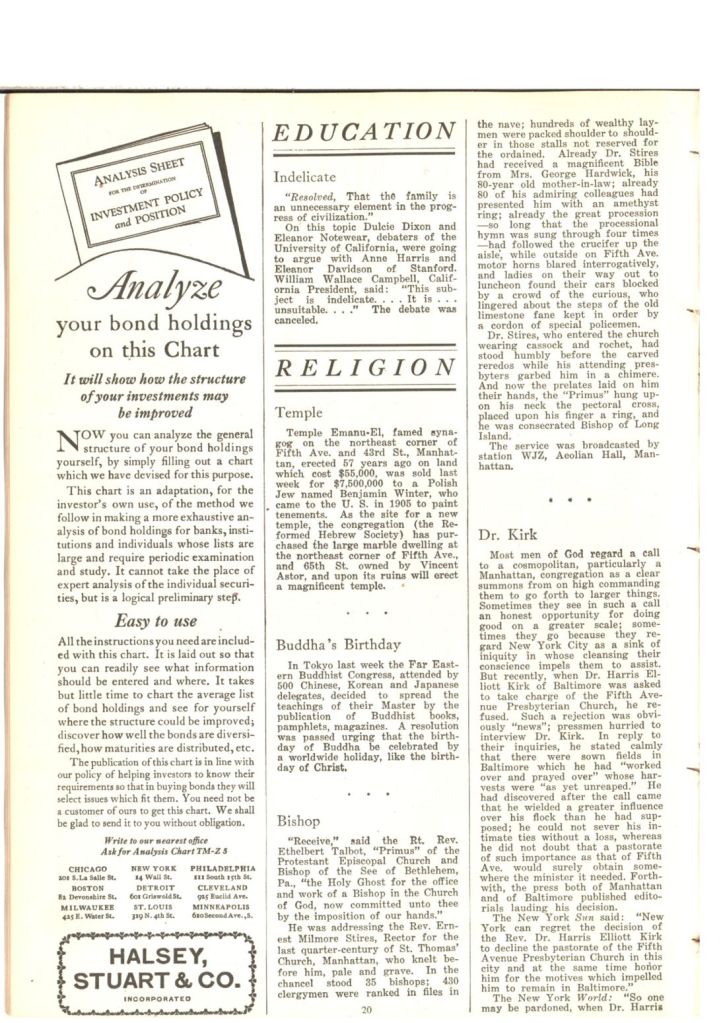
That isn’t Buddha on the cover of Time Magazine, December 7, 1925 issue (99 years ago). It is Jose R. Capablanca, then world chess champion, who had recently lost some matches in a Moscow tournament.
Buddha did appear in the magazine, with this in the Religion section:
Buddha’s Birthday
In Tokyo last week the Far Eastern Buddhist Congress, attended by 500 Chinese, Korean and Japanese delegates, decided to spread the teachings of their Master by the publication of Buddhist books, pamphlets, magazines. A resolution was passed urging that the birthday of Buddha be celebrated by a worldwide holiday, like the birthday of Christ.
As a cultural archaeologist, with an inordinate love of old magazines, I would like to post every page of the issue. Instead, I have selected just one full-page ad. This is for the Five-Foot Shelf of Books, aka The Harvard Library, compiled by legendary academic Charles W. Eliot, who was president of Harvard for forty years. The Shelf/Library contained “418 masterpieces” in fifty volumes.
In promoting this as the perfect Christmas gift, the headline says “It took twenty centuries to make this Christmas gift for you” and closes with “BOOKS—The finest gift of all”.
The good news: The complete Shelf/Library, later known as the Harvard Classics, is widely available for free online.The better news: Books are still the finest gift of all.
The restless, agitated mind, Hard to protect, hard to control, The sage makes straight, As a fletcher the shaft of an arrow.
Like a fish out of water, Thrown on dry ground, This mind thrashes about, Trying to escape Māra’s* command.
The mind, hard to control, Flighty—alighting where it wishes— One does well to tame. The disciplined mind brings happiness.
The mind, hard to see, Subtle—alighting where it wishes— The sage protects. The watched mind brings happiness.
Far-ranging, solitary, Incorporeal and hidden Is the mind. Those who restrain it Will be freed from Māra’s bonds.
For those who are unsteady of mind, Who do not know true Dharma, And whose serenity wavers, Wisdom does not mature.
For one who is awake, Whose mind isn’t overflowing, Whose heart isn’t afflicted And who has abandoned both merit and demerit, Fear does not exist.
Knowing this body to be like a clay pot, Establishing this mind like a fortress, One should battle Māra with the sword of insight, Protecting what has been won, Clinging to nothing.
All too soon this body Will lie on the ground, Cast aside, deprived of consciousness, Like a useless scrap of wood.
Whatever an enemy may do to an enemy, Or haters, one to another, Far worse is the harm From one’s own wrongly directed mind.
Neither mother nor father, Nor any other relative can do One as much good As one’s own well-directed mind.
Translated by Gil Fronsdal
*Māra: The personification of evil in Buddhism and often referred to as the Buddhist “devil” or “demon”. According to some accounts of the Buddha’s enlightenment experience, when the he sat under the bodhi tree, vowing not to rise until he attained liberation from the cycle of rebirth, he was approached by Māra, who sought to dissuade him from his quest. When he refused, Māra sent his minions to destroy him, but their weapons were transformed into flower blossoms.
Following is an outline of Buddhism, found in The Basic Teachings of the Buddha (2007) by Glenn Wallis. Wallis is a far-reaching, creative and iconoclastic scholar of Buddhism, as reflected in his later work, such as A Critique of Western Buddhism (2019), which is available to read and download free.
HABITAT 1. We are like ghosts sleepwalking in a desolate and dangerous domain. DE-ORIENTATION 2. We remain transfixed there, enchanted by pleasure and flamboyant speculation. 3. The most enthralling belief of all is that of supernatural agency. 4. There is a safeguard against this bewitchment: knowing for yourself. RE-ORIENTATION 5. The means of “knowing for yourself” is immediately available: it is the sensorium. 6. But the modes of perception are miragelike, and the perceived like a magical display. 7. And there is no self, no integral perceiver, behind those modes of perception. 8. To hold on to the miragelike perceiver, the phantom self, is a stultifying burden. MAP 9. When we reflect on these propositions, four preeminent realities become obvious, 10. as do the emergence and cessation of our incessant “worlding.” DESTINATION 11. Our genuine refuge from this whirlwind of worlding is to be unbound; 12. to eradicate infatuation, hostility, and delusion. Eradicated, quenched, unbound. 13. Binding is concomitant with the fabricated. 14. Unbinding is concomitant with the unfabricated. GOING 15. Cultivation of present-moment awareness is the means to conspicuous unbinding. 16. Application of this awareness in daily life is concomitant with living as a buddha: awakened.
December includes three notable religious holidays.
Christmas, commemorating the birth of Jesus. It is a major holiday, one of the two most important Christian holidays, and one that has become a secular celebration, especially in America.
Hanukkah, commemorating the retaking and rededication of the Temple in Jerusalem. Religiously, it is a minor holiday, not even included in the Hebrew Bible. Traditionally, it has become a cultural and social counterbalance to Christmas, especially in America.
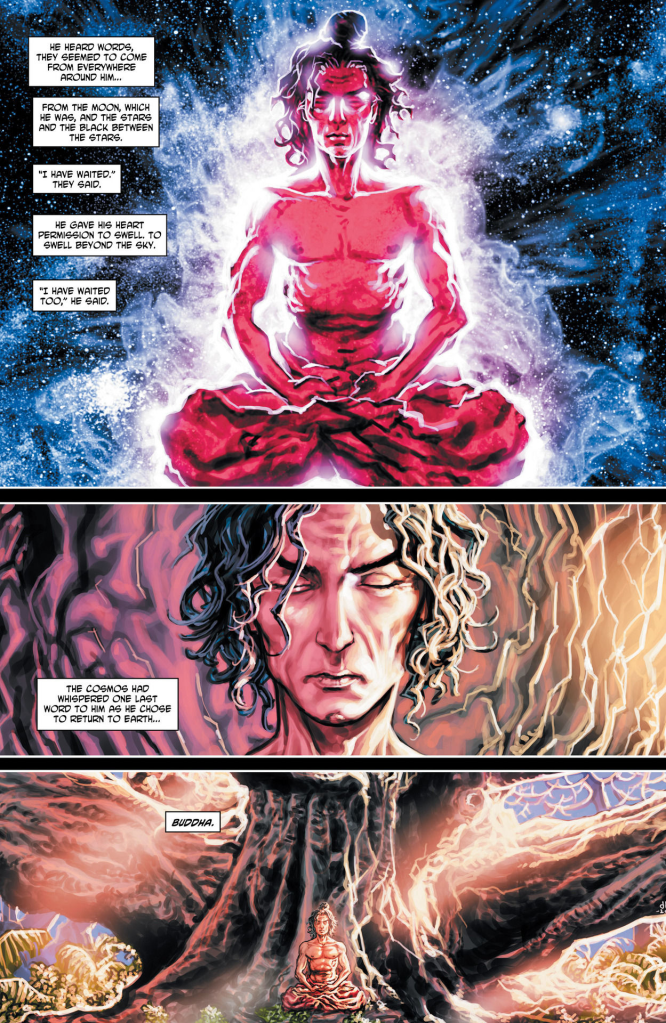
Bodhi Day isn’t about the birth of a significant person or about the military victory over a religious oppressor. It is about a man who sat under a tree and ultimately woke up, or, as it is usually put, attained enlightenment.
I never rely on AI to do my writing, but I have given my friend Claude a chance to concisely explain Bodhi Day observances:
Bodhi Day (also known as Rohatsu in Japanese tradition) commemorates the day when Siddhartha Gautama attained enlightenment and became the Buddha. It’s typically observed on December 8th in the Mahayana tradition, though some traditions follow different calendars.
Here’s how Bodhi Day is observed in different parts of the world:
Japan (Rohatsu):
The day marks the end of a weeklong sesshin (intensive meditation retreat) in Zen monasteries
Practitioners often meditate through the night, mirroring the Buddha’s enlightenment experience
Traditional decorations include strings of colored lights, representing the stars the Buddha saw upon enlightenment
Southeast Asian Countries:
In countries like Thailand and Sri Lanka, the enlightenment is actually celebrated as part of Vesak Day in May
Temples are decorated with flowers and lights
Devotees participate in meditation sessions and listen to dharma talks
Food offerings are made to monks and sharing meals with the community is common
United States and Western Countries:
Buddhist temples and centers often hold special meditation sessions
Some practitioners decorate small ficus trees (similar to the Bodhi tree) with lights
Educational programs about the Buddha’s enlightenment are organized
Many observe the day with a traditional breakfast of milk and rice, recalling the offering made to the Buddha by Sujata
China and Taiwan:
Known as Laba Festival (腊八节)
Traditionally celebrated with Laba congee, a special porridge made with various grains and dried fruits
Temples hold ceremonies and offer free congee to visitors
Many people visit temples to make offerings and pray for blessings
Modern Observances:
Some Buddhists maintain a more contemplative practice, spending the day in meditation
Many practitioners dedicate themselves to acts of kindness and compassion
Some observe the day by reading Buddhist texts or sutras
Virtual meditation sessions and teachings have become common, especially in recent years
The focus across all these observances remains on the core meaning of the Buddha’s enlightenment – the realization that freedom from suffering is possible through understanding and practicing the dharma.
Claude
Each year I wonder what to say about Bodhi Day, the Buddha, and Buddhism. With a day to go, I still don’t know.
I don’t know whether it reads right to left, left to right, or up to down. I don’t know the language, I don’t know that it is a language. I know it is a message, one time, never to be repeated.
Fun fact: Search the Poetry Foundation, a repository of poetry, and you find 5,042 poems about clouds.
I worked to find a fitting title for this post. I know what I want to include or not include, but I don’t know how to digest that into a description. So I settled on “Some simple books to know” without explaining what I mean by “simple”. Maybe you’ll figure it out.
Anyway, this is a list, without much else. All are found in multiple English translations and commentaries, which I need, and maybe you need, since I am not capable in Pali, Chinese, biblical Hebrew, or Coptic.
At some later time, I hope to detail each of these books individually, and why it is essential to read and study different translations and commentaries. For now, just peruse the list, investigate if you like.
Dhammapada
There are millions of words attributed to the Buddha, written about the Buddha and Buddhism. This is the most concise collection of the Buddha’s sayings. It is the first book I ever read about Buddhism, and there is no time, all these books later, I do not turn to it.
Tao Te Ching
The foundational text of Taoism. Lao Tzu was likely not a real person. This wisdom is simple, compelling, everlasting, and very real.
Chuang Tzu (the title of the text and the name of the person)
Chuang Tzu was more likely than Lao Tzu to have been a real person, though words attributed to him are likely not all his. Doesn’t matter. Few figures in wisdom history are as earnestly wild and fun as this guy. His reach among contemporary creators and thinkers is extensive. If any work on this list can be described as mind-blowing, he/this is it. (He is the originator of the well-known story in which he wakes up not knowing whether he is a man who dreamt he was a butterfly or a butterfly who dreamt he was a man.)
Book of Job
One of the truly transgressive books of the Hebrew Bible. If read as “God knows best and who are you to question. Trust Me.”, which is what the added coda and much teaching indicate, it is piously conforming. If read as “this is a mystery, none of us knows what is going on, and things do get bad and good fast (in other words, WTF!)” you are closer to a truth.
Ecclesiastes/Kohelet
The first mystery of Kohelet is how it ever ended up in the Hebrew Bible, given that it reflects so much human agency and freedom in the face of an everchanging impermanent life and world, a world where everything is wind and vapor (a better translation of hevel, which in the KJV is “vanity”). Kohelet is not a license to do whatever you want because we are all going to die anyway. It is a navigational guide to days, seasons and years that are seemingly orderly but actually chaotic, even absurd. It’s a wonderful life.
Gospel of Thomas
The Gospel of Thomas is sometimes referred to as the Fifth Gospel. As with the words of Jesus in the other four, scholars have worked tirelessly to determine as best as possible which are actually his and which are added in the spirit of his teaching. Thomas is entirely sayings, no narrative, some of which ended up in the other gospels, some of which are found only in this text. Among the sayings, the one that for me stands above all is this: “Be [or become] passersby.” (Saying 42) If you know that, you know (almost) everything.





 Bob Schwartz