Commerce has been part of human life from the beginning. Acquiring, trading, buying, selling.
Commercial means more than that. It includes messages about acquiring, trading, buying, selling.
The difference over time has been the balance of these commercial elements with other parts of our lives and culture. One vision of a dystopian future has been one in which commercial messages are ubiquitous and constant. The more we want to acquire, trade, buy, sell, the more the messages are about doing that, and the more those messages encourage and tempt us to do that.
We may not have reached that predicted dystopia, but it is fair to say that we are living in a commercial culture, with both the commerce and the messages.
Which is why we should not be surprised that a leader emerged whose entire life has been devoted not just to commerce, but to commercial messaging. In fact, since stretching the truth, or outright lying and deception, is considered a part of commercial messaging, we should also not be surprised that the leadership involves lots of truth stretching, lying and deception. If a commercial spokesman ends up as leader, what else would we expect?
It might be good for us to back off a little—or a lot—from the commercial culture we find ourselves in. Unfortunately, it won’t result in a quick change in current leadership. But it can put us on the path to better balance between the commercial and the non-commercial. And in time, maybe find ourselves with lives and leadership involving less acquiring, trading, buying, selling, less messaging about those, and more messaging about other things of value.
It is not my way to recommend religious and spiritual practices for anyone. I report my own practices, experiences and observations, leaving it to others to choose or ignore.
I am not making an exception for the Tibetan Buddhist practice of mind training, known as lojong. It took me a while—a long while, decades—to discover this. Given the wide range of Buddhist practices, the Tibetan varieties have not been a major part of my life. It is not that I haven’t studied and appreciated traditions outside of Zen Buddhism, my lifelong practice, but there are simply too many worthy paths to follow them all without getting nowhere.
But I have now discovered lojong. I can report that it is unlike any practice I have experienced in Buddhism, and more, quite unlike any practice in other religious and spiritual traditions.
Lojong is roughly a thousand years old, with refinements and commentaries over the centuries, right up to the present. Lojong consists of 59 instructional slogans, divided into seven points, aimed at training the mind. Training to do what and be what? Simply, oversimply, to live and learn wisdom and compassion. Lojong manages to encompass all of Buddhism in a series of actionable tasks.
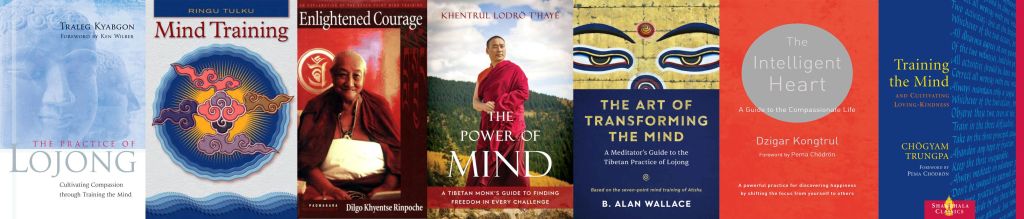
If one does not have a live teacher, as I do not, there are a number of excellent books about lojong, along with videos by some of these excellent teachers. Some, like Pema Chodron and her teacher Chogyam Trungpa, are well-known. Others are known in the Tibetan Buddhist communities, but unfamiliar to many others. Evey one is worthy of knowing.
It is my way to try to be comprehensively grounded in areas new to me, as this is, and then to narrow my focus. Below is a list of those books and teachers I have found helpful in early days. I wish I could say “this is the one for me” or “this is the one for you”. I can’t. Each one offers a view that may well explain a point or that may be an expression that resonates. If I say that the order listed below is best-first, there may be a little truth in that—for me—but even that is a stretch.
Tens of millions of Americans have seen the vision of Trump America and don’t like it. It is a vision reflected in four years of Trump as president, four years as former president, four years coming as president again. It is also based on Trump serving with a majority in both houses of Congress and a majority sympathetic to him on the Supreme Court.
The first principle: The vision for those who don’t like the Trump vision is not simply a vision without Trump. The past election veered between no-Trump and assorted other pitches. It didn’t work.
The second principle: The Democratic Party—the only alternative in an immutable two-party system—is a valuable asset but does not seem capable of providing an actionable, effective and attractive vision. America would be far worse off without Democrats as a counterbalance. But being not-Republicans and not-Trump is not enough.
Effective and attractive leaders offering actionable strategies and vision will emerge. Eventually, sooner or later. But it cannot be stressed enough: not-this is not enough, and neither is retreading visions that will not work in these times, in this nation, for and with these people. Some principles are so basic—rule of law, for example—that they should be a part of any vision. But it is not enough.
As noted, Democrats are an essential element in a two-party system now dominated by Republicans. But the thought that if Democrats can just win a slim majority here or there, or at least reduce a Republican majority here or there, is not enough. It is not a vision.
If you discover some visionary leaders, or better yet if you are a visionary leader, come forward. Proverbs 29:18 says “Where there is no vision, the people perish.” Or the wrong vision prevails.
Whatever your area of study and learning—not just religion, but science, business, arts, etc.—there are those who you want to learn from and those who want to teach you. Sometimes individually, sometimes institutionally.
You may keep in mind two Buddhist principles that apply universally: skillful means and testing teachings.
Skillful or expedient means—known in Sanskrit as upaya—suggests that at any point in a life, under any particular circumstances, one method of learning may be appropriate for an individual, but at another point under different circumstances, another method may be more appropriate.
Buddha was also very specific about how an individual can choose methods and teachings. In a sutra attributed to Buddha, he recommended testing teachings, and not simply accepting teachings from any teacher—not even himself:
Don’t accept what you hear by report, and don’t accept mere tradition. Don’t jump to conclusions based on assumptions. Don’t accept a statement just because it is found in scriptures, or on the basis of general acceptance, or because it is what your teacher says. After examination, only believe and act upon what you yourself have tested and found reasonable. —Kalama Sutta
The year 2024 presented challenges. The new year will too.
Some of the challenges were and will be individual and personal, some shared and public.
In the past year, I thought more and more about compassion. For a while I bemoaned what I perceived to be a lack of compassion on the part of other people, lots of other people. But late in the year, I began to see that cultivating compassion could only begin with me. Fortunately, I discovered a thousand-year-old Buddhist practice known as lojong, aimed at doing just that.
One of the many points of the practice concerns how to deal with adversity, including enemies. Many are familiar with the suggestion of Jesus to “love your enemies.” This goes one stop further, with the suggestion “Be grateful to everyone.” Everyone, including those who do harm.
“Be grateful to everyone.”
This is a very profound statement. One of our primary tasks in this training is to get rid of anger and hatred. If we disperse these emotions, a great deal of suffering will vanish along with them. When we feel grateful, it breaks down anger and we cannot continue to feel hate. That is why this slogan is so effective. It is not difficult to be relaxed and forgiving when conditions are harmonious. However when things go wrong and we feel abused or under stress, we tend to be hostile. Dwelling on our hurt stirs up our aversion and the whole experience becomes totally negative. This can be avoided if we remember the positive potential in the situation.
The adversities that other people bring us are gifts, not betrayals. Disappointments try our patience and compassion. If our lives are completely sheltered and blessed, we have no friction to use as raw material in our practice. We will never conquer our ego if we are spared from every single upset and provocation. Atisha was known to travel with an attendant who was terribly bad-tempered. The man was irritable and very rude to everyone. People could not understand why a kind and wise teacher like Atisha permitted this nasty man to accompany him on his travels and they asked him how he put up with it. Atisha answered that the man was his “patience tester” and very precious to him.
Our efforts to generate compassion are always in connection with other people and our progress depends on these relationships. The people we live and work with and who share our lives are the sentient beings for whom we seek enlightenment. They are also the means of acquiring wisdom and patience on the way to enlightenment. Rather than feeling insulted or victimized by those who have been unkind to us, we bear the discomfort and feel thankful towards it.
Suffering so often comes from not being able to find the good in things and being critical. If we can be positive about whatever comes, we cling less to the world and are less wounded by bad experiences.
Aside from whatever personal situations arise, it is certain that in 2025 many people will be affected, frustrated, angry or outraged by developments in public life. It will be difficult to treat the people responsible for those policies with kindness or gratitude.
In the case of those who suffer because of those policies, we can do what we can to help relieve that suffering.
In the case of those who cause that suffering, being grateful to them is the last thing on our minds. But when we treat it as an opportunity to develop our wisdom and patience, that is something to be thankful for.
At this moment, the mountains, sun and clouds are related. Soon after, the sun rises higher and lightens the whole mountains, the clouds dissipate, and the mountains stand there.
Hanukkah, which begins on the evening of December 25, is known as the Festival of Lights. It might also be called the Festival of Light—more light.
Each night the light of the candles increases (but see note below). Just as each day after the winter solstice the sunlight increases.
If you light the candles to celebrate the storied rededication of the Temple, you might also recognize the miracle of each of us bringing more light into the world—one candle at a time.
So this Hanukkah, you might add this to the blessings:
יותר אור הלילה yoter or halila More light tonight!
Happy Hanukkkah!
Notes:
1
The Talmud (Shabbat 21b:5) reports that there was disagreement among the rabinnic schools about whether to add or subtract candles each night:
“Beit Shammai and Beit Hillel disagree as to the nature of that adjustment. Beit Shammai say: On the first day one kindles eight lights and, from there on, gradually decreases the number of lights until, on the last day of Hanukkah, he kindles one light. And Beit Hillel say: On the first day one kindles one light, and from there on, gradually increases the number of lights until, on the last day, he kindles eight lights.”
Even though the School of Hillel won the argument, you should feel free to follow the School of Shammai. If anyone complains, just tell them you read it in the Talmud.
2
As for the freedom to reimagine Hanukkah, the following is from an essay on Hanukkah in the Apocrypha by Rabbi Aaron D. Panken, of blessed memory:
“The eight-day Jewish holiday of Hanukkah (“Dedication” or “Initiation”) is remarkable in a number of ways. According to the Jewish conception of scripture, it is decidedly postbiblical, the earliest significant holiday with no basis in the Tanakh. It is unambiguously political, commemorating both a staunch uprising against a Syrian-Greek tyrant and a spirited attack on those Jews sympathetic to the Greek way of life. It is unrelentingly religious, valorizing the struggles of priestly leaders who protect a particular interpretation of their faith at all costs under the grimmest of circumstances. It is also unceasingly interpreted, as scholars, communal leaders, and practicing Jews have applied many innovative new frames (including economic, territorial, military, consumerist, and Zionist) to the holiday, allowing it to evolve with the times while retaining its relevance and remaining one of the most widely observed Jewish celebrations.”
Today is the Winter Solstice in the Northern Hemisphere, when daylight starts growing. (Summer Solstice elsewhere, where daylight begins waning.)
Next week, Christmas and Hanukkah coincide, with the first candle of Hanukkah on Christmas night.
Whether your view is astronomical, with earth revolving round the sun, spiritual, with growing light, or religious, with a Messiah born or a temple retaken and rededicated, it is a special time.
Ecclesiastes (known as Kohelet in the Hebrew Bible) has grown into my favorite biblical book. Its view is consistent with all of those perspectives, whether a planet circling, darkness waning, children born, sacred spaces renewed.
We learn from Kohelet what we may not be taught during the holidays, but which the solstice demonstrates: All things pass.
This does not suggest that we restrain joy, our joy or especially the joy we bring to others. We can be the sun of the winter solstice, brighter day by day. We can be the candles, brighter every day, one to eight.
No book of the Bible has been more mysterious than Kohelet, the mystery being, with its somewhat existential view, why the compilers of the Hebrew Bible included it at all. The solstice tells us, as does the book itself, again and again.
All things pass, and in that passing, our role is to live. Seasons come and go, holidays come and go, we come and go.
Here, on Winter Solstice, with Christmas, Hanukkah and many other holidays for many people to come, we live.
In everything that happens below the sun. Go eat your bread and enjoy. Drink your wine Happily. God long ago approved your acts. Let your clothes always be freshly washed. Keep your hair scented with good oil. Enjoy life with the woman you love During all the shining days you are given Below the sun. Your unique purpose is To bellow a good life below the sun. Use all your powers while you are here. Ecclesiastes 9:4-10
Kylie Bax, Donald Trump, Bill Clinton, Melania Knauss
It is an overstatement to say that any one photo captures an era.
And yet, this photo of two models and two American presidents (or to-be) is bursting with meaning.
The least recognizable person is model Kylie Bax, a long-time friend of Donald Trump.
The other three are major American figures. Donald Trump and Bill Clinton need no introduction, and Melania Knauss (later Melania Trump) is also well-known.
It is difficult, near impossible, not to interpret the photo based on everything we now know or assume. Worth way more than a thousand words.


 Bob Schwartz