Bob Schwartz

“We Study Fascism, and We’re Leaving the U.S.”

“We’re like people on the Titanic saying our ship can’t sink. And what you know as a historian is that there is no such thing as a ship that can’t sink.”
Professor Marci Shore


We Study Fascism, and We’re Leaving the U.S.
New York Times
By Marci Shore, Timothy Snyder and Jason Stanley

Marci Shore, Timothy Snyder and Jason Stanley, all professors at Yale and experts in authoritarianism, explain why America is especially vulnerable to a democratic backsliding — and why they are leaving the United States to take up positions at the University of Toronto.

Professor Stanley is leaving the United States as an act of protest against the Trump administration’s attacks on civil liberties. “I want Americans to realize that this is a democratic emergency,” he said.

Professor Shore, who has spent two decades writing about the history of authoritarianism in Central and Eastern Europe, is leaving because of what she sees as the sharp regression of American democracy. “We’re like people on the Titanic saying our ship can’t sink,” she said. “And what you know as a historian is that there is no such thing as a ship that can’t sink.”

Professor Snyder’s reasons are more complicated. Primarily, he’s leaving to support his wife, Professor Shore, and their children, and to teach at a large public university in Toronto, a place he says can host conversations about freedom. At the same time, he shares the concerns expressed by his colleagues and worries that those kinds of conversations will become ever harder to have in the United States.


I have written about Timothy Snyder a number of times before, starting here. As the piece says, he and his colleagues are experts on fascism.

If you are able to read and watch the extended New York Times piece and video, you will find over 1,000 comments to which the professors reply. The comments raise important questions, including the issue of whether it would be better for them to stay and fight the fight, rather than leaving the country. Another question is why they are doing this now, rather than protesting—if this is a protest—sooner.

That last matter is easily answered. They have been studying the issue for their careers, and have been highlighting it in America for a long time. If you were an expert on this and had been pleading for more people to pay attention and do something, how much longer would you be willing to stay and fight, when the foreseeable reality came to pass?

Just because they are in Toronto and not America, their work will continue to enlighten anyone anywhere who is listening. As in so many areas, and not for the last time, America’s loss is Canada’s gain. Again.

Better Homes 1961: Best Home Ideas + Fight Communism

TV Guide, Week of August 26, 1961

If you were reading the TV Guide for the Week of August 26, 1961 you would see two ads from Better Homes and Gardens magazine:


Best Home Ideas of 1961
The editors of Better Homes and Gardens scour the country to give you the best in 1961 house plans and ideas. See them in the September issue.


and


How Your Family Can Fight Communism
Learn what you are battling to save, how you and your children can save it—read the September issue of Better Homes and Gardens.


This is not to say that having a better home and fighting Communism were the only concerns of Americans in August 1961. But they were high on the list.

Does that seem strange more than sixty years later? Is it surprising that the hopes and fears of some—many?—Americans haven’t changed that much, minus the hammer and sickle?

The second ad promises that you will “Learn what you are battling to save” as if maybe readers weren’t sure what they were fighting for. What are you battling to save?

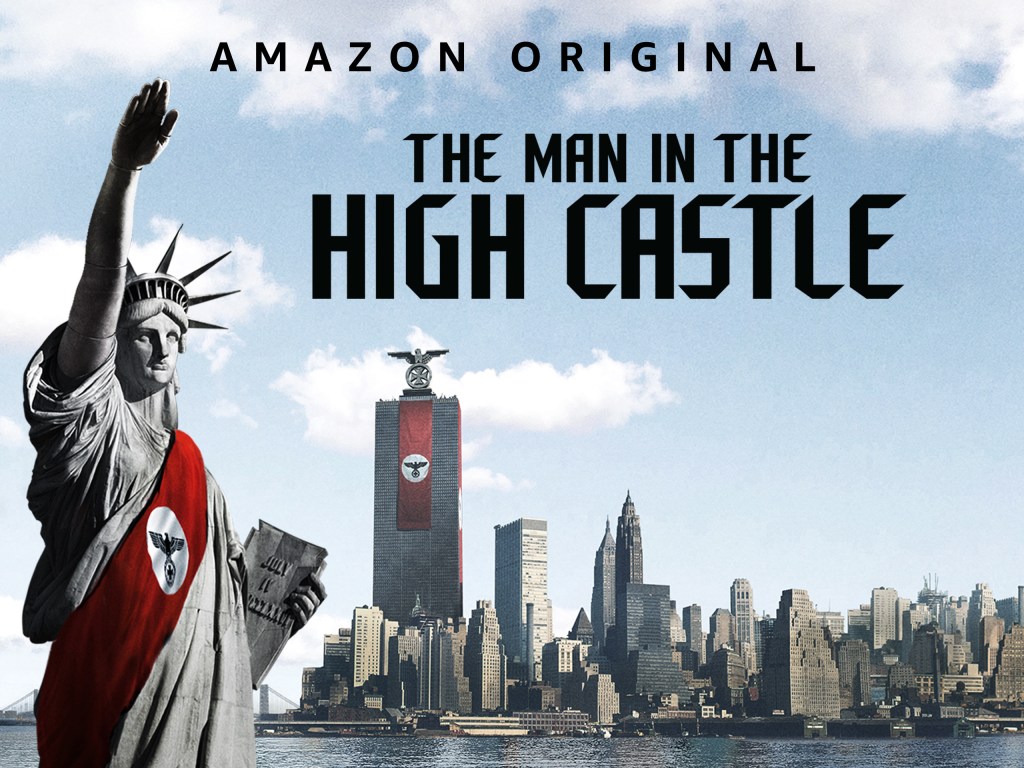
We can live an alternative history now: The Man in the High Castle by Philip K. Dick

Philip K. Dick (PKD) was a genius and visionary creative. Nobody’s mind is like anybody else’s, but his was more unlike than most. He had worlds in his mind that were like this one but were not at the same time. It is why so many of his books and stories became groundbreaking movies and why he was by some standards not standard.

The Man in the High Castle, original novel and extended TV expansion, is about history “as it happened” and history “as it might otherwise be”. Sometimes this is called alternative or counterfactual history. What if _? In this case, what if Germany and Japan had won World War II?

Except at the same time that Germany and Japan won World War II they lost World War II. Despite substantial real-life evidence that they won the war and control the world, there are films proving that they lost and that the Allies won. Of course, in the world we live in, in the history we know, the Allies did win the war. So why wouldn’t there be films depicting that victory and the Axis defeat?

In the world of The Man in the High Castle, these are just films and not just films. They are acts of imagination just as the novel—all of PKD’s novels, all histories—are acts of imagination.

Can you live in a world of imagination? That is precisely the accusation that PKD’s behavior sometimes elicited, that he was mentally unstable. But he recognized that we live in a world not just of imagination but of constant and immediate change, reflected in his theme of the I Ching in The Man in the High Castle.

If you live in an oppressive world where Hitler won the war but you have reason to believe that you are actually living in a world where Hitler lost the war, are you unrealistic or even crazy? Or is it crazy not to believe in the possibility? To surrender needlessly and prematurely? Is change not only possible but inevitable? Do you need alternative films to prove it?

Heading into a terrible wildfire season: Let AI put out the fires!

AI is now infused into everything, or soon will be. That includes consumer products from coffee or shoes to large scale undertakings. How exactly is AI in your coffee, not just involved in the process of growing it and bringing it to your kitchen? Don’t ask. Just be confident that the day is coming when AI will be in everything, or so they say.

I thought about his when I heard that funds have been cut for people who fight fires, especially in a summer when increasingly dangerous wildfires will increase again. Firefighters are generally underpaid relative to their importance, and the money for them is now reduced or gone.

I can imagine the fever dreams of AI true believers who imagine firefighting-drones controlled by AI controllers. No brave or expensive people needed. Or of the powerful but simple-minded leaders these true believers advise. “It will be just like in the movies!”

Except that if that ever happens, it is not anytime soon. But those wildfires are very soon and certain. This is not a movie, except maybe a disaster movie. AI may come to the rescue, but I doubt it.

It is time to start rebuilding American life NOW

There are various estimates of how long it will take to rebuild American life—its economy, its culture, its society—following the ongoing attempts to tear it down and throw it back to 1913, or the Gilded Age, or whatever era is thought by some to be better (meaning: better for them). The rebuilding estimates range from a few years to a generation or more.

Those of us who believe that America is not perfect—what nation is?—but that America has generally been on the right track toward a better future, based on its core principles, shouldn’t wait.

We shouldn’t wait and don’t have to. For example, if books are banned and removed from public libraries and schools, we start our own non-public libraries and start giving away books that contain a broad view. And speaking of schools, if universities are being told by the government what to teach and what not to teach, we start our own schools, not dependent on federal funding, not to promote any particular ideology except the philosophy of openness. And so on.

Where will the resource for these initiatives come from? It might come from ordinary citizens. But it is an open secret that there are Americans with progressive leanings and vast fortunes. Let them help with the rebuilding, not later when it will be that much harder, but now when a rebuilding effort will inspire and encourage, reminding us not that there will be light at the end of a tunnel but that we are only in the tunnel if we allow ourselves to believe it.

The American Cultural Revolution is underway


The Cultural Revolution (1966-1976) was a sociopolitical campaign launched by Chinese Communist Party Chairman Mao Zedong aimed at preserving “true” Communist ideology and purging remnants of capitalist and traditional elements from Chinese society.

Key features included:

  • Mass mobilization of urban youth (“Red Guards”) to attack political enemies
  • Widespread persecution of intellectuals and officials deemed “counter-revolutionary”
  • Destruction of historical artifacts, temples, and cultural sites
  • Public humiliation and violence against “class enemies”
  • Forced relocation of urban intellectuals to rural areas for “re-education”
  • Significant economic disruption and educational collapse

The movement resulted in millions of deaths, destroyed countless cultural artifacts, and severely damaged China’s economy and education system. It ended shortly after Mao’s death in 1976, with Deng Xiaoping later implementing reforms that moved China away from radical Maoism.

Claude


Mao’s Cultural Revolution was a brutal setback for China, one that took them decades to recover from. As the name says, it was much more than a political initiative. Every aspect of life in China—social, cultural, educational, economic—was to be upended, so that communism could prevail eternally and so that every remnant of Western and capitalist “wrong thinking” could be eliminated—along with those who carried the infection.

For a while, American analysts have understandably focused on the political, governmental and legal aspects of the current administration. But there are elements so obviously social and cultural that the centrality of those aspects is unavoidable. Among these, there have been express demands that universities tow the line on issues far beyond DEI and antisemitism—or else.

An American Cultural Revolution is underway. Will it look anything like Mao’s version, with “wrong thinkers” killed, imprisoned, re-educated or otherwise isolated, punished and corrected? Will it succeed here, in whole or in part?

Yesterday, the long-serving Librarian of Congress was summarily dismissed without warning or reason, apparently for making one of the world’s great cultural repositories too “woke”. What do you think?

Why polls don’t matter in slowing the trajectory of tyranny

There are two benefits of the polls showing increased dislike of Trump and his policies.

It is a benefit to news media, who always need something tantalizing to talk about.

It is a benefit to those who oppose Trump, inspiring and encouraging that opposition, with hope that Republicans who have to run in two years will see the signs.

But in practical terms, even as polls seem to indicate dissatisfaction, these polls mean little.

Tyranny is a power game, not a game of numbers, but of power strategically grabbed, held and exercised.

History says that authoritarians don’t need widespread support to succeed, or even majority support. Modern history’s most glaring example is Nazi Germany. In the last democratic election, before democracy was ended, the Nazi party won only 23% of the vote for the legislature. In one of the most fateful mistakes ever, “clever” leaders thought that by bringing Hitler into government, he could be controlled and his potential power diluted and diminished. That is not what happened.

Be inspired and encouraged by the polls. But know that even if two-thirds of America rejects the policies, many or most of those policies will still be pursued. This is a juggernaut on a mission, an opportunity to literally remake America. Polls will not stop that.

Democracy Awakens 2016

President wants Britain to pay for U.S. defending Europe against Hitler. How about those Crown Jewels?

British Prime Minister: Mr. President, as you know, Europe is in dire shape. It may be a matter of days before Britain is defeated by Hitler. We need your help.

U.S. President: Sure. How much are you willing to pay?

PM: Mr. President?

President: We can’t just give you things without getting something back. So let’s make a deal. The treasures in Europe mostly aren’t available right now. But you still have your own British treasures. Your Crown Jewels are worth a few billion dollars. Let us have those now and we will give you all the defense you need. And when we win, I know that France and Italy also have treasures. We can negotiate for those. A lot of gold there. That Vatican has plenty.

PM: Mr. President?

President: Let me know how it’s going in the war. If you want to make a deal, you know where to find me.

Moses and the three coyotes

Who are you and what are you doing here, the three coyotes asked.

They call me Moses, because as an infant I was set afloat and was picked out of the water by a princess, and then…it’s a long story. I wandered in a desert for a long time and I got used to it. So I’m trying out other deserts.

This is the Sonoran Desert, the three coyotes said. What are you carrying? It looks like a stick and a stone.

The stick is a magic staff. It can turn into a snake. The stone is a bunch of sayings. Do you want to hear them?

No we don’t, the three coyotes said. We don’t need a stick that turns into a snake. We’ve got plenty of snakes of our own.

Well, I guess I’ll be moving on, Moses said. I’m sure I’ll see you again.

Not if we see you first, the three coyotes said.

© 2025 by Bob Schwartz