Welcome to Bubba,s
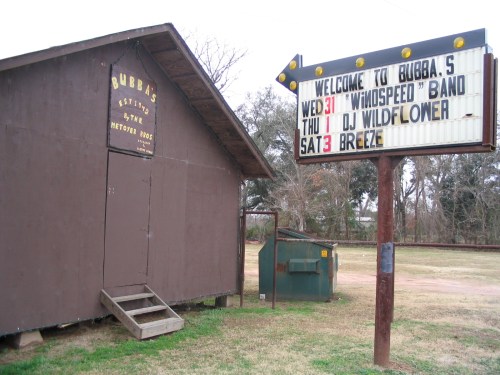
© Bob Schwartz
© Bob Schwartz
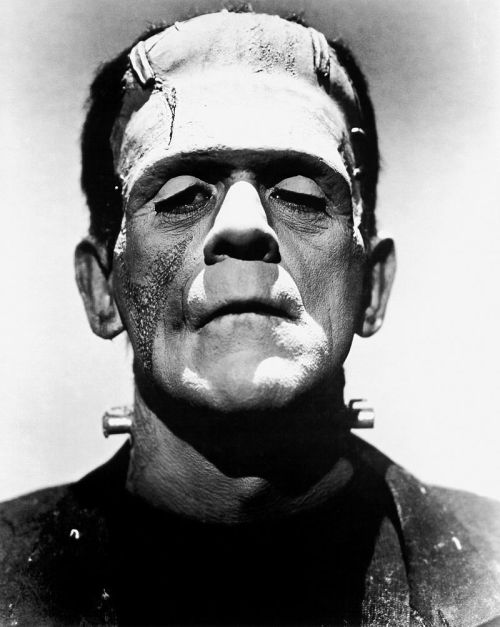
“The Creature showed unparalleled malignity and selfishness in evil; he destroyed my friends; he devoted to destruction beings who possessed exquisite sensations, happiness, and wisdom; nor do I know where this thirst for vengeance may end. Miserable himself that he may render no other wretched, he ought to die. The task of his destruction was mine, but I have failed.”
Frankenstein
I was at first touched by the expressions of his misery; yet, when I called to mind what Frankenstein had said of his powers of eloquence and persuasion, and when I again cast my eyes on the lifeless form of my friend, indignation was rekindled within me. “Wretch!” I said. “It is well that you come here to whine over the desolation that you have made. You throw a torch into a pile of buildings, and when they are consumed, you sit among the ruins and lament the fall.”
Frankenstein
This year marks the 200th anniversary of the publication of Frankenstein, Mary Shelley’s monumental work of modern literature. The characters and story have been fashioned into hundreds of forms, some truer to the original than others. One basic element is inescapable: the story of a skilled technician trying to create something new, only to discover that the Creature is ultimately destructive of much that is cherished and good.
That is where the Republican Party finds itself with Trump. Admittedly, Trump has more fans than Victor Frankenstein’s Creature ever did, but is similarly an uncontrollable force of twisted nature.
In the final chapter of Frankenstein, Captain Walton concludes the narrative letters that chronicle his passenger Victor Frankenstein’s relating the tale of the Creature he created:
You have read this strange and terrific story, Margaret; and do you not feel your blood congeal with horror, like that which even now curdles mine?…
Sometimes I endeavoured to gain from Frankenstein the particulars of his creature’s formation, but on this point he was impenetrable. “Are you mad, my friend?” said he. “Or whither does your senseless curiosity lead you? Would you also create for yourself and the world a demoniacal enemy? Peace, peace! Learn my miseries and do not seek to increase your own.”…
“Oh! My friend, if you had known me as I once was, you would not recognize me in this state of degradation. Despondency rarely visited my heart; a high destiny seemed to bear me on, until I fell, never, never again to rise.”…
“If I were engaged in any high undertaking or design, fraught with extensive utility to my fellow creatures, then could I live to fulfil it. But such is not my destiny; I must pursue and destroy the being to whom I gave existence; then my lot on earth will be fulfilled and I may die.”…
“He [the Creature] showed unparalleled malignity and selfishness in evil; he destroyed my friends; he devoted to destruction beings who possessed exquisite sensations, happiness, and wisdom; nor do I know where this thirst for vengeance may end. Miserable himself that he may render no other wretched, he ought to die. The task of his destruction was mine, but I have failed.”…
I entered the cabin where lay the remains of my ill-fated and admirable friend. Over him hung a form which I cannot find words to describe — gigantic in stature, yet uncouth and distorted in its proportions. As he hung over the coffin, his face was concealed by long locks of ragged hair; but one vast hand was extended, in colour and apparent texture like that of a mummy. When he heard the sound of my approach, he ceased to utter exclamations of grief and horror and sprung towards the window. Never did I behold a vision so horrible as his face, of such loathsome yet appalling hideousness….
I was at first touched by the expressions of his misery; yet, when I called to mind what Frankenstein had said of his powers of eloquence and persuasion, and when I again cast my eyes on the lifeless form of my friend, indignation was rekindled within me. “Wretch!” I said. “It is well that you come here to whine over the desolation that you have made. You throw a torch into a pile of buildings, and when they are consumed, you sit among the ruins and lament the fall.”
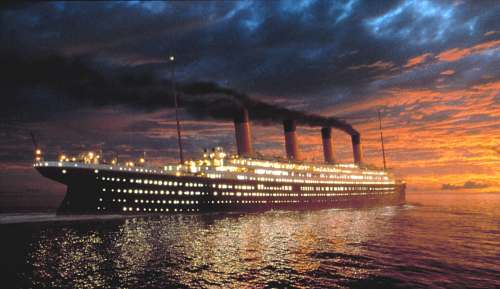
It has been more than twenty years since the epic, iconic movie Titanic was released. More than a century since the “unsinkable” biggest ship sank. Yet until today, when the movie popped up, I hadn’t fully focused on its metaphoric value. Which makes me one of the last to catch on, but I’m known to be slow.
On the same day, the rich president, whose only “achievement” has been to help other even richer people get even richer, was spouting normal nonsense—all based on America being unsinkable (thanks only to its being in his “capable” hands). Meanwhile, the stock market, a bellwether of confidence, is suffering another difficult day, pointing to an inevitable big correction, or worse.
We’ve had over a hundred years to consider the Titanic, a situation combining arrogance, incompetence, selfishness, ignorance, stubbornness, pride, wealth, along with the tragic power of nature and chance. King of the World doesn’t matter if you’re the captain or just a passenger heading for an avoidable iceberg.

This isn’t about baseball, though the quote is from a baseball writer. Bill James is not just a superb writer; he is a thinker whose analysis of the game has changed baseball more than any other thinker has ever changed any game. You can look it up.
This is about optimism and hope. I was reading The New Bill James Historical Baseball Abstract (a 998-page volume whose title alone should tell you just how thoughtful Bill James is). He describes Robin Yount, who as of the time of publication James considered the Number 4 shortstop in baseball history:
Robin Yount (1974–1993, 2856 G, 251 1406 .285)
Robin Yount was a major league regular when he was 18 years old. We always wondered how good he would be, how much he would improve. In 1978, after Yount had been in the major leagues four years, he held out in the spring, mulling over whether he wanted to be a baseball player, or whether he really wanted to be a professional golfer.
When that happened, I wrote him off as a player who would never become a star. If he can’t even figure out whether he wants to be a baseball player or a golfer, I reasoned, he’s never going to be an outstanding player.
Yount was unhappy about suggestions that the Brewers would move him to the outfield. According to Dan Okrent in Nine Innings, “Yount didn’t merely reject the suggestion; he brooded about it, resented it, and lost himself in self-doubt. Members of the front office… saw Yount’s reaction as immature sulking.”
But as soon as he returned to baseball, Yount became a better player than he had been before; his career got traction from the moment he returned. What I didn’t see at the time was that Yount was in the process of making a commitment to baseball. Before he had his golf holiday, he was there every day, he was playing baseball every day, but on a certain level he wasn’t participating; he was wondering whether this was really the sport that he should be playing. What looked like indecision or sulking was really the process of making a decision.
This is often true. What Watergate was about was not the corruption of government, as most people thought, but rather, the establishment of new and higher standards of ethical conduct. Almost all scandals, I think, result not from the invention of new evils, but from the imposition of new ethical standards. Same thing with Yount; he wasn’t backing away from baseball; he was just putting the bit in his teeth, accepting new responsibilities. In the biographies of men and nations, success often arrives in a mask of failure. (emphasis added)

Superstar musician Avicii (Tim Bergling) has died at the age of 28.
You will see him identified as a DJ and producer, which is true as far as it goes. Actually, he was simply a musician—an extraordinarily talented one. So if someone asks “what did he play?” you can just reply “music.”
Producers have always been important for recording music, and became more important in the modern pop era. Beatle’s producer George Martin was appropriately called “the Fifth Beatle”; without him, the epic music would never have sounded the same.
Hip-hop and dance music introduced performers who “played” turntables and mixed bits of recorded music, which collaboration evolved into full-scale production and creation. The role is a combination of composition and conducting. Avicii came along with a new generation of young DJs and producers, and in the ears of many, was top of the class.
From Billboard:
Bergling started out releasing music on Laidback Luke Forum in the late ’00s, where DJs and producers would post music and seek feedback from budding peers. In 2011, he broke through to an international audience with the progressive house track “Levels,” which hit No. 1 in his native Sweden and on the U.S. Billboard Dance Club Songs chart — and earned him a Grammy nod. His 2012 David Guetta collab “Sunshine” earned him a Grammy nomination as well, and that same year, he became the first electronic artist to headline New York City’s storied Radio City Music Hall.
In 2013, Avicii released his debut studio album, True, which featured the game-changing, massive international hit “Wake Me Up!” ft. Aloe Blacc. Combining EDM, folk and country music, the song became a No. 1 hit in many countries and peaked at No. 4 on the Billboard Hot 100. His second album, Stories, dropped in 2015 and featured vocals from Chris Martin, Wyclef Jean, Robbie Williams, Matisyahu, Brandon Flowers, Gavin DeGraw and more. The EP Avīci (01) came out in Aug. 2017 and featured his Rita Ora collaboration “Lonely Together.”
The place to start, if you don’t know Avicii, is with his debut album True. When I first heard it, my joy was mixed with a sense that this was some new kind of music that he had created. Losing artists of that talent and achievement is difficult and sad.

Cold Coffee
The longer this coffee sits
The colder it gets.
Heat it
To make it warmer
Add ice
To make it colder
Cream makes it lighter
Sugar sweeter
Drink up.
©

I am ambivalent about the benefits and effects of unstoppable technological progress. It is nearly a force of nature. Rain helps our plants to thrive, our food to grow, our rivers to flow, our thirst to be quenched. But it can also overwhelm and destroy, so that we seek shelter from it in a flood or hurricane. Still, I wouldn’t trade technology in, not all of it, not easily. I am just wary and watchful.
This is from Thomas Merton’s journals. He lived as a monk in a handmade hermitage on the grounds of the Abbey of our Lady of Gethsemani in Kentucky. It is a tiny building that up until 1965 did not have electricity:
“At last the electric line is coming to my hermitage!”
Yesterday in the morning, when I went out for a breath of air before my novice conference, I saw men working on the hillside beyond the sheep barn. At last the electric line is coming to my hermitage! All day they were working on the holes, digging and blasting the rock with small charges, young men in yellow helmets, good, eager, hardworking guys with machines. I was glad of them and of American technology, pitching in to bring me light, as they would for any farmer in the district. It was good to feel part of this, which is not to be despised, but is admirable. (Which does not mean that I hold any brief for the excess of useless developments in technology.)
Thomas Merton Journals, February 16, 1965, V.206–7

More posts about Merton:
Merton: Events and Pseudo-Events
For Me to Be a Saint Means to Be Myself

Birkenau – Gerhard Richter
Today is Yom HaShoah, Holocaust Remembrance Day. It is a memorial day for those who died in the Holocaust, a Greek word meaning “sacrifice by fire.” Established by Israel in 1951, the day is now commemorated around the world. In the U.S., Congress has made it part of the week-long Days of Remembrance.
A new study released today “finds significant lack of Holocaust knowledge in the United States.” Without repeating the painful findings, it is enough to say that if trends continue, in a couple of generations a large majority of Americans will have very vague and erroneous views of what took place, if they know anything about the Holocaust at all. Painful but not surprising, given that Americans’ knowledge of their own history is pretty vague and often erroneous.
In 2018, and at any point in history, the phenomenon of the Holocaust matters for a lot reasons. Here at just a few.
The depths of human depravity exceed our imagination. The heights of human heroism, which the Holocaust also demonstrated, exceed our imagination too.
Whatever identity group you belong to, you can never be confident that you will not be the next despised “other” who must be totally eliminated. Which means that hatred of the other is to be avoided and acceptance of the other is to be applauded.
Science and technology can be very evil. It is true that Hitler couldn’t rely only on sophisticated chemical gas to kill Jews, supplementing that with old-fashioned mass shootings and body pits. But if he had had the opportunity to complete his work on rockets and atomic bombs, for example, who knows what the number of eliminated non-Aryans might have been?
As important as remembrance is, it is not as important as living, acting and speaking in ways to relieve current suffering. Dead and displaced at the hands of an evil leader is not history. It is now. “Never again” cannot be just for what happens to Jews. “Never again” is for everybody, or it is for nobody.
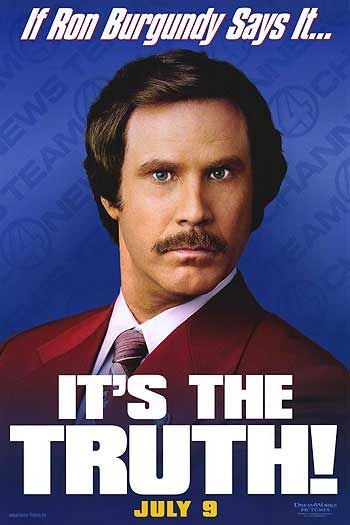
“I don’t know how to put this, but I’m kind of a big deal.”
Ron Burgundy, Anchorman
I just watched Anchorman for the first time in a few years. There may be some artistic or social subtext there, but it is really just a monumentally stupid and funny movie. I’ve been watching the news, living in Trump America, and I need laughs.
So I checked out some reviews from when it was first released in 2004. Most reviewers liked it and thought it was a monumentally stupid and funny movie.
And then I found Stephen Hunter’s review in the Washington Post. I quote it here because his description of Ron Burgundy and his colleagues reminded me so much of somebody else.
Oh, yeah, I love lamp.
On the Spot News
By Stephen Hunter
Friday, July 9, 2004
Over the past century, film geniuses have erected many a cathedral of style, solemn structures of tradition and cohesion, the highest projection of the imagination: Swedish Realism, German Expressionism, Spanish Poetic Realism, Italian Neorealism, Danish Dogmatism.
To this hallowed list does Will Ferrell’s “Anchorman” petition for admission. Its contribution: San Diego Neo-Infantilism….
The source of much mirth in “Anchorman” isn’t just the self-deluding Burgundy himself — though Ferrell is typically brilliant at projecting a character without a shred of inner life or self-awareness — but also his little coterie of on-air stud boys. They see themselves as four horsemen outlined against a diamond-blue, eternal April sky, but of course they’re really four horses’ asses on a one-way trip toward oblivion. Brian Fantana (Paul Rudd with his own Royal Air Force mustache; why did guys then think that was so cool?) is Mr. Cologne; he knows the right man-perfume dabbed on his neck gets him to chick heaven. Steven Carell is Brick Tamland, the weatherman, whose IQ approaches that of the object for which he’s named and whose continual inability to understand reality is endlessly funny. Finally, sports guy Champ Kind (David Koechner) wears ten-gallon hats, makes poo-poo faces and boo-boo sound effects for comic relief among the guys (how unfunny they are is really funny) and is secretly gay.
The men fight the ascension of Veronica and the new woman she represents; the joke is how ridiculously inefficient their campaign is and how utterly it’s ignored by station management (Fred Willard and Chris Parnell). The guys, it turns out, have no chops, no arguments, no resources, no skills, nothing except the maleness that has been at the center of their entitlement their whole lives. (emphasis added)


