For those who wonder whether meanness is a sin or vice, you can start with Summa Theologica by St. Thomas Aquinas, where Question 135 addresses the issue. Or you could ask your parents or your elementary school teachers or your spouse or your children: It’s not nice to be mean.
Which should make us think about why rampant meanness is not only acceptable, but encouraged, entertaining, and profitable. Cheaters may never prosper (though they often do), but meaners are doing very well these days.
Saying that all things virtuous seem to be dying and on life support is an overstatement that doesn’t get us far. Instead, four possible explanations of how what was once a private disturbance has become such a pandemic, a public poison:
Meanness by proxy: All art and performance is based on the ability and willingness of creators to express what we can’t or won’t. It would be nice to think that we only long to be the one who can move people to tears or laughter, inspire people to reach higher, and if we can’t be those creators, at least they are doing that for us. The same thing unfortunately applies to darker messaging, though. We may not be able to attack quite so sharply and eloquently, but we appreciate that someone can. “Yeah, what he said!”
Meanness as superiority: This is a subset of meanness by proxy. There’s perversity in enjoying the meanness of others, but at the same time taking pride in being one who would never say something like that because…we are better than that and would never be so mean. (Whatever the theological status of meanness, by the way, pride is definitely on all the lists of sins.)
Meanness as incompetent and faulty criticism: This is the explanation of meanness as sub-juvenile behavior. When little children aren’t sure why they hate somebody or something, or can’t articulate it, they revert to name-calling and indiscriminate meanness: “You’re a poo-poo head!” It’s a fantastic dream that one day, thanks to some spell, the most gratuitously mean would be magically forced to speak only such childish epithets.
Meanness unconditioned by a thought/speech barrier: The thought/speech barrier, the wall that should keep many thoughts from ever being spoken, is dissolving. Whether phenomena such as Twitter are causal, enabling, or merely symptomatic is beside the point. Thought moves from brain to mouth (or keyboard) at the speed of synapse. Mean heart becomes mean words in a literal instant.
There is a genuine critical function, which can be exercised with thoughtfulness, care, and respect. That simple sentence, a foundation of a free, enlightened society, is looking particularly quaint, and seems for many to have lost its meaning.
“As for the peace plan floated by the White House last week: The 28-point plan amounts to a holiday wish list from the Kremlin….This isn’t a peace plan. It’s a blueprint for Ukraine’s capitulation. If implemented, it would turn this pro-Western, democratic nation, which has been courageously resisting Russian aggression since 2014, into a Kremlin colony.”
Russia’s barbaric assault on Ukraine continues: A single Russian drone and missile strike on an apartment block in western Ukraine last week killed at least 31 civilians. Meanwhile, Russia is ramping up its campaign of sabotage in Europe: Polish authorities blamed the Kremlin for a Nov. 15 explosion on a rail line used to transport supplies to Ukraine. As German Chancellor Friedrich Merz said recently, Europe “is not at war” but it is also “no longer at peace” with Russia.
The growing threat from Vladimir Putin’s despotic, expansionist regime calls for Churchillian resolution, unity and strength on the part of the transatlantic alliance. Instead, Neville Chamberlain-style irresolution and confusion reigns on both sides of the Atlantic. The situation is far more concerning in the United States than in Europe, with the Trump administration having seemingly endorsed, at least for now, a “peace plan” that would give Russia a victory at the negotiating table that it hasn’t earned on the battlefield.
The Europeans have stepped up, providing weapons and funding to Ukraine as U.S. support has dried up. The European Union has a plan to do even more by sending Kyiv some $200 billion in frozen Russian assets as a “loan” that would likely never be repaid. Obviously, given the current corruption scandal in Kyiv, safeguards on the disbursement of the money would be needed. But this is a vital — indeed, irreplaceable — source of funding that can keep Ukraine afloat for years. Yet tiny Belgium, where most of the funds are frozen, is wringing its hands and holding up the plan. There is no Plan B: Europe has to send the Russian funds or else Ukraine will run out of money. So why dither and delay?
As for the peace plan floated by the White House last week: The 28-point plan amounts to a holiday wish list from the Kremlin. It would require Ukraine to cede the entire Donbas region — even the parts that Russian troops have been unable to conquer — and to cut the size of its armed forces by roughly a third. Ukraine would not be allowed to join NATO, and NATO would not be allowed to dispatch peacekeeping troops to Ukraine. Ukraine would hold elections within 100 days and “all Nazi ideology” would be “prohibited”; this is Kremlin code for toppling the Zelensky government. Russia isn’t being asked to limit the size of its armed forces or to hold elections; all the demands are on Ukraine.
What does Ukraine get in return? A separate draft agreement specifies that in the event of renewed Russian aggression, the United States could respond with “armed force, intelligence and logistical assistance, economic and diplomatic actions.” But the U.S. wouldn’t be compelled to do anything. Ukraine would be left to rely on a worthless Russian pledge of “nonaggression” — something it already promised in the 1994 Budapest Memorandum.
This isn’t a peace plan. It’s a blueprint for Ukraine’s capitulation. If implemented, it would turn this pro-Western, democratic nation, which has been courageously resisting Russian aggression since 2014, into a Kremlin colony.
Apparently, the odious proposal was hatched in secret meetings between Steve Witkoff, President Donald Trump’s credulous peace envoy, and Kirill Dmitriev, the wily head of Russia’s sovereign wealth fund, who is dangling promises of lucrative Russian investments if the Trump administration will only end the war on the Kremlin’s terms. (The draft agreement speaks of “mutually beneficial” opportunities, including energy and artificial intelligence.) Ukraine and Europe were not consulted, and both are scrambling to make their voices heard in Washington.
Yet the White House is pressuring Ukraine to agree by Thanksgiving or else lose all remaining U.S. support, including, presumably, U.S. intelligence warnings of Russian missile and drone launches. This is a geopolitical five-alarm fire, with the only saving grace being that Trump could change his mind, as he has so often done in the past.
In August, Trump met with Putin in Alaska and afterward told European leaders that Ukraine would have to cede land it still controls to Russia. Alarmed European leaders rushed to the White House and convinced Trump to back off. Trump subsequently imposed sanctions on two Russian oil companies, Rosneft and Lukoil, and even gave Ukraine permission to use U.S.-supplied missiles to strike Russia for the first time.
The U.S. sanctions, combined with Ukrainian drone attacks, are reducing the funds available to back Putin’s war machine: Russian oil revenues have fallen 20 percent in the past month. Even India is weaning itself from Russian energy imports. It would be folly to remove the pressure now, when it is just starting to bite.
That is all the more the case because other recent developments favor Russia: notably, the corruption scandal currently embroiling Zelensky and the likelihood that the eastern Ukrainian city of Pokrovsk will finally fall to the Russian army after a lengthy and costly siege. From Putin’s perspective, Ukraine now might be weak enough to bow down before his maximalist demands. Trump apparently believes this too.
That is an illusion. While Ukrainians may be more divided than before about Zelenksy’s leadership and more willing to trade some territory for peace, they remain united in refusing to surrender. The Witkoff-Dmitriev pact is a victor’s peace, but Ukraine hasn’t been defeated. The Russian military has barely advanced since 2022, at a price of roughly a million casualties. But the Trump administration’s willingness to make peace on the Kremlin’s terms can only raise Putin’s hopes that he can win this war after all.
That is the worst possible signal to send at a time when the Russian threat to Europe has never been clearer or more ominous. It makes a wider war with Russia more, not less, likely. Europe needs to counter Trump’s appeasement by rushing frozen Russian funds to Ukraine without delay.
By Max Boot Max Boot is a Washington Post columnist and a senior fellow at the Council on Foreign Relations. A Pulitzer Prize finalist in biography, he is the author, most recently, of the New York Times bestseller “Reagan: His Life and Legend,” which was named one of the 10 best books of 2024 by the New York Times.
The Hebrew Bible (Old Testament) begins with the Hebrew word “Bereshit”, conventionally translated as “In the beginning”.
In Hebrew the word begins with the second letter of the alphabet, Bet, like the second letter B.
But it is the beginning. So why doesn’t the text start with an Aleph/A word, the first letter of the alphabet?
This is a conundrum that has challenged the rabbis for centuries. They have spoken and written insightfully at length about it.
You don’t have to know what the rabbis have said or written. You don’t have to be Jewish, you don’t have to know Hebrew. You don’t have to be a student of the Bible. You already know enough, as detailed above.
Instead, consider this like a Zen koan, something to ponder without resolving. If it helps your pondering, whether you know Hebrew or not, you might look at and contemplate the image of the letters. Is there something about the letters themselves that tells you something about why one was chosen instead of the other to start off this famous story?
First, not all billionaires, not even most billionaires, are bad for the nation and the people of the nation.
Second, absent some horrible investment decisions, the billionaires will not be impoverished, in this or any future lifetime.
But there are billionaires who are using their money and power to make things worse for people or who don’t care if their money and power make things worse for people.
Here is the good news: A number of those billionaires made and continue to make their money from the buying power of consumers. Buying power as in power. Consumers as in…well, maybe you.
If this sounds simplistic, it isn’t. I am not alone in thinking about where the profits from my purchases of goods and services are going. Sometimes I make conscientious choices. Sometimes—I admit it—I choose price, convenience or utility over other factors.
The thing is, when I see and hear about the billionaires I’ve funded and fund, making the individuals or their companies richer, the path to alternative choices continues to shrink. Consolidation, conglomeration, oligopoly, monopoly rule.
The leverage is still there. ______________ will not find themselves living on the street or standing in a breadline, unless that is where they get their kicks. But if some choices you make keep a little of your money away from them, that’s not such a bad thing, is it?
We know what fight without enlightenment looks like. There isn’t enough space on the unlimited internet to chronicle that. In terms of overturning a bad situation, one example of unenlightened rebellion is ironically the French revolution (France being the birthplace of the Enlightenment).
Enlightenment without fight is more complicated. That is the situation where more elevated personal and social principles are promoted and maybe partly adopted, but the forces of the unenlightened hold the power to suppress that and even to move us backwards and down.
To give America its historic due, our revolution was not a half-bad example of enlightened fighting. Which is not surprising, given that the literal Enlightenment was a driving force and guiding philosophy, with a pragmatic American twist. Maybe the outcome was less than perfect and less than vulnerable to the worst counter forces. But not half-bad.
Enlightened fighting is easier said than done, and certainly in America 2025.
Enlightenment doesn’t just require a good heart and good feeling. There is real thinking and real knowledge involved. Am I saying that there is not currently enough real thinking and real knowledge in America? Am I?
Fighting doesn’t mean just doing something, anything out of frustration, anger or even hope for a better tomorrow. Doing something, anything can leave the impression that the fight is ongoing, while that may be an illusion/delusion. That’s where enlightenment, thinking and knowledge come in. Not to mention, of course, courage.
So if you are one who wants to hasten the end of this dangerous nonsense, ask two things. Are you or those who want your support enlightened in ways that will advance the fight beneficially and successfully? Are you or those who want your support courageous and fighting in ways that will advance the fight beneficially and successfully?
Looking at the mat and cushion on the floor of the room today, it looked like a place. Another room from the room it is in.
Meditation is another room. Whether you meditate for one of the simple reasons or as part of a greater practice and program, it is another room.
Whatever room you are in, in small apartment or a mansion, there is another room that has no walls, ceiling or floor (yes, that makes it hard to sit on a mat!), encompassing everyone and everything. As a bonus, rent-free and mortgage-free.
You are not going to stay there, as you live in all the other rooms—in your house, office, stores, or whatever. But a visit to this other room, seeing all it holds and reveals, can be inspiring (literally meaning breathing in).
We had the best education. We went to school every day. I only took the regular course. Reeling and Writhing to begin with. Then the different branches of Arithmetic—Ambition, Distraction, Uglification, and Derision.
Alice’s Adventures in Wonderland
Read Alice’s Adventures in Wonderland now. Again if it’s been a while, and definitely now if for the first time.
Lewis Carroll (born Charles Dodgson, 1832-1898) was famously creative as a mathematician and logician. He wove puzzles and tortured logic all through his book Alice’s Adventures in Wonderland.
Puzzles and tortured logic are a major component of America in 2025.
The leadership and the citizens of Wonderland are variously tyrannical, illogical, stupid, or just plain bizarre. Alice literally does not fit in. While she is only a child, she has more sense than everyone she meets combined.
If I had a news network I’d suspend the futile attempts to explain what’s going on and would instead read aloud one chapter from Alice in Wonderland every day. It would be more constructive and more fun than listening to their trying to make sense of the nonsensical.
Trump’s posts and speeches seem to be taken straight from Alice in Wonderland:
For example:
We must have a trial. Really this morning I have nothing to do. With no jury or judge I’ll be Judge. I’ll be jury. I’ll try the whole cause and condemn you to death.
We’re all mad here. I’m mad. You’re mad. A dog growls when it’s angry and wags its tail when it’s pleased. Now I growl when I’m pleased and wag my tail when I’m angry. Therefore I’m mad.
Be what you would seem to be. Never imagine yourself not to be otherwise than what it might appear to others that what you were or might have been was not otherwise than what you had been would have appeared to them to be otherwise.
You have no right to think. Just about as much right as pigs have to fly. I give you fair warning either you or your head must be off. Take your choice!
We had the best education. We went to school every day. I only took the regular course. Reeling and Writhing to begin with. Then the different branches of Arithmetic—Ambition, Distraction, Uglification, and Derision.
Thus it began: Someone running late to the airport asked me to find a patron saint to help their making a flight.
My view of saints is nuanced. I believe that the long roster of Christian saints offers valuable spiritual touchstones for people of all traditions. Belief in the underlying miracles or in the power of a particular saint to intervene in particular situations is another matter. For me, saints are much more than a curiosity, but less than a holy emissary. Still, important and worthwhile.
I found Saint Joseph of Cupertino. Even for saints and their various patronages, he is extraordinary. Based on his life, he is the patron saint of air travelers, aviators, astronauts, people with mental handicaps, test takers, and poor students. That covers a lot of ground:
Saint Joseph of Cupertino (1603-1663) was an Italian Franciscan friar known for mystical levitation experiences during prayer and Mass. Born Giuseppe Desa in Cupertino, Italy, he had a difficult childhood marked by poverty and learning difficulties.
Despite initial rejections due to his lack of education, he eventually became a priest. He became famous for reportedly levitating into ecstatic trances during religious services—sometimes floating to the altar or rising into the air—which drew crowds and scrutiny from Church authorities. These episodes occurred so frequently that he was eventually forbidden from participating in public religious ceremonies.
This led me to a little-known and less-seen movie based on his life, The Reluctant Saint (1962). Made by veteran Hollywood director Edward Dymtyrk, it is modest and well-made.
As his life story and the film (and the poster above referring to “The Flying Friar”) detail, the most remarkable feature was his ability to levitate. This is how the airplane aspects of his patronage came to pass.
If you watch the movie, or at least the last fifteen minutes, you will see a hearing about Joseph’s levitating above the altar when he celebrated his first mass. The brothers testify to what they witnessed, but one priest, Father Raspi, is adamant that it is the work of the devil possessing Father Joseph.
Father Raspi performs an exorcism (21 years before The Exorcist movie), including wrapping Joseph in chains so that he cannot levitate. When it is over, he leaves Joseph in chains. As Father Raspi and the brothers leave, they hear the chains falling away. When they go back, they are struck by a blinding bright light.
This story of Saint Joseph of Cupertino will inspire different thoughts in different people.
Did a humble, simple-minded, possibly mentally-challenged man pass his priest examination with flying colors? Did that same man, lifted by spirit, levitate?
Did this saint help someone make a flight on time?
Many people have things to hide. Many of those people hide them with lies, distractions, obscurities, payoffs, threats or punishments.
Even some, maybe many, of his supporters suspect that Trump has things to hide, though those supporters may think he, good man that he is, is hiding them for good reasons.
Trump has managed to hide things or explain away whatever was seen as inconsequential or often as fake.
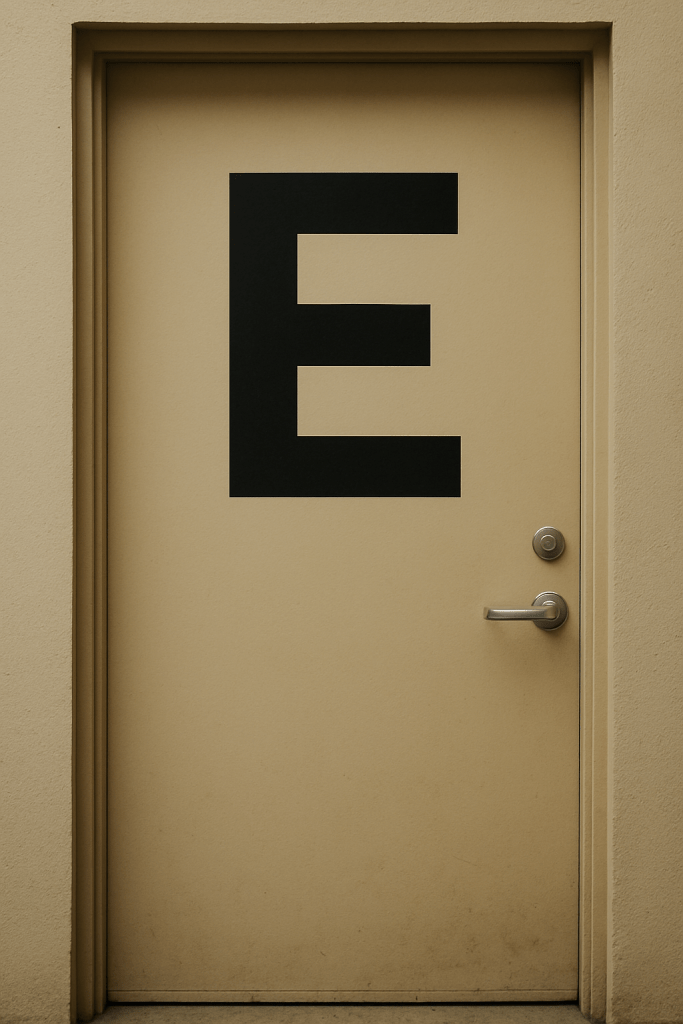
He knows, and those who know him know, that the door marked “E” is turning out to be a challenge. Which explains how much effort has gone into to keeping it closed and blocking the view.
In criminal law, when a defendant or witness invokes the Fifth Amendment right against self-incrimination, the instruction to the jury is that it may not infer guilt from that silence.
In life outside the courtroom, when someone tries to block the view of what actually happened, we do infer something from it. There is some possibility, we reasonably think, that blocking the view means that someone is hiding something.
The door marked “E” is opening a crack. We may see more if the congressional demand for complete FBI files is complied with, but there are many possible and likely obstacles to that.
Trump has managed to keep all other doors into his life closed so far, and has been very successful at it. If and when we get this door opened and see it all, we may be both astonished and unsurprised.
At that moment, the sun was to the left of the picture, out of sight, having already disappeared from view. In another moment, the light and medium gray was dark gray and the pink was gone. Then the dark gray was black. The sun will remain out of view for hours, when it will reappear yellow. At that moment.









 Bob Schwartz