Bob Schwartz

The problem with the new U.S. Department of Labor social media campaign is not only the depiction of all white men. The real problem is that it looks like Nazi Germany worker propaganda.

U.S. Department of Labor (2025)

“In the Nazi worldview, there was a close link between the German spirit and productive labor for the advancement of the Volksgemeinschaft. Tapping the full potential of worker productivity rested on improving worker morale and increasing worker support for the regime more generally.”

The Washington Post writes:


Labor Department social media campaign depicts a White male workforce

The campaign has drawn scrutiny, with critics saying the agency is not realistically portraying the diversity of the country and is sending messages that feel exclusionary.


While the male whiteness of the campaign is problematic, that wasn’t my first impression. What it looked like to me was a workforce campaign you might have seen in Nazi Germany, not just because of the handsome and rugged Aryan men, but in the very style of the art. The inclusion of the word “homeland” doesn’t help, although it is better than “Build Your Fatherland’s Future.”

Or am I just oversensitive to those visual and verbal echos?
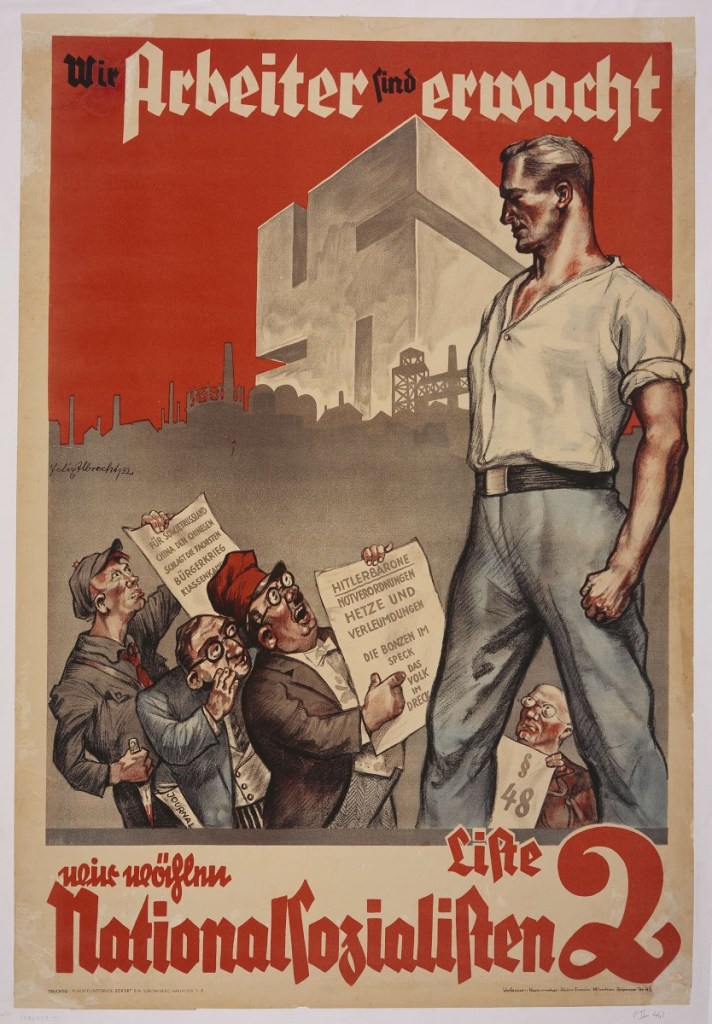
We Workers Have Awakened (1932)
You Are the Front (1940)
Beauty of Labor (1934)

Penguin love according to Buddhism

“If penguins don’t let go of their young at some point, the little ones will never grow up to be competent adult penguins.”

“Attachment may be the most difficult emotion to overcome, but we can make progress by continually observing how it brings us suffering and does us no good. In place of our attachment, we can cultivate a less self-centered love, a visionary love that is tuned in with the actual best interests of others. This kind of love often involves letting go. For instance, if penguins don’t let go of their young at some point, the little ones will never grow up to be competent adult penguins. They will never be free to live fully. By letting go, the parents are not rejecting love and care, but expressing a higher form of love. As lojong [mind training] practitioners, we can cultivate visionary love for those close to us, and then spread that love among all sentient beings, simply because they have the same desire to be happy that we do.”
Dzigar Kongtrul, The Intelligent Heart: A Guide to the Compassionate Life

Judging and projection

Gomo Tulku (1922-1985)

One of the most famous quotes about judging is from the Gospels:


Do not judge, so that you may not be judged.
Matthew 7:1


Despite that wisdom, Christians and others often tend to forget or ignore it. A lot of judging goes on.

Another similar perspective is taken in Buddhism, which is not to say that Buddhists don’t indulge in judging also.

A maxim from the classic 59 maxims of mind-training (lojong):


  1. Don’t reflect on others’ shortcomings.

We should train our minds to see others as pure by thinking that when we see a fault in someone, it’s because we project imaginary faults onto others due to things appearing to be impure from our own side. Practicing in this way, we will be able to protect ourselves from the tendency to judge others.
Gomo Tulku (1922-1985), Seven Steps to Train Your Mind


This goes farther than the Christian message that we shouldn’t judge others because we might get judged back. We don’t judge because whatever the other is doing, we are looking in a mirror. We are pure, though our self-importance keeps us from knowing it. The other is pure, but is also kept from knowing it. Our role is not to judge, but to help them see it and help ourselves see it.

Note that no one suggests that we put our critical thinking in neutral. If we find that what we or others do, say or think might be better, we can point it out, provided our motivation is making things better, and not proving ourselves better and smarter.

The House will reopen soon, the federal government maybe not

Elected Republicans are thinking a little bit more today about the consequences of their actions and strategies.

Republicans control the House and have shut it down for months. They believe this issue has been lost in the bigger issue of the entire shutdown of the federal government and the damage it is doing and the suffering it has caused. Which, according to them, is all the fault of the Democrats.

That changed today. In light of the election results yesterday, which the president takes personally, he has reversed the claim that Democrats are to blame for the shutdown. He now properly blames the shutdown on the Republicans.

It is easier to open the House. Speaker Johnson can do this in the time it takes to read this post. He may have to bear up under the seating of newly elected Democrat Adelita Grajalva, who would be the deciding vote on demanding release of the infamous Epstein Files. But there is now a concern that Republicans are vulnerable at the polls, and the indisputable charge that they alone are responsible for the House not working at all—can’t blame the Democrats for that—will get noticed. Even if voters aren’t asking questions now, they will.

It is harder to open and restart the federal government, even now that the president has endorsed doing it. The Democratic demand is that SNAP and the ACA subsidies must be assured by Congress in the budget bill. No matter what the Republicans say, voters are also noticing that keeping food from 42 million Americans and cheaper health insurance from millions more is the fault of the Republicans. But not spending money on hungry people and on the health of Americans is part of the current Republican plan. It’s a quandary for Republicans.

So the House will reopen soon, even if it means seating Congresswoman Grijalva, but ending the shutdown may take longer.

© 2025 Bob Schwartz

Two books about lying

Some don’t think they need to read a book about lying because it is succinctly and definitively covered in “The Good Book”, that is, the Bible:

  1. You shall not bear false witness against your neighbor
    Exodus 20:16

(Or as universally interpreted, in any circumstance to anyone. In other words, don’t lie.)

If you do want to read a good book about lying, its subtleties and its damaging effects, following are a couple.

Lying: Moral Choice in Public and Private Life (1978) by Sissela Bok

This is the modern masterpiece on the subject. You might think, “well, it was written almost fifty years ago, and a lot has changed since then.” Of course, nothing has changed, either in lying or in the astute analysis of lying. If anything, you might observe that lying has come to play an even more important role, at least in American life—commandment or no commandment.

Chapters in Lying by Sissela Bok:

I IS THE “WHOLE TRUTH” ATTAINABLE?
II TRUTHFULNESS, DECEIT, AND TRUST
III NEVER TO LIE?
IV WEIGHING THE CONSEQUENCES
V WHITE LIES
VI EXCUSES
VII JUSTIFICATION
VIII LIES IN A CRISIS
IX LYING TO LIARS
X LYING TO ENEMIES
XI LIES PROTECTING PEERS AND CLIENTS
XII LIES FOR THE PUBLIC GOOD
XIII DECEPTIVE SOCIAL SCIENCE RESEARCH
XIV PATERNALISTIC LIES
XV LIES TO THE SICK AND DYING

As you can see, just reading the chapter titles is enough to get you thinking.

Lying (2013) by Sam Harris

This book is much shorter (83 pages, really a long essay) and more smoothly written than Bok’s book, given Harris’ bestselling skill as a writer. Obviously not as incisive and insightful.

A suggestion is to read them both, especially because Harris’ book is such a quick read. A much bigger suggestion is to pay attention to lying and to think about what you say and what you hear from any source. If it is someone, private or public, who claims allegiance to the mentioned Good Book and its commandments, it is worth thinking about whether the lies fit into any of the exceptional circumstances, or whether the principle is just being ignored entirely.

Beyond

Beyond

From a foothill
Face the foothill
Of the mountains beyond
Beyond that the hidden
Circling back to a foothill
From a foothill

© 2025 Bob Schwartz

Teach-ins are back

For some, teach-ins were an integral part of organized resistance and opposition to a war and to social and national injustice and inhumanity.


Teach-ins are extended educational gatherings where participants discuss and learn about controversial issues, typically combining lectures, debates, and workshops. They’re designed to raise awareness and foster critical thinking about social or political topics.

Teach-ins emerged in March 1965 at the University of Michigan as a response to the Vietnam War. Faculty members organized an overnight event with lectures and discussions as an alternative to striking, which would have disrupted students’ education. The format quickly spread to campuses nationwide.

Early teach-ins featured:

  • Marathon sessions (often 12+ hours)
  • Mix of presentations, debates, and open discussion
  • Focus on alternative perspectives to mainstream narratives
  • Emphasis on collective learning and action

The model became a signature protest tactic of 1960s-70s campus activism, addressing civil rights, environmental issues, and anti-war movements.


Teach-ins are back, not yet in the same number as in the past, but they are spreading.

Like this:


Why we’re holding a teach-in about American history at the Smithsonian

On 26 October, podcasters, professors, journalists and ordinary citizens will gather on the steps of the Smithsonian National Museum of American History for a teach-in in defense of history and museums.


If you look online, you’ll find many more happening, maybe in your own backyard.

Here’s the original teach-in at the University of Michigan in March 1965:

Here’s a Free Speech teach-in at Barnard in September 2025:

Is this nostalgia for a time when protest happened and sometimes worked? No. It is confirmation that when people effectively organize and educate, it is possible that eventually things can be turned around. Eventually (not to put a damper on this) as in the ten years between the University of Michigan teach-in and the end of the Vietnam War. But without the teach-ins and the marches and levitating the Pentagon (look it up), there is no telling how much more death and damage and suffering would have been inflicted.

It is worth teaching-in.

Snake in the Oval Office, attracted by all the gold?

When considering why this snake would appear on the president’s desk in the Oval Office, I concluded that it might be all the gold there that attracted it.

I asked Claude whether snakes are attracted to gold, the color or the metal. Claude replied:


No, snakes are not attracted to gold in either form.

Snakes lack the visual systems and cognitive processing to be drawn to specific colors like gold. Their color vision varies by species, but they don’t show preference for shiny or yellow objects.

They’re also not attracted to the metal itself. Snakes respond primarily to heat signatures (via infrared sensing in some species), chemical cues, and vibrations when hunting or navigating. Gold has no special thermal, chemical, or vibrational properties that would interest them.

The myth likely stems from old tales of snakes guarding treasure, which were metaphorical or served storytelling purposes rather than reflecting snake behavior.


I didn’t know that mythical snakes were said to guard treasures.

I do know a famous biblical story about snakes, a devilish snake that appears in a perfect setting and ruins everything.

As for storytelling, I am as capable of telling/making up stories as the ancients. In this case, there is a snake in the Oval Office, presumably attracted to all the gold that the president has kept adding to it.

President, Oval Office, gold, snakes. Pretty good story.

© 2025 Bob Schwartz

Every task matters

So much depends upon pouring the orange juice.

My second set of tasks each morning are household ones. Preparing breakfast for us.

The main breakfast item varies day to day, but there is a set of fixed daily preliminaries. Coffee is made, the table is set, juice is poured, berries are dished.

Each task, in the grand scheme of things, does not appear to have a major impact. But each of them is done with care, even if once in while the juice spills when poured. Only human.

There is something ultimate about each task. William Carlos Williams wrote, “so much depends Upon/a red wheel barrow”. So much depends upon pouring the orange juice.

© 2025 Bob Schwartz

Your wish-fulfilling gem

Lapis lazuli

Here is your wish-fulfilling gem.

You may say that even if there is such a thing as a wish-fulfilling gem, which you may doubt, that this is only a photo of it, not one you can hold in your hand, so whatever power it might have, which you doubt, it has no power since it is just a picture.

Here is your wish-fulfilling gem.

Think about a wish it might grant to you. You can’t have that wish.

Instead, give the wish away, not to any one person but to anyone and everyone. Wish it for all of them—except for yourself.