Sliver
Sliver
Between shade and sill
a sliver of not yet sunrise
nudges black to gray
hints at objects in the room
unsleeping in the dark.
© Bob Schwartz
Sliver
Between shade and sill
a sliver of not yet sunrise
nudges black to gray
hints at objects in the room
unsleeping in the dark.
© Bob Schwartz
It is natural in America to look at an economic recovery in American terms. The impact of the economic crisis is here and any solutions will be applied here.
But failing to notice how catastrophic the pandemic has been for economies around the world is shortsighted. Just as shortsighted as some high-level leader thinking that the pandemic would never reach our shores and that whatever the rest of the world was doing about it meant nothing for our (disastrous) strategy—or non-strategy.
No matter what you hear from a high-level leader (the same one who gave us the America-only non-strategy for the pandemic) this is more than ever a global economy. So as we follow the important details of the American economic situation, we should occasionally look in on the economic situations in Europe, Asia and the rest of the world. Some countries are doing a little better than others, while some countries are in a deep hole that is even worse than ours, and unlikely to recover for years. Does it matter for America? What do you think?
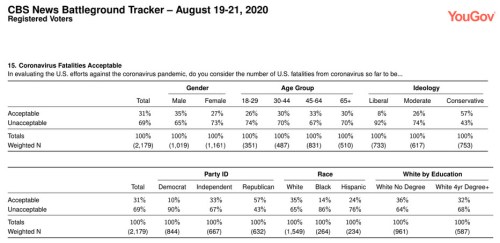
CBS/YouGov Poll – August 21-23, 2020:
In evaluating the U.S. efforts against the coronavirus pandemic, do you consider the number of U.S. fatalities from coronavirus so far to be Acceptable or Unacceptable
Total: 31% Acceptable/69% Unacceptable
Democrat: 10% Acceptable/90% Unacceptable
Republican: 57% Acceptable/43% Unacceptable
The number of U.S. coronavirus fatalities so far is 175,000, with predictions that by the end of the year it will be 300,000 or more.
As striking as that Acceptable number is, it may not be the most significant number.
From the start of the Trump presidency, we have been trying to measure the “Trump base.” There have been many estimates, and like others, I have said that it was somewhere around 30%.
Now we have solid proof that this number is just about right. Separate from any judgments, merely acknowledging that some number of the deaths were preventable, if you believe that 175,000 Americans dead is “acceptable”, you are under the influence of some powerful force. And in this case, for that 31%, that force is Trump. They are the do-or-die base.
Knowing that the Trump base is 31% of Americans is valuable information. While it still doesn’t tell us anything definitive electorally, it does tell us, whoever wins, what we will be facing. One-third of America, however they were disposed before all this, now has a diametrically different vision of everything. This goes beyond the minority vision that Trump is somehow a good and effective president. It is an entirely different country than the other two-thirds lives in.
It’s going to be a bumpy–and for too many deadly–ride.
Lost
If everyone is lost
(they won’t admit it but they are)
why not get lost yourself
instead of following them?
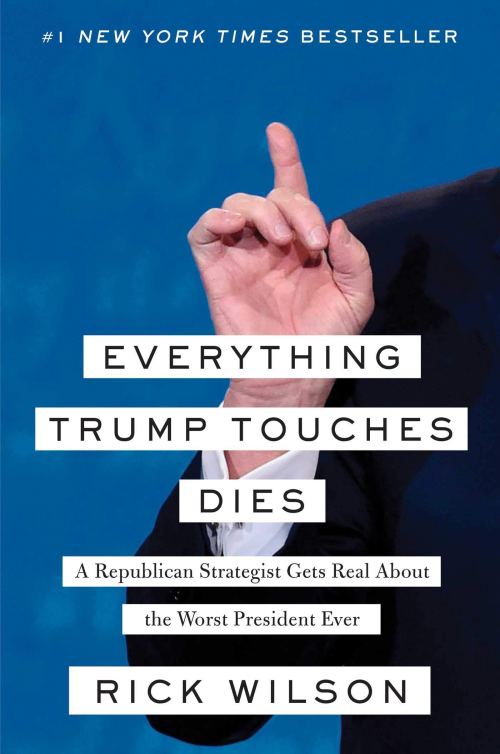
When Rick Wilson published his book Everything Trump Touches Dies, it seemed like the title was a metaphor, or maybe a polite way of saying that everything Trump touches turns to s***.
Anyway, the pandemic in America has proven that the title is literal, not figurative. Which leads to a question for college football. If Trump says that playing this fall is a good idea–that it is necessary–should you follow his lead? Or should you run as fast as possible in the opposite direction, given that his track record on the pandemic is so perfect–perfectly wrong?

I’ve scoured the streaming services and my own collection for a movie that would serve as medicine for the pandemic.
I don’t just want to be distracted, though that is helpful. I want to be lightened and leavened, as if lifted in a hot air balloon on a sunny day, floating over pleasing and fascinating lands and seas.
That’s why I am watching The Princess Bride (1987), as I have dozens of times before. It is a fairy tale for children and adults, written by William Goldman from his novel and directed by Rob Reiner.
Maybe no movie has every contained such a right measure of engaging plot, wit and charm that so appeals to viewers of all ages. Need pandemic medicine? Watch The Princess Bride.

Raise your hands if you’ve ever used Wikipedia. Okay, put them down.
Raise your hands if you use Wikipedia regularly. Okay.
Raise your hands if you’ve ever donated to keep Wikipedia, a non-profit service, up and running. Uh-huh.
A few times a year, Wikipedia pops up a request for donations. This time around, they suggest $2.75, or more if you can. Only 2% of Wikipedia users donate. 2%.
The nonprofit Wikimedia Foundation provides the essential infrastructure for free knowledge. We host Wikipedia, the free online encyclopedia, created, edited, and verified by volunteers around the world, as well as many other vital community projects. All of which is made possible thanks to donations from individuals like you. We welcome anyone who shares our vision to join us in collecting and sharing knowledge that fully represents human diversity.
Those of us who consider ourselves serious researchers acknowledge that Wikipedia should only be a starting point for research (though many people don’t recognize that). Those of us who consider ourselves serious researchers also acknowledge that lots of times, it is precisely where we do start. We can imagine a world without Wikipedia, but we agree it would be a less informative and entertaining one.
Please donate to Wikipedia today.
One thing now obvious is that brave and aggressive plans to resume conventional life—in business, schools, sports and other institutions—are going to be waiting a while longer. The profound impact of these delays can’t be minimized.
Like it or not, new and often unfamiliar ways are being forced upon us. The good news is that there are plenty of creative and adaptable people to help fashion these new ways. Lots of the options may not be comfortable or familiar, but we’ve got what we’ve got.
As these ways are being fitted to our lives (or our lives fitted to them), we should keep up our spirit of optimism. But we should place that precious optimism carefully. For the moment, some loud or fanatical hopes for immediate institutional normality are just wasted whistling in the dark. Instead, that optimism should be transferred to whatever we do now and to the ways things will be when we emerge from this moment.
We can make this work. We can make this work.
If you are a regular viewer of TV news about the pandemic, you have watched the expertise of Dr. Peter Hotez. Peter Hotez MD PhD is Professor of Pediatrics and Molecular Virology & Microbiology, and Dean of the National School of Tropical Medicine at Baylor College of Medicine where he is also Co-Director of the Texas Children’s Center for Vaccine Development.
He has just published COVID19 in America: An October Plan. It is hopeful, remarkable in its simplicity, but not necessarily easy:
We have an option. Through federal leadership and guidance, we could bring our entire nation towards a level of containment sufficient to safely open schools, colleges, and even host sporting events. We could return Americans safely to the workplace….
Implementing the October 1 plan will force America to make some difficult choices, but none as devastating as the mounting deaths if we choose to simply stay the course.
COVID19 in America: An October Plan
Within a few weeks, we will reach the awful milestone of 100,000 new COVID19 cases per day, next 225,000 deaths by October 30, and possibly 300,000 deaths by the end of 2020. However, it is not too late to chart a different course. By October 1, we could safely reopen our schools, colleges, and businesses. Potentially we could even launch a college football season or the NFL?
Our homeland security threat
COVID19 has gone beyond dangerous levels in America. We just surpassed 65,000 new cases per day, and I estimate that currently one-quarter of all the world’s COVID19 cases now occur in the Southern US. Soon we will reach Dr. Anthony Fauci’s projected apocalyptic benchmark of 100,000 new cases per day (https://www.nytimes.com/2020/06/30/us/politics/fauci-coronavirus.html). In addition, we are experiencing dramatic increases in hospitalizations and ICU admissions across the southern half of the United States, and as predicted, the number of deaths has spiked. The University of Washington just estimated that 225,000 Americans will die by October 30 (https://covid19.healthdata.org/united-states-of-america), and potentially that number could reach close to 300,000 by the end of 2020. To place that number in perspective the terrible 1918 influenza pandemic that lasted until 2020 (or some say 2022) caused 675,000 deaths in the US (https://www.cdc.gov/flu/pandemic-resources/1918-pandemic-h1n1.html). This COVID19 public health impact does not include the many “recovered” patients with long-lasting disabilities resulting from virus injury to their lungs, vascular system, and heart, as well as potentially long-term neurologic and cognitive deficits.
Soon, practically every American will personally know someone who has gotten very sick or hospitalized with COVID19.
Still another aspect is my concern that low-income neighborhoods across the South – where social distancing is often more difficult and essential workers must physically be in their place of employment – are now being decimated. COVID19 is a health disparity, and LatinX, African American, and Native American people are pouring into emergency rooms, hospitals, and ICUs. For me this is the most heart-wrenching aspect of COVID19 and a reason I speak out.
It is more than public health
Beyond the dire public health impact of the 2020 COVID19 epidemic in America are the socioeconomic effects. The impact on jobs and the economy has been well-reported, but equally important is the fact that now millions of Americans feel unsafe. Many of us are fearful of leaving our homes or having our children in school. It is also impossible to imagine how schools can be considered safe in areas of the country where virus transmission is accelerating. Within a few weeks of opening schools in the South, teachers, staff, bus drivers, parents will become ill, and require hospitalization. School staffs will become demoralized, and schools will again close. In time, a collective feeling of futility and hopelessness will become pervasive. Our nation will be left vulnerable due to internal unrest, cybersecurity attacks, and more, as COVID19 transitions to a homeland security threat.
We do not have to live this way
Adding to America’s frustration is the knowledge that many European and other nations are now returning to normalcy in the aftermath of their springtime COVID19 epidemic. Transmission is way down, allowing schools and colleges to reopen safely, while people return to work and enjoy cafes (https://www.bbc.com/news/world-europe-52935145), and restaurants.
What went so terribly wrong?
Why did Europe successfully emerge from its COVID19 epidemic while America still struggles and even faces a much larger threat in the coming weeks and months?
The successful nations implemented a national plan and roadmap with a target date and target goals of reaching defined levels of virus containment.
There are different metrics used to define containment. For some it means, one prevalent COVID19 infection per million residents (http://www.healthdata.org/sites/default/files/files/Projects/COVID/Estimation_update_041720.pdf). For others, one new case per million residents per day. Under these circumstances, public health measures, including testing, contact tracing, syndromic surveillance, and effective public health communication can would prevent a resurgence.
In contrast, the US never really had a federal plan and roadmap. There was no federal directive or visible champion for implementing a national strategy. In its place, our federal government ceded control to the states. It forced the states to make its own decisions, while the US government provided important FEMA and other support, including ventilators, protective equipment, and supply chain management.
This approach was doomed to fail from the beginning:
The result was predictable: A fragmented, arbitrary, and broken COVID19 response.
The consequence: The US is the epicenter of the global COVID19 pandemic, and we will maintain this status in the future.
In the current trajectory, COVID19 will only get much worse as we head into the fall and winter. Compounding our epidemic is the likelihood that season influenza will soon return, and we could see another measles resurgence given the decline in vaccination rates (https://www.cdc.gov/mmwr/volumes/69/wr/mm6919e2.htm).
The default is that we might soon endure the greatest public health catastrophe in the history of the United States over the last hundred years.
The Fix: A New National Plan
We have an option. Through federal leadership and guidance, we could bring our entire nation towards a level of containment sufficient to safely open schools, colleges, and even host sporting events. We could return Americans safely to the workplace.
To do this by October 1 we now need to do the following:
We have few choices
Doing nothing or continuing a strategy based on states in the lead will only invite further tragedy. By late in the fall every American will personally know someone who is severely ill or hospitalized with COVID19. Hospitals across America will be overrun, hospital personnel will become sick in droves, and we might experience 300,000 deaths by the end of 2020. Moreover, we won’t have a safe and effective COVID19 vaccine anytime soon. My earliest timetable is the middle of 2021, and even then, that timeframe would be a world land speed record.
This will become one of the most unstable times in the history in the United States.
Implementing the October 1 plan will force America to make some difficult choices, but none as devastating as the mounting deaths if we choose to simply stay the course.
Peter Hotez MD PhD is Professor of Pediatrics and Molecular Virology & Microbiology, and Dean of the National School of Tropical Medicine at Baylor College of Medicine where he is also Co-Director of the Texas Children’s Center for Vaccine Development.
Do you know what angel gear is?
Angel gear
the neutral gear in a motor vehicle, especially when used to coast downhill
You may have figured out that it is called “angel gear” because when you coast down a long steep hill really fast, there is a good chance you will end up as an angel.
There are thousands of examples of people—some pretty smart—putting their brains in neutral as they plan pandemic strategies.
Some of these plans make me chuckle, because crying has to alternate with something.
Some in college football, for just one of many examples, still believe they can proceed with a fall season provided they follow stringent practices. One practice is that any player who tests positive will be out for 10 days and that any players who come in contact with him—including other players—will quarantine for 14 days. Any contact.
As some have pointed out, this could have just one infected player causing the quarantine of most of his own team and much of an opposing team.
In a related “strategy,” some teams have suspended pre-season contact practices so that at least the team itself will not be immediately decimated by discovering an infected player. That way, the team will at least get to start the season, though of course it will be a season with contact. It is after all football.
It is completely understandable that people and enterprises want to find ways to continue functioning, for so many practical and life-affirming reasons. But that can’t come with abandoning reason and putting brains in neutral. That downhill is still too steep and deadly.

