Bob Schwartz

Category: War

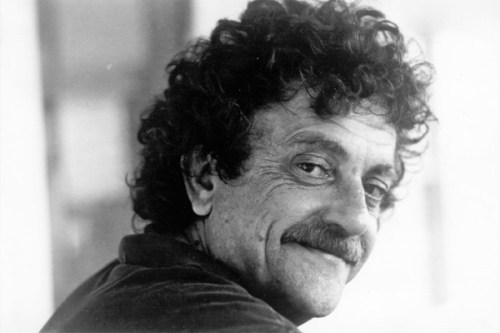
Slaughterhouse-Five


Kurt Vonnegut

A friend in Israel has been corresponding with me about the current mess there. He is a proud and passionate American-Israeli. In the course of the conversation, he mentioned Dresden.

I, along with millions of others, can’t think of Dresden without thinking of Kurt Vonnegut. There is some chance, if you are of a certain age, that you don’t know Dresden or Vonnegut, so here is a summary.

In February 1945, just a few months before World War II ended, the Allies firebombed the city of Dresden, Germany. Much of the city was destroyed and tens of thousands lost their lives. At the same time, Allied prisoners of war were being held by Germany in Dresden.

Kurt Vonnegut was one of the most interesting and original writers of the 20th century, and he influenced the cultural lives of readers throughout the 1960s and beyond. He was also one of those prisoners of war who was an eyewitness to the destruction in Dresden. He tried for more than twenty years to write about it, and finally in 1969 published his novel Slaughterhouse-Five, a title reference to the Dresden slaughterhouse in which he was held. It is a masterpiece, but not what anyone would expect a novel about the horrors of war to be like. It is, though, precisely what you might expect from Vonnegut.

The first chapter is his factual history of how he came to write this book. That chapter alone is worth reading, even if you think you don’t want or wouldn’t like the rest. In it, he recounts this conversation with a friend:

Over the years, people I’ve met have often asked me what I’m working on, and I’ve usually replied that the main thing was a book about Dresden.

I said that to Harrison Starr, the movie-maker, one time, and he raised his eyebrows and inquired, “Is it an anti-war book?”

“Yes,” I said. “I guess.”

“You know what I say to people when I hear they’re writing anti-war books?”

“No. What do you say, Harrison Starr?”

“I say, ‘Why don’t you write an anti-glacier book instead?’”

What he meant, of course, was that there would always be wars, that they were as easy to stop as glaciers. I believe that, too.

And even if wars didn’t keep coming like glaciers, there would still be plain old death.

Please read Slaughterhouse-Five (and more Vonnegut if you are so moved). You will be glad you did.

Suit and Tie: The Sad and Silly Syrian Election

Syrian President Assad Votes

It is reported that President Bashar al-Assad wore a dark suit and light blue tie for voting in today’s Syrian election. Good reporting. He looked good. So did his wife Asma.

Assad actually had opponents, the first time Syria has had a contested presidential election in fifty years. No one could think that this opposition meant anything. The other candidates could not think so. And yet there were supporters and voters at the polls, maybe out of fear, maybe out of hope, maybe just wanting to pretend things are normal. Some new normal, so that with one more term, a few more years added to his enlightened regime, there would be no more deaths after the 160,000, no more displaced and refugees after the millions.

Journalists and other nations are sworn by a sense of fairness and professionalism and diplomacy and sovereignty to pretend that this is an election, even if they have some quibbles. They might, if they had a better sense of irony or humor, treat it like Halloween or Mardi Gras. An occasion on which one dresses up to play the part of something you are not, say, a democratically elected leader in dark suit and light blue tie.

The U.S. also had an election during a civil war. Lincoln did have opposition and he did win. Whatever he wore when he voted, he certainly didn’t look as slick as Assad, nor was Mary Todd as socialite beautiful as Asma. By that point Lincoln was deeply tired and sick of the horrible conflict and would do anything he could to finally end it. The good news is that there would be only a few more months of war. The not so good news is that even with the good that came, it would take decades for the wounds to begin healing. The worst news, for Lincoln and the country, is that he would soon be assassinated.

Lincoln and the civil war were sad but never silly. Assad, in his dark suit and light blue tie, within this hollow semblance of an election, is sad and morbidly silly. Unlike Lincoln, he may be around for years, continuing to rack up votes and deaths. But looking real good.

VA Health Crisis: Listen to IAVA

VA IG Report

We should listen to the Iraq and Afghanistan Veterans of America about this VA health system crisis.

As the name implies, IAVA represents the latest generation of American war veterans. They are in some ways the most attuned to the current realities and sensibilities of veterans’ issues in 2014. Not because they have been around the longest, but because they are native to the way things work, or don’t, here in the early 21st century in America.

Those realities regarding the health care crisis in the VA are shocking to some, but come as no surprise to those who have watched it happening, including Congress (both parties) and the President.

Is it fixable? What won’t fix it is political posturing, handwringing, or even the delayed but imminent departure of VA Secretary Shinseki.

What will fix it? Good policy well executed, without excuses or cover up. The IAVA can help with that.

In the wake of yesterday’s Inspector General Report about the Phoenix VA health system, IAVA CEO and Founder Paul Rieckhoff said:

The new IG report on the Phoenix VA is damning and outrageous. It also reveals the need for a criminal investigation. Each day we learn how awful things are in Phoenix and across the country. The VA’s problems are broad and deep – and President Obama and his team haven’t demonstrated they can fix it. As one of only two combat veterans, Senator John McCain’s call for Secretary Shinseki’s resignation is particularly impactful…

Today’s report makes it painfully clear that the VA does not always have our veterans’ backs. Even before this report came out, IAVA members were losing confidence in Secretary Shinseki and President Obama. At Memorial Day events across the nation, our members voiced outrage, anger, and impatience at the growing VA scandal. This new report only increases the belief that the promise to veterans has been broken. We are sharing this report now with our members and seeking their reaction. In the coming days, we will share the voices of our members with the President, VA leaders and those in Congress.

In the IAVA 2014 Policy Agenda, the VA health system was just one of a number of initiatives offered for consideration. On that score, IAVA recommends this (excerpted):

I. Establish a Presidential Commission to end the VA claims backlog.

II. Transform the Veterans’ Benefits Administration’s (VBA) adversarial culture…

III. Reform VA’s work credit and productivity evaluation system for claims processor….

IV. Outline the VA’s responsibility about the requirements to substantiate a claim….

V. Adopt the “treating physician rule” for medical evaluations for compensation and pension…

VI. Require appeals form to be sent along with the Notice of Decision letters in order to expedite the appeals process.

VII. Evaluate the Segmented Lanes work initiative to continually assess whether it is meeting the goals of fast tracking…

VIII. Report the intake of new compensation and pension claims on the Monday Morning Workload Report.

IX. Report separated statistics on the intake and processing of supplemental and original claims in the Monday Morning Workload Report…

XIII. Continue to engage veteran stakeholders in updating the VA Schedule for Rating Disabilities (VASRD).

XIV. Require the VA to accept a PTSD diagnosis provided from a qualified private medical provider.

X. Establish a model to accurately project the claims workload and the resource and staffing requirements needed to meet the demand.

XI. Make all disability benefits questionnaires available to private medical providers.

XII. Simplify notification letters to provide easily digestible, specific and clear information about the reasons for rating decisions.

XV. Allow the VA to incentivize private medical providers to furnish medical health records to the VA for processing.

XVI. Clarify and report accuracy ratings for each regional VA….

This is an agenda, and if the President and the good people of Congress want to adjust or add, that is their prerogative and duty. But you have to start somewhere, with something on the table, and this is a good place for that. If these warriors are smart enough and capable enough and honorable enough to fight our wars, they are surely able to suggest the smart, honorable, and capable ways of treating them when those wars are over.

The Ukrainian Favor

Ukrainian Contingent Ends Iraq Mission

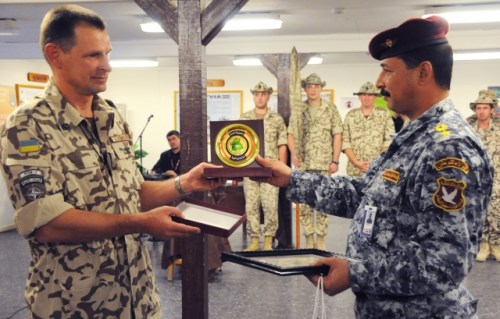
Commander of the Ukrainian contingent in Diwaniya presents a certificate and gift to
a member of the Qadisiya Province Iraqi Police, during an end of mission ceremony
at Camp Echo, Dec. 9, 2008.

“Are you asking as a friend or calling in a chit? A friend would not ask me to do this.”
“A friend just won’t hold it against you if you don’t.”
Adapted from Suits, USA Network

In 2008, Ukrainian troops officially left the U.S.-instigated Iraq War. Since 2003, 5,000 Ukrainian troops had served there (the third largest contingent in the multinational force) and 18 soldiers had died. No service or sacrifice can be minimized, even if these numbers pale in comparison to the American investment. Ukraine answered the call with honor and valor, as it had in other international conflicts, presumably because there are principles at stake, including the principle that modern internationalism means a commitment to mutual trust and support.

At the ceremony marking the end of the Ukrainian mission, Maj. Gen. Michael Ferriter, deputy commanding general for operations, Multi-National Corps-Iraq, said:

We know that violence is at its lowest level in five years, and the Iraqi Security Forces, partnering with Coalition forces, will take the lead in defending their country. And soon, the Iraqi people will vote in the future of their country in the provincial elections. These changes were not brought about naturally, but were instead brought about by the dedication and the hard work of the men and women from the nations such as yours. You helped create the Iraqi Security Force and instilled in them a solid foundation of skills essential to the future security and prosperity of Iraq.

To Iraq’s benefit, and through Ukraine’s efforts, you have helped ensure a higher quality of life for the people of Iraq. Ukraine forces made contributions that enabled all Coalition partners to be successful here, but it has not been without cost. A precious 18 Ukrainian Soldiers have died here.

Ukraine is asking for help from anyone to hold their country together. Under the circumstances, that is going to be difficult and may not be possible.

Are they asking as a friend or calling in a chit? If we don’t provide adequate or effective help, will they hold it against us? Should they?

Putin and the Little Engine That Could

Vladimir Putin - Little Engine

The pro-Russian insurgency in eastern Ukraine, and the Russian warnings to stay away and out, are not surprising. A fifth-grader doing a Social Studies assignment (if there is still Social Studies) had this one figured out.

So obviously did the American intelligence and foreign policy experts. They can’t tell us they know because that would give something away, even if that fifth-grader has already guessed. The other reason it isn’t officially talked about is that, officially, few are sure what to do next.

Vladimir Putin is well set up, for something. He can take little bites out of the region, or if Ukraine should erupt in instigated civil war, he can enter on the pretext of assuring the stability and security of a neighboring country. There is plenty of historical precedent for this strategy, and for this strategy working.

We—and this includes those who claim to know him—are not sure exactly who Putin is: cunning statesman, cowboy, sociopath? Whether he has himself killed people, up close, is a matter of conjecture, but many have no trouble believing it. German Chancellor Angela Merkel, who grew up in Communist East Germany and knows him, suggests that he is out of touch with the realities of the situation. Former U.S. President George W. Bush just displayed his painting of Putin, which picture says as much about W. as an artist as it does about the Russian President.

Putin is not out of touch with reality, any more than those people who believe that visualizing an outcome will ultimately make it so. He is under no delusion that realizing his reality will be cost free. He is just willing to pay the price, or allow others to chip in, maybe profoundly.

The U.S. may have the most distorted view of war in history. It isn’t that great sacrifice or valiant service haven’t been made. The U.S. didn’t just participate in some of the most significant defenses of human freedom; it helped freedom prevail. But for a few generations, there has been a lot of blood and treasure sacrificed in a sometimes well-meaning, sometimes self-serving fog. The source of the confusion is that for more than 150 years, the U.S. has not experienced national war on its soil. Regional conflicts and shocking, fleet- and building-destroying hostilities, but not a national war, inside or on our borders.

Whatever the list of solutions to international problems and provocations, war shouldn’t just be at the bottom of the list. It should be in some strategic sub-basement, below the last resort. At this moment, war in Europe is where it should be: unthinkable. But if something is unthinkable, then everything else has to be more thinkable, more discussed. Right now, the U.S. body politic is fascinated with other matters major and minor, because we need a break.

But trust this: Putin doesn’t give a care for what happened to a plane that has been at the bottom of the Indian Ocean for weeks. He is single-mindedly like that favorite American children’s book The Little Engine That Could, chugging along: I think I can, I think I can.

We don’t have to be concerned about Ukraine or we can be concerned. We don’t have to take action or we can take action. We don’t have to go to war or we can go to war. What isn’t optional is talking about it in the public square, in a conversation led by the President and others. This is not jumping the gun. It is a sensible prelude to an emerging situation, which could at any moment escalate from blah-blah-blah to something more active and serious.

The U.S. has not been very good at sensible preludes. The run-ups to recent wars have been filled with hyper-drama, fueled by the occasional exaggeration or lie. Ukraine, Europe, and the world need something else. Putin thinks he can. Who knows what we think?

Afghanistan Loves Russia

Hamid Karzai - Congress

Karzai and Putin sitting in a tree
K-I-S-S-I-N-G

In 1979, Russia invaded Afghanistan. The U.S. supported the insurgents who eventually chased Russia out of Afghanistan. In 1989, Russia left Afghanistan.

In 2001, al-Queda attacked the U.S on September 11. That same year, the U.S. sent troops to Afghanistan to remove the Taliban from power and to eliminate their safe haven for Osama bin Laden and al-Qaeda.

In 2004, Hamid Karzai was elected President of Afghanistan. That image above shows him addressing a joint session of Congress on June 15, 2004, with Vice President Dick Cheney and Speaker of the House Dennis Hastert applauding.

In 2011, the U.S. found and killed Osama bin Laden. Plans were made to withdraw U.S. troops from Afghanistan, but not before thousands of U.S. and other allied troops died, in the longest war in U.S. history.

In 2013, negotiations began with President Karzai for an agreement that would allow some U.S. troops to remain in Afghanistan in a support role after withdrawal. President Karzai, not wanting to appear to be in friendly partnership with the U.S., has so far failed to reach such an agreement.

Today, President Karzai announced that he supports the Russian position in Crimea, putting him in the same league as Syria, North Korea, Iran, and Venezuela. We still have troops in Afghanistan. The troops who died on behalf of President Karzai are still dead. The Afghans who died at the hands of the Russians are still dead. There are no reports yet about whether Dick Cheney or Dennis Hastert are still applauding.

There are no words to make sense of this. So instead, here is the Afghan flag, along with an explanation of the flag from the ever-authoritative CIA Factbook. Note especially the part about the Afghan flag having more changes in it than any other national flag in the 20th century. As always, a funny old world.

Afghanistan Flag

Three equal vertical bands of black (hoist side), red, and green, with the national emblem in white centered on the red band and slightly overlapping the other two bands; the center of the emblem features a mosque with pulpit and flags on either side, below the mosque are numerals for the solar year 1298 (1919 in the Gregorian calendar, the year of Afghan independence from the UK); this central image is circled by a border consisting of sheaves of wheat on the left and right, in the upper-center is an Arabic inscription of the Shahada (Muslim creed) below which are rays of the rising sun over the Takbir (Arabic expression meaning “God is great”), and at bottom center is a scroll bearing the name Afghanistan; black signifies the past, red is for the blood shed for independence, and green can represent either hope for the future, agricultural prosperity, or Islam Afghanistan had more changes to its national flag in the 20th century than any other country; the colors black, red, and green appeared on most of them.

Putin’s Moldovan Invasion v. Dynasty’s Moldavian Massacre

Dynasty Royal Wedding
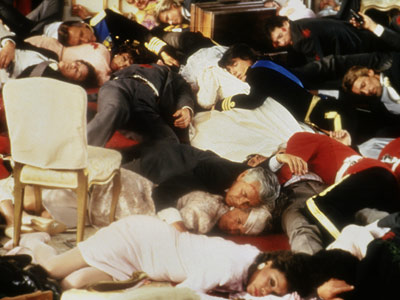
A cliffhanger is a cliffhanger. Russia may be about to invade its neighbor Moldova, based on troop buildup along the border. Almost thirty years ago, on May 15, 1985, the ABC series Dynasty ended Season 5 by leaving the world hanging, as terrorists invaded and shot up the royal wedding of Prince Michael of Moldavia and Amanda Carrington.

(Note: To clarify the Moldavia/Moldova confusion. Moldavia is a traditional region that now straddles the nations of Romania and Moldova. The language of Moldova is Romanian, and the Romanian name for Moldavia is Moldova. The producers of Dynasty may or may not have been aware of this, or that Moldova was at the time a part of the Soviet empire, or much else geographic. Dynasty was not a documentary or reality series. “Prince Michael of Moldavia” just sounded so cool and romantic, as was the fake country.)

Who would survive this now infamous Moldavian Massacre (you can watch it here)? Viewers of Dynasty, then #1 in the ratings, would have to wait all summer to find out. Meanwhile, that season-ending episode reportedly attracted 60 million viewers.

Will Putin invade Moldova, claiming that just as with Crimea, Moldovans are pleading to join up with their Russian friend and neighbor (and former ruler)? How will the world respond? How will Putin respond to that? That’s a real cliffhanger. And even though Putin seems to be playing a part in a costume epic, in which he is the royal hero, a sort of Putin’s Dynasty, this is no television series. Perhaps Czar Vladimir of Russia will wake up and see that.

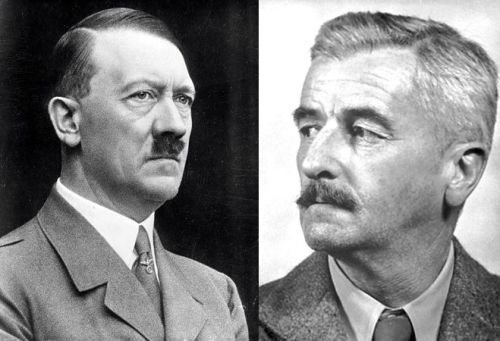
Ukraine: Adolf Hitler and William Faulkner

Adolf Hitler - William Faulkner
The term lingua franca means a language that is understood across cultures. It literally means “Frankish language,” referring to a hybrid language that was used for commerce and diplomacy during the Renaissance. Today, one might call English a lingua franca, since unofficially and officially (as in air transport), it is the one universally used and understood.

In contemporary history, the person who comes up most often as an historical analogy is Adolf Hitler. For good reason. Others may have killed more. Others may have conquered more territory. But Hitler did it all, ignited world war, and did it in our times, in living memory, and in ways that shaped the world—and thus shaped our thinking and conversation now and for generations to come. He is the historical persona franca.

A previous post pointed out that Putin’s post-Olympics invasion of Ukraine bested Hitler’s annexation of Austria in March 1938. Hitler waited almost two years after his self-promotional 1936 Berlin Olympics before the Anschluss; somewhat bizarrely, even though Putin politely waited for two days after the Paralympics in Sochi closed, the annexation of Crimea was effectively done while the Olympics were still being held.

When Hillary Clinton mentioned in a speech that Putin’s actions were reminiscent of Hitler, she was shushed up by her supporters and her detractors. Talk like that was deemed premature, alarmist, undiplomatic, and, in Hillary’s case, unpresidential. And yet as events have sped along, the mentions increase. Just today, the former U.S. Ambassador to Russia had to admit that we have not seen an event like the annexation of Crimea since…the 1930s. And whether Hitler is a persona franca or a trump card, Putin uses it himself, claiming that the Ukrainian ouster of Yanakovych was orchestrated by Nazi thugs who are now in power.

History matters, and Hitler matters in history, whatever use he may be in thinking about the critical issues developing in Ukraine. This year is the centennial of World War I (also known as THE World War and the War to End All Wars, before there was a second one). So maybe take a little time to learn a little more about Europe in the period from 1914 to 1945—a mere thirty years or so in which there were two world wars, one of the most evil men in history, an attempt to eliminate an entire people from the earth, and the development of an apocalyptic weapon that gives God a run for his money.

Why learn this history? Because literally everything that is in the news about Russia and the Ukraine is joined with it. Because history never goes away, particularly in Europe. Or anywhere. As William Faulkner wrote, having lived in the American South where history never goes away, where understanding history is the only way to understand today, “The past is never dead. It’s not even past.”

Anschluss 1938

Anschluss
History doesn’t have to be analogical, though that is often tempting. Instead, it can just be generally informative, not predictive about how particular parties may act and should react, but just as lessons in the variety of global experience.

In March 1938—the anniversary just passed last week—Hitler annexed Austria, an event now known as the Anschluss. Here, for general information, and not necessarily for comparison, are excerpts from the BBC Bitesize site:


Hitler wanted all German-speaking nations in Europe to be a part of Germany. To this end, he had designs on re-uniting Germany with his native homeland, Austria. Under the terms of the Treaty of Versailles, however, Germany and Austria were forbidden to be unified.

Hitler also wanted control of the largely German-speaking area within Czechoslovakia, called the Sudetenland. Importantly, Austria shared a border with this area.

In an attempt to realise his goals, Hitler was determined to destabilise Austria and undermine its independence. His ultimate goal was anschluss (union) with Austria…

The new Austrian Chancellor, Schuschnigg tried to preserve the country from German invasion by trying not to give Hitler an excuse for aggression. He tried to co-operate with Hitler as much as possible…

Hitler ordered Austrian Nazis to create as much trouble and destruction as possible in order to put pressure on Schuschnigg. If Hitler could claim that Austrian law and order had broken down he could justify marching German troops into Vienna to restore peace – despite the fact that he was responsible for the chaos in the first place.

Four days in March

Wednesday 9th March 1938

On the 9 March 1938, in a desperate act, Schuschnigg announced a referendum whereby the Austrian people would decide for themselves if they wanted to be a part of Hitler’s Germany. Hitler was furious. If the Austrians voted against joining Germany his excuse for invasion would be ruined.

Thursday 10th March 1938

Hitler told his generals to prepare for the invasion of Austria. He ordered Schuschnigg to call off the referendum. Knowing he would receive no help from Italy, and that France and Britain would not interfere in Hitler’s plans, Schuschnigg conceded. He called off the referendum and resigned.

The Nazi Austrian Interior Minister, Seyss-Inquart, was ordered by Hitler to ask for German help in restoring order in Austria.

Friday 11th March 1938

Hitler reassured Czechoslovakia that they had nothing to fear.

Saturday 12th March 1938

German troops marched into Austria unopposed. Hitler now had control of Austria. A month later, Hitler held a rigged referendum. The results showed that the Austrian people approved of German control of their country.


Note: Czechoslovakia indeed had something to fear. That same year, Germany invaded the German-speaking Czech region, the Sudetenland, and ultimately conquered the entire nation. It was that invasion that prompted the intervention of British Prime Minister Neville Chamberlain, who tried to “make peace” with Hitler at the infamous Munich conference.

In 1968, exactly thirty years later, the Prague Spring of political and cultural liberalization led to an invasion of Czechoslovakia by the Soviet Union. Fortunately, the spirit of that spring was never fully crushed, and inspired a flowering of sometimes secret creativity and rebellion.

Ukraine: What’s Happening on the Weak Side?

Basketball
The weak side in basketball does not suggest weakness. It is the part of the court away from the ball. This doesn’t mean that the players there are weak or that the action there is unimportant. On the best teams, there can be almost as much happening on the weak side as there is on the strong side. Players may be running around, positioning themselves to take advantage, either by scoring or by taking away the ball. On the lesser teams, weak side players sometimes seem to drift aimlessly, or just stand around, depending on someone else to somehow work it out. If you don’t have the ball, what else is there to do?

We know exactly where the ball is in the current Ukraine crisis. And we know exactly who has the ball. The question is what the players on the weak side are doing. Are there plays carefully diagramed by the coach, practiced for just such a situation? Is there a player away from the ball, away from the basket, just waiting to heroically steal and drive all the way down court? Or are the weak side players drifting, trying to remember plays they once learned or improvise new ones?

The shot clock is running.