Bob Schwartz

Category: War

Masters of War

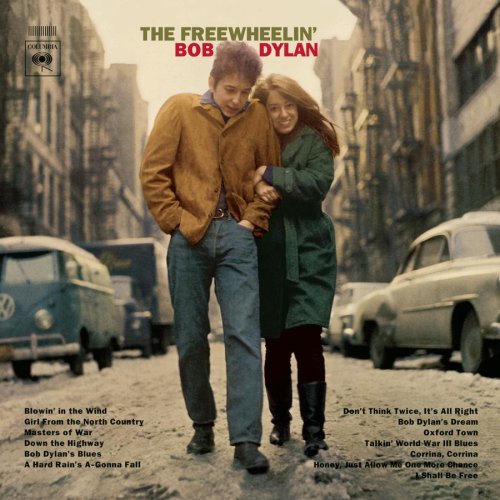
Freewheelin' Bob Dylan

Even Jesus would never
Forgive what you do
–Bob Dylan, Masters of War

Masters of War is a track from The Freewheelin’ Bob Dylan (1963). As a recording, it couldn’t be farther from current slick production values. It is a young brilliant artist strumming a guitar, singing in a pretty idiosyncratic way.

It is a song about war, but it isn’t an anti-war song; listening to it reveals that, and Dylan later confirmed it. It is about the people behind the curtain, the people on the battlefield, the people caught in the crossfire. War is a serious business that we don’t take seriously enough. Let all us put our motives, prejudices and and agendas brutally on the table, setting aside high-minded and sometimes dishonest pretexts, explanations and excuses.

All the verses are critical, but the last verse is bitter, angry and vindictive. Is that justice? What should we do with the masters of war? We have tried in modern times to build reasoned ethical oversight and standards of justice. After World War I, the war to end war, the Geneva Conventions. After World War II, trials –and executions–of perpetrators and international courts of justice. But what happens when the oversight and standards are breached and belittled? Would Jesus forgive? Should we?


Come you masters of war
You that build all the guns
You that build the death planes
You that build the big bombs
You that hide behind walls
You that hide behind desks
I just want you to know
I can see through your masks

You that never done nothin’
But build to destroy
You play with my world
Like it’s your little toy
You put a gun in my hand
And you hide from my eyes
And you turn and run farther
When the fast bullets fly

Like Judas of old
You lie and deceive
A world war can be won
You want me to believe
But I see through your eyes
And I see through your brain
Like I see through the water
That runs down my drain

You fasten the triggers
For the others to fire
Then you set back and watch
When the death count gets higher
You hide in your mansion
As young people’s blood
Flows out of their bodies
And is buried in the mud

You’ve thrown the worst fear
That can ever be hurled
Fear to bring children
Into the world
For threatening my baby
Unborn and unnamed
You ain’t worth the blood
That runs in your veins

How much do I know
To talk out of turn
You might say that I’m young
You might say I’m unlearned
But there’s one thing I know
Though I’m younger than you
Even Jesus would never
Forgive what you do

Let me ask you one question
Is your money that good
Will it buy you forgiveness
Do you think that it could
I think you will find
When your death takes its toll
All the money you made
Will never buy back your soul

And I hope that you die
And your death’ll come soon
I will follow your casket
In the pale afternoon
And I’ll watch while you’re lowered
Down to your deathbed
And I’ll stand o’er your grave
’Til I’m sure that you’re dead

The Rubicon and the Pillar: If We Pass This Little Bridge


The Lives of the Twelve Caesars
By Suetonius

XXXI.

…The lights going out, he [Julius Caesar] lost his way, and wandered about a long time, until at length, by the help of a guide, whom he found towards daybreak, he proceeded on foot through some narrow paths, and again reached the road. Coming up with his troops on the banks of the Rubicon, which was the boundary of his province, he halted for a while, and, revolving in his mind the importance of the step he was on the point of taking, he turned to those about him, and said: “We may still retreat; but if we pass this little bridge, nothing is left for us but to fight it out in arms.”

XXXII.

While he was thus hesitating, the following incident occurred. A person remarkable for his noble mien and graceful aspect, appeared close at hand, sitting and playing upon a pipe. When, not only the shepherds, but a number of soldiers also flocked from their posts to listen to him, and some trumpeters among them, he snatched a trumpet from one of them, ran to the river with it, and sounding the advance with a piercing blast, crossed to the other side. Upon this, Caesar exclaimed, “Let us go whither the omens of the Gods and the iniquity of our enemies call us. The die is now cast.”

Veterans Month and Mental Health

It is appropriate to talk about this Veterans Day 2018—Sunday, November 11—when talking about veterans and mental health.

Veterans Day was originally celebrated as Armistice Day, the day that World War I ended. This Veterans Day marks the one hundredth anniversary of the end of “the war to end all wars.”

Modern awareness of the widespread psychological effects of warfare began early in World War I, with the phenomenon of “shell shock.” In looking back at the war, there is still a question of how many cases were, in terms then used, “commotional” (due to explosions at close range) and how many cases were “emotional” (due to the psychological experience of war). In either case, numbers of warriors came home different and troubled—troubles which might last for the rest of their lives, and even serve to shorten those lives.

In the wars since, different theories and treatments have been developed, different labels have been attached. Today, those of us on the outside of this experience know it as PTSD. Those on the inside know it as the hell of war and its aftermath.

This will be another month—since a day is absolutely not enough—of honoring veterans. Judging by the still inadequate attention and support, they are more honored in the breach than in the observance. Among the failures too long to list is insufficiently acknowledging and taking responsibility for the mental health of those who we send to serve.

If you don’t want war—blessed are the peacemakers—then work for that. If you want war, or reluctantly think that war is necessary, treat those you send to fight for you as your own family, your own siblings, your own children. Because they are somebody’s.

“Afghanistan’s Charlie Chaplin says he aims to make people smile, forget grief”

“His live performances provide respite in a city that routinely gets attacked by Taliban insurgents and suicide bombers, mainly claiming allegiance to Islamic State.”

For those who think that they have troubles in their lives and in their nation, or that laughing doesn’t help, or that one person can’t make a difference, even if just a small and temporary one, for your consideration:

Reuters:

Afghanistan’s Charlie Chaplin says he aims to make people smile, forget grief

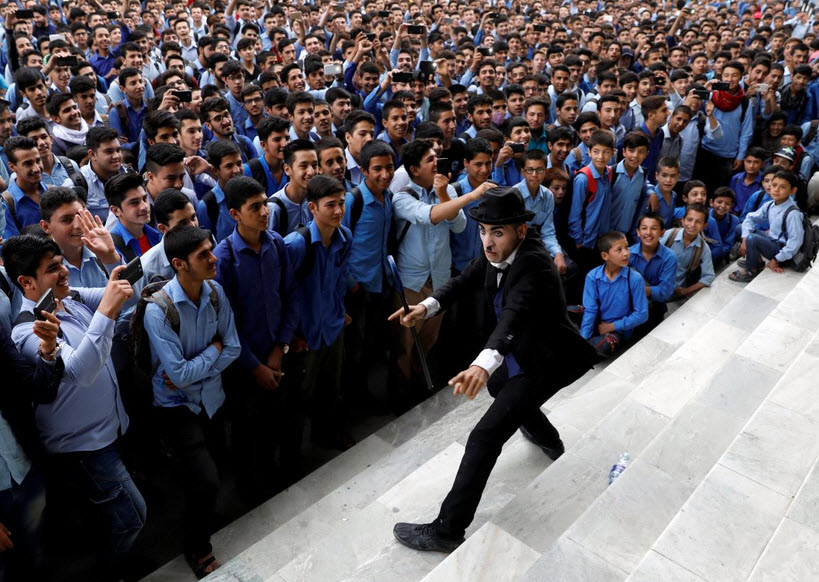
KABUL (Reuters) – Afghanistan’s Charlie Chaplin says he has witnessed suicide attacks, explosions and threats from hardline Islamic militant groups, but is determined to waddle and bumble to fulfill the primary goal of his life.

“It is very simple, I want to give Afghans a reason to smile,” said Karim Asir, a stand-up comedian who performs across the capital Kabul in Chaplin’s trademark oversized shoes, baggy pants, cane and black bowler hat.

Asir, 25, said Chaplin impersonators are found all over the world helping people ignore grief and making them laugh, and he does the same.

Asir’s early years were in Iran, where his family fled after the hardline Taliban took control of Afghanistan in 1996. There he saw performances of Chaplin on Iranian TV.

After the family returned home, Asir started wearing make-up and recreating Chaplin’s characters in his performances, despite his parent’s apprehensions.

His live performances provide respite in a city that routinely gets attacked by Taliban insurgents and suicide bombers, mainly claiming allegiance to Islamic State.

Asir says he has been threatened by militants who say his performances are un-Islamic. But despite the threats, he performs in public parks, orphanages, private parties and at charity events organized by international aid agencies.

“I want to give my people a chance to forget their problems such as war, conflicts and insecurity in Afghanistan,” he said.

In Kabul, when Asir’s fans surround him to take selfies, he smiles but is constantly worried about attacks.

“I am afraid of getting attacked by a suicide bomber or an explosion but these issues cannot stop me from being Charlie Chaplin,” he said.

Christmas for Refugees

How could you say to me,
“Off to the hills like a bird!
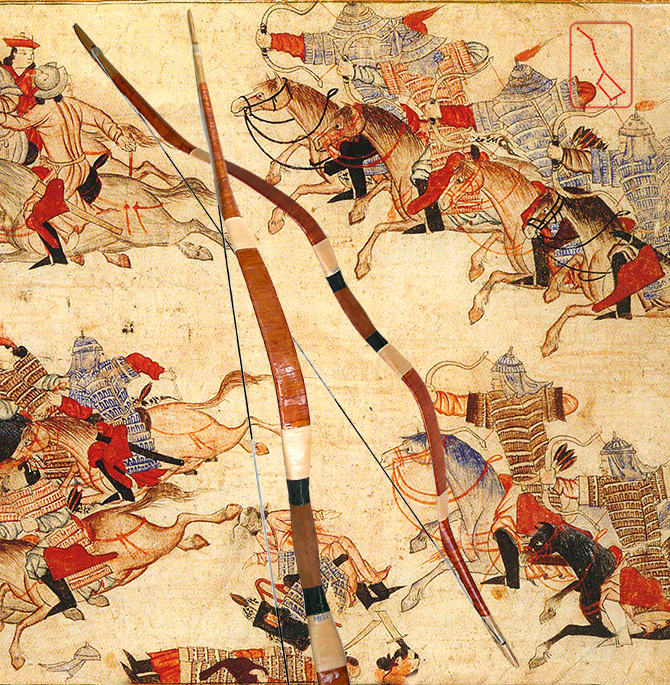
For, look, the wicked bend back the bow,
they fix to the string their arrow
to shoot from the gloom at the upright.
The foundations destroyed,
what can a righteous man do?”
Psalms 11:1-2 (Robert Alter translation)

Now after they had left, an angel of the Lord appeared to Joseph in a dream and said, “Get up, take the child and his mother, and flee to Egypt, and remain there until I tell you; for Herod is about to search for the child, to destroy him.” Then Joseph got up, took the child and his mother by night, and went to Egypt,
Matthew 1:13-14 (NRSV)

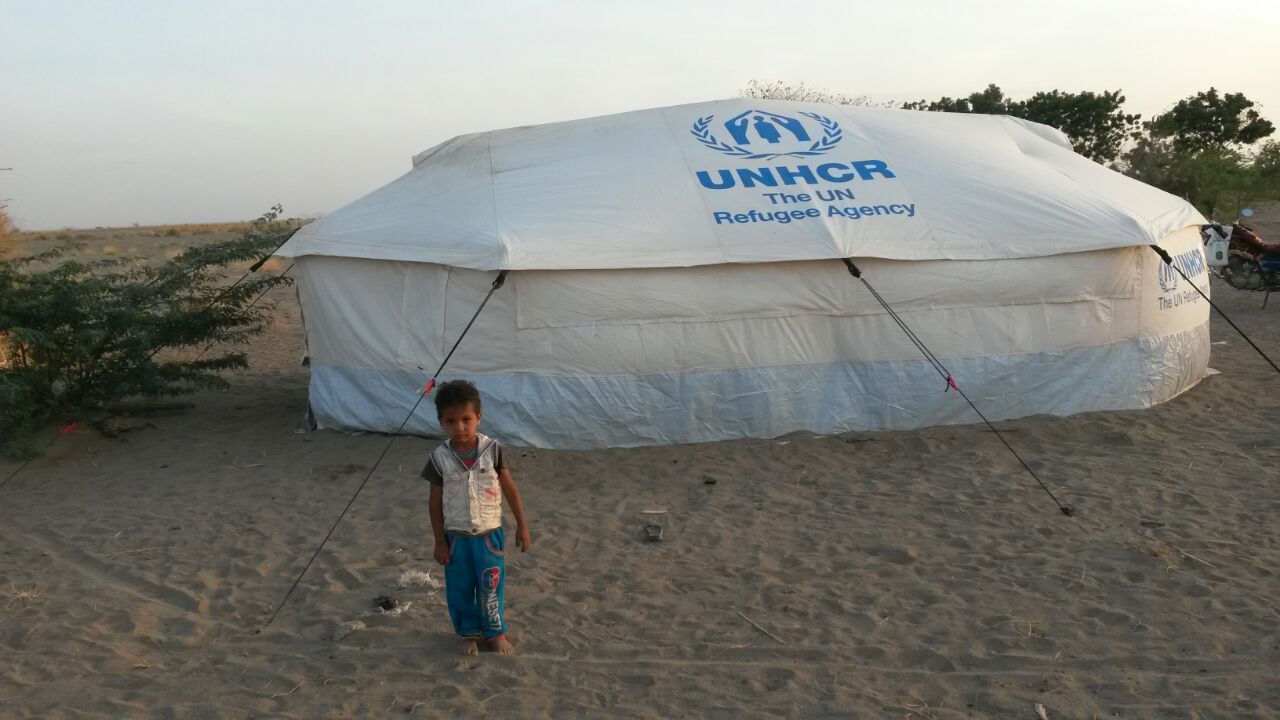
The wicked bend back the bow. The innocent flee. Give this Christmas to the UNHCR.

A Very Short Primer on Veterans

1. When we as people of a nation order or ask others to fight for any cause, we must treat them, their service, and their families with the highest practical lifelong honor and healing, that is, with more than just symbols or rhetoric.

2. As we order or ask for that service, from the first we must study the causes that we are fighting for, in light of all our truest values, not just the values that are convenient, expedient, self-serving or inadequately considered.

3. While we will likely never be a world without warriors, we owe it to the warriors—past, present and future—to be peacemakers.

​The UN Declares Nuclear Weapons Illegal 

Some think the United Nations is naive and childish at best, and at worst a way for small nations and idealistic dreamers to get in the way of superpowers doing the dirty and necessary grown up business of the world. 

That is the context of the vote (122 of 193 nations) to declare nuclear weapons illegal, a vote that was boycotted, derided and ignored by those superpowers. 

The UN is not naive and the vote is not ridiculous. From the start, the UN was meant to stand in the way of tragedy, or help fix it when it couldn’t be avoided. The UN is in part the collective conscience of the world, and like conscience, is set aside for the sake of pragmatism and convenience. 

The first and only time atomic bombs were used in war was 72 years ago. Since then, the power and quantity of those weapons has grown exponentially, as has the number of nations owning them. What is naive and childish is to think that the power and numbers won’t continue to grow. Thinking that keeping nations such as Iran and North Korea out of the club is a solution, while existing members continue to stockpile, is delusional. There will always be another nation, always more and more powerful weapons. 

Also delusional is the thought that having avoided the use of nuclear weapons for 72 years demonstrates a likelihood that it will never happen again. Looking back at millenia of brutal geopolitics, we would laugh if that thought isn’t so painfully ignorant. 

It’s true that the UN declaration, even with a majority of nations behind it, has no practical effect. But it should leave every citizen and every nation thinking about this all the time, from practical and philosophical perspectives. It seems that the concept of normal is eluding us more and more, but if every house in your town was filled with lots of highly dangerous explosives, how normal is that? How would you sleep? Do you trust your neighbors, all of them, any of them, that much? 

Be Peace

6 Long has my whole being dwelt
among those who hate peace.
7 I am for peace, but when I speak,
they are for war.
Psalm 120, translated by
Robert Alter

Terror in Manchester is one more shattering note in a cacophony of mindless aggression. News of the nation and the world attests to it, from nasty tweets by so-called leaders to torturers and mass murderers. We dwell among those who hate peace.

In Psalm 120, Robert Alter translates the Hebrew ani shalom in verse 7 as “I am for peace”:

The Hebrew appears to say “I am peace,” but, without emending the text, the most plausible way to understand these two words, ani shalom, is that they function as though there were an elided “for” (in the Hebrew not a word but the particle l’).

I dare not take issue with Alter, the great modern translator of the Hebrew Bible, but merely want to extend a thought. If the Hebrew appears to say “I am peace”, maybe that is precisely what it means to say.

Being for peace is a start and an essential part. Being peace is one step beyond this, where there is no space between us and the peace we seek. One step toward that elusive peaceful world, in spite of those who hate peace.

China’s Big Long View: “Swords Drawn and Bows Bent”

In a story about current tensions between the United States and North Korea, this was reported:

“The United States and South Korea and North Korea are engaging in tit for tat, with swords drawn and bows bent, and there have been storm clouds gathering,” China’s foreign minister, Wang Yi, said in Beijing, according to Xinhua, the state news agency.” (emphasis added)

It is hard to imagine the American President or Secretary of State using such poetic language to describe such a serious situation. But allusions to swords and bows is not just poetic. It reflects the thousands of years that China has had to deal with situations just like this.

In the world, few nations, and none so powerful, are as young as the United States. We tend to equate power with enlightened perspective, but that is silly. Even the European nations can’t compare their histories to the long and hard lessons that many Asian nations have learned.

It is no accident that in the years since the end of a series of modern Asian wars involving the West—World War II, Korean War, Vietnam War—Asian nations have to some degree risen and dominated in various ways. China in particular. These nations have had to ride the wave of history, going back to times when swords and bows were the tools of strategy and subjugation, of victory and defeat.

Many Americans think that the most significant global affairs began a couple of centuries or so ago, when this nation emerged in North America as the perfection of what our European ancestors tried but failed to accomplish. Like all precocious children, we think that it is all about us, especially because of our might and our ability to damage and destroy. Those who have seen it all before are careful not to provoke us, but know that no matter how big our weapons, they are only swords and bows, about which they have much more experience.

Trump Van Winkle

The U.S. just dropped the biggest non-nuclear bomb ever on an ISIS target in Afghanistan.

The president apparently believes he can “defeat” ISIS and “win” the war in Afghanistan by dropping really big bombs. The biggest. Sad that no one thought of that before.

A number of times in world situations (and in domestic situations too) it appears that Trump has been completely absent from any discussion, debate or learning for decades. It doesn’t matter, since his opinion, at least until recently, has been based mostly on what he sees and hears on the news and on his emotional gut reaction. And as with most uninformed gut reactions, subject to change at a moment’s notice

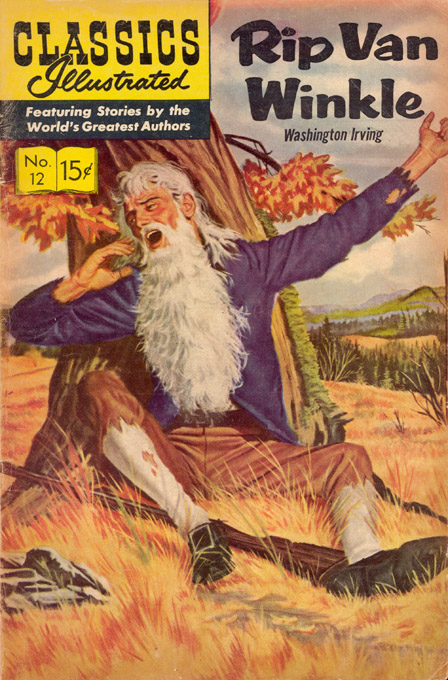
Or maybe he’s been asleep. Like Rip Van Winkle, who slept for at least 20 years, only to wake up and discover a strange but more satisfactory world. Maybe one in which he is suddenly president.