Bob Schwartz

Category: Uncategorized

Claude AI (aka Bucky) helps us become great generalists
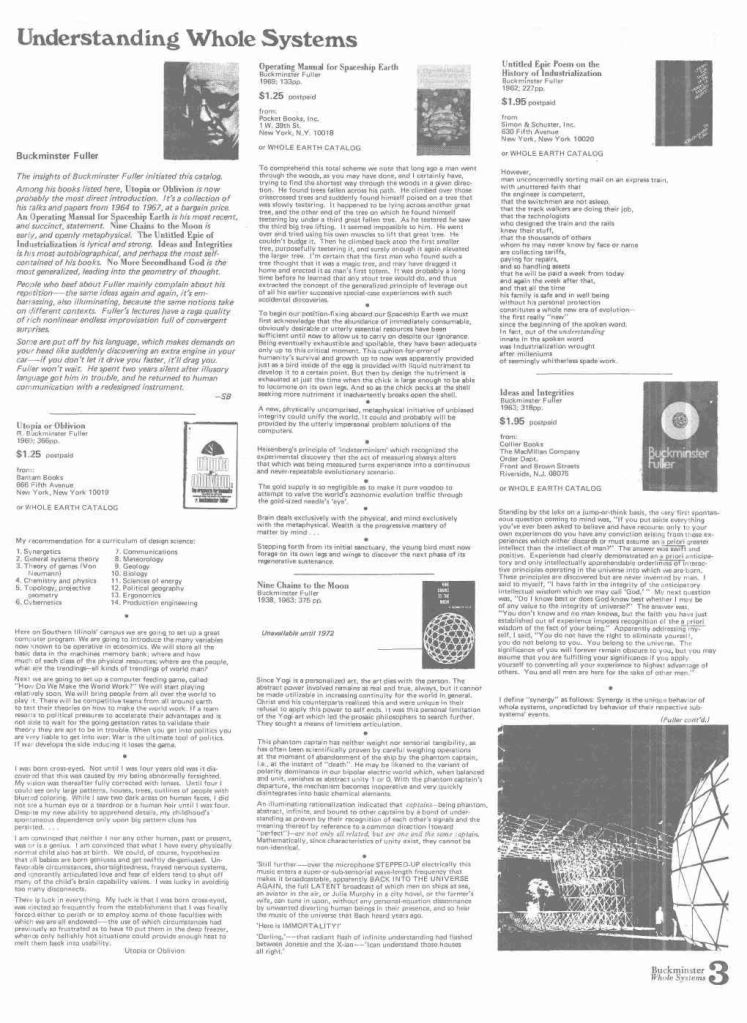
Whole Earth Catalog

R. Buckminster Fuller (1895-1983)—widely known as Bucky—was a world-changing architect, systems theorist, writer, designer, inventor, philosopher, and futurist. He was a genius and prophet of generalism. He believed that over-specialization narrows us and stands in the way of solving problems and envisioning the future.

When Stewart Brand began publishing the Whole Earth Catalog in the 1960s, he put Fuller’s books on the very first page. “The insights of Buckminster Fuller initiated this catalog,” he wrote. As a mission for the holistic all-encompassing general reach of the catalog Brand said, “We are as gods and might as well get good at it.”

Fuller attributed his big-picture holistic perspective to his service as a naval officer in the early 20th century. At the time, and in some ways still, ships at sea were almost entirely self-sufficient. Those on board had to know about everything and be able to do anything. That is reflected in one of his most famous books, Operating Manual for Spaceship Earth.

Claude and other AI resources can help us become better generalists. The World Wide Web (thank you Tim Berners-Lee) was a major step in that direction. AI is the next step. It is not that Claude can access trillions of words while even the best of us only know thousands. It is that when we are motivated to know more about lots of things—which as gods we should want—we have a new resource to help us be the generalists that we need to be. Now more than ever.

© 2024 by Bob Schwartz
Crumbs

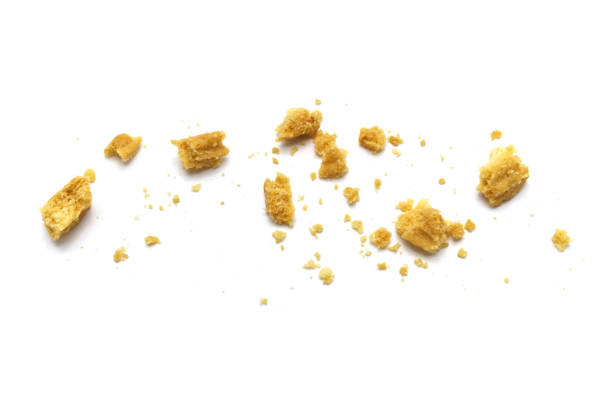
Crumbs are wheat and water
A meal for a bird
Or starving man
Untidy for the well-fed
A trail of clues
To a way out
The loaf is whole again
In water and wheat

© 2024 by Bob Schwartz

Haman in Gaza (Purim 5784)


“There is a certain people. They do not keep the king’s laws, so that it is not appropriate for the king to tolerate them. Let a decree be issued for their destruction.”
Esther 3:8

Haman is in Gaza
God is not
in Esther

The cost and danger of earnest equivocation

And to the angel of the church in Laodicea write: The words of the Amen, the faithful and true witness, the origin of God’s creation:
I know your works; you are neither cold nor hot. I wish that you were either cold or hot. So, because you are lukewarm, and neither cold nor hot, I am about to spit you out of my mouth.
Book of Revelation 3:14-16 (NRSV)

There are two kinds of equivocation. One is the careless “oh well” or “whatever”. The other is a concerned and studied “on the one hand, on the other hand”.

There can be value in a subtle and nuanced analysis that leads to an equivocal conclusion and solution. It can be a corrective to a stubborn, thoughtless or selfish attachment to one argument or one side.

But circumstances and situations don’t stand still. If and when one side goes from inconvenient and troubling outcomes to dangerous and tragic ones, what then for an equivocal position? It is possible to claim that changed circumstances now change the equivalence. But we can’t pretend that the delayed rebalancing, the belated abandonment of equivalence, has not had a cost and irretrievable loss.

It may be late to choose non-equivocation. Late to choose cold or hot. Late for those who would otherwise be alive and thriving. But never too late.

© 2024 by Bob Schwartz

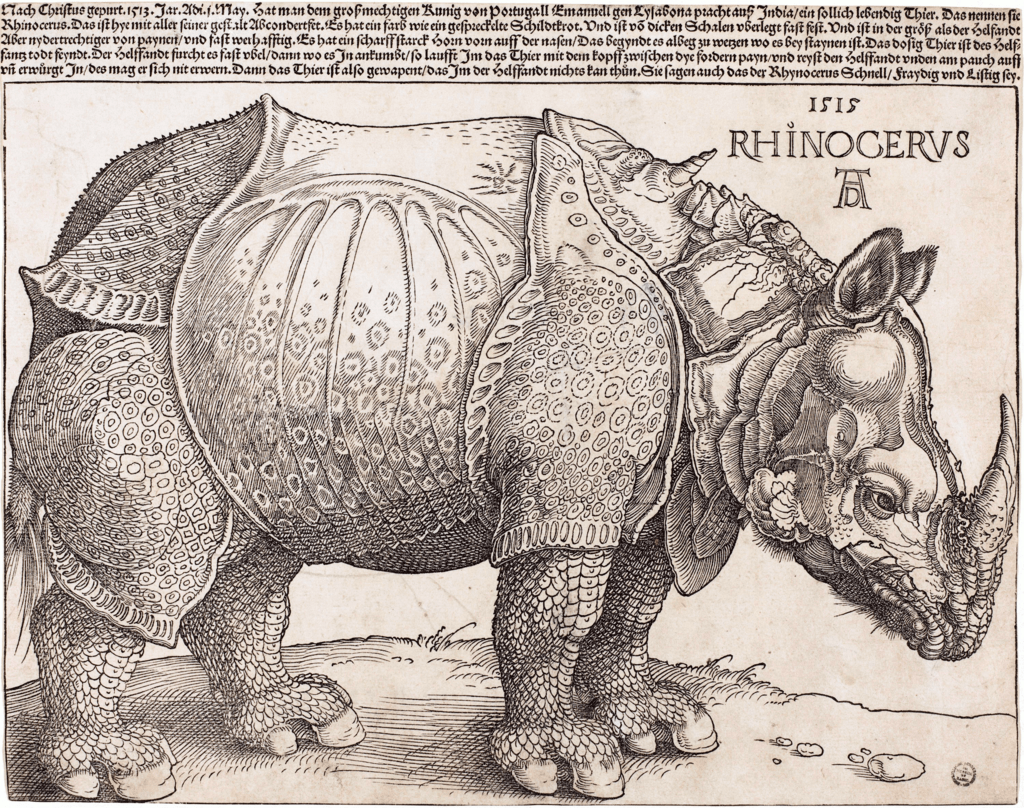
Bring me the rhinoceros fan

Rhinoceros, Albrecht Dürer

I began today listening to birds:

If birds sing in the morning
Why not me
Why not we

I quickly turned to a rhinoceros.* There is a famous Zen koan that has nothing to do with birds. Also everything to do with birds, even if they are not mentioned.

I thought of writing about the koan here. Funny that I haven’t before. I thought of sending friends the koan, found at Blue Cliff Record 92, without explanation or commentary. What would they think? What do you think?


Yanguan (750-843) called to his attendant, saying, “Bring me the rhinoceros fan**.”
The attendant said, “It’s broken.”
Yanguan said, “If the fan is broken, then bring me the rhinoceros.”
The attendant didn’t answer.


*I didn’t intend for that sentence to be multi-layered, but it could be. I wrote “turned to” to mean changing the subject. One of the great absurdist plays by Eugene Ionesco is Rhinoceros, in which the people of a town one-by-one turn into a rhinoceros. It is sometimes interpreted as a parable about people turning into Nazis during World War II.

**Likely an expensive item, made of rhinoceros horn or picturing a rhinoceros. Not someone who is fanatical about rhinoceros.

© 2024 by Bob Schwartz

Critical mass: Truth/nonsense ratio in public life

Note: Originally I used the word “bullshit” instead of “nonsense”. Even if many of us use the word regularly, it does have a harsh ring. Feel free, when you read “nonsense” to make the substitution.

I am not an expert on the impact of truth and nonsense in public life. I am, however, familiar with both.

For this purpose, I define truth as reasonable, rational, well-informed and even-handed discussion of actuality. Nonsense is discussion that is untruthful, ill-informed, illogical and driven by ideology. Of course many things don’t and can’t neatly fit into those categories. But for this purpose, they will serve.

The premise is that there is always a ratio of the two. Society, the nation, the world are more livable and workable when that ratio is at a certain point. If the ratio of truth to nonsense gets too low—say one part truth to two or three parts nonsense—trouble is on the way, or has already arrived.

That ratio has reached a critically low point in American public life. It shouldn’t be necessary to list the many examples. One election and one major public figure should be enough.

When nonsense overwhelms truth, rather than it just being an unavoidable and unhelpful element, the consequences can be dire and unpredictable. People who value truth grow discouraged and demoralized. People begin to wonder whether truth is achievable or worthwhile pursuing. People begin to think that nonsense in public life isn’t as bad as some say. In fact, for them nonsense may be the most expedient way to reach certain goals.

History is filled with times the truth/nonsense ratio has hit dangerously low levels, sometimes with truth practically disappearing. The outcomes have been tragic.

Is there a rebalancing remedy? I am a sworn optimist. But we can’t ignore that the former president was found to have told more than 10,000 lies during four years in office. That’s an average of about ten lies a day. He’s kept up the pace after leaving office, even under oath. And he’s running again, talking nonsense and having powerful people talk nonsense for him.

What can you do? Speak truth (reasonable, rational, well-informed, even-handed). Encourage and praise truth and truth telling. Discourage, uncover, dispute, politely criticize, aggressively condemn (as appropriate) nonsense, whoever and wherever.

© 2024 by Bob Schwartz

Poet and philosopher kings and queens to guide us

The School of Athens by Raphael

Plato suggested we might be best ruled by philosopher kings.

Besides adding queens, I add poets.

Politicians, scientists, all kinds of smart or not so smart people think they are the ones to lead us through our challenging times. Poets and philosophers are mostly marginalized and ignored, because they are thought to be out of touch with hard realities and useless when it comes to critical matters.

Note that it is sometimes the politicians, scientists and smart people who have created and worsened those challenging times. Poets and philosophers offer unique perspectives on those challenges and realities.

As I’ve said before, we need more poets and philosophers in our field of vision and our public lives. Ask for them to be there. And if you are one of them, be there.

© 2024 by Bob Schwartz

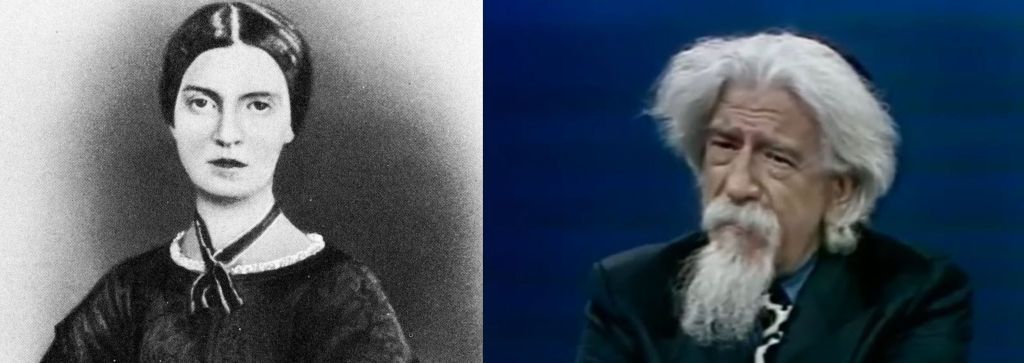
Dickinson + Heschel = Hope + Optimism

Hope is the thing with feathers
That perches in the soul,
And sings the tune without the words,
And never stops at all,

And sweetest in the gale is heard;
And sore must be the storm
That could abash the little bird
That kept so many warm.

I’ve heard it in the chillest land,
And on the strangest sea;
Yet, never, in extremity,
It asked a crumb of me.

—Emily Dickinson


“I am an optimist against my better judgment.”
—Abraham Joshua Heschel

The joy as it flies/Be passersby

He who binds to himself a joy
Does the winged life destroy
He who kisses the joy as it flies
Lives in eternity’s sunrise
—William Blake

Yeshua said, Be passersby
—Gospel of Thomas 42

The joy is passing by or you are passing by. Unattached.

Joe and Don, a small town tale

Joe sits most days on the porch of his house on Main Street. Everybody knows Joe, most everybody likes him. People passing by stop and chat. They listen to Joe’s wisdom, his stories about his life, what he’s done, what he’s seen. He can get a little nostalgic, but that’s just Joe being Joe.

Don doesn’t live on Main Street. He lives in a mansion on the hill. Every day his driver brings him around. He gets out of the limo, walks around, grabbing anyone who’ll listen. He talks and talks and talks, mostly about himself or about some cockeyed vision of the town and how it’s going to hell, unless he saves it. Some people like Don, but most people are just scared of him. He seems to be getting crazier every day. He is frightening, but some say that’s just Don being Don.

Election for mayor is coming up soon. Joe and Don have both decided to run. People are sad, because they know the town has other people who could do a better job. Will Joe get off the porch? Will Don stop threatening people? Is there something wrong with the town?

© 2024 by Bob Schwartz