AI and Coyote contemplate a candle on January 20


For more about why AI and Coyote are contemplating a candle on January 20, see How to January 20, 2025 and beyond: Keep a light lit in your window, on your desk, anywhere.
For more about why AI and Coyote are contemplating a candle on January 20, see How to January 20, 2025 and beyond: Keep a light lit in your window, on your desk, anywhere.

Those of us concerned about the next four years of American leadership, which starts today, can react and respond in many ways. We consider how to act, what to say and what to think.
Today I offer a simple idea. Not a solution, just a simple idea.
Starting today, and as long as it is valuable, keep a dedicated light lit. In your window, on your desk, wherever it can be seen by you and by others. That is far from all we might choose to do or say. But it is a bright start.
We just celebrated two holidays where light is an essential element, whether in a lamp or from a star. Also, many traditions include lights that stay lit constantly as reminders and messages.
I have long used battery-operated electric candles around the house, for various occasions. Now I see that the idea of an eternal light, on this occasion, for this purpose, can be useful.
Starting today, I am keeping one of those candles on my desk, lit at all times, and when night falls, one in my office window. What is that saying for me, what might that say for you? What if someone asks: Why is there a candle in your window, what does it mean? We might benefit from thinking about that.
If I say be happy today, January 20, 2025, you may wonder what to be happy about. Light a light, keep it lit, and you may discover.
© 2025 by Bob M. Schwartz
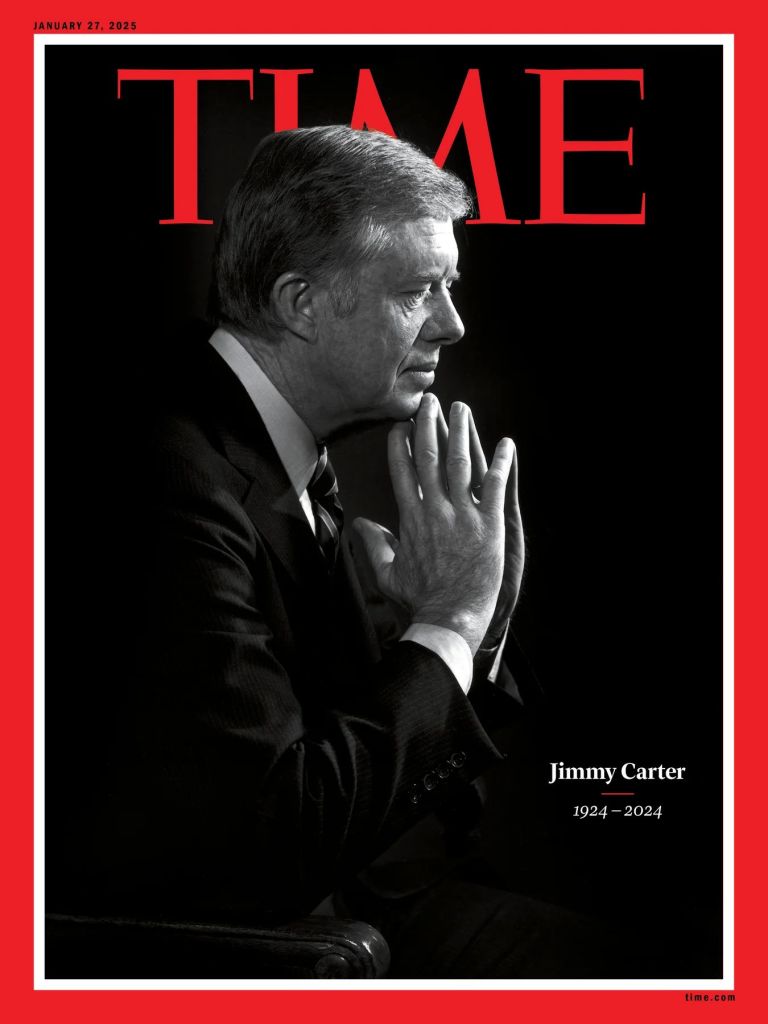
Congress has long mandated that after the death of U.S. presidents, official flags at the Capitol fly at half-staff for thirty days.
Jimmy Carter died on December 29 at the age of 100. So during the Inauguration on January 20, flags would be flown at half-staff. But Trump objected crudely, saying that Democrats were “giddy” at the possibility. Speaker of the House Mike Johnson thus ordered that during the Inauguration the flags would be fully flown.
Trump was Time magazine’s Person of the Year for 2024. But for their magazine cover on Inauguration week, we appreciate that it is this particular former president who is featured. We don’t know how Trump feels about this, though we might yet hear.
If America needs role models for moral leadership and exemplary living, we have had few presidents, maybe none, who fit the role better than Jimmy Carter.

David Lynch died this week. Praise and appreciation have been profuse.
Among his many wonderful creations is the TV series Twin Peaks.
Phil Hoad in the Guardian ranked Lynch’s films and TV shows:
The great American film-maker died this week, leaving behind a body of work unmatched in its seductive strangeness and transcendent mystery. We put it in order.
While these kinds of rankings can be controversial, there is little doubt—for me at least—that Twin Peaks is at the top. Hoad wrote:
1. Twin Peaks S1 & 2 (1990-91)
A damn fine cup of coffee. A girl wrapped in plastic. A log-carrying oracle. Grief expressed through novelty song. Thumbs up from Dale Cooper. Canada as the source of all corruption. Backwards talk from dwarves and dames. Traffic lights in the night. The leering demon behind the sofa. Like a fish in a percolator, the original Twin Peaks was where the Lynchian sensibility filtered irreversibly into the zeitgeist.
Audiences had never seen anything like it: an ostensible homage to the comforts of daytime soap opera, none of it facile or ironic, but cut with Lynch’s habitual 1950s pop-culture references, dadaist skits and appalling sexual brutality. Not only did it expand the parameters of television but it amounted to the fullest and most seductive statement of the director’s worldview; his great American cosmology, in which the forces of good and evil warred for the souls of small-town prom queens and FBI agents alike.
Yes, the second season dips badly after Laura Palmer’s killer is revealed, and Lynch was occupied with Wild at Heart and other things. But his collaborators’ flailing attempts to replicate Lynchian weirdness in his absence only served to highlight his inimitable talent for finding the offbeat route to overwhelming emotion. Every time the series called for revelatory violence or charged metaphysics (“It is happening again!”), he returned to the director’s chair and unfailingly delivered. Thanks for warning us about the Black Lodge, Mr Lynch – and see you in the White one.
By 1990, some of us had already watched thousands of hours of TV, and had already seen the dazzling strangeness of Lynch films like Blue Velvet. We had also seen some interesting and inspiring experiments in television programs. But as Hoad wrote, and is worth repeating, “Audiences had never seen anything like it.”
(On a personal note, in the midst of Season 1, I organized a viewing party for friends and printed up a little Twin Peaks booklet to follow along.)
Before Lynch’s death, I was already in the process of rewatching Twin Peaks. The moment Episode 1 began, when I heard the unforgettable theme music, and watched the opening credits, I was reminded of a central message that the experience of Twin Peaks, and other Lynch creations, reflects: Things are strange, everything is strange, and that is wonderful.
The original Twin Peaks series is streaming on Paramount+ and available on other services.

“I know not with what weapons World War III will be fought, but World War IV will be fought with sticks and stones.”
― Albert Einstein
“If in the first act you have hung a pistol on the wall, then in the following one it should be fired. Otherwise don’t put it there.”
—attributed to Anton Chekhov (a dramatic principle known as Chekhov’s Gun)
The Netflix documentary series, Turning Point: The Bomb and the Cold War, is recommended.
Nine nations have an estimated 13,000 nuclear weapons. According to the principle of Chekhov’s Gun, if you have hung 13,000 guns on stage, in the ensuing global drama, one of those weapons will be used. As one expert notes in the series, that we haven’t experienced nuclear Armageddon is not because we are smart, but because we are lucky.
We are either living in a new Cold War or never left the first one. Either way, as dark as it may be, we need to learn and contemplate exactly what a Cold War equipped with so many available nuclear weapons means.
That is the theme of the series. It covers the histories, up to the present, of the Cold War and The Bomb, which are inextricably linked. The world after World War II cleaved into two mighty factions, both convinced the other was an existential threat and must be defeated or removed. The difference from every other fight before in history is that those powers posed a literal existential threat—and still do.
Daniel Ellsberg is famous for his Vietnam War-era whistle-blowing, with his leaking of the so-called Pentagon Papers, revealing that the war was a costly and unwinnable lost cause. But years before that, Ellsberg was one of the brains at the Rand think tank, which was asked in the 1950s to evaluate the possible outcome of a thermonuclear war. Ellsberg relates his shock then and now. The estimate was that 600 million people might be killed—20% of the world’s population at the time.
© 2025 by Bob M. Schwartz
In any area, when learning, I seek teachers over time. Eventually, I may narrow that down, not ignoring the value of the others, but recognizing that as we progress, as we change, as everything changes, some are more fitting for immediate study, some less.
This has been the case with my religious life. I am neither a practitioner nor advocate for flitting from one beautiful sweet flower to another or to staying with one tradition or teacher for a lifetime. It should be a matter, as I repeat regularly, for pursuing and testing what works. One should never be reluctant to follow a single narrow road or to follow different paths that may look to others like mindless wandering. If we clearly see, not easy, that the single narrow road and the multiple paths are all one beneficial way.
Study all, study some, study one, study none.
This can apply to any area of learning. You can follow this in any direction. Start with one, expand to some or many, come back to a few or just one. Nothing will be lost or wasted, provided you keep them all carefully in mind.
But what about “study none”? Is there a point at which, whatever the path or paths, you can or should stop studying? This is subtle, so subtle that I am challenged beyond my reach. All along, wherever you are on the path, you are always studying none. One of my earliest influences, Sri Ramana Maharshi, had a nice way of dealing with this, a way consistent with many other traditions.
When asked a question about practice or philosophy by a student, he directed the student to ask “Who is asking the question?” That is, any investigation begins, and ends, with investigation of the mind asking the question. Whatever the subject, not just the spiritual but in all areas, the study is that. Of course there is much to learn in any area. That is why we have teachers, schools, and vast bodies of knowledge. But our relation to all that knowledge, to all others and to ourselves, is beyond and beneath all those studies. Which, in a crude way, is what I mean by study none.
© 2025 by Bob Schwartz
Commerce has been part of human life from the beginning. Acquiring, trading, buying, selling.
Commercial means more than that. It includes messages about acquiring, trading, buying, selling.
The difference over time has been the balance of these commercial elements with other parts of our lives and culture. One vision of a dystopian future has been one in which commercial messages are ubiquitous and constant. The more we want to acquire, trade, buy, sell, the more the messages are about doing that, and the more those messages encourage and tempt us to do that.
We may not have reached that predicted dystopia, but it is fair to say that we are living in a commercial culture, with both the commerce and the messages.
Which is why we should not be surprised that a leader emerged whose entire life has been devoted not just to commerce, but to commercial messaging. In fact, since stretching the truth, or outright lying and deception, is considered a part of commercial messaging, we should also not be surprised that the leadership involves lots of truth stretching, lying and deception. If a commercial spokesman ends up as leader, what else would we expect?
It might be good for us to back off a little—or a lot—from the commercial culture we find ourselves in. Unfortunately, it won’t result in a quick change in current leadership. But it can put us on the path to better balance between the commercial and the non-commercial. And in time, maybe find ourselves with lives and leadership involving less acquiring, trading, buying, selling, less messaging about those, and more messaging about other things of value.
© 2025 by Bob Schwartz
It is not my way to recommend religious and spiritual practices for anyone. I report my own practices, experiences and observations, leaving it to others to choose or ignore.
I am not making an exception for the Tibetan Buddhist practice of mind training, known as lojong. It took me a while—a long while, decades—to discover this. Given the wide range of Buddhist practices, the Tibetan varieties have not been a major part of my life. It is not that I haven’t studied and appreciated traditions outside of Zen Buddhism, my lifelong practice, but there are simply too many worthy paths to follow them all without getting nowhere.
But I have now discovered lojong. I can report that it is unlike any practice I have experienced in Buddhism, and more, quite unlike any practice in other religious and spiritual traditions.
Lojong is roughly a thousand years old, with refinements and commentaries over the centuries, right up to the present. Lojong consists of 59 instructional slogans, divided into seven points, aimed at training the mind. Training to do what and be what? Simply, oversimply, to live and learn wisdom and compassion. Lojong manages to encompass all of Buddhism in a series of actionable tasks.
If one does not have a live teacher, as I do not, there are a number of excellent books about lojong, along with videos by some of these excellent teachers. Some, like Pema Chodron and her teacher Chogyam Trungpa, are well-known. Others are known in the Tibetan Buddhist communities, but unfamiliar to many others. Evey one is worthy of knowing.
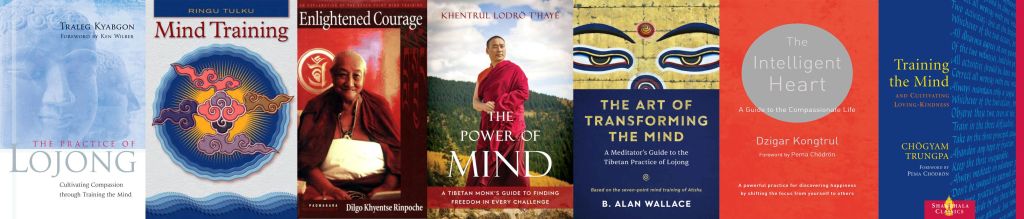
It is my way to try to be comprehensively grounded in areas new to me, as this is, and then to narrow my focus. Below is a list of those books and teachers I have found helpful in early days. I wish I could say “this is the one for me” or “this is the one for you”. I can’t. Each one offers a view that may well explain a point or that may be an expression that resonates. If I say that the order listed below is best-first, there may be a little truth in that—for me—but even that is a stretch.
The Practice of Lojong: Cultivating Compassion through Training the Mind by Traleg Kyabgon
Mind Training by Ringu Tulku
The Intelligent Heart: A Guide to the Compassionate Life by Dzigar Kongtrul
The Great Path of Awakening: The Classic Guide to Lojong, a Tibetan Buddhist Practice for Cultivating the Heart of Compassion by Jamgon Kongtrul
The Power of Mind: A Tibetan Monk’s Guide to Finding Freedom in Every Challenge by Khentrul Lodrö T’hayé Rinpoche
Training the Mind and Cultivating Loving-Kindness by Chogyam Trungpa
The Compassion Book: Teachings for Awakening the Heart by Pema Chodron
The Art of Transforming the Mind: A Meditator’s Guide to the Tibetan Practice of Lojong
by B. Alan Wallace
Training in Compassion: Zen Teachings on the Practice of Lojong by Norman Fischer
Tens of millions of Americans have seen the vision of Trump America and don’t like it. It is a vision reflected in four years of Trump as president, four years as former president, four years coming as president again. It is also based on Trump serving with a majority in both houses of Congress and a majority sympathetic to him on the Supreme Court.
The first principle: The vision for those who don’t like the Trump vision is not simply a vision without Trump. The past election veered between no-Trump and assorted other pitches. It didn’t work.
The second principle: The Democratic Party—the only alternative in an immutable two-party system—is a valuable asset but does not seem capable of providing an actionable, effective and attractive vision. America would be far worse off without Democrats as a counterbalance. But being not-Republicans and not-Trump is not enough.
Effective and attractive leaders offering actionable strategies and vision will emerge. Eventually, sooner or later. But it cannot be stressed enough: not-this is not enough, and neither is retreading visions that will not work in these times, in this nation, for and with these people. Some principles are so basic—rule of law, for example—that they should be a part of any vision. But it is not enough.
As noted, Democrats are an essential element in a two-party system now dominated by Republicans. But the thought that if Democrats can just win a slim majority here or there, or at least reduce a Republican majority here or there, is not enough. It is not a vision.
If you discover some visionary leaders, or better yet if you are a visionary leader, come forward. Proverbs 29:18 says “Where there is no vision, the people perish.” Or the wrong vision prevails.
© 2025 by Bob Schwartz
Whatever your area of study and learning—not just religion, but science, business, arts, etc.—there are those who you want to learn from and those who want to teach you. Sometimes individually, sometimes institutionally.
You may keep in mind two Buddhist principles that apply universally: skillful means and testing teachings.
Skillful or expedient means—known in Sanskrit as upaya—suggests that at any point in a life, under any particular circumstances, one method of learning may be appropriate for an individual, but at another point under different circumstances, another method may be more appropriate.
Buddha was also very specific about how an individual can choose methods and teachings. In a sutra attributed to Buddha, he recommended testing teachings, and not simply accepting teachings from any teacher—not even himself:
Don’t accept what you hear by report, and don’t accept mere tradition. Don’t jump to conclusions based on assumptions. Don’t accept a statement just because it is found in scriptures, or on the basis of general acceptance, or because it is what your teacher says. After examination, only believe and act upon what you yourself have tested and found reasonable.
—Kalama Sutta
© 2025 by Bob Schwartz
 Bob Schwartz