Bob Schwartz

Category: Uncategorized

Breaking News! U.S. Senator Tom Wright has a secret identity: Black Condor!

This is breaking news!

The story begins with archaeologist Richard Grey leading an expedition in Outer Mongolia. His wife had just given birth to a son, Richard Grey Jr.

The expedition came under attack. She hid her baby. All were killed, except for the infant.

Condors adopted the baby and taught him to fly. This led to his becoming the superhero Black Condor.

Meanwhile, U.S. Senator Tom Wright was faced with a dilemma. An appropriations bill was about to be voted on. Tom Wright knew the bill was graft, but did he want to cross his own party? He decides to vote against the bill.

The party had to get Tom Wright out of the way. They arranged to have him killed by running his car off the road. As Tom Wright lay dying, Black Condor swooped in to try to save him. Black Condor was astonished to see that he and Tom Wright looked exactly alike. Richard Grey Jr./Black Condor adopted the identity of U.S. Senator Tom Wright, committed to doing good, both as a Senator and as a flying superhero.

Most of us don’t know the names of every current U.S. Senator, so Senator Tom Wright sounds plausible, even if the rest of the story doesn’t.

Tom Wright was not a U.S. Senator. He is the creation of Crack Comics from 1940 to 1943. However, the idea of one of our Senators having a secret superhero identity is too tantalizing not to share.

Following are some of the pages that tell the story.

Would a political party run a dissident Senator off the road? While we are at it, which of our current Senators do you think might have a secret superhero identity?


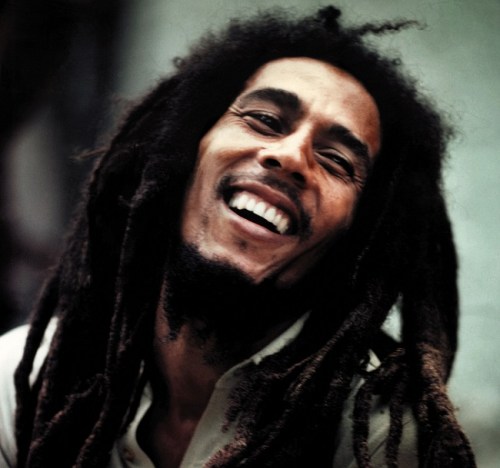
Jamaica, hurricane and freedom: Redemption Song by Bob Marley

Emancipate yourselves from mental slavery
None but ourselves can free our minds

I have not posted about Bob Marley’s Redemption Song for years.

I do listen to his music often, and with the unfortunate news about Jamaica and Hurricane Melissa, today is a good day to feature this song. Actually, given the state of so many things, every day is a good day to listen and dance to many of Bob Marley’s spirit-filled and lyrical messages.

There is redemption from craziness, but it is right here, not hereafter. He sings:

Emancipate yourselves from mental slavery
None but ourselves can free our minds…
Won’t you help to sing these songs of freedom?


Old pirates, yes, they rob I
Sold I to the merchant ships
Minutes after they took I
From the bottomless pit
But my hand was made strong
By the hand of the Almighty
We forward in this generation
Triumphantly

Emancipate yourselves from mental slavery
None but ourselves can free our minds
Have no fear for atomic energy
Cause none of them can stop the time
How long shall they kill our prophets
While we stand aside and look?
Some say it’s just a part of it
We’ve got to fulfill the Book

Won’t you help to sing
These songs of freedom?
Cause all I ever have
Redemption songs
Redemption songs
Redemption songs

Bob Marley, Redemption Song


“A mysterious mental force is behind the attack on our democracy…only young minds can resist its powers!”: The Rangers of Freedom

The Rangers batle the Super-Brain and his desperado soldiers–insidious destroyers of American freedom and democracy.

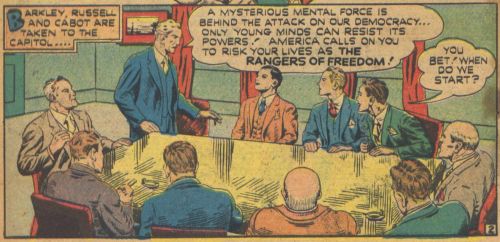
“A mysterious mental force is behind the attack on our democracy…only young mind can resist its powers!”

In October 1941, America had not yet entered World War II and the fight against insanity and fascism. That didn’t stop comic book publishers from entering the fray.

The Rangers of Freedom were a team of America’s most valiant young people who took on the lunatic enemies of democracy.

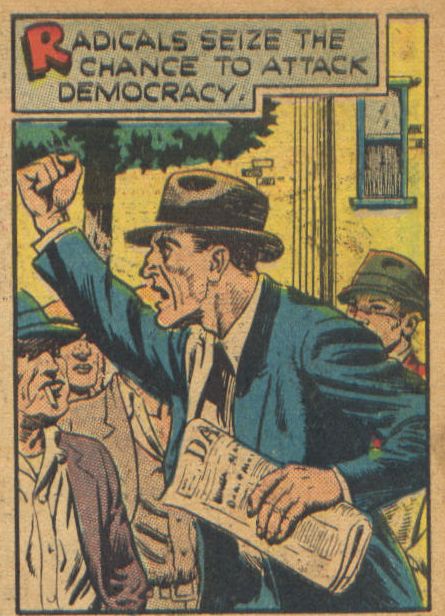
Above is the cover of the first issue. Following are some of the panels showing the fanatics and the formation of the Rangers of Freedom.

Where are today’s Rangers of Freedom? We need them now!

Rangers of Freedom
Lunatics swarm over America!
Rangers of Freedom 2
Radicals seize the chance to attack democracy.
Rangers of Freedom 3
Only young minds can resist its powers!

Talk to your things and ask them what they are doing for you and the world

Maybe you think you have too much stuff, too little stuff, or just the right amount of stuff.

I’ve acquired stuff, moved stuff, disposed of stuff, acquired more stuff.

It is not that I have too much, too little, or just the right amount. It is that each thing is supposed to be doing something, or maybe has done something, or has the potential to do something in the future.

Books on the shelf are there to be read or referred to, to serve as colorful display, and to show visitors how well-read (or at least literarily acquisitive) I am. As for the books behind cabinet doors and in the closet, well, not as much showing off. In either place, am I actually reading and referring to most of them?

Everything here is like that—useful, decorative, both. Useful for practical, intellectual, emotional, spiritual purposes. Aesthetic and eye-pleasing, or not so much. Everything.

I’ve been considering talking to each of these things individually and asking: What exactly are you doing here? I would make it clear that they are not having to plead for their life (a little disingenuous, since disposal might be in their future). I just genuinely want to know what purpose they serve.

I’m looking at the floor lamp in the corner of my office. If asked, it would be a pretty simple conversation. It is the entire light in the room when the sun is down. It is not the only light I might have here, but here it is, so when it comes to purpose, the case is made.

Not as simple with many other things, the hundreds of things, big and small, that are everywhere here. Some of them are like the lamp, obviously useful. Others, either because there are too many of them (certain pieces of unworn/unwearable clothing) or of questionable/non-existent utility (dozens of pieces of old-school electronic equipment) would have a harder time explaining themselves.

But explain themselves they should. What will each of them say? What will each of your things say? Maybe we should ask.

© 2025 Bob Schwartz

The Blue Jays bar at the end of the world

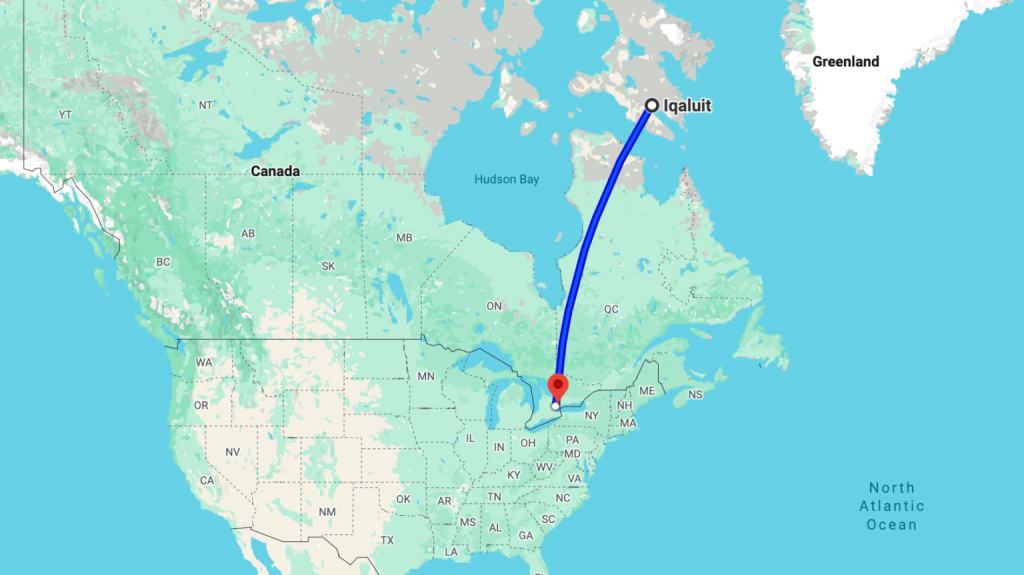
Is Santa Claus a Blue Jays fan? We don’t know, but the northernmost city in Canada is filled with Blue Jays fans, a city much closer to the North Pole than Toronto. So, yeah, it would make sense if Santa was among them.


The Blue Jays bar at the end of the world

There are no roads in and out.

Only planes can get you there, and of course, boats. But that’s only if Frobisher Bay isn’t frozen over (which it is for about nine months of the year).

Canada’s northernmost city is closer to Greenland, nearer to the North Pole, than it is to Toronto.

“It feels like we’re on the moon,” Valerie Hill, general manager of The Storehouse Bar and Grill, told me in a call.

Although the residents of Iqaluit have spotty cell service, a climate that’s more fit for polar bears and almost total darkness for much of the winter — they do, during these late, exceedingly exciting October nights, have their pennant-winning Blue Jays.

And during the team’s greatest playoff run in 32 years, they mostly gather to watch in the warmth of The Storehouse Bar and Grill — one of the few watering holes in the zero-stoplight town.

In fact, more than two percent of the city’s population can be found there….

Matt Monagan, MLB.com


Interesting photo. But did I take it or did AI make it? What is reality, man?

I took the above photo of a nearby mountain at sunrise.

(Digression: “Take” is a curious word for the act of photography. I asked my trusty fake intelligence companion Claude—no offense Claude—why we say “take” for photos. A concise answer:


The phrase “take a photo” likely comes from the early days of photography when the process literally involved “taking” something from the scene.

In early photography, you captured and fixed a unique image from reality onto a physical plate or film. The light from the scene was chemically recorded—you were essentially taking an impression or imprint of that moment. This was a one-time extraction: that specific exposure on that piece of film couldn’t be repeated.

The metaphor stuck even as photography evolved. We continue to say “take” despite now making digital copies rather than capturing something unique, because the sense of actively capturing or seizing a moment from time remains.

Other languages have similar expressions—French uses “prendre” (to take), Spanish “tomar” (to take), though some languages like German use “machen” (to make), reflecting a different metaphor.


This is a fascinating quick explanation, and I’m sure if I asked for extended analysis, I would get much more.

It is interesting that Romance languages go with take, but Germans go with “make”. Extended AI analysis would likely explain this at greater length. But this digression has gone on long enough.)

Anyone might wonder whether my taking the photo and the circumstances I described are true. I haven’t, but if I provided enough detail, an AI photo could be generated that would look something like this. Not exact, but something much like this.

Except the sun is real, the sun was really rising, the mountain is real, the sun was really casting light and dark on the mountain, I am real, and I really took the photo. I should also mention that AI is real too.

Or. A subtle Buddhist concept is to learn to treat everything as an illusion, a dream. Not that all of that, all of this, is not real, just as if it is an illusion, a dream. Which it is.

Believe me, don’t believe me, when I say that I really took the above photo of a nearby mountain at sunrise. It doesn’t matter to the mountain, or the sun, or me.

What is reality, man?

Meditation: More than just stress relief and anxiety reduction

Meditation can do more than just relieve stress, reduce anxiety and sharpen focus, although it may do all that.

To explain what that more might be, here are a couple of paragraphs from one of the best introductions to Buddhism available, by Traleg Kyabgon Rinpoche (1955-2012):


In the West, what meditation means and the reasons for practicing it are understood in many different ways. Meditation has become quite popular. Many people, particularly in the health professions, now recognize its benefits. Some people think that meditation will help them live longer, prolong their youth, lose weight, stop smoking, and so on. Meditation may do all those things, but in the Eastern traditions, such as Buddhism and Hinduism, it has a more profound meaning. Meditation is not practiced for a specific reason such as reducing stress, increasing concentration while playing sports, or dealing with anxiety. It has to be put in the overall context of how we view our lives and how we perceive the world; this can only be provided by a certain kind of philosophical or religious perspective.

Many people are frightened by the notion of religion and say, “I want to learn how to practice meditation, but please spare me the Eastern mumbo-jumbo. I am quite willing to do the breathing exercises or whatever else you tell me to do.” In the Eastern tradition, the practice of meditation relates to transforming ourselves in a fundamental way, not simply changing one aspect of our self. By transforming ourselves we are able to deal with whatever happens in our lives in an appropriate and a meaningful way.

The Essence of Buddhism: An Introduction to Its Philosophy and Practice by Traleg Kyabgon


Programmed for Joy

Programmed for Joy

Birds are programmed to sing
We are programmed for joy
Nothing stops them

© 2025 Bob Schwartz

Must listen: A Remark You Made by Weather Report

Starting in the early 1970s, Weather Report and its virtuoso composers and players—Joe Zawinul on piano, Wayne Shorter on sax, and by the time of this track Jaco Pastorius on bass—were part of the loosely-defined jazz fusion movement. Fused with what? With whatever sounded good to master musicians, in hope that listeners would come along. Their motto might have been “listen without prejudice”. Listeners did and made Weather Report musical stars.

I’ve picked A Remark You Made from the Heavy Weather album (1977), not just because it might be more pleasing to non-jazz people, but because it is so beautiful and contemplative, as indicated by one YouTube listener commenting, “I want this played at my funeral.”

O Canada: An unprecedented musical moment of Neil Young + The Band + Joni Mitchell

It is a day to honor Canada.

The Toronto Blue Jays begin the World Series against the Dodgers.

Trump has another temper tantrum over Canada:

Trump says all Canada trade talks ‘terminated’ over ad criticising tariffs
US president accuses Canada of ‘egregious behaviour’ after release of ad featuring Ronald Reagan criticising tariffs
Guardian

I’ve written about the irreplaceable place of Canadian artists in popular music:

Without Canadian artists where would we be?

To honor the Blue Jays, the Trump tantrum, etc., I offer a once-in-a-generation musical moment.

Martin Scorcese’s The Last Waltz (1978) is a documentary about the last performance of The Band, accompanied by many musical friends, at Winterland in San Francisco. The movie begins with the words “This film should be played loud!” and it should be.

The Band, all but one of them Canadians, were joined by two other legendary Canadians, Neil Young and Joni Mitchell.

Here are Neil Young, The Band and Joni Mitchell performing Young’s Helpless.