Bob Schwartz

Category: Sports

Dennis Rodman Fired from Council on Foreign Relations

Dennis Rodman
For the record, that headline is a joke.

Former NBA Star Dennis Rodman has never been a member of the Council on Foreign Relations, either before or after his surreal visit with Kim Jung Un in North Korea. The CFR says, “With nearly 4,700 members and term members, CFR’s roster includes top government officials, renowned scholars, business leaders, acclaimed journalists, prominent lawyers, and distinguished nonprofit professionals.” Dennis Rodman is not one of those.

If you have followed the story of Rodman’s North Korean visit, you may be amused.

If you have not, please do not spend a single brain cell on learning anything more. If you want any engagement at all, just take a look at the photo above of Dennis Rodman in a wedding dress (he was not getting married). Consider that he is one of the biggest stories in America today, at least for fifteen minutes. Then consider why we have difficulty solving real problems.

Presidential Debates Without Tears: Politics Isn’t Beanbag


You can’t expect objective evaluations of the first Presidential debate from either campaign. Republicans want to talk hyperbolically about a victory. Democrats may have candid ideas, but few outside the inner circles will hear them.

The significance of any competition, besides the actual win or loss, is lessons learned. After that first debate, four explanations appear:

The President and his campaign were complacent.
They misread the situation.
They could not strategize or execute effectively.
It was just a bad night.

It was probably a little of all of these. Some will think that last one is just an excuse made by losers, but if you’ve watched competitions of all kinds, sports and otherwise, you’ve seen it. It’s circumstances, it’s the moment. It’s a quantum thing.

Nevertheless, that still leaves the other three as explanations and lessons.

The most significant Republican politician of the last days of the 20th century—yes, that would be Newt Gingrich—said straight out during the halcyon days of the primaries that Mitt Romney was a liar. Whether that was said with admiration or dismay is hard to know.

During that same campaign, Romney observed that “Politics isn’t beanbag.” Detractors then and now focused on the absurdity of this reference to an obscure children’s game. It was like his mentions of trees or the Keystone Cops. Who talks like that, they scoffed.

The focus was on the wrong point of the statement. Strange as Romney may appear to many people, one thing that isn’t strange, and shouldn’t be, is his ambition. Few if any politicians have ever played beanbag, or seen a beanbag match, if that’s what it’s called. But every politician knows about fighting hard, with or without rules.

If a banner saying “Politics isn’t beanbag” isn’t hanging from the wall of the Obama debate headquarters, it should be. Everything the campaign needs to know about Mitt Romney is captured in those three words.

Penn State: Worse Than Death

There is a theme in crime and horror fiction in which someone is not killed, but is instead punished by being allowed to live and witness the degradation and demise of all that he has loved and built.

That is exactly what happened for alumni, fans and boosters, with this morning’s announced sanctions against Penn State. In advance of the announcement, some speculated that the NCAA would be creative in its punishments and that in the end Penn State might actually wish for the “death penalty” of a cancelled season of football.

Done and done.

Every current Penn State football player is free to play elsewhere this season and in future. If he is on scholarship, he can choose to stay at school but never play, and he will still receive his scholarship. Current recruits are free to commit to other colleges. Four years of no post-season play assures that first-rank players are unlikely to play at Penn State. Scholarships will be cut back. And the all-time winning record of Joe Paterno has been toppled, just like his statue, by the vacating of all team wins from 1998 to 2011.

When Penn State fields a team this year, it will be a spectacle. The team will be bereft of talent, a ghost of its gloried self. Lose or win, it will perform under fifty shades of ignominy. Even now, there may be someone at the school thinking that Penn State might be better off volunteering to take the one year break that the NCAA did not impose. That dramatic step won’t happen, but it might help convince the very skeptical—who believe that the reprioritizing of college football is beyond the reach of the most well-meaning and contrite—that Penn State really gets the magnitude of what is wrong, and that it can be a reluctant role model for a better next generation of college athletics.

The NBA And The Buddha: Discourse On The Loving Kindness Of The Player Formerly Known As Ron Artest


Just yesterday on an NBA broadcast, former Los Angeles Laker superstar Earvin “Magic” Johnson stumbled over the name of current Laker star Ron “Metta World Peace” Artest. Those quote marks for Artest are imprecise. Magic is not Johnson’s real name; it is simply the nickname accorded to him for his achievements on the court. Metta World Peace is Artest’s legal name, since he changed it in September 2011.

Over the course of his career, the adjective most often used to describe Mr. World Peace is “eccentric.” Whether or not people keep track of these things, he may have had more different numbers than anyone in NBA history; his current number 37 is the number of weeks that Michael Jackson’s Thriller album was at the top of the charts.

Beyond eccentric, he has been involved in a number of infamous altercations. In April, his elbow to the head of Oklahoma City Thunder’s James Harden caused a concussion, and resulted in World Peace’s seven-game suspension. (The speculation that Harden’s beard, which is one of the most splendid in all of sports, may have set World Peace off is unsupported.)

Earvin was dubbed “Magic” for his abilities, following a high school game that featured his triple-double of 36 points, 18 rebounds and 16 assists. NBA player Lloyd Free got the nickname “World” growing up in Brooklyn, because of his skills going to the basket, including his 360-degree turns. In 1981 he made it official by changing his name to World B. Free.

Metta World Peace did not get his name by acclamation. It was presumably chosen to reflect something about the man and the player. World Peace seems pretty obvious. But what about Metta?

Metta is a Pali word used in Buddhism. It means kindness, friendliness or compassion. The text known as the Metta Sutta (The Buddha’s Discourse on Loving-Kindness) is one of the oldest in the Buddhist canon, and is recited daily by many Buddhist monks and lay people. Here is one of many translations of this beautiful and essential work, by Sharon Salzberg:

This is what should be done
By those who are skilled in goodness,
And who know the path of peace:

Let them be able and upright,
Straightforward and gentle in speech,
Humble and not conceited,
Contented and easily satisfied,
Unburdened with duties and frugal in their ways,
Peaceful and calm, and wise and skillful,
Not proud and demanding in nature.

Let them not do the slightest thing
That the wise would later reprove.
Wishing: in gladness and in safety,
May all beings be at ease.

Whatever living beings there may be;
Whether they are weak or strong, omitting none,
The great or the mighty, medium, short or small,
The seen and the unseen,
Those living near and far away,
Those born and to-be-born—
May all beings be at ease!

Let none deceive another,
Or despise any being in any state.

Let none through anger or ill-will
Wish harm upon another.

Even as a mother protects with her life
Her child, her only child,
So with a boundless heart
Should one cherish all living beings;
Radiating kindness over the entire world,
Spreading upward to the skies,
And downward to the depths;
Outward and unbounded,
Freed from hatred and ill-will.

Whether standing or walking, seated or lying down,
Free from drowsiness,
One should sustain this recollection.
This is said to be the sublime abiding.

By not holding to fixed views,
The pure-hearted one, having clarity of vision,
Being freed from all sense desires,
Is not born again into this world.

To move from one branch of Buddhism to another (the Metta Sutta belonging mainly to the Theravada, Zen being part of the Mahayana), it seems we are faced with a Zen koan, a paradox aimed at confounding our thinking into beyond thinking:

How and why would a man known for fits of violent confrontation take the names Metta and World Peace? Is it aspirational, a reminder to him of an ideal to reach or not reach, even as he was inflicting pain? Is it instructional, forcing people to look up and find the Metta Sutta, for the benefit of themselves and all beings? Or is it, as with all koans, never meant or able to be solved, by Ron Artest, Metta World Peace, or anyone?

May all beings be at ease!

Jackie Robinson and Sanford, Florida


Last week marked the 65th anniversary of Jackie Robinson’s first major league game with the Brooklyn Dodgers, on April 15, 1947. This event was covered, though far short of the saturation coverage of stories such as the Trayvon Martin/George Zimmerman case. But there is important common ground between the two stories—Sanford, Florida.

What brought this up was watching The Jackie Robinson Story, a biopic released in 1950 and starring Jackie Robinson as himself, while he was still one of baseball’s biggest stars.

It is not much of a film (though it includes a sweet performance by a young Ruby Dee as Robinson’s wife). But as a social document, it is essential, both for its candor about the obstacles he faced and for its occasional softening of history. One of those softened spots is Sanford.

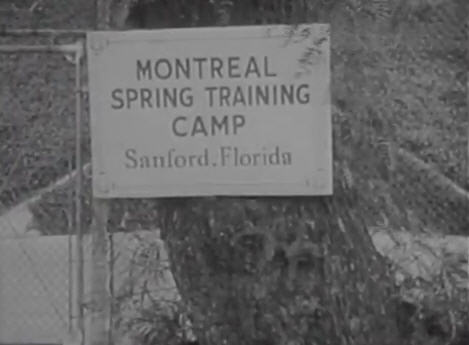
In the spring of 1947, Robinson was playing for the Dodgers’ farm team in Montreal. Spring training was held in Sanford. There were concerns about what the reaction would be, and in fact some people in Sanford who denied Robinson the opportunity to stay there during spring training; he ended up living in Daytona Beach. In the movie, this episode is represented less heatedly, with a black lawyer simply meeting the bus in Daytona and taking Robinson to arranged housing.

Some take current events as proving that things haven’t changed, in Sanford and in general. But the year that Jackie Robinson transformed baseball, he became one of the most popular people in America—people, not just baseball players. It’s still pretty striking to watch the real Jackie Robinson standing one-of-a-kind in a fake clubhouse filled with white actors playing white players. The scene has now been replaced by clubhouses where that is unthinkable, for performance alone, if not for higher reasons of fairness and humanity. There’s little time to be comforted by achievements when faced with evidence of continuing race issues, in Sanford and elsewhere. But it’s okay to take a moment to appreciate progress where you find it, and then move on to the next fight.

God’s Brackets

The second round game between Xavier and Notre Dame in the NCAA Division 1 basketball tournament, played on the eve of St. Patrick’s Day, led to questions: Does God have brackets, and in the case of two competing Catholic schools, does God have favorites? Does the deity decide whose prayers to answer (priests, players, coaches, administrators, gamblers, etc.), or is it strictly hands off? However that works, Xavier did beat Notre Dame.

This in turn led to considering just how many Catholic schools did start out in the first and second rounds of the tournament. The list includes their affiliation with various orders, in no way intended to suggest either educational or athletic advantage or superiority:

Creighton (Jesuit)
Georgetown (Jesuit)
Gonzoga (Jesuit)
Iona (Christian Brothers)
Loyola Maryland (Jesuit)
Marquette (Jesuit)
Notre Dame (Congregation of Holy Cross)
St. Bonaventure (Franciscan)
St. Louis (Jesuit)
St. Mary’s California (Lasallian)
Xavier (Jesuit)

Without drawing conclusions, leaving that to more discerning commentators and to sports and religion scholars seeking grist for the academic mill, here are a couple of stray stats for bracketologians:

Of this year’s 68 teams, 11 were from Catholic schools (about 16%).

There are 201 Catholic colleges and universities in the U.S., not all of them in Division 1. About 5% of them went to the tournament.

The Green Fields of the Mind

A. Bartlett Giamatti was the president of Yale University and, for a brief time until his untimely death in 1989, the Commissioner of Major League Baseball.

Besides his commitment to baseball, Giamatti was a man of letters who left behind some remarkable writing about the game. None is more moving and famous than his short essay The Green Fields of the Mind.

On the occasion of a new baseball season, here is an excerpt. Whoever you root for, whatever the season or the game – baseball, politics, art, religion, business, love, life – it offers hard to accept wisdom and the semi-sweet opposite of comfort:

It breaks your heart. It is designed to break your heart. The game begins in the spring, when everything else begins again, and it blossoms in the summer, filling the afternoons and evenings, and then as soon as the chill rains come, it stops and leaves you to face the fall alone. You count on it, rely on it to buffer the passage of time, to keep the memory of sunshine and high skies alive, and then just when the days are all twilight, when you need it most, it stops…

It breaks my heart because it was meant to, because it was meant to foster in me again the illusion that there was something abiding, some pattern and some impulse that could come together to make a reality that would resist the corrosion; and because, after it had fostered again that most hungered-for illusion, the game was meant to stop, and betray precisely what it promised…

And there are others who were born with the wisdom to know that nothing lasts. These are the truly tough among us, the ones who can live without illusion, or without even the hope of illusion. I am not that grown-up or up-to-date. I am a simpler creature, tied to more primitive patterns and cycles. I need to think something lasts forever, and it might as well be that state of being that is a game; it might as well be that, in a green field, in the sun.