Bob Schwartz

Category: Publishing

Random Notes on Editing

Random Notes on Editing
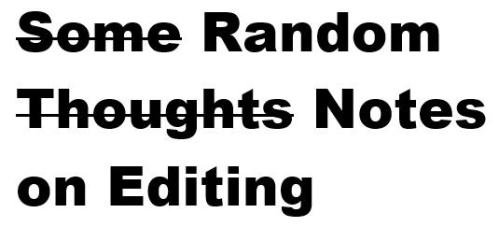
1. Whether working on a business report, legal brief, story or even a non-written creation, you have either had the privilege to edit others or have suffered the tough medicine of being edited.

2. All works are improvable. Ask God.

3. There is a difference between edits that are improvements and changes based on subjective sensibilities, though there is a gray area in between.

4. It is easiest to identify improvement editing when the creation is discretely functional and results are measurable, as with some sorts of advertising copy. Some would say readability and clarity fall into this functional category—that is, unless tortured readability is a creative choice and can be handled deftly. Ask Faulkner or Joyce.

5. Voice may be the hardest part of editing. It may also be the hardest part of writing. Even the most technical sorts of work can convey a distinctive voice—you will find this in textbooks, in legal articles, even in judicial rulings. Some writers don’t know abstractly what a distinctive voice is because they just naturally have one. Others work to develop it. That is the dual quandary for editors. If a writer has a voice, or the beginnings of one, you want to cultivate it without editing it away. If a writer doesn’t have much of a voice, there is a risk of the editor—who is often a pretty good writer too—to substitute a different voice entirely.

6. The Bible is the most importantly edited work in Western history, maybe in human history. Speaking of voice, imagine being the one responsible for editing the voice of God, Moses or Jesus. Yet somebody did. These editors took no credit, though it is fun to consider what those acknowledgements might look like. “And finally I’d like to thank my editor, without whom these transcripts of my speeches would not have the power that they do. JC.”
The Mad Dancers

The Mad Dancers
The Baal Shem Tov is the eighteenth-century founder of the Hasidic movement in Judaism. Jews and non-Jews who know the modern versions of the movement often don’t know much about its beginnings. Some of those contemporary manifestations may seem distant from the original spirit.

We have no writings by the Baal Shem Tov, so we rely on the records of his disciples, and on legends and stories that have come down the years—and that still have a remarkable power to inspire. Their authenticity is not in their being a verbatim record of what was said and what happened. Instead, they are an unmistakable reflection of a unique spiritual figure from any age or faith.

The Baal Shem Tov believed in and lived the direct experience of God everywhere in everything. Study and conventional piety took second place, which made him unpopular with the establishment, and would still today. He thought we should be outdoors in the trees, not indoors at the desks. Living in a divine state of optimism, joy and wonder was the ideal. People who live that way, of course, are remarkably hard to control.

This story is taken from The Golden Mountain (1932) by Meyer Levin.

The Mad Dancers

Already the voices of opponents were raised against the Baal Shem’s teaching, for many
rabbis could not understand his ways. Some said of him that he dishonored the Sabbath with singing and freedom, some said that his ways and the ways of those who followed him and called themselves Chassidim were truly the ways of madmen.

One of the scholars asked of the Baal Shem, “What of the learned rabbis who call this teaching false?”

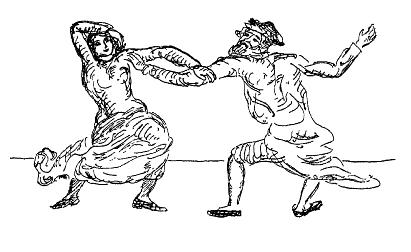
The Baal Shem Tov replied, “Once, in a house, there was a wedding festival. The musicians sat in a corner and played upon their instruments, the guests danced to the music, and were merry, and the house was filled with joy. But a deaf man passed outside the house; he looked in through the window and saw the people whirling about the room, leaping, and throwing about their arms. ‘See how they fling themselves about! ‘ he cried, ‘it is a house filled with madmen! ‘ For he could not hear the music to which they danced.”

Relying on Ourselves and Not Rolling Stone

Rolling Stone - Tsarnaev

This is what upsets us? This magazine cover is our biggest problem?

As of today, some retailers—of those retailers who actually sell paper magazines any more—are refusing to the carry the new issue of Rolling Stone with a cover showing a youthful and attractive photo of Boston bomber Dzhokhar Tsarnaev. They, along with maybe millions in the socialsphere, are making a statement.

But what exactly is that statement, and why are they making it?

If it’s about not giving any more publicity to him, along with any coverage of the Boston bombing and the upcoming trial, you can make a case that that might be healthy for all of us. But since there’s been no call for less coverage, that can’t be it.

If it’s about continuing the coverage, but making sure the coverage only reflects one particular approach, what approach would that be, exactly? And if it’s about not “glamorizing” him, where is the directorate that is going to make sure that all photos, cover and otherwise, of the most despicable people look suitably evil and ugly?

We have reached a point, not unique in history but maybe more now than ever, where reaction to everything is often overtaking thought about everything. The theory of “the wisdom of crowds”—that individuals can be wrongheaded, but heads put together are self-correcting and frequently right—needs to be reconsidered, if not thrown out the window.

If this Rolling Stone cover is a threat to anything, we have a problem. If we think that this cover makes mass murder look “cool” and is a contributor to our social difficulties, we really don’t know what those difficulties are. If we think that we shouldn’t have magazine covers with social and political miscreants, the Magazine Cover Authority will have to make a much broader review of all publications, before they pass them on to the Magazine Content Authority.

We have to start relying on our own thoughts, and when that careful thinking leads to conclusions, on our own abilities to directly address what we find. If a Rolling Stone cover with Tsarnaev is emblematic of anything, it is that Tsarnaev is here, he did what he did, and we should be working on that, and not on choices that magazines make.

For more on self-reliance, you might read Ralph Waldo Emerson’s classic essay of the same name. There was a time when Emerson’s essays were widely taught in schools—back in the Stone Age, before America got so smart and well-connected, before we realized that science and technology were the key to the future, and that the musty, fusty words of some old fart from Boston really had nothing to offer us.

Whoso would be a man must be a nonconformist. He who would gather immortal palms must not be hindered by the name of goodness, but must explore if it be goodness. Nothing is at last sacred but the integrity of your own mind. Absolve you to yourself, and you shall have the suffrage of the world.
Ralph Waldo Emerson
Self-Reliance (1841)