Bob Schwartz

Category: Politics

What If President Dennison Is Our National Karma?

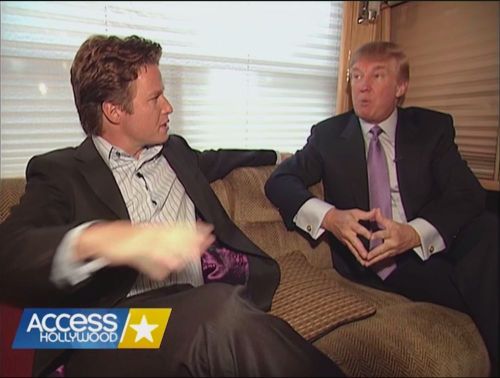
Billy Bush (BB) and David Dennison (DD)

A man reaps what he sows.
Galatians 6:7

Karma: A term used to refer to the doctrine of action and its corresponding “ripening” or “fruition”, according to which virtuous deeds of body, speech, and mind produce happiness in the future (in this life or subsequent lives), while nonvirtuous deeds lead instead to suffering.
Princeton Dictionary of Buddhism

When I experience the presidency of David Dennison, I wonder how we got here. One answer that won’t go away is that it is the sum of everything we have done and are doing as an American society—or everything we haven’t done and aren’t doing.

This isn’t to say that we are somehow being punished for transgressions, or that socially and culturally we haven’t done some admirable and adaptive things. It is just to say that some elements (not picking on social media, just using it as an example) have the potential to take us down the wrong road, and that when you add up the elements with potential for future misdirection, and the choices we have made, maybe it should not be surprising that we woke up one day—literally—to discover that the most unlikely human being in the world was the leader of the most powerful nation in the world.

So maybe the best response is to look at every one of those elements and choices, and mindfully consider whether they might have played a part in getting to this point. That might not rid us of Dennison soon, or of our national karma, or of our weird political harvest, but at least we will have the open-eyed, open-hearted hope of getting it right the next time.

Update: Why Trump Wanted to Be “David Dennison” in the Hush Money Agreement with Stormy Daniels (Hint: It Has to Do with Her Breasts)

Update: Following this post, I realized that “DD” are also the initials of Dirk Diggler. Diggler, the main character in the movie Boogie Nights (1997), is a well-endowed male porn star based on the famous porn actor John Holmes. So is the choice of “David Dennison” about a porn star’s breasts or about a porn star’s penis? Or both?

In the non-disclosure agreement signed by Stormy Daniels to keep quiet about her relationship with Trump, he used the name David Dennison. The signature line—which according to her new lawsuit he didn’t sign—doesn’t even have that fake name. All it says is “DD”.

Why David Dennison? The initials tell it all.

Stormy Daniels bra size, reported in the multiple sites that keep track of such things, is 34DD. This is Trump’s juvenile little joke. Get it? If you’re not laughing, that’s because nothing Trump does—including his attempted jokes—is a laughing matter. Just, as he would tweet, SAD!

David Dennison and Stormy Daniels

Donald Trump Jr. and the Happy Smiling Poor of India

“The poor know all about poverty and only the morbid rich would find the topic glamorous.”
Sullivan’s Travels

Washington Post:

Donald Trump Jr. says he admires India’s poor people because of their spirit and smiles

Donald Trump Jr., the president’s eldest son, is in India this week to promote his family’s real estate empire and more than $1 billion worth of luxury Trump Tower projects in four cities, but he still had time to praise India’s poor for their smiles.

“I don’t mean to be glib about it, but you can see the poorest of the poor and there is still a smile on a face. It’s a different spirit that you don’t see in other parts of the world … and I think there’s something unique about that. I know some of the most successful people in the world, and some of them are the most miserable people in the world.”

You can draw your own conclusions about what this says about Don Jr. and others in the Trump family and circle. You can guess who the miserable successful people might be.

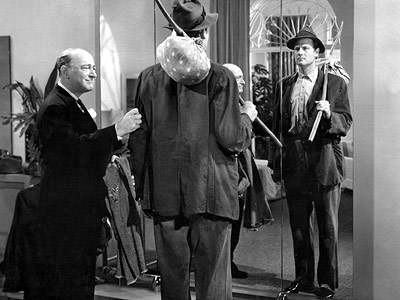
As for the happy smiling poor he admires, I quote from the movie Sullivan’s Travels  by Preston Sturges. A successful Hollywood director of nonsensical comedies, John L. Sullivan, wants to confront the grim reality of the Great Depression, and so plans to travel in disguise as a tramp. His butler Burrows sets him straight:

Burrows: I have never been sympathetic to the caricaturing of the poor and needy, sir.

John L. Sullivan: Who’s caricaturing? I’m going out on the road to find out what it’s like to be poor and needy and then I’m going to make a picture about it.

Burrows: If you’ll permit me to say so, sir, the subject is not an interesting one. The poor know all about poverty and only the morbid rich would find the topic glamorous.

John L. Sullivan: But I’m doing it for the poor. Don’t you understand?

Burrows: I doubt if they would appreciate it, sir.

And:

Burrows: You see, sir, rich people and theorists – who are usually rich people – think of poverty in the negative, as the lack of riches – as disease might be called the lack of health. But it isn’t, sir. Poverty is not the lack of anything, but a positive plague, virulent in itself, contagious as cholera, with filth, criminality, vice and despair as only a few of its symptoms.


White House Music: Love the Way You Lie (Updated)

Update: See below for news of 2012 tweet from Trump, commenting about Rihanna’s real life abuse situation, saying that if she is dating Chris Brown “She has a death wish. A beater is always a beater.”

Donald Trump and John Kelly probably haven’t ever heard Love the Way You Lie by Eminem and Rihanna. Maybe the younger, just-resigned, spouse-abusing White House Staff Secretary Rob Porter has, though he didn’t take it personally.

If you haven’t seen the interview with Porter’s second ex-wife Jennifer Willoughby (the first was also abused), please watch it. It is one of the most articulate, honest and compelling testimonies about abuse you will see. She explains how it is possible to stay in what in retrospect looks like an impossible and dangerous relationship. She also warns Hope Hicks, one of Trump’s closest aides and Porter’s current girlfriend, to be careful.

Anyway, Love the Way You Lie popped up on a playlist today. Maybe coincidence, maybe not. Maybe the White House, still trying to figure out how to defend Porter, should listen.


Rihanna:

Just gonna stand there and watch me burn
Well, that’s all right
Because I like the way it hurts
Just gonna stand there and hear me cry
Well, that’s all right
Because I love the way you lie
I love the way you lie

Eminem:

I can’t tell you what it really is
I can only tell you what it feels like
And right now there’s a steel knife in my windpipe
I can’t breathe, but I still fight while I can fight
As long as the wrong feels right, it’s like I’m in flight
High off her love, drunk from her hate
It’s like I’m huffin’ paint
And I love her the more I suffer, I suffocate
And right before I’m about to drown she resuscitates me
She fuckin’ hates me, and I love it, “Wait!
Where you going?”, “I’m leaving you.” “No, you ain’t
Come back!” We’re runnin’ right back, here we go again
It’s so insane, ’cause when it’s goin’ good it’s goin’ great
I’m Superman with the wind at his back, she’s Lois Lane
But when it’s bad it’s awful, I feel so ashamed
I snap, “Who’s that dude?”, I don’t even know his name
I laid hands on him, I’ll never stoop so low again
I guess I don’t know my own strength

You ever love somebody so much
You can barely breathe when you’re with ’em?
You meet, and neither one of you even know what hit ’em
Got that warm fuzzy feelin’
Yeah, them chills used to get ’em
Now you’re gettin’ fuckin’ sick of lookin’ at ’em?
You swore you’d never hit ’em, never do nothin’ to hurt ’em
Now you’re in each other’s face
Spewin’ venom in your words when you spit ’em
You push, pull each other’s hair, scratch, claw, bit ’em
Throw ’em down, pin ’em
So lost in the moments when you’re in ’em
It’s the rage that took over, it controls you both
So they say it’s best to go your separate ways
Guess that they don’t know ya
‘Cause today, that was yesterday, yesterday is over
It’s a different day, sound like broken records playin’ over
But you promised her, next time you’d show restraint
You don’t get another chance, life is no Nintendo game
But you lied again
Now you get to watch her leave out the window
Guess that’s why they call it window pane

Now, I know we said things, did things that we didn’t mean
And we fall back into the same patterns, same routines
But your temper’s just as bad as mine is
You’re the same as me when it comes to love
You’re just as blinded, baby, please
Come back, it wasn’t you, baby, it was me
Maybe our relationship isn’t as crazy as it seems
Maybe that’s what happens when a tornado meets a volcano
All I know is I love you too much to walk away though
Come inside, pick up your bags off the sidewalk
Don’t you hear sincerity in my voice when I talk?
Told you this is my fault, look me in the eyeball
Next time I’m pissed I’ll aim my fist at the drywall
Next time? There won’t be no next time!
I apologize even though I know it’s lies
I’m tired of the games, I just want her back
I know I’m a liar, if she ever tries to fuckin’ leave again
I’ma tie her to the bed and set this house on fire

Rihanna:

Just gonna stand there and watch me burn
Well, that’s all right
Because I like the way it hurts
Just gonna stand there and hear me cry
Well, that’s all right
Because I love the way you lie
I love the way you lie


From The Hill:

CNN’s Jake Tapper on Friday resurfaced an old tweet from President Trump denouncing domestic abuse, hours after Trump praised Rob Porter, who resigned as White House staff secretary over allegations that he abused his ex-wives.

In October 2012, Trump tweeted in response to news that singer Rihanna appeared to be once again romantically paired with Chris Brown after he physically assaulted her.

“If Rihanna is dating Chris Brown again then she has a death wish,” Trump wrote. “A beater is always a beater– just watch!”

Quinnipiac University Poll: 72% of Republicans Say That Trump Is a Good Role Model for Children

Quinnipiac University National Poll :

It is important that a president be a good role model for children, 90 percent of American voters say, but President Donald Trump is not a good role model for children, these voters say 67 – 29 percent in a Quinnipiac University National Poll released today.

There is almost no gender gap in grading President Trump’s standing as a role model. Every party, gender, education, age and racial group, except Republicans, say the president falls short, the independent Quinnipiac University Poll finds.

Republicans say 72 – 22 percent that Trump is a good role model for children.

Hope in a Sore American Storm

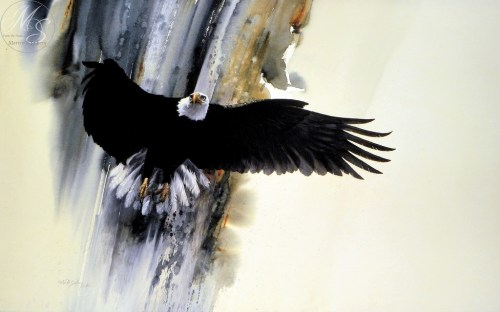
Wings of Wonder – Morton Solberg

Hope is the thing with feathers
That perches in the soul,
And sings the tune without the words,
And never stops at all,

And sweetest in the gale is heard;
And sore must be the storm
That could abash the little bird
That kept so many warm.

I’ve heard it in the chillest land,
And on the strangest sea;
Yet, never, in extremity,
It asked a crumb of me.

Emily Dickinson, Hope Is The Thing With Feathers

The storm in America is sore.

Those of us who know American history well, who understand how American government works, who have seen it in some of its worst days, want to maintain a sense that all things must pass.

But some of us who want to see a way past the current circumstances are having trouble assembling a vision of that path.

People have confidence in the checks and balances cleverly built into American democracy, and they are right to be impressed. You cannot say enough about the brilliance of the Constitution, the platform for history’s most durable and successful democracy.

But the founders and the Constitution presuppose sufficient people, particularly leaders, of the highest qualities. The list of those qualities is long and obvious. Honest, knowledgeable, capable, intelligent, brave, selfless, compassionate, just, on and on. There was never any expectation that America would be led by saints, just that when people and matters of government got out balance, other people and matters would step up to make it right.

There has never before been a time when it seemed there were not enough of those people with those qualities at the highest levels. We had no idea what happens to the elegance of constitutional America in those circumstances. Until now.

America—the America that knows and believes in the Constitution, American history, the rule of law, the system of checks and balances—must continue to plan and strategize a way past. But mere confidence that this is just one more difficulty that will be dissolved by electoral democracy, time and the American spirit may be misplaced. Which leaves us with hope. That thing with feathers, singing its tune.

Trump and the Pusher Man: Easy Rider or Mean Girls?

“We must get much tougher on drug dealers and pushers if we are going to succeed in stopping this scourge.”
Donald Trump, State of the Union Address (2018)

In real life, I haven’t heard the term “drug pusher” used seriously in a long time. Which means that Trump is living in the past or is a big fan of either Easy Rider or Mean Girls.

For the record, the term “drug pusher” likely originated as prison slang in the 1930s, and maintained some fading currency for a few decades. Not so much today, at least not in my circles.

Easy Rider (1969)

Hoyt Axton’s song The Pusher, as recorded by Steppenwolf, was featured in the soundtrack of the movie Easy Rider:

You know I’ve smoked a lot of grass
Oh Lord, I’ve popped a lot of pills
But I never touched nothin’
That my spirit could kill
You know, I’ve seen a lot of people walkin’ ’round
With tombstones in their eyes
But the pusher don’t care
Ah, if you live or if you die

You know the dealer, the dealer is a man
With the love grass in his hand
Oh but the pusher is a monster
Good God, he’s not a natural man
The dealer for a nickel
Lord, will sell you lots of sweet dreams
Ah, but the pusher ruin your body
Lord, he’ll leave your, he’ll leave your mind to scream

God damn, the pusher
God damn, I say the pusher
I said God damn, God damn the pusher man

Well, now if I were president of this land
You know, I’d declare total war on the pusher man

Mean Girls (2004)

One of the iconic scenes in the movie Mean Girls has the teacher Ms. Corbury (Tina Fey) explaining herself to her student Cady Heron (Lindsay Lohan):

“I’m a pusher Cady. I push people….And now I’m gonna push you because I know you’re smarter than this.”

Leading to this conversation:

I hate her! I mean, she’s really failing me on purpose, just because I didn’t join that stupid Mathletes! She was so queer, she was like, “I’m pusher Cady, I’m a pusher.”

Hahaha! What does that even mean?

Like a drug pusher?

Probably. She said she works three jobs. You know, I bet she sells drugs on the side to pay for her pathetic divorce.

Yes, like a drug pusher, and yes Cady, for somebody’s pathetic divorce(s). If he were president of this land, you know, he’d declare total war on the pusher man.

Note: It is probably not necessary to say this, but I will. This is not to minimize the serious problem America has with opioids and other tragically destructive drugs. It is just to point out how out of touch and out of time Trump, Sessions and others are about the problem, its causes and its solutions. And since I’m adding this note, I will mention that the song The Pusher (a Trump favorite?) makes a clear distinction between the dealer of marijuana (“love grass in his hand”) and the pusher of deadly drugs (“a monster”).

How Democracies Die

“The electoral road to breakdown is dangerously deceptive. With a classic coup d’état, as in Pinochet’s Chile, the death of a democracy is immediate and evident to all. The presidential palace burns. The president is killed, imprisoned, or shipped off into exile. The constitution is suspended or scrapped. On the electoral road, none of these things happen. There are no tanks in the streets. Constitutions and other nominally democratic institutions remain in place. People still vote. Elected autocrats maintain a veneer of democracy while eviscerating its substance.”
How Democracies Die


From the newly published book How Democracies Die by Steven Levitsky and Daniel Ziblatt, Professors of Government at Harvard University:

But there is another way to break a democracy. It is less dramatic but equally destructive. Democracies may die at the hands not of generals but of elected leaders—presidents or prime ministers who subvert the very process that brought them to power. Some of these leaders dismantle democracy quickly, as Hitler did in the wake of the 1933 Reichstag fire in Germany. More often, though, democracies erode slowly, in barely visible steps….

This is how democracies now die. Blatant dictatorship—in the form of fascism, communism, or military rule—has disappeared across much of the world. Military coups and other violent seizures of power are rare. Most countries hold regular elections. Democracies still die, but by different means. Since the end of the Cold War, most democratic breakdowns have been caused not by generals and soldiers but by elected governments themselves….

The electoral road to breakdown is dangerously deceptive. With a classic coup d’état, as in Pinochet’s Chile, the death of a democracy is immediate and evident to all. The presidential palace burns. The president is killed, imprisoned, or shipped off into exile. The constitution is suspended or scrapped. On the electoral road, none of these things happen. There are no tanks in the streets. Constitutions and other nominally democratic institutions remain in place. People still vote. Elected autocrats maintain a veneer of democracy while eviscerating its substance.

Many government efforts to subvert democracy are “legal,” in the sense that they are approved by the legislature or accepted by the courts. They may even be portrayed as efforts to improve democracy—making the judiciary more efficient, combating corruption, or cleaning up the electoral process. Newspapers still publish but are bought off or bullied into self-censorship. Citizens continue to criticize the government but often find themselves facing tax or other legal troubles. This sows public confusion. People do not immediately realize what is happening….

We know that extremist demagogues emerge from time to time in all societies, even in healthy democracies. The United States has had its share of them, including Henry Ford, Huey Long, Joseph McCarthy, and George Wallace. An essential test for democracies is not whether such figures emerge but whether political leaders, and especially political parties, work to prevent them from gaining power in the first place—by keeping them off mainstream party tickets, refusing to endorse or align with them, and when necessary, making common cause with rivals in support of democratic candidates. Isolating popular extremists requires political courage. But when fear, opportunism, or miscalculation leads established parties to bring extremists into the mainstream, democracy is imperiled.

Once a would-be authoritarian makes it to power, democracies face a second critical test: Will the autocratic leader subvert democratic institutions or be constrained by them? Institutions alone are not enough to rein in elected autocrats. Constitutions must be defended—by political parties and organized citizens, but also by democratic norms. Without robust norms, constitutional checks and balances do not serve as the bulwarks of democracy we imagine them to be. Institutions become political weapons, wielded forcefully by those who control them against those who do not. This is how elected autocrats subvert democracy—packing and “weaponizing” the courts and other neutral agencies, buying off the media and the private sector (or bullying them into silence), and rewriting the rules of politics to tilt the playing field against opponents. The tragic paradox of the electoral route to authoritarianism is that democracy’s assassins use the very institutions of democracy—gradually, subtly, and even legally—to kill it….

How serious is the threat now? Many observers take comfort in our Constitution, which was designed precisely to thwart and contain demagogues like Donald Trump. Our Madisonian system of checks and balances has endured for more than two centuries. It survived the Civil War, the Great Depression, the Cold War, and Watergate. Surely, then, it will be able to survive Trump.

We are less certain. Historically, our system of checks and balances has worked pretty well—but not, or not entirely, because of the constitutional system designed by the founders. Democracies work best—and survive longer—where constitutions are reinforced by unwritten democratic norms. Two basic norms have preserved America’s checks and balances in ways we have come to take for granted: mutual toleration, or the understanding that competing parties accept one another as legitimate rivals, and forbearance, or the idea that politicians should exercise restraint in deploying their institutional prerogatives. These two norms undergirded American democracy for most of the twentieth century. Leaders of the two major parties accepted one another as legitimate and resisted the temptation to use their temporary control of institutions to maximum partisan advantage. Norms of toleration and restraint served as the soft guardrails of American democracy, helping it avoid the kind of partisan fight to the death that has destroyed democracies elsewhere in the world, including Europe in the 1930s and South America in the 1960s and 1970s.

Today, however, the guardrails of American democracy are weakening. The erosion of our democratic norms began in the 1980s and 1990s and accelerated in the 2000s. By the time Barack Obama became president, many Republicans, in particular, questioned the legitimacy of their Democratic rivals and had abandoned forbearance for a strategy of winning by any means necessary. Donald Trump may have accelerated this process, but he didn’t cause it. The challenges facing American democracy run deeper. The weakening of our democratic norms is rooted in extreme partisan polarization—one that extends beyond policy differences into an existential conflict over race and culture. America’s efforts to achieve racial equality as our society grows increasingly diverse have fueled an insidious reaction and intensifying polarization. And if one thing is clear from studying breakdowns throughout history, it’s that extreme polarization can kill democracies.

There are, therefore, reasons for alarm. Not only did Americans elect a demagogue in 2016, but we did so at a time when the norms that once protected our democracy were already coming unmoored. But if other countries’ experiences teach us that that polarization can kill democracies, they also teach us that breakdown is neither inevitable nor irreversible. Drawing lessons from other democracies in crisis, this book suggests strategies that citizens should, and should not, follow to defend our democracy.

Many Americans are justifiably frightened by what is happening to our country. But protecting our democracy requires more than just fright or outrage. We must be humble and bold. We must learn from other countries to see the warning signs—and recognize the false alarms. We must be aware of the fateful missteps that have wrecked other democracies. And we must see how citizens have risen to meet the great democratic crises of the past, overcoming their own deep-seated divisions to avert breakdown. History doesn’t repeat itself. But it rhymes. The promise of history, and the hope of this book, is that we can find the rhymes before it is too late.

The Poetry of Citizenry

“You are Whitman, you are Poe, you are Mark Twain, you are Emily Dickinson and Edna St. Vincent Millay, you are Neruda and Mayakovsky and Pasolini, you are an American or a non-American, you can conquer the conquerors with words.”
Lawrence Ferlinghetti, Poetry as Insurgent Art

“There is a strong underground tradition of the poetry of engagement, which we might also call the poetry of citizenzry.”
Edward Hirsch, A Poet’s Glossary

“Poetry, an act of the imagination, is subject to historical forces, but it also talks back to history. The idea of witnessing should be widened to go beyond the documentary response to events. ‘I am the man . . . I suffered . . . I was there,’ Walt Whitman declared. A broad imaginative sympathy was part of his lived experience.”
Edward Hirsch, A Poet’s Glossary

I’ve written before about poetry as insurgent art, a term used by Lawrence Ferlinghetti. Here I add to the conversation with three entries from A Poet’s Glossary by Edward Hirsch—an essential book for those who read write study or teach poetry.

It is no surprise to regular readers that I think these are extraordinary times. And that I think people in all quarters should consider the ways they can help right the ship and steer it in a different direction. That is, all hands on deck, including poets.

How well that works, or whether it works at all, is to be determined. But as the student Sophie Scholl said of her tiny but morally mighty White Rose resistance movement in Nazi Germany, which boldly distributed simple leaflets, “Somebody, after all, had to make a start.” As well poets as anyone else.


From A Poet’s Glossary by Edward Hirsch:

political poetry

Poetry of social concern and conscience, politically engaged poetry. The feeling often runs high in the social poetry of engagement, especially when it is partisan. Poets write on both sides of any given war, defend the State, attack it. All patriotic and nationalistic poetry is by definition political. Political poetry, ancient and modern, good and bad, frequently responds vehemently to social injustice. Thus the poet is Jeremiah crying out to the assembly to witness the folly, unprecedented in both West (Cyprus) and East (Kedar), of a people who have forsaken the fountain of living waters for the stagnant water at the bottom of a leaky cistern. The Lamentations of Jeremiah, a series of poems mourning the desolation of Jerusalem and the sufferings of her people after the siege and destruction of the city and the burning of theTemple by the Babylonians, is also a political poem.

Strabo came up with the label stasiotika (“stasis-poems”) for Alcaeus’s partisan songs, political poems, which are propagandistic poems of civil war and exile, accounts of his political commitments. The premise of political poetry is that poetry carries “news” or information crucial to the populace. Political poetry is a poetry self-consciously written inside of history, of politics. It responds to external events. “Mad Ireland hurt you into poetry,” W. H. Auden famously decreed in his elegy for W. B. Yeats, and so, too, we might say that the madness of any country’s brutality has often wounded its poets into a political response in poetry. “I stand as a witness to the common lot, / survivor of that time, that place,” Anna Akhmatova wrote in 1961. Behind the poem in quest of justice, these lines from Shakespeare’s Antony and Cleopatra (1623): “our size of sorrow, / Proportion’d to our cause, must be as great / As that which makes it.”

There is an ephemeral quality to a lot of political poetry—most of it dies with the events it responds to—but a political poem need not be a didactic poem. It can be a poem of testimony and memory. For the best political poems of the twentieth century, I think of Vahan Tekeyan’s poems of the Armenian genocide; of the Spanish Civil War poet Miguel Hernandez’s haunting prison poems, especially “Lullaby of the Onion” (1939); and the Turkish poet Nazim Hikmet’s equally poignant prison poems, especially “On Living” (1948) and “Some Advice to Those Who Will Spend Time in Prison” (1949); of Bertolt Brecht’s World War II poems and Nelly Sachs’s Holocaust poems. I think of the Italian poet Cesare Pavese’s testimonies to ordinary people in trouble, Hard Labor (Lavorare stanca, 1936), and Pablo Neruda’s epic testament, Canto General (1950). I think of the many poems of indictment and summons, of land and liberty, collected in the Nigerian writer Wole Soyinka’s breakthrough anthology, Poems of Black Africa (1975).

There is a strong tradition in England of political poems. Edmund Spenser’s Complaints (1591) takes aim at social and political targets. John Milton wrote a series of pro-Cromwellian short poems in the 1640s and ’50s. Some of John Dryden’s greatest poetry was written in response to events, such as his two-part political satire Absalom and Achitophel (1681, 1682). William Wordsworth’s political poems are among his best, such as his sonnet “To Toussaint L’Ouverture” (1803), though a few of his late patriotic poems are also among his worst. Percy Bysshe Shelley’s The Mask of Anarchy (1819), which was “Written on the Occasion of the Massacre at Manchester” (“I met Murder on the way—/ He had a mask like Castlereagh”), is a frankly political poem that always gives me a chill. Elizabeth Barrett Browning published two striking books of political poetry during her Italian sojourn, Casa Guidi Windows (1850) and Poems Before Congress (1860). The most popular Victorian poet, Alfred, Lord Tennsyon, never distinguished between the personal and the political, the private and the public.

Political poetry has always seemed somewhat suspect in American literary history. “Our wise men and wise institutions assure us that national political events are beyond the reach of ordinary, or even extraordinary, literary sensitivity,” Robert Bly writes. Yet there is a strong underground tradition of the poetry of engagement, which we might also call the poetry of citizenzry. This runs from Walt Whitman’s political poems of the 1850s, which prefigure Leaves of Grass, and John Greenleaf Whittier’s Anti-Slavery Poems (1832–1887), to leftist poets of the 1930s (Kenneth Fearing, Edwin Rolfe, Muriel Rukeyser). The civil rights movement and the Vietnam War enraged poets, and, as Bly points out, some of the most inward poets, such as Robert Duncan, Denise Levertov, and Galway Kinnell, wrote some of the best poems against the Vietnam War. Most poetry of the 1940s and ’50s shunned politics, but Thomas McGrath (“Ode for the American Dead in Korea,” retitled in the early 1970s “Ode for the American Dead in Asia”) and Kenneth Rexroth (“A Christmas Note for Geraldine Udell,” 1949) bucked the trend. For forty years, Adrienne Rich was one of the most outspoken political poets in late twentieth-century American poetry, a model for a generation of political and activist poets. She went through several phases in relationship to polemics. She proposed a position that resists didacticism in “Power and Danger: Works of a Common Woman” (1978), her introduction to a collection of poems by Judy Grahn:

No true political poetry can be written with propaganda as an aim, to persuade others “out there” of some atrocity or injustice (hence the failure, as poetry, of so much anti-Vietnam poetry of the sixties). As poetry, it can come only from the poet’s need to identify her relationship to atrocities and injustice, the sources of her pain, fear, and anger, the meaning of her resistance.

protest poetry 

Poetry of dissent, of social criticism. It protests the status quo and tries to undermine established values and ideals. The protest poet is a rebellious citizen, speaking out, expressing disapproval of a political policy or social action. Protest poetry, the most earnest of genres, is timely, oppositional, reactive, urgent. It is an activist type of political poetry born from outrage and linked to social action. It turns poetry into a medium for polemics.

The reprehensible policy of apartheid in South Africa, which legislated racism, also stimulated a powerful tradition of protest poetry. The Zulu poet Herbert I. E. Dhlomo’s long poem Valley of a Thousand Hills (1941) is the most extended work of South African protest poetry. One thinks of the contributions of Dennis Brutus (1924–2009), whose work is brought together in Poetry and Protest: A Dennis Brutus Reader (2006); Arthur Nortje (1942–1970), whose work is published posthumously in Dead Roots (1973) and Lonely Against the Light (1973); and Mazisi Kunene (1930–2006), who first sounded his aggressive, telegraphic note in Zulu Poems (1970). The New Black poetry of the 1970s, or Soweto poetry, was a protest poetry of black consciousness. In the United States, there is also a strong tradition of African American poetry that protests racism. It extends from the Harlem renaissance to the Black Arts movement. Most antiwar poetry is protest poetry. The combatant antiwar poetry of Wilfred Owen (1893–1918) and Siegfried Sassoon (1886–1967) protested the technological horrors of modern warfare. The Spanish Civil War generated both local and global protest poetry. The Vietnam War galvanized a tremendous amount of protest poetry by such poets as Robert Lowell, Allen Ginsberg, Adrienne Rich, and Robert Bly. These poets felt a cultural imperative to speak out against the war. The repression and disintegration of the American imagination is one of the persistent themes of Vietnam-era protest poetry. Much of the feminist poetry of the 1960s and ’70s is protest poetry. “A patriot is not a weapon,” Adrienne Rich writes in her long poem An Atlas of the Difficult World (1981). “A patriot is one who wrestles for the soul of her country / as she wrestles for her own being.” Sam Hamill’s anthology Poets Against the War (2003) was a hastily gathered book of protest poems against the war in Iraq. The strength of protest poetry is its sense of immediacy and outrage. However, most of these politically motivated poems, which are often made in outrage against a specific atrocity, don’t outlive their historical moment.

witness of poetry, poetry of witness 

Poetry of testimony. In the early 1990s, Carolyn Forché transformed the Polish poet Czeslaw Milosz’s phrase the witness of poetry (taken from the book of the same name, 1983) into “the poetry of witness.” Her anthology Against Forgetting: Twentieth-Century Poetry of Witness (1993) gathers together the work of 145 poets “who endured conditions of historical and social extremity during the twentieth century—through exile, state censorship, political censorship, house arrest, torture, imprisonment, military occupation, warfare, and assignation. Many poets did not survive, but their works remain with us as poetic witness to the dark times in which they lived.” Poetry, an act of the imagination, is subject to historical forces, but it also talks back to history. The idea of witnessing should be widened to go beyond the documentary response to events. “I am the man . . . I suffered . . . I was there,” Walt Whitman declared. A broad imaginative sympathy was part of his lived experience.

In 1944, the Hungarian poet Miklós Radnóti wrote four harrowing “Postcard” poems in the midst of a forced march westward across Hungary. Radnóti was one of twenty-two prisoners murdered and tossed into a collective grave. After the war, his widow had his body exhumed and these poems were found in his field jacket, written in pencil in a small Serbian exercise book. Thus his poems nearly literally rise up from a mass grave. They inscribe a suffering unimaginably intense, a consciousness of death nearly unbearable. They are purposefully entitled “Postcards.” Here the informality of the postcard (dashed off, superficial) is belied by the scrupulousness with which Radnóti describes and re-creates the scene of his impending death. The postcard is a message directed to another person. It has a particular reader in mind, but its openness also suggests that it can be read by anyone. Thus the poem in the guise of a postcard is a testimony back to life, a signal that Radnóti had pushed back the silence long enough to embody a final experience. His poems of witness display the classical brevity and poise of an Orphic art that comes back from the underworld to give testimony.
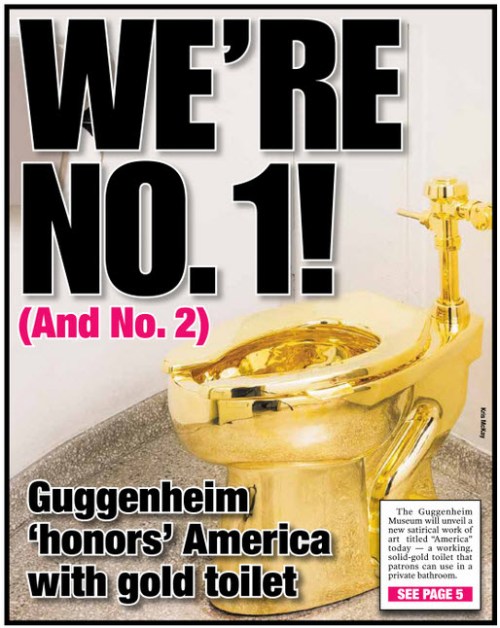
“The White House asked to borrow a van Gogh. The Guggenheim offered a gold toilet instead.”

Washington Post:

The emailed response from the Guggenheim’s chief curator to the White House was polite but firm: The museum could not accommodate a request to borrow a painting by Vincent Van Gogh for President and Melania Trump’s private living quarters.

Instead, wrote the curator, Nancy Spector, another piece was available, one that was nothing like “Landscape With Snow,” the 1888 Van Gogh rendering of a man in a black hat walking along a path in Arles, France, with his dog.

The curator’s alternative: an 18-karat, fully functioning, solid gold toilet — an interactive work titled “America” that critics have described as pointed satire aimed at the excess of wealth in this country.

For a year, the Guggenheim had exhibited “America” — the creation of contemporary artist Maurizio Cattelan — in a public restroom on the museum’s fifth floor for visitors to use.

But the exhibit was over and the toilet was available “should the President and First Lady have any interest in installing it in the White House,” Spector wrote in an email obtained by The Washington Post.

The artist “would like to offer it to the White House for a long-term loan,” wrote Spector, who has been critical of Trump. “It is, of course, extremely valuable and somewhat fragile, but we would provide all the instructions for its installation and care.”

New York Post – September 16, 2016