Bob Schwartz

Category: Politics

Barbara Jordan And The National Community
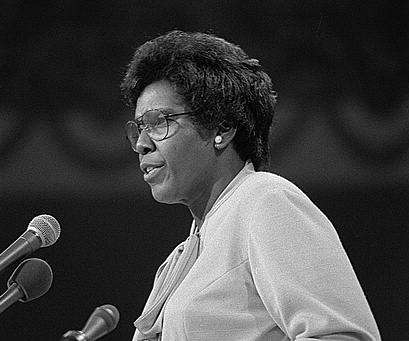
Well I am going to close my speech by quoting a Republican President and I ask you that as you listen to these words of Abraham Lincoln, relate them to the concept of a national community in which every last one of us participates:

“As I would not be a slave, so I would not be a master.” This — This — “This expresses my idea of Democracy. Whatever differs from this, to the extent of the difference, is no Democracy.”

In preparation for the Democratic National Convention—in preparation for being an American—everyone must hear and read Congresswoman Barbara Jordan’s keynote address to the Democratic National Convention in 1976, “Who Then Will Speak for the Common Good?”

Even if Barbara Jordan (1936-1996) had not been an extraordinary woman with an extraordinary story, this speech would deserve regular listening and reading, and all the accolades it has received.

Her story is that of a girl raised in segregated Houston. A gifted student, she attended Texas Southern University instead of the University of Texas, which at the time was still segregated.  She was a national champion college debater, and went on to Boston University School of Law.

In 1966, she became the first African American woman elected to the Texas Senate. Then in 1972 she became the first African American woman from a southern state to serve in the House of Representatives. Her skill at pragmatic political compromise was matched by unyielding commitment to the Constitution and to the ideals of America.

(A movie about her life is in development, based on the biography Barbara Jordan: American Hero, starring Academy Award-nominee Viola Davis.)

Barbara Jordan was one of the great American orators of the 20th century. When Professors Stephen E. Lucas and Martin J. Medhurst asked 137 leading scholars to recommend speeches on the basis of social and political impact, Barbara Jordan’s keynote address  was near the top at number 5. In fact, of the top 13 American political speeches of the century, two were made by her. The only other speaker to appear that high on the list twice  is FDR:

1. Martin Luther King, Jr.      “I Have A Dream”
2, John Fitzgerald Kennedy    Inaugural Address
3. Franklin Delano Roosevelt    First Inaugural Address
4. Franklin Delano Roosevelt    Pearl Harbor Address to the Nation
5. Barbara Charline Jordan    1976 DNC Keynote Address
6. Richard Milhous Nixon    “Checkers”
7. Malcolm X    “The Ballot or the Bullet”
8. Ronald Wilson Reagan     Shuttle ”Challenger” Disaster Address
9. John Fitzgerald Kennedy    Houston Ministerial Association Speech
10. Lyndon Baines Johnson    “We Shall Overcome”
11. Mario Matthew Cuomo    1984 DNC Keynote Address
12. Jesse Louis Jackson    1984 DNC Address
13. Barbara Charline Jordan    Statement on the Articles of Impeachment

Her number 13 speech on the Articles of Impeachment against Richard Nixon came in 1974, two years after she took her seat in the House, two years before the keynote address. It is nearly the equal and a fitting companion to that later speech. In the wake of the Watergate revelations, as the impeachment of Richard Nixon moved forward, both Democrats and Republicans stood up to uphold the Constitution against this attempted subversion. America and the House Judiciary Committee had the good fortune to have at its service a very new Congresswoman from Texas:

Today I am an inquisitor. I believe hyperbole would not be fictional and would not overstate the solemnness that I feel right now. My faith in the Constitution is whole, it is complete, it is total. I am not going to sit here and be an idle spectator to the diminution, the subversion, the destruction of the Constitution….

James Madison again at the Constitutional Convention: “A president is impeachable if he attempts to subvert the Constitution.”

The Constitution charges the president with the task of taking care that the laws be faithfully executed, and yet the president has counseled his aides to commit perjury, willfully disregarded the secrecy of grand jury proceedings, concealed surreptitious entry, attempted to compromise a federal judge while publicly displaying his cooperation with the processes of criminal justice.

“A president is impeachable if he attempts to subvert the Constitution.”

If the impeachment provision in the Constitution of the United States will not reach the offenses charged here, then perhaps that eighteenth century Constitution should be abandoned to a twentieth-century paper shredder. Has the president committed offenses and planned and directed and acquiesced in a course of conduct which the Constitution will not tolerate? That is the question. We know that. We know the question. We should now forthwith proceed to answer the question. It is reason, and not passion, which must guide our deliberations, guide our debate, and guide our decision.”

America was at a crossroads in 1976, which by coincidence was the bicentennial year of our birth as a nation. Democracy had been threatened at the highest level from within, and democracy had prevailed. But democracy, we should have known, is always under threat, and when it is, the question is not only how to uphold it but what exactly we mean by democracy, that is, what exactly is it that we are defending?

In 1976, as the keynote speaker at the Democratic National Convention, Barbara Jordan spoke as eloquently as anyone has about our “national community.” She stood in front of an audience at Madison Square Garden in New York and explained the promise and challenge of the American Constitution and democracy in a way that has not been equaled since:

It was one hundred and forty-four years ago that members of the Democratic Party first met in convention to select a Presidential candidate. Since that time, Democrats have continued to convene once every four years and draft a party platform and nominate a Presidential candidate. And our meeting this week is a continuation of that tradition. But there is something different about tonight. There is something special about tonight. What is different? What is special?

I, Barbara Jordan, am a keynote speaker.

When — A lot of years passed since 1832, and during that time it would have been most unusual for any national political party to ask a Barbara Jordan to deliver a keynote address. But tonight, here I am. And I feel — I feel that notwithstanding the past that my presence here is one additional bit of evidence that the American Dream need not forever be deferred.

Now — Now that I have this grand distinction, what in the world am I supposed to say? I could easily spend this time praising the accomplishments of this party and attacking the Republicans — but I don’t choose to do that. I could list the many problems which Americans have. I could list the problems which cause people to feel cynical, angry, frustrated: problems which include lack of integrity in government; the feeling that the individual no longer counts; the reality of material and spiritual poverty; the feeling that the grand American experiment is failing or has failed. I could recite these problems, and then I could sit down and offer no solutions. But I don’t choose to do that either. The citizens of America expect more. They deserve and they want more than a recital of problems.

We are a people in a quandary about the present. We are a people in search of our future. We are a people in search of a national community. We are a people trying not only to solve the problems of the present, unemployment, inflation, but we are attempting on a larger scale to fulfill the promise of America. We are attempting to fulfill our national purpose, to create and sustain a society in which all of us are equal.

Throughout — Throughout our history, when people have looked for new ways to solve their problems and to uphold the principles of this nation, many times they have turned to political parties. They have often turned to the Democratic Party. What is it? What is it about the Democratic Party that makes it the instrument the people use when they search for ways to shape their future? Well I believe the answer to that question lies in our concept of governing. Our concept of governing is derived from our view of people. It is a concept deeply rooted in a set of beliefs firmly etched in the national conscience of all of us.

Now what are these beliefs? First, we believe in equality for all and privileges for none. This is a belief — This is a belief that each American, regardless of background, has equal standing in the public forum — all of us. Because — Because we believe this idea so firmly, we are an inclusive rather than an exclusive party. Let everybody come.

I think it no accident that most of those immigrating to America in the 19th century identified with the Democratic Party. We are a heterogeneous party made up of Americans of diverse backgrounds. We believe that the people are the source of all governmental power; that the authority of the people is to be extended, not restricted.

This — This can be accomplished only by providing each citizen with every opportunity to participate in the management of the government. They must have that, we believe. We believe that the government which represents the authority of all the people, not just one interest group, but all the people, has an obligation to actively — underscore actively — seek to remove those obstacles which would block individual achievement — obstacles emanating from race, sex, economic condition. The government must remove them, seek to remove them. We.

We are a party — We are a party of innovation. We do not reject our traditions, but we are willing to adapt to changing circumstances, when change we must. We are willing to suffer the discomfort of change in order to achieve a better future. We have a positive vision of the future founded on the belief that the gap between the promise and reality of America can one day be finally closed. We believe that.

This, my friends is the bedrock of our concept of governing. This is a part of the reason why Americans have turned to the Democratic Party. These are the foundations upon which a national community can be built. Let all understand that these guiding principles cannot be discarded for short-term political gains. They represent what this country is all about. They are indigenous to the American idea. And these are principles which are not negotiable.

In other times — In other times, I could stand here and give this kind of exposition on the beliefs of the Democratic Party and that would be enough. But today that is not enough. People want more. That is not sufficient reason for the majority of the people of this country to decide to vote Democratic. We have made mistakes. We realize that. We admit our mistakes. In our haste to do all things for all people, we did not foresee the full consequences of our actions. And when the people raised their voices, we didn’t hear. But our deafness was only a temporary condition, and not an irreversible condition.

Even as I stand here and admit that we have made mistakes, I still believe that as the people of America sit in judgment on each party, they will recognize that our mistakes were mistakes of the heart. They’ll recognize that.

And now — now we must look to the future. Let us heed the voice of the people and recognize their common sense. If we do not, we not only blaspheme our political heritage, we ignore the common ties that bind all Americans. Many fear the future. Many are distrustful of their leaders, and believe that their voices are never heard. Many seek only to satisfy their private work — wants; to satisfy their private interests. But this is the great danger America faces — that we will cease to be one nation and become instead a collection of interest groups: city against suburb, region against region, individual against individual; each seeking to satisfy private wants. If that happens, who then will speak for America? Who then will speak for the common good?

This is the question which must be answered in 1976: Are we to be one people bound together by common spirit, sharing in a common endeavor; or will we become a divided nation? For all of its uncertainty, we cannot flee the future. We must not become the “New Puritans” and reject our society. We must address and master the future together. It can be done if we restore the belief that we share a sense of national community, that we share a common national endeavor. It can be done.

There is no executive order; there is no law that can require the American people to form a national community. This we must do as individuals, and if we do it as individuals, there is no President of the United States who can veto that decision.

As a first step — As a first step, we must restore our belief in ourselves. We are a generous people, so why can’t we be generous with each other? We need to take to heart the words spoken by Thomas Jefferson:

Let us restore the social intercourse — “Let us restore to social intercourse that harmony and that affection without which liberty and even life are but dreary things.”

A nation is formed by the willingness of each of us to share in the responsibility for upholding the common good. A government is invigorated when each one of us is willing to participate in shaping the future of this nation. In this election year, we must define the “common good” and begin again to shape a common future. Let each person do his or her part. If one citizen is unwilling to participate, all of us are going to suffer. For the American idea, though it is shared by all of us, is realized in each one of us.

And now, what are those of us who are elected public officials supposed to do? We call ourselves “public servants” but I’ll tell you this: We as public servants must set an example for the rest of the nation. It is hypocritical for the public official to admonish and exhort the people to uphold the common good if we are derelict in upholding the common good. More is required — More is required of public officials than slogans and handshakes and press releases. More is required. We must hold ourselves strictly accountable. We must provide the people with a vision of the future.

If we promise as public officials, we must deliver. If — If we as public officials propose, we must produce. If we say to the American people, “It is time for you to be sacrificial” — sacrifice. If the public official says that, we [public officials] must be the first to give. We must be. And again, if we make mistakes, we must be willing to admit them. We have to do that. What we have to do is strike a balance between the idea that government should do everything and the idea, the belief, that government ought to do nothing. Strike a balance.

Let there be no illusions about the difficulty of forming this kind of a national community. It’s tough, difficult, not easy. But a spirit of harmony will survive in America only if each of us remembers that we share a common destiny; if each of us remembers, when self-interest and bitterness seem to prevail, that we share a common destiny.

I have confidence that we can form this kind of national community.

I have confidence that the Democratic Party can lead the way.

I have that confidence.

We cannot improve on the system of government handed down to us by the founders of the Republic. There is no way to improve upon that. But what we can do is to find new ways to implement that system and realize our destiny.

Now I began this speech by commenting to you on the uniqueness of a Barbara Jordan making a keynote address. Well I am going to close my speech by quoting a Republican President and I ask you that as you listen to these words of Abraham Lincoln, relate them to the concept of a national community in which every last one of us participates:

“As I would not be a slave, so I would not be a master.” This — This — “This expresses my idea of Democracy. Whatever differs from this, to the extent of the difference, is no Democracy.”

Thank you.

Judge Richard Posner: “I’ve Become Less Conservative Since The Republican Party Started Becoming Goofy.”


Last month, Judge Richard Posner of the 7th U.S. Circuit Court of Appeals in Chicago gave an interview to NPR’s Nina Totenberg.

Richard Posner is one of the most widely-respected judges and legal analysts in the country. Brilliant and forthright, he is admired by people across the political spectrum for his integrity, insight and elegant reasoning.

He has traditionally been identified as a conservative and with the Milton Friedman school of economics, but lately he has been reassessing that alignment:

“There’s been a real deterioration in conservative thinking. And that has to lead people to re-examine and modify their thinking….I’ve become less conservative since the Republican Party started becoming goofy.”

During the interview, he wondered aloud about what Chief Justice John Roberts must be thinking, having gone from conservative hero to goat because of his vote to uphold the Affordable Care Act:

“All of a sudden you find out that the people you thought were your friends have turned against you, they despise you, they mistreat you, they leak to the press. What do you do? Do you become more conservative? Or do you say, ‘What am I doing with this crowd of lunatics?’”

One of life’s more subtle and hard-to-accept lessons is this: You may think that you are known by the esteemed company you keep, but you do well to pay close attention to the esteemed company you lose.

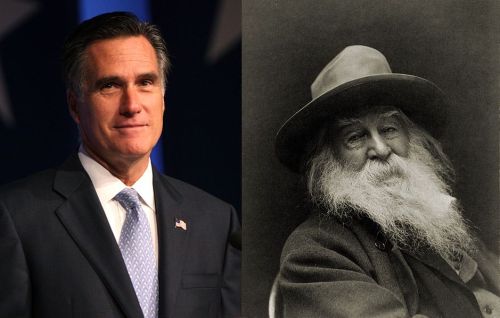
The Body Electric: Mitt Romney and Walt Whitman


Those who love America and poetry should love Walt Whitman. So should Mitt Romney.

Just as the Civil War was a dividing line in our history, Whitman was the line in poetry and culture. His lyrical innovation and his exuberant celebration of all things human and exciting—including sex and beautiful bodies—limited appreciation by nineteenth century readers. If Whitman seemed out of place then, he is right at home now:

Of Life immense in passion, pulse, and power,
Cheerful—for freest action form’d, under the laws divine,
The Modern Man I sing.

Why should Mitt Romney care about Walt Whitman?

Whitman was more than just an expert on being himself and singing about himself. He recognized that constancy and consistency is not a part of the artist’s makeup. And so he wrote the mantra for all those who stand so accused:

Do I contradict myself? Very well, then I contradict myself, I am large, I contain multitudes.

Romney should also care as a student of the Presidency. The most memorable poems about an American President (and there are surprisingly few) were written by Whitman. On the death of Abraham Lincoln, he wrote not one but two famous elegies that are still read and recited today.

From O Captain My Captain:

O CAPTAIN! my Captain! our fearful trip is done;
The ship has weather’d every rack, the prize we sought is won;
The port is near, the bells I hear, the people all exulting,
While follow eyes the steady keel, the vessel grim and daring:
But O heart! heart! heart!
O the bleeding drops of red,
Where on the deck my Captain lies,
Fallen cold and dead.

From When Lilacs Last in the Door-yard Bloom’d:

WHEN lilacs last in the door-yard bloom’d,
And the great star early droop’d in the western sky in the night,
I mourn’d—and yet shall mourn with ever-returning spring.

O ever-returning spring! trinity sure to me you bring;
Lilac blooming perennial, and drooping star in the west,             5
And thought of him I love.

Finally, while Mitt Romney may have never read the poem I Sing the Body Electric, there is an extraordinary scene in the third verse. It is a pastoral picture of a tall older man—fifteen years older than Romney—standing with his five grown sons. He is deeply beloved for who he is and what he has done. It is not just the way that Mitt Romney wants to be seen; it may be the way he is seen by those who do know and love him:

I know a man, a common farmer—the father of five sons;
And in them were the fathers of sons—and in them were the fathers of sons.

This man was of wonderful vigor, calmness, beauty of person;
The shape of his head, the pale yellow and white of his hair and beard, and the immeasurable meaning of his black eyes—the richness and breadth of his manners,
These I used to go and visit him to see—he was wise also;
He was six feet tall, he was over eighty years old—his sons were massive, clean, bearded, tan-faced, handsome;
They and his daughters loved him—all who saw him loved him;
They did not love him by allowance—they loved him with personal love;
He drank water only—the blood show’d like scarlet through the clear-brown skin of his face;
He was a frequent gunner and fisher—he sail’d his boat himself—he had a fine one presented to him by a ship-joiner—he had fowling-pieces, presented to him by men that loved him;
When he went with his five sons and many grand-sons to hunt or fish, you would pick him out as the most beautiful and vigorous of the gang.

You would wish long and long to be with him—you would wish to sit by him in the boat, that you and he might touch each other.

“I Shook The Hand Of The American Dream”: Rick Santorum And The Weirdness Of The Tortured And Overextended Metaphor


This is about Rick Santorum speaking at the Republican National Convention. But it is not about politics.

It is about rhetoric, as in writing and speechifying.

Rick Santorum is a fearless stylist. Some of us love sweater vests, and were happy to see someone so openly and proudly wearing them.

But as a speaker, his RNC speech, while obviously heartfelt and clearly partisan, contained an over-the-top device that all writers and all speakers and just about any communicator needs to avoid: the tortured and overextended metaphor.

To begin with, metaphors are tricky for anybody, even the most seasoned writer. When a metaphor is off by more than a little, the term we use to describe it is “torturned.”

Beyond the tortured metaphor is the extended one. Even an apt metaphor gets its strength from its ability to surprise and hook our imagination. Like all great moments, it is here and should soon be gone. The extended metaphor milks that moment dry.

And so without further ado, this excerpt from Rick Santorum’s speech:

America is still the greatest country in the world – and with God’s help and good leadership we can restore the American Dream.

Why?

I held its hand. I shook the hand of the American Dream. And it has a strong grip.

I shook hands of farmers and ranchers who made America the bread basket of the world. Hands weathered and worn. And proud of it.

I grasped dirty hands with scars that come from years of labor in the oil and gas fields, mines and mills. Hands that power and build America and are stewards of the abundant resources that God has given us.

I gripped hands that work in restaurants and hotels, in hospitals, banks, and grocery stores. Hands that serve and care for all of us.

I clasped hands of men and women in uniform and their families. Hands that sacrifice and risk all to protect and keep us free. And hands that pray for their safe return home.

I held hands that are in want. Hands looking for the dignity of a good job, hands growing weary of not finding one but refusing to give up hope.

And finally, I cradled the little, broken hands of the disabled. Hands that struggle and bring pain, hands that ennoble us and bring great joy.

“I shook the hand of the American dream…. Hands looking for the dignity of a good job…And finally, I cradled the little, broken hands of the disabled.”

While Rick Santorum may be wrong on the issues, he has proved himself a man of conscience and conviction (maybe one of the reasons he failed to get his party’s nomination). But as a speaker, the image of those hands with eyes wide open, looking for a good job, may be one that sticks with us.

The Romneys And The Regular People


Wild speculation continues to spin about what the Romneys don’t want to reveal in their tax returns. Low tax rates? Offshore investments? Questionable tax shelters?

Following Occam’s razor, the simplest explanation is that they simply don’t want to bolster what we already know: the Romneys are not regular people. We have seen glimpses of that in the little bits of disclosure, but year after year of low-tax ultra-income would just make the point more overwhelming and concrete.

Ann Romney seems to be a good person who has been a good wife and mother. She has suffered from health problems, maybe more than her fair share. Compassion demands that we regard that suffering without criticism and with open-hearted empathy.

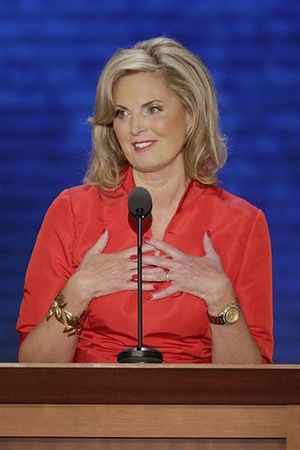
But her speech to the Republican National Convention was ridiculous in the literal sense. She talked about the plight of regular people as if she had long-time close relationships with lots of them and had deep, first-hand understanding of their struggles. Anything is possible, but that is far-fetched. There is nothing wrong with the Romneys’ life. People are entitled to their lives and experiences; sometimes it’s not even a matter of choice when those rarefied lives are foist on them by circumstances.

Over the years that Mitt Romney has clumsily been running for President, pundits of both parties have offered a simple solution to him and, presumably, to his wife: just be yourself, whoever that is. America hates phonies. The Republicans ought to know this, given how often they charge President Obama with that crime.

Mitt Romney is not a regular person, and has never been. Neither is Ann. Maybe you can win the Presidency as an openly stratospherically rich and out of touch person, maybe you can’t. But watching someone try so hard to hide that is not only poor politics, it is downright depressing.

Donald Trump, The Birth Certificate And The WMDs


Donald Trump continues to pump up the question of Barack Obama’s birth certificate, even on the eve of the Republican National Convention. In fact, the big “surprise” he has in store for the convention may have something to do with that (publication of the President’s “actual” birth certificate, perhaps?)

There are two sides to the question of Barack Obama’s birth: one small group that seemingly refuses to accept the reality that he was born in the United States, and one very large group—including plenty of Republicans—who can’t understand how there is a small group still denying that reality.

This is all about reality, and the way that politics deals with it.

The underlying truth about the curious stubbornness of “birther” partisans is not that they deny the President was born in Hawaii. It’s that they deny and refuse to accept that he is the President, wherever he was actually born. They will never be satisfied by any proof that Barack Obama wasn’t born outside the United States, because as a necessary political matter, he really was born outside.

We faced a similar issue nine years ago. In the prelude to the Iraq War, two possible realities fought it out, and there were large numbers of both believers and skeptics about the reality of WMDs, which was the casus belli. Some circumstantial evidence was offered for their existence, which didn’t quite satisfy a number of reasonable people. But as a political matter, WMDs had to exist, and since there was no way of definitively answering the question short of invasion, invade we did. All these years later, there is broad consensus that there were no WMDs. But that hasn’t stopped a small but durable band of believers from still insisting that they were there, because as a political matter they have to have been. For them, there will never be enough proof to the contrary.

It may not seem like it in the midst of this election season, but politics actually has some good uses. Denying reality is not one of them. Politics is supposed to serve reality, not the other way around.

Movies: Force of Evil


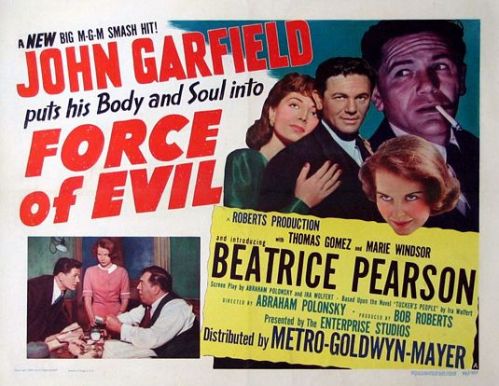
The overlooked movie Force of Evil (1948)  is one of the most striking creative critiques of big business in any medium. It was produced by the major, decidedly capitalistic studio MGM, and it featured one of Hollywood’s biggest stars at the time, John Garfield, in what many consider his greatest performance. A standout of intelligent film noir, it has a brilliant and poetic script, written and directed by Abraham Polonsky.

Garfield is still a celebrated name in movies. Polonsky is more narrowly known, mostly among film historians. Shortly after Force of Evil, both Polonsky and Garfield were blacklisted in the craze of anti-Communist McCarthyism that swept the movie industry. Polonsky would not work again for twenty-one years.

There are two kinds of political movies. One is expressly and directly about political issues. The other kind—the one that so worried Commie-hunters—are films that look entertaining on the surface, but have a subversive and counter-cultural subtext. Force of Evil is a sort of third wave. You can watch it as a well-acted and engaging melodrama, which it is. But at some points, the politics explicitly but gracefully rises above subtext, in a way that is mostly undidactic, so it doesn’t get in the way of enjoying and appreciating the movie. It is quite a trick that Polonsky pulls off.

One of the archetypes of storytelling is the two brothers who end up on opposite sides of the law—Cain and Abel, the cop and the gangster. In this movie, both brothers are on the wrong side, just on a different scale. Leo is small-time, running a modest numbers betting business. (Numbers, sometimes called the policy racket, is an illegal lottery, long popular in low-income neighborhoods. Small bets are placed on the last three digits of the daily betting take at a race track; the odds are thus 1000 to 1.)  Joe (John Garfield), the younger brother who Leo helped put through Harvard Law, works for Ben, one of the biggest racketeers in New York.

Joe wants to make his first million, and he believes he will thanks to an ingenious plan to rig the outcome of the numbers on the Fourth of July. Since bettors often pick the numbers 776 on Independence Day, when that number comes up, the bettors will win for a change, but all the small-time numbers operators will go out of business, and be taken over by Ben. It is a strategy of forced, one-sided, underhanded mergers. (That’s right, the corrupt big business will play its dirty tricks on the slightly less corrupt small businesses—and on the innocent poor people—on the Fourth of July.)

Joe tries to save his brother by bringing him over to the bigger, richer and slightly darker side. But there are few heroes here. Events overtake characters, and in the end everyone, including a rival boss, is dead—except for Joe and the young woman he loves. While not exactly a happy ending, this outcome led some to complain that this sort of redemption was inconsistent with the rest of the movie. Maybe so, but this was made by one of the world’s biggest movie studios, and anyway, we all deserve a break in the face of this bleakness.

Bleak it may be, but Force of Evil is not some sort of dull lesson in ideology. It is a great, entertaining and rarely-seen film that deserves attention, whatever your politics.

Hints For Hurricane Watchers


In 2005 we became a nation of hurricane watchers. We couldn’t help it: there were so many Atlantic hurricanes and tropical storms that season that the National Hurricane Center ran out of names:

Tropical Storm ARLENE
Tropical Storm BRET
Hurricane CINDY
Hurricane DENNIS
Hurricane EMILY
Tropical Storm FRANKLIN
Tropical Storm GERT
Tropical Storm HARVEY
Hurricane IRENE
Tropical Depression TEN
Tropical Storm JOSE
Hurricane KATRINA
Tropical Storm LEE
Hurricane MARIA
Hurricane NATE
Hurricane OPHELIA
Hurricane PHILIPPE
Hurricane RITA
Tropical Depression NINETEEN
Hurricane STAN
Tropical Storm TAMMY
Subtropical Depression TWENTY-TWO
Hurricane VINCE
Hurricane WILMA
Tropical Storm ALPHA
Hurricane BETA
Tropical Storm GAMMA
Tropical Storm DELTA
Hurricane EPSILON
Tropical Storm ZETA

It turned out to be a season of devastation, not the least of which was the still-resonating aftermath of Katrina. One of the upshots was political: the memorable and controversial response of President George W. Bush to Katrina (“heck of a job, Brownie”) still sticks to him as a mark on his Presidency.

Hurricanes and politics are back again, this time as Isaac heads toward a possible disruption of the Republican Convention in Tampa.

For those who experienced Hurricanes 2005 firsthand, checking the 5:00am advisory on the National Hurricane Center website became a ritual—as did checking the 11:00am, 2:00pm, 5:00pm, 8:00pm, 11:00pm and 2:00am advisories. Besides the text descriptions from “Forecaster Avila” and “Forecaster Franklin” there were the maps.

The maps provided a wealth of graphical information, including the famous “Uncertainty Cone.” This is a prediction, three and five days out, of the broad possible route of the storm, including possible timeline and strength. The cone is meant to catch the attention of all areas that might be subject to the storm’s dynamic path.

That cone is in turn based on very sophistical computer modeling of how storms behave. There are at least eight different guidance models used by forecasters, all them with a different record of successful prediction. Sometimes the models are close to each other, especially as the late life of a storm. But often the models are widely divergent. On a map, these tracks are represented by colored lines; they look like, and are sometimes called, spaghetti tracks.

Maps of uncertainty cones and advisories are still available for viewing on the NHC site, along with educational briefings and a fascinating and exhaustive history of storm seasons past. But something has gone away, as NHC explains:

The National Hurricane Center does not generate a graphic of the guidance models it uses to produce its forecasts. Such graphics have the potential to confuse users and to undermine the effectiveness of NHC official tropical cyclone forecasts and warnings.

NHC is right. If you don’t recognize that one track is more reliable than another, especially in light of current conditions, you could easily jump to an ill-informed conclusion. However, those who don’t have a degree in meteorology but who do have an unofficial certificate in hurricane tracking (those hours in front of the computer in the middle of the night have to be good for something) still love to watch those colored lines squiggle around the map.

If you are watching Isaac, visit the National Hurricane Center website. And then, if you dare to and can watch responsibly, check out the models for yourself. One of the best places to find them is here—which happens to be, by chance or fate, at the University of Wisconsin-Milwaukee, just about an hour from Janesville.

Why Compassion Matters


On August 4, in a hospital just a few miles from where this post is being written, John Wise, 66, snuck into the room where his wife Barbara, 65, was lying. They had been married for 45 years. She was suffering, reports indicate, from a triple aneurysm, and her prognosis appears to have been poor. He ended her life, shooting her in the head, though she did not die until the next day. His plan to shoot himself immediately after that was thwarted when his gun jammed. This week, he was charged with aggravated murder and faces life in prison without parole.

This has raised, not for the first or last time, the issue of mercy killing in the face of untreatable illness and declining quality of life. With an aging and ailing population, whether it is our family or ourselves, this goes each passing day from the abstract to the very real.

You can deal with this on an intellectual and practical level, weighing moral and legal issues, determining what you might do or ask others to do under a variety of circumstances. But hearing this story, the most natural thing is to cry. Not out of any failure to resolve those issues, but out of sheer compassion.

Compassion is what matters. All of our spiritual traditions commend it, but maybe none makes it more plainly central than Buddhism. The first truth of Buddhism is the reality of suffering; all else in how we are to live stems from this.

The story is told of a woman whose child had died. She came to the Buddha, who instructed her to visit neighbors and to return with a mustard seed from a house that had not been touched by death. She came back empty handed. This wasn’t to make her feel “better,” which it couldn’t. This was to help her see herself where she was, a living drop in the sea of suffering.

Compassion is more than walking in another’s shoes, more than the Golden Rule, more than “no man is an island.” It is the deepest possible recognition, beyond words, of the need that universal suffering creates. The need to care unconditonally.

If compassion is present in our lives and our politics, whatever we do cannot be completely wrong. If compassion is absent, nothing we do can be right, no matter how good it is meant to seem.

The One The Only The Real Hank Williams


Sometimes something good can come from something bad.

Somebody wearing the ill-fitting name Hank Williams has been going around saying nasty things about President Obama (he’s a Muslim, he hates America). Despite that name being a few sizes too big for him, it appears he has somehow managed to have some success as a musician and as the son of a more famous father. But as with the name, the shoes are also way too big to fill.

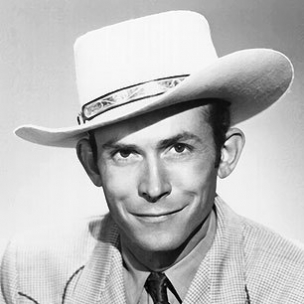
Hank Williams (1923-1953) was one of the great musical artists and folk poets in America. He died too young at the age of 29, but had already produced songs that entertained millions and inspire musicians fifty years after his death. His songs have been covered by scores of artists as diverse as Al Green, Beck, Bob Dylan, Bruce Springsteen, George Thorogood, Keb’ Mo’, Keith Richards, Red Hot Chili Peppers and Tom Petty.

If you haven’t heard of Hank Williams, you are missing something. If you haven’t heard him, because you “don’t like country music”, you are missing something. Don’t believe it? Believe the Pulitzer Prize Board, which in 2010 awarded him a Special Citation for “his craftsmanship as a songwriter who expressed universal feelings with poignant simplicity and played a pivotal role in transforming country music into a major musical and cultural force in American life.”

So if someone named Hank Williams, Jr. is going around badmouthing the President, what good can come of that?

Just this: In the midst of looking around for things to say about Hank Williams, a brand new independent film came to light. The Last Ride is the story of a fateful trip. Hank Williams was heading out for a series of concerts to end in Canton, Ohio on New Year’s Day 1953. Bad weather prevented flying, so a college student was hired to drive him from Nashville to the concerts. Before reaching Ohio, on January 1, Williams died in West Virginia. Last Ride is the story of that trip. The film has already been screened in New York and Los Angeles, and later this week can be seen in Nashville, Dallas, Seattle and Bakersfield.

There’s plenty of Hank Williams music around. Give it a listen. Because if the only Hank Williams you know about is the Junior who seems so out of touch with reality, there’s someone to discover. Hank Williams—the one the only—was nothing but real.

Hear the lonesome whippoorwill
He sounds too blue to fly
The midnight train is whining low
I’m so lonesome I could cry

I’ve never seen a night so long
When time goes crawling by
The moon just went behind a cloud
To hide its face and cry

Did you ever see a robin weep
When leaves begin to die
That means he’s lost the will to live
I’m so lonesome I could cry

The silence of a falling star
Lights up a purple sky
And as I wonder where you are
I’m so lonesome I could cry