Bob Schwartz

Category: Politics

God and the H-Bomb

God and the H-Bomb

The Hydrogen Bomb is in the news, thanks to North Korea’s questionable claim that they have one and have tested it.

In the years following World War 2, the H-Bomb was big news. Big, just like The Bomb. The world had seen the destructive power of the A-Bomb used at Hiroshima and Nagasaki. The H-Bomb made the A-Bomb look like a stick of dynamite. Where once there was the power to destroy cities, we could now destroy the world. And ourselves. We were as gods, at least in our punishing might.

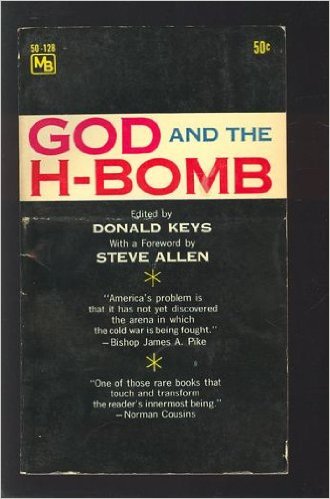
In 1961, a book called God and the H-Bomb was published. It’s not in print, but you might find a copy used or in a library, as I did a few years ago. The cover carries this question: “What counsel do our spiritual leaders offer in response to mankind’s greatest challenge?”

The roster of contributors is an impressive list of thinkers, some of whom are still recognized names, some less familiar. Paul Tillich, Martin Buber, Pope Pius XII, and so on.

We don’t see many—any—religious and spiritual leaders interviewed about the North Korean test, about the Iran deal, or about any Bomb related stories. Except for those religious and spiritual leaders with political strategy in mind or a political axe to grind.

That’s not what this 55-year-old book is about. It is about the moral and spiritual dimensions of the H-Bomb. That is reflected in the titles of the pieces. The power of self-destruction. War and Christian conscience. Fifteen years in hell is enough. Thy neighbor as thyself. The road of sanity.

The foreword is by Steve Allen, who is a little remembered as a significant television personality, but less as one of the most entertaining and brilliant public intellectuals of the middle twentieth century. Here’s what he writes:

That our nation is in the throes of moral collapse of serious dimensions is, apparently, no longer a debatable conclusion. Liberal and conservative spokesmen vie to see who shall express the conviction most vigorously. Churchmen and secularists, too, agree that we have fallen upon evil days. These various groups naturally differ as to the reasons for the situation, but that it exists no one seems to doubt….

Will our nation be guided in this dread hour by the moral code it professes to honor?

Will it?

Alternate history: What if the presidential losers were winners?

If you are a fan of alternate history, you should first of all be reading Philip K. Dick’s The Man in the High Castle and watching the series on Amazon (no spoiler: the U.S. lost World War II). For something else different, there’s this:

What if the major party losers for President actually won the election?

There are a few glitches, thanks to an untimely assassination and resignation, a loser later becoming a winner, a winner later becoming a loser, and a seriously messed up vote count. To avoid this, I’ve eliminated those losers who at one time did get to be President, by hook or crook.

Adlai Stevenson
Barry Goldwater
Hubert Humphrey
George McGovern
Walter Mondale
Michael Dukakis
Bob Dole
Al Gore
John Kerry
John McCain
Mitt Romney

Practice saying this, alternate historians. President Stevenson. President Goldwater.

If you really want to get far out, add prominent third-party losers to the mix.

President Wallace? To put that one in perspective, George Wallace got 46 electoral votes in 1968, compared to just 52 for Goldwater in 1964 and 49 for Jimmy Carter in 1980.

And, of course, there’s President Ross Perot. He ran twice, didn’t win any electoral votes, but provided the model for any billionaire third-party candidates in the future. As if such a thing could ever happen again.

War on ISIS: You Can’t Ask About Boots on the Ground Without Asking About the Draft

No poll about sending ground troops to fight ISIS—or anywhere else—is complete without asking questions about the military draft.

A recent NBC News poll taken after the events in Paris asked:

Would you support or oppose the United States sending additional ground troops to fight ISIS (Islamic militants) in Iraq and Syria?

Strongly support: 33%
Somewhat support: 32%
Somewhat oppose: 18%
Strongly oppose: 13%
DK/NA: 3%

The following questions should be added:

Do you have any family members in the eligible age range for Selective Service registration, between ages 18 and 25?

If a military draft was put in place by Congress, would you support or oppose the United States sending additional ground troops to fight ISIS in Iraq and Syria?

If your representative in Congress voted in favor of a military draft, would you be more likely or less likely to vote for them in the next election?

(That age range is based on the current requirement for men between 18 and 25 to register with Selective Service. At various times, the draft has covered a much wider range, all the way up to age 45.)

If a military draft was in place, the support for ground troops would likely plummet, if respondents were honest (which they sometimes aren’t). If the mandatory service included women—as it does in Israel, the darling of conservatives—the support number might approach zero. Especially if respondents/voters weren’t sure they could pull strings to get their loved ones out of serving.

Any member of Congress who voted in favor of a military draft, men only or men and women, is almost assured of losing the next election.

This is no way diminishes regard and thanks for the extraordinary valor and service of those who voluntary choose to serve in any military action. This is simply to suggest that those who righteously support such actions in the abstract might have a very different opinion when they, to put it bluntly, crudely and literally, have precious skin in the game.

It May Not Be Politically Correct to Talk About It, But Is Donald Trump Mentally Healthy?

Donald Trump says he saw something that nobody else did: people in Jersey City cheering as the Twin Towers fell on 9/11.

From the Washington Post:

Republican presidential candidate Donald Trump says he saw people cheering the Sept. 11 attacks across the river in New Jersey — a claim officials strongly deny.

Trump first told the story Saturday at a rally in Birmingham, Alabama, as he pressed the need for greater surveillance, including monitoring certain mosques, in the wake of the Paris attacks.

“I watched when the World Trade Center came tumbling down. And I watched in Jersey City, New Jersey, where thousands and thousands of people were cheering as that building was coming down. Thousands of people were cheering,” Trump said Saturday at a rally in Birmingham, Alabama.

Trump repeated the assertion Sunday in an interview with George Stephanopoulos on ABC’s “This Week,” as Stephanopoulos explained to Trump that police had refuted any such rumors at the time.

“It did happen. I saw it,” said Trump. “It was on television. I saw it.”

“There were people that were cheering on the other side of New Jersey, where you have large Arab populations. They were cheering as the World Trade Center came down,” he said.

“I know it might be not politically correct for you to talk about it,” he added, “but there were people cheering as that building came down, as those buildings came down. And that tells you something.”

It comes down to two possibilities.

One is that Trump is just saying stuff and making up stuff for political benefit. Pretty outrageous stuff, but it’s been working for him so far. There have long been internet rumors to this effect, but every possible objective source—police, news media, even Republican politicians—deny it ever happened. But it is a rumor that is a definite winner among certain constituencies.

Or. There is something creepily genuine about Trump’s profession of belief in this. He saw it on television, he says, even though it was never on television. Which means that maybe, just maybe, Donald Trump has a problem. A psychological one. People do and say all kinds of things that cross all kinds of lines—ethical, moral, criminal—without having mental illness. On the other hand, it would not be that surprising for someone who has skated for so long on the edge of saying whatever is needed—very successfully and profitably—to cross a boundary to the place where things that never happened do appear to have happened. All evidence to the contrary.

Defeating ISIS: Lessons from the American and Israeli Wars of Independence

We can’t “defeat” ISIS. Not if that means declaring “victory” over Middle East-based Muslim radicalism and terror.

There are lessons from the American and Israeli Wars of Independence. This isn’t to suggest any moral equivalence comparing those world-changing events to the monstrosity of ISIS. But there are things to learn.

Both Wars of Independence were attempts to upend empire and established order and create a new model (both uprisings, not coincidentally, involving the British). Both were insurgencies by True Believers, one political and economic, one religious. Both are examples of the power of the heart, because the heart not only wants what the heart wants, it will do anything to get what the heart wants. True belief will find a way.

The British thought that their massive and formal force would roll right over the Americans. They did not count on all sorts of stealthy and tricky techniques, on secret communications, on a guerilla war. Mostly, the British didn’t account for the depth of American commitment: hearts and minds and souls. It may not always work that way, but competitions often go, simply, to the side that just wants it more. And that would be the Americans.

The British were never quite sure what they were doing in Palestine. But they did know something about world order and keeping order. Besides, some Brits didn’t much like the Jews anyway. The Zionists believed, literally, that they had God on their side. As far as hearts and minds and souls getting what they want, doing anything to win did mean the occasional act of terror (for example, the 1946 bombing of the King David Hotel in Jerusalem, leaving 96 dead). As far as who wanted it more, the founders of the modern Jewish state not only defeated the British, but turned back all attempts by hate-fueled neighbors to root them out.

In the aftermath of Paris, just as with 9/11 and other recent terrible events, if we keep talking simplistically about “defeating”, “eliminating” or “building American-style democracy”, we are—there’s no other way to say this—fools. We should eliminate and prevent horror, terror and monstrosity wherever and whenever we can. But if we think that the toxic mixture of true belief, grievance and pathology is just going to vanish because we are purer and more powerful, that would be funny if it weren’t so sad and dangerous.

If you don’t think that hearts, minds and souls matter when it comes to extremism, just look at the sorry record of irresolute and wasteful wars when we ignore that. We may feel righteous and superior, and want to vindicate civilization. But that doesn’t relieve us of the responsibility to be smart. Smart about what we face, what we can accomplish and how to accomplish it. So we can do some good, and do less harm.

The I Ching of Paris

Hexagrams 44 and 29

Question for the I Ching (using the coin method of consultation): How do we deal with the events in Paris?

The I Ching replies:

Hexagram 44 – Gou (Encountering, Coming to Meet)
Heaven above, Wind below.
Changing lines in the third, fourth and top place.

Changes to:

Hexagram 29 – Kan (Water, Darkness, The Abysmal)
Water above, Water below.

Excerpts from two leading translations:

The Complete I Ching
Alfred Huang

Hexagram 44 – Gou

The structure of the gua [hexagram] is Heaven above, Wind below. The wind blows everywhere under Heaven, encountering every being. It should be an auspicious gua. However, there is only one yielding line beneath five solid lines, symbolizing that the yin element is advancing and approaching the yang elements. When King Wen saw this happening, he heightened his vigilance. He realized that an unworthy person was worming his way into favor at the court. The growing negative influences would displace good people one after another. Darkness and difficulties had been eliminated, but their negative influences had not totally faded. These influences were permeating different areas. One must beware of this tendency and take prompt precautions against possible misfortune. Thus King Wen’s Decision and the Duke of Zhou’s Yao Text are full of warnings. But Confucius’s commentaries still shed light on the positive side.

This gua discusses the principle of encountering. In Chinese, meeting a person (or anything) unexpectedly is defined as encountering. When people encounter each other, either they are attracted, making adjustment for a harmonious relationship, or they reject each other, creating conflict between them. In human life sometimes one cannot refrain from misunderstanding and conflict. But one should not indulge in it and think that conflict is unavoidable and cannot be resolved. The ancient sages advocated adopting a conciliatory attitude. Here one yin element approaches five yang elements. She dares to come forward because her strength grows stronger. In this situation, one should not overlook taking preventive measures.

King Wen’s strategy of eliminating evil forces was to show no animosity but to act without tolerance. His administration constrained evil elements like tying up rams. But evil elements still wormed themselves into the favor of the court. King Wen realized that the evil forces had been eliminated, yet their influence had not totally faded. His analogy was that the maiden was too strong; it was not good to marry such a woman. The Duke of Zhou describes the evil forces as waiting to move forward like a lean pig. They should be stopped as if fastened with a metal brake. It is wise to restrain their influence by not letting them influence other people, but it was wiser to influence people with positive virtue.

[Changes to:]

Hexagram 29 – Kan

The central theme of this gua is: falling but not drowned; in danger but not lost. Maintain your confidence: soothe your mind. With assurance and faith, caution and trust, you can pass through any difficult situation. Both Abysmal and Abyss carry the sense of being bottomless. Kan is a pit, but it is not bottomless. There is hope.

Darkness represents not only a pit but also a situation of difficulty or danger. The structure of this gua is a doubling of the primary gua, Water. The image of Water is a yang line plunging between two yin lines, like running water flowing along and between the banks of a river. In ancient times, crossing a river represented a great danger. Thus, the attribute of Water was designated a situation of difficulty or danger. Here, Water is doubled, suggesting that one is plunging into a situation fraught with difficulties or danger. However, the ancient Chinese believed that no matter how dangerous or dark a situation was, if one was able to follow the way of Heaven, one could pass through it as safely as water passes through a ravine.

Water flows on twice over,
Darkness is doubled.
In correspondence with this,
The superior person cultivates and practices virtue constantly
And responds through teaching.


The I Ching
Wilhelm/Baynes

Hexagram 44 – Kou

This hexagram indicates a situation in which the principle of darkness, after having been eliminated, furtively and unexpectedly obtrudes again from within and below. Of its own accord the female principle comes to meet the male. It is an unfavorable and dangerous situation, and we must understand and promptly prevent the possible consequences.

The inferior man rises only because the superior man does not regard him as dangerous and so lends him power. If he were resisted from the first, he could never gain influence.
The time of COMING TO MEET is important in still another way. Although as a general rule the weak should not come to meet the strong, there are times when this has great significance. When heaven and earth come to meet each other, all creatures prosper; when a prince and his official come to meet each other, the world is put in order. It is necessary for elements predestined to be joined and mutually dependent to come to meet one another halfway. But the coming together must be free of dishonest ulterior motives, otherwise harm will result.

[Changes to:]

Hexagram 29 – K’an

In man’s world K’an represents the heart, the soul locked up within the body, the principle of light inclosed in the dark—that is, reason. The name of the hexagram, because the trigram is doubled, has the additional meaning, “repetition of danger.” Thus the hexagram is intended to designate an objective situation to which one must become accustomed, not a subjective attitude. For danger due to a subjective attitude means either foolhardiness or guile. Hence too a ravine is used to symbolize danger; it is a situation in which a man is in the same pass as the water in a ravine, and, like the water, he can escape if he behaves correctly.

Through repetition of danger we grow accustomed to it. Water sets the example for the right conduct under such circumstances. It flows on and on, and merely fills up all the places through which it flows; it does not shrink from any dangerous spot nor from any plunge, and nothing can make it lose its own essential nature. It remains true to itself under all conditions. Thus likewise, if one is sincere when confronted with difficulties, the heart can penetrate the meaning of the situation. And once we have gained inner mastery of a problem, it will come about naturally that the action we take will succeed. In danger all that counts is really carrying out all that has to be done—thoroughness—and going forward, in order not to perish through tarrying in the danger.

Properly used, danger can have an important meaning as a protective measure. Thus heaven has its perilous height protecting it against every attempt at invasion, and earth has its mountains and bodies of water, separating countries by their dangers. Thus also rulers make use of danger to protect themselves against attacks from without and against turmoil within.
Veterans Day: The Annual Shame of a Nation

Veterans Boots

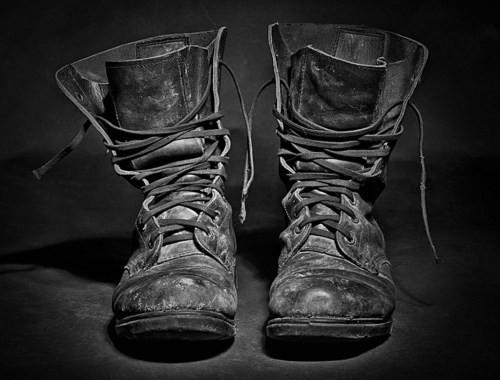
Failure to take full and proper care of veterans is not a Democratic or Republican shame. The only reason to focus on Republicans here is that last night, in their debate, on the eve of Veterans Day, only four passing mentions of veterans were made during two hours.

The debate was formally about the economy, but since every one behind the podiums is practiced at changing the subject, there’s no reason some or all of them couldn’t have just said: The economy is an important topic, but just tonight, this particular night, I’d like to focus my time exclusively on veterans matters.

Here’s what one of them might have said:

There is enough responsibility to go around for getting this nation involved in military conflicts. It doesn’t matter what party started it or finished it or didn’t finish it. It doesn’t matter whether it was a great idea or a terrible idea or whether it is too soon to tell. As a nation, we do what we do, and we have to pay the price and keep our promises. In the case of military service, that promise is to spare no expense or effort to not only make combatants whole, or whole as humanly possible, but to elevate their service to priority status in our national consciousness and commitments.

That’s why I’m going to spend whatever minutes I have on this national debate platform tonight to talk specifically about immediate solutions to veterans issues, rather than casting blame or blowing hot air. I also call upon the millionaires and billionaires supporting us and trying to influence the election to divert just a little of that money to nonpartisan efforts such as Iraq and Afghanistan Veterans of America to start solving the problem. Of course, making this a government first priority would be nice too. Because if it comes down to a choice between any of us actually getting the nomination, which is admittedly a long shot for most of us anyway, and the comfort and well-being of those men and women we’ve flag-wavingly asked to fight on our behalf, I’d rather ask that those veterans be made whole than that I be President.

I know. Dream on.

Ask for Forgiveness: The Perfect Ben Carson Strategy That He Won’t Use

Ben Carson

Ben Carson has gotten caught embellishing/lying about some details in his life that are part of his inspirational narrative.

What’s weirdest about his response—spin, blame the media, discount the degree of untruth, etc.—isn’t that making up stuff is unusual for politicians. Zebras and stripes, leopards and spots. What’s weird is that being a sincere and serious Christian, all he has to do is tell the truth. Say that he exaggerated or even lied, and ask for forgiveness. Because he is, after all, only human, only a sinner like us all.

His many Christian supporters should not only forgive him. They should see him as a model of genuine Christian contrition and humility. Which presumably is what God and Jesus ask of us. Not to be saints, which we can’t be anyway, but to be self-aware, confessing humans, bent on being better. It is entirely possible that he could actually make gains among Christian supporters for doing that.

If those supporters refused to forgive, that might put in question the depth of their unconditional Christian commitment. Lying itself doesn’t put your faith and commitment in question (remember, only human), but stubbornly persisting in finding every which way not to say you have lied is a little more troubling. And maybe a little less Christian.

Does the New Jeb Bush Book Infringe Hundreds of Copyrights?

Jeb Bush - Reply All

A funny thing: None of the Bush politicians are lawyers. Though they do know some.

Which is one reason Jeb’s new book of his e-mails from being Florida governor (Reply All) is perplexing, along with the question of why he’s publishing it at all. He makes a big point of saying in it that in Florida, letters and e-mails to the governor are part of the public record, which is true. Anyone has the right to read them.

But…that doesn’t settle the question of whether the writers of those letters and e-mails still hold any copyright in them, such that if you (Jeb) decided to collect them all, and publish them in a book of your own that you sold, you might not be infringing their rights. Because the two things—being a public record and giving up the right not to be copied—are two separate things.

I’ll leave it to other lawyers and to journalists to pursue this matter, if it’s worth pursuing, because frankly, I don’t care that much. Maybe it’s just the spectacle of a campaign unraveling in so many ways that has piqued my interest a little. Or wondering, as historians may if they care to, how this all went so wrong.

If You’re Tired of Hearing About the Vietnam War, Tell Our Leaders to Stop Reenacting It

This weekend, an administration official tried to explain in an interview what exactly we are now doing in Iraq and Syria. It was like a ghost or the walking dead, sounding eerily and unhappily exactly like the rhetoric that was rolled out in the middle days of the Vietnam War.

There are roughly three groups about Vietnam: those who lived through it on the home front, those who lived through it (or not) in battle, and a generation or more that is so tired of hearing about a war that ended forty years ago. So tired of it. Can’t you all ever get over it?

Too bad. No, we should never “get over” Vietnam, no matter how many generations pass, and no matter how tired those generations are about the lessons we might learn. Vietnam was the first truly modern war of the media age and of the post-national era.

In media terms, it offered the best possibility up to that time to say positive stuff about a complex war policy, have it widely broadcast (though not as widely as digital today), and have the media endorse it and people believe it. Okay, that does sound like a description of what happened in Iraq, but that just proves the point.

As far as post-national warfare, Vietnam was technically a civil war, but it was obviously something else too. There was an army of North Vietnam, but there were also indigenous forces and a people’s movement trying to upset an unacceptable status quo, which we supported and ultimately defended. For a while. Until there was no more government of South Vietnam. And then it became a matter of just not losing. Which we did.

Another parallel is not paying attention to history, our own and that of others. The French abandoned Indochina, but that was supposedly just because they were, well, French. Americans know and are better than that. Just as in Afghanistan, where the Soviets abandoned their war, but that was supposedly because, well, they were Commies. Freedom loving Americans know and are better.

Which brings us back round to Iraq and Syria today. If you make the effort, you could go back to the LBJ days of Vietnam and hear exactly the same words that were spoken this weekend. Not just something like it, but exactly. Such as: it’s their fight, not ours.

There are things worth fighting for on the world stage, even when it is not on our homeland. But it is hard enough to figure out what those things are, and even harder to commit ourselves and our loved ones to the fight, when we are swimming in a sea of official stuff and nonsense. We want the brutal truth, if our leaders can tell it, especially when it is bound to be a brutal and long fight.