Bob Schwartz

Category: Philosophy

Rabindranath Tagore

Rabindranath Tagore


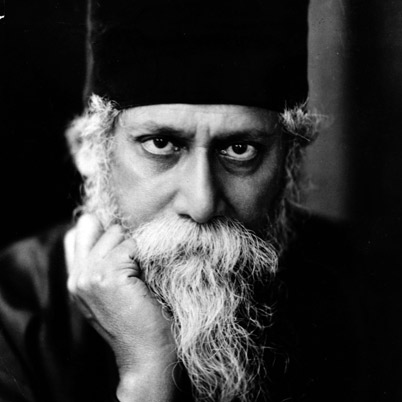
Take a break with Rabindranath Tagore (1861-1941).

He was a Bengali poet, essayist, dramatist, composer and philosopher, and is the most esteemed creative artist of modern India. He was the first non-European to win the Nobel Prize in Literature in 1913.

A brief introduction is Stray Birds (1916), which consists of 326 very short verses—each one usually one or two sentences. Below is a selection of them. Among the many online items by and about Tagore there is a 1961 documentary about Tagore by Satyajit Ray, India’s most celebrated film director.

These literary stray birds may seem at first glance to be mere poetic aphorisms. Taken together, though, this is a worldview of inspired simplicity.

From Stray Birds by Rabindranath Tagore

1
Stray birds of summer come to my window to sing and fly away.
And yellow leaves of autumn, which have no songs, flutter and fall there with a sigh.

2
O troupe of little vagrants of the world, leave your footprints in my words.

6
If you shed tears when you miss the sun, you also miss the stars.

28
O Beauty, find thyself in love, not in the flattery of thy mirror.

35
The bird wishes it were a cloud. The cloud wishes it were a bird.

36
The waterfall sings, “I find my song, when I find my freedom.”

40
Do not blame your food because you have no appetite.

43
The fish in the water is silent, the animal on the earth is noisy, the bird in the air is singing,
But Man has in him the silence of the sea, the noise of the earth and the music of the air.

45
He has made his weapons his gods. When his weapons win he is defeated himself.

48
The stars are not afraid to appear like fireflies.

52
Man does not reveal himself in his history, he struggles up through it.

58
The sparrow is sorry for the peacock at the burden of its tail.

62
The Perfect decks itself in beauty for the love of the Imperfect.

75
We read the world wrong and say that it deceives us.

88
He who wants to do good knocks at the gate; he who loves finds the gate open.

121
I carry in my world that flourishes the worlds that have failed.

123
The bird thinks it is an act of kindness to give the fish a lift in the air.

128
To be outspoken is easy when you do not wait to speak the complete truth.

130
If you shut your door to all errors truth will be shut out.

141
When I travelled to here and to there, I was tired of thee, O Road, but now when thou leadest me to everywhere I am wedded to thee in love.

146
I have my stars in the sky,
But oh for my little lamp unlit in my house.

156
The Great walks with the Small without fear.
The Middling keeps aloof.

158
Power takes as ingratitude the writhings of its victims.

161
The cobweb pretends to catch dew-drops and catches flies.

166
The canal loves to think that rivers exist solely to supply it with water.

169
Thought feeds itself with its own words and grows.

178
It is the little things that I leave behind for my loved ones, –great things are for everyone.

184
He who is too busy doing good finds no time to be good.

193
A mind all logic is like a knife all blade.
It makes the hand bleed that uses it.

207
Praise shames me, for I secretly beg for it.

208
Let my doing nothing when I have nothing to do become untroubled in its depth of peace like the evening in the seashore when the water is silent.

210
The best does not come alone. It comes with the company of the all.

235
Do not say, “It is morning,” and dismiss it with a name of yesterday. See it for the first time as a new-born child that has no name.

243
The stream of truth flows through its channels of mistakes.

248
Man is worse than an animal when he is an animal.

258
The false can never grow into truth by growing in power.

280
Let the dead have the immortality of fame, but the living the immortality of love.

296
Blessed is he whose fame does not outshine his truth.

317
Man’s history is waiting in patience for the triumph of the insulted man.

319
I long for the Island of Songs across this heaving Sea of Shouts.

323
I have suffered and despaired and known death and I am glad that I am in this great world.
Moses on Krypton, Superman in Egypt

Mose & Superman


The story of the Exodus and Passover is a story of freedom, faith and return from exile. It is also a story about the universal question of identity: who am I?

According to the story told in the Book of Exodus, Moses is born a lowly Hebrew, a child of slaves. Set afloat by his mother to avoid Pharaoh’s slaying of the first born, he is found and given the Egyptian name Moses. He is raised as Egyptian royalty, though as a baby he is fed at the breast of his Hebrew mother.

It is never clear in the text when or how he first finds out about his heritage. We only know that he does discover that he is a Jew. He flees to Midian and marries Zipporah, who bears him a son. The name chosen for their son tells a story, the story of Moses and of the Jewish people. The name is Gershom, meaning “I have been a stranger in a foreign land.” (Exodus 2:22)

This famous phrase leads to a question: exactly which land is Moses a stranger in? Is he a Hebrew who has been a stranger in Egypt, despite living his entire adult life as a great Egyptian? Or is he an Egyptian suddenly identified with a people he never knew as his own?

A clue is found in the stories about Moses as a speaker. Twice Moses tries to tell God that he is speech challenged. When directed to address the Jews, Moses claims to be “slow of tongue” and “heavy of mouth.” When told to speak to Pharaoh, Moses describes himself cryptically as having “uncircumcised lips.” Some interpreters attribute this to an actual speech impediment, perhaps stuttering. But a different view is that Moses is trying to tell God something sensible: Moses does not speak Hebrew very well. And why should he speak Hebrew, when he has spent his life as an Egyptian?

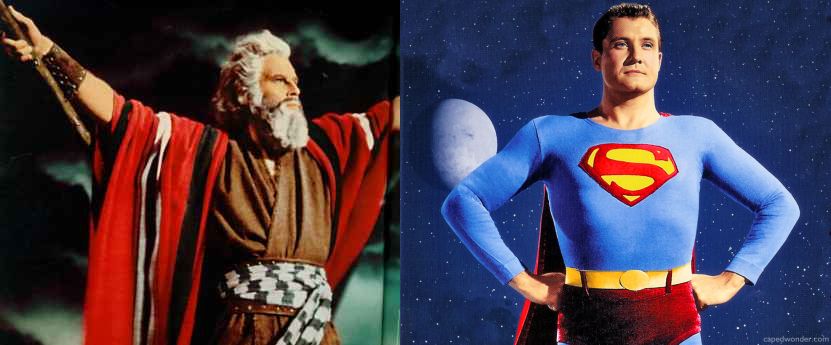
At this point, we leave Egypt for a trip to Cleveland in the 1930s. Jerry Siegel and Joe Shuster are a couple of nerdy Jewish teenagers with a love of science fiction and a talent for comic book art. They had grown up with the stories of the Bible, including the tales of Moses. Consciously or not, they mixed these together into a comic book creation that would become a modern cultural icon: Superman.

In the Siegel and Shuster version, there is no infant floated off in a basket to avoid his death, and no Egyptian princess to find and adopt him. Instead, the Kryptonian infant Kal-el (a version of the Hebrew phrase Kol El, “the voice of God” or “all of God”) is rocketed off in a space capsule to avoid the planet’s destruction. The capsule crashes on Earth, and he is found and adopted by the Midwestern couple, Ma and Pa Kent.

The biblical infant is raised as an Egyptian and given the Egyptian name Moses; Kal-el is raised as an earthling and given the Midwestern name Clark Kent. The time will come for both of them, Moses and Clark Kent, to reclaim their true identities in order to tap into great power, to become super-men.

But this reclaiming of identity is not without difficulties. The man born Kal-el struggles with his disguises: Is he Superman pretending to be Clark Kent, or is he Clark Kent who has a second identity as Superman?

These particular stories of exile and identity are only two of many such stories in history and in popular culture. It is a story that repeats itself again and again, not only among the Jewish people in ancient and modern times, but among all people in all times and circumstances.

Think of the Jews in the midst of their Exodus, chronically uncertain about who they were and where they belonged. As much as they wanted to follow their faith and their leader to a promised place, their adopted home for generations—even if not by choice, even under the oppressor’s thumb—had been Egypt.

Think of Moses, caught between two worlds. Yet the struggle for identity turns out to be a source of strength for him. All that he accomplished could never have happened if he had been only an Egyptian or only a Hebrew. It was through his being both, and through his trying to resolve that seeming contradiction, that the events of the Exodus transpired.

Think of ourselves. We may believe that by staying in one place and simply holding tight to an unchanging way, we can maintain an identity free of questions, and we can avoid being strangers in a foreign land. But that is impossible. Those around us are constantly changing and the world around us is constantly changing. The land we think of as familiar becomes foreign to us, and we find ourselves strangers in it.

Being a stranger is unavoidable, and it can be a good thing. Like Moses, we discover who we are only when we question who we are in the particular place and time we inhabit. Along with the divine direction that he heard, it is this burning question of identity that drove Moses to do great things. It is a valuable lesson for all of us as we retell the story of the Exodus this Passover.

© 2026 by Bob Schwartz

God’s Political Will


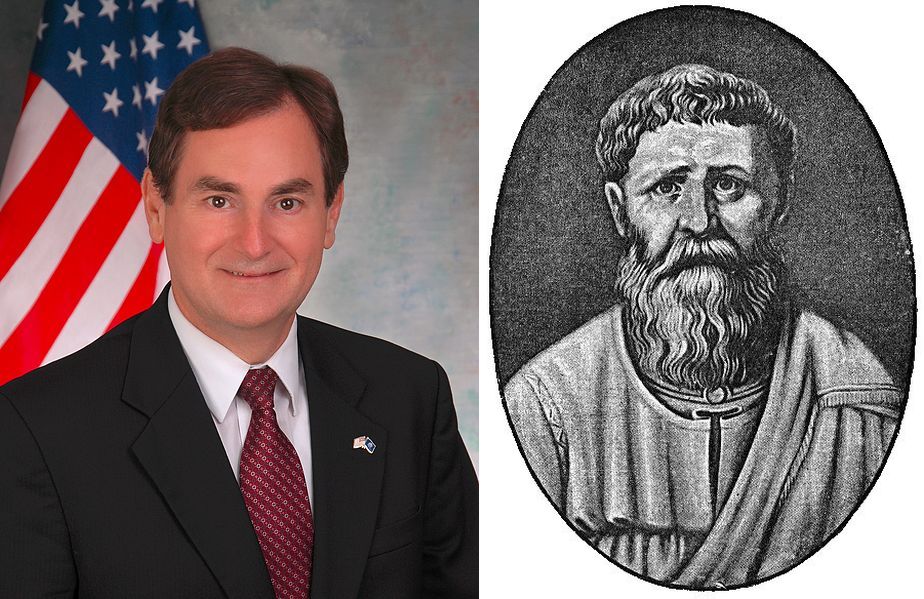
This post was originally published on October 25, 2012, a week before the general election in which Republican Richard Mourdock was running to win a Senate seat. Indiana was and remains solidly Republican, yet he lost to Democrat Joe Donnelly. It was attributed to a debate in which Mourdock said “life is that gift from God that I think even when life begins in that horrible situation of rape, that it is something that God intended to happen.”


In the history of Christian theology, philosophy has sometimes been seen as a natural complement to theological reflection, whereas at other times practitioners of the two disciplines have regarded each other as mortal enemies….

Philosophy takes as its data the deliverances of our natural mental faculties: what we see, hear, taste, touch, and smell. These data can be accepted on the basis of the reliability of our natural faculties with respect to the natural world. Theology, on the other hand takes as its starting point the divine revelations contained in the Bible. These data can be accepted on the basis of divine authority, in a way analogous to the way in which we accept, for example, the claims made by a physics professor about the basic facts of physics.

 On this way of seeing the two disciplines, if at least one of the premises of an argument is derived from revelation, the argument falls in the domain of theology; otherwise it falls into philosophy’s domain.

Stanford Encyclopedia of Philosophy


Current American politics includes little study and application of philosophy. Some of our founders were steeped in philosophy, being educated sons of the Enlightenment. But even then, the struggling rebel nation was marked by pragmatism: there may be no atheists in foxholes, but there aren’t many philosophers either. Today, even when ideologues throw around the names of Mill or Burke, that is a rarity. Most of our politicians don’t know, can’t practice and don’t care about philosophy.

Theology is another story. Our government and the campaign trail seem to be overflowing with those who consider themselves theologians, whether they call themselves that or not. But even though the ground of theology is distinct from philosophy, the rigor and discipline required is exactly the same. The simplistic adoption of an isolated theological premise is no more sturdy than an isolated philosophical one. A solid theological conclusion must be supported from start to finish. If you can’t answer all (or at least most) of the consequent questions, you can’t be trusted to answer any.

And so when Indiana Senate candidate Richard Mourdock announced that when a woman becomes pregnant through rape, the pregnancy is “God’s will,” the question isn’t whether that is true. The question is: assuming it is true, what else is God’s will?

Mr. Mourdock, and every other politician who claims to know God’s will, owes us a comprehensive list of those things that are and are not God’s will. In the case of Mr. Mourdock, if he is schooled in the fine points of Christian theology, that should be a straightforward matter.

For example: Are the outcomes of elections God’s will? If Mr. Mourdock’s opponent wins, will that be God’s will? If President Obama beats Mitt Romney, will that be God’s will?

There are a raft of sub-questions for the theologian. If God wills an election winner, how does it happen? Are some potential voters kept away from the polls by stormy weather or traffic jams? And how exactly does God decide who the winner should be? Is there a scorecard based on the Ten Commandments or the Seven Deadly Sins? Does a high score on “bearing false witness” or “greed,” for example, make it difficult to get an endorsement?

In the event Mr. Mourdock does not win, it may be God’s will after all. Just a few miles from his home in Darmstadt, Indiana is an excellent school, Trinity College of the Bible and Theological Seminary. Trinity offers a number of degree programs and dozens of courses on theology. If his keen interest in theology continues, that could be just the way to spend his time.

To Understand America 2025, Read Alice’s Adventures in Wonderland

We had the best education. We went to school every day. I only took the regular course. Reeling and Writhing to begin with. Then the different branches of Arithmetic—Ambition, Distraction, Uglification, and Derision.
Alice’s Adventures in Wonderland

Read Alice’s Adventures in Wonderland now. Again if it’s been a while, and definitely now if for the first time.

Lewis Carroll (born Charles Dodgson, 1832-1898) was famously creative as a mathematician and logician. He wove puzzles and tortured logic all through his book Alice’s Adventures in Wonderland.

Puzzles and tortured logic are a major component of America in 2025.

The leadership and the citizens of Wonderland are variously tyrannical, illogical, stupid, or just plain bizarre. Alice literally does not fit in. While she is only a child, she has more sense than everyone she meets combined.

If I had a news network I’d suspend the futile attempts to explain what’s going on and would instead read aloud one chapter from Alice in Wonderland every day. It would be more constructive and more fun than listening to their trying to make sense of the nonsensical.

Trump’s posts and speeches seem to be taken straight from Alice in Wonderland:

For example:

We must have a trial. Really this morning I have nothing to do. With no jury or judge I’ll be Judge. I’ll be jury. I’ll try the whole cause and condemn you to death.

We’re all mad here. I’m mad. You’re mad. A dog growls when it’s angry and wags its tail when it’s pleased. Now I growl when I’m pleased and wag my tail when I’m angry. Therefore I’m mad.

Be what you would seem to be. Never imagine yourself not to be otherwise than what it might appear to others that what you were or might have been was not otherwise than what you had been would have appeared to them to be otherwise.

You have no right to think. Just about as much right as pigs have to fly. I give you fair warning either you or your head must be off. Take your choice!

We had the best education. We went to school every day. I only took the regular course. Reeling and Writhing to begin with. Then the different branches of Arithmetic—Ambition, Distraction, Uglification, and Derision.

Umberto Eco: Ur-Fascism

This post is from 2017, seven years ago, the first year of a strange American administration. Like the woman in the shoe who couldn’t keep track of her children, older posts may be worthy, but I don’t remember them all. Thanks to astute readers who stumbled upon this and reminded me that it is always current.


Celebrated Italian author and scholar Umberto Eco (1932-2016)  published an article in 1995 entitled Ur-Fascism .

Eco grew up during the time of Mussolini. In the article, he jumps from memories of that experience to describe some varieties of fascism and other types of totalitarianism. Not all are well-defined fascism, he says, but he does identify the core characteristics of what he calls Ur-Fascism.

I think it is possible to outline a list of features that are typical of what I would like to call Ur-Fascism, or Eternal Fascism. These features cannot be organized into a system; many of them contradict each other, and are also typical of other kinds of despotism or fanaticism. But it is enough that one of them be present to allow fascism to coagulate around it.

Eco goes on to list 14 features of Ur-Fascism. This is the excerpted list; please read the article for an expanded explanation. And as you read it, please consider which of those features you might be seeing now.

1. The first feature of Ur-Fascism is the cult of tradition….As a consequence, there can be no advancement of learning.

2. Traditionalism implies the rejection of modernism….In this sense Ur-Fascism can be defined as irrationalism.

3. Irrationalism also depends on the cult of action for action’s sake. Action being beautiful in itself, it must be taken before, or without, any previous reflection.

4. No syncretistic faith can withstand analytical criticism. The critical spirit makes distinctions, and to distinguish is a sign of modernism.

5. Besides, disagreement is a sign of diversity. Ur-Fascism grows up and seeks for consensus by exploiting and exacerbating the natural fear of difference.

6. Ur-Fascism derives from individual or social frustration. That is why one of the most typical features of the historical fascism was the appeal to a frustrated middle class, a class suffering from an economic crisis or feelings of political humiliation, and frightened by the pressure of lower social groups.

7. To people who feel deprived of a clear social identity, Ur-Fascism says that their only privilege is the most common one, to be born in the same country. This is the origin of nationalism.

8. The followers must feel humiliated by the ostentatious wealth and force of their enemies….Thus, by a continuous shifting of rhetorical focus, the enemies are at the same time too strong and too weak.

9. For Ur-Fascism there is no struggle for life but, rather, life is lived for struggle.

10. Elitism is a typical aspect of any reactionary ideology, insofar as it is fundamentally aristocratic, and aristocratic and militaristic elitism cruelly implies contempt for the weak. Ur-Fascism can only advocate a popular elitism.

11. In such a perspective everybody is educated to become a hero. In every mythology the hero is an exceptional being, but in Ur-Fascist ideology, heroism is the norm.

12. Since both permanent war and heroism are difficult games to play, the Ur-Fascist transfers his will to power to sexual matters. This is the origin of machismo (which implies both disdain for women and intolerance and condemnation of nonstandard sexual habits, from chastity to homosexuality). Since even sex is a difficult game to play, the Ur-Fascist hero tends to play with weapons—doing so becomes an ersatz phallic exercise.

13. Ur-Fascism is based upon a selective populism, a qualitative populism, one might say. In a democracy, the citizens have individual rights, but the citizens in their entirety have a political impact only from a quantitative point of view—one follows the decisions of the majority. For Ur-Fascism, however, individuals as individuals have no rights, and the People is conceived as a quality, a monolithic entity expressing the Common Will. Since no large quantity of human beings can have a common will, the Leader pretends to be their interpreter….Because of its qualitative populism Ur-Fascism must be against “rotten” parliamentary governments.

14. Ur-Fascism speaks Newspeak.

Eco closes with this:

Ur-Fascism is still around us, sometimes in plainclothes. It would be so much easier, for us, if there appeared on the world scene somebody saying, “I want to reopen Auschwitz, I want the Black Shirts to parade again in the Italian squares.” Life is not that simple. Ur-Fascism can come back under the most innocent of disguises. Our duty is to uncover it and to point our finger at any of its new instances—every day, in every part of the world.

Emerson and Thoreau: Make America Transcendentalist Again

Ralph Waldo Emerson (1803–1882) and Henry David Thoreau (1817–1862) are the most famous members of the mid-nineteenth century intellectual movement known as American Transcendentalism. Few read Emerson or Thoreau these days, unless it is a class requirement, and even then it is doubtful that much attention is paid. (Maybe the hip-hop Hamilton treatment would help.)

We have a crying need to know these American thinkers. In their time, the promise of America was being compromised. Some Americans were tired of being preached at by overzealous, narrow-minded and hypocritical religionists. Some were not being sufficiently nourished by the current culture. Some seemed to be following each other or the latest trend like sheep. Times like these are times like those. So a look back and revival of Emerson and Thoreau might not be a bad idea.


Whoso would be a man, must be a nonconformist. He who would gather immortal palms must not be hindered by the name of goodness, but must explore if it be goodness. Nothing is at last sacred but the integrity of your own mind….

What I must do is all that concerns me, not what the people think. This rule, equally arduous in actual and in intellectual life, may serve for the whole distinction between greatness and meanness. It is the harder because you will always find those who think they know what is your duty better than you know it. It is easy in the world to live after the world’s opinion; it is easy in solitude to live after our own; but the great man is he who in the midst of the crowd keeps with perfect sweetness the independence of solitude.

Ralph Waldo Emerson, Self-Reliance


Colleges, in like manner, have their indispensable office—to teach elements. But they can only highly serve us when they aim not to drill, but to create; when they gather from far every ray of various genius to their hospitable halls, and by the concentrated fires, set the hearts of their youth on flame. Thought and knowledge are natures in which apparatus and pretension avail nothing. Gowns and pecuniary foundations, though of towns of gold, can never countervail the least sentence or syllable of wit. Forget this, and our American colleges will recede in their public importance, whilst they grow richer every year.

Ralph Waldo Emerson, The American Scholar


I observe that in our political elections, where this element, if it appears at all, can only occur in its coarsest form, we sufficiently understand its incomparable rate. The people know that they need in their representative much more than talent, namely the power to make his talent trusted. They cannot come at their ends by sending to Congress a learned, acute and fluent speaker, if he be not one who, before he was appointed by the people to represent them, was appointed by Almighty God to stand for a fact—invincibly persuaded of that fact in himself—so that the most confident and the most violent persons learn that here is resistance on which both impudence and terror are wasted, namely faith in a fact. The men who carry their points do not need to inquire of their constituents what they should say, but are themselves the country which they represent; nowhere are its emotions or opinions so instant and true as in them; nowhere so pure from a selfish infusion….

A healthy soul stands united with the Just and the True, as the magnet arranges itself with the pole; so that he stands to all beholders like a transparent object betwixt them and the sun, and whoso journeys towards the sun, journeys towards that person. He is thus the medium of the highest influence to all who are not on the same level. Thus men of character are the conscience of the society to which they belong.

Ralph Waldo Emerson, Character


Our life is frittered away by detail. An honest man has hardly need to count more than his ten fingers, or in extreme cases he may add his ten toes, and lump the rest. Simplicity, simplicity, simplicity! I say, let your affairs be as two or three, and not a hundred or a thousand; instead of a million count half a dozen, and keep your accounts on your thumb-nail. In the midst of this chopping sea of civilized life, such are the clouds and storms and quicksands and thousand-and-one items to be allowed for, that a man has to live, if he would not founder and go to the bottom and not make his port at all, by dead reckoning, and he must be a great calculator indeed who succeeds. Simplify, simplify….

The nation itself, with all its so-called internal improvements, which, by the way, are all external and superficial, is just such an unwieldy and overgrown establishment, cluttered with furniture and tripped up by its own traps, ruined by luxury and heedless expense, by want of calculation and a worthy aim, as the million households in the land; and the only cure for it, as for them, is in a rigid economy, a stern and more than Spartan simplicity of life and elevation of purpose. It lives too fast. Men think that it is essential that the Nation have commerce, and export ice, and talk through a telegraph, and ride thirty miles an hour, without a doubt, whether they do or not; but whether we should live like baboons or like men, is a little uncertain. If we do not get out sleepers, and forge rails, and devote days and nights to the work, but go to tinkering upon our lives to improve them, who will build railroads? And if railroads are not built, how shall we get to Heaven in season? But if we stay at home and mind our business, who will want railroads? We do not ride on the railroad; it rides upon us….

Hardly a man takes a half-hour’s nap after dinner, but when he wakes he holds up his head and asks, “What’s the news?” as if the rest of mankind had stood his sentinels. Some give directions to be waked every half-hour, doubtless for no other purpose; and then, to pay for it, they tell what they have dreamed. After a night’s sleep the news is as indispensable as the breakfast. “Pray tell me anything new that has happened to a man anywhere on this globe,”—and he reads it over his coffee and rolls, that a man has had his eyes gouged out this morning on the Wachito River; never dreaming the while that he lives in the dark unfathomed mammoth cave of this world, and has but the rudiment of an eye himself….

Shams and delusions are esteemed for soundest truths, while reality is fabulous. If men would steadily observe realities only, and not allow themselves to be deluded, life, to compare it with such things as we know, would be like a fairy tale and the Arabian Nights’ Entertainments. If we respected only what is inevitable and has a right to be, music and poetry would resound along the streets. When we are unhurried and wise, we perceive that only great and worthy things have any permanent and absolute existence, that petty fears and petty pleasures are but the shadow of the reality. This is always exhilarating and sublime. By closing the eyes and slumbering, and consenting to be deceived by shows, men establish and confirm their daily life of routine and habit everywhere, which still is built on purely illusory foundations.

Henry David Thoreau, Where I Lived and What I Lived For

Chuang Tzu and Dreams

Once upon a time, I, Chuang Tzu, dreamt that I was a butterfly, flitting around and enjoying myself. I had no idea I was Chuang Tzu. Then suddenly I woke up and was Chuang Tzu again. But I could not tell, had I been Chuang Tzu dreaming I was a butterfly, or a butterfly dreaming I was now Chuang Tzu? However, there must be some sort of difference between Chuang Tzu and a butterfly! We call this the transformation of things.

Chuang Tzu (Zhuangzi) (c. 369 BCE – c. 286 BCE) is one of two renowned sages of Taoism. The other, Lao Tzu (Laozi), is the reputed author of the Tao Te Ching, but is thought not to be an actual person. Though the details of the life of Chuang Tzu are murky, he is thought to be very real, though not all the writings bearing his name may actually be his.

The adventurous and challenging words of Chuang Tzu are unlike any in global literature, religion or philosophy. Above is his most famous story, repeated and pondered for centuries.

For a slightly bigger picture, following is an excerpt from Chuang Tzu in which the story of the butterfly is found.

Only fools think that they are now awake and that they really know what is going on, playing the prince and then playing the servant. What fools! The Master and you are both living in a dream. When I say a dream, I am also dreaming. This very saying is a deception. If after ten thousand years we could once meet a truly great sage, one who understands, it would seem as if it had only been a morning.


From The Book of Chuang Tzu
Translated by Martin Palmer

Chapter 2
Working Everything Out Evenly

‘How do I know that the love of life is not a delusion? Or that the fear of death is not like a young person running away from home and unable to find his way back? The Lady Li Chi was the daughter of a border warden, Ai. When the state of Chin captured her, she wept until she had drenched her robes; then she came to the King’s palace, shared the King’s bed, ate his food, and repented of her tears. How do I know whether the dead now repent for their former clinging to life?

‘Come the morning, those who dream of the drunken feast may weep and moan; when the morning comes, those who dream of weeping and moaning go hunting in the fields. When they dream, they don’t know it is a dream. Indeed, in their dreams they may think they are interpreting dreams, only when they awake do they know it was a dream. Eventually there comes the day of reckoning and awakening, and then we shall know that it was all a great dream. Only fools think that they are now awake and that they really know what is going on, playing the prince and then playing the servant. What fools! The Master and you are both living in a dream. When I say a dream, I am also dreaming. This very saying is a deception. If after ten thousand years we could once meet a truly great sage, one who understands, it would seem as if it had only been a morning.

‘Imagine that you and I have a disagreement, and you get the better of me, rather than me getting the better of you, does this mean that you are automatically right and I am automatically wrong? Suppose I get the better of you, does it follow that I am automatically right and you are therefore wrong? Is it really that one of us is right and the other wrong? Or are we both right and both wrong? Neither you nor I can really know and other people are even more in the dark. So who can we ask to give us the right answer? Should you ask someone who thinks you are right? But how then can that person give a fair answer? Should we ask someone who thinks I am right? But then if he agrees with me, how can he make a fair judgement? Then again, should we ask someone who agrees with both of us? But again, if he agrees with both of us, how can he make a true judgement? Should we ask someone who disagrees with both of us? But here again, if he disagrees with both of us, how can he make an honest judgement? It is clear that neither you, I nor anyone else can make decisions like this amongst ourselves. So should we wait for someone else to turn up?

‘To wait for one voice to bring it all together is as pointless as waiting for no one. Bring all things together under the Equality of Heaven, allow their process of change to go on unimpeded, and learn to grow old. What do I mean by bringing everything together under the Equality of Heaven? With regard to what is right and wrong, I say not being is being and being is not being. But let us not get caught up in discussing this. Forget about life, forget about worrying about right and wrong. Plunge into the unknown and the endless and find your place there!’

The Outline said to the Shadow, ‘First you are on the move, then you are standing still; you sit down and then you stand up. Why can’t you make up your mind?’

Shadow replied, ‘Do I have to look to something else to be what I am? Does this something else itself not have to rely upon yet another something? Do I have to depend upon the scales of a snake or the wings of a cicada? How can I tell how things are? How can I tell how things are not?’

Once upon a time, I, Chuang Tzu, dreamt that I was a butterfly, flitting around and enjoying myself. I had no idea I was Chuang Tzu. Then suddenly I woke up and was Chuang Tzu again. But I could not tell, had I been Chuang Tzu dreaming I was a butterfly, or a butterfly dreaming I was now Chuang Tzu? However, there must be some sort of difference between Chuang Tzu and a butterfly! We call this the transformation of things.

“Dear God, Are You There? We are in a deep spiritual crisis that can’t be relieved by politics, or philosophy.”

This is excerpted from the New York Times. Please read it in its entirety.


Dear God, Are You There?

We are in a deep spiritual crisis that can’t be relieved by politics, or philosophy.

By George Yancy

George Yancy is professor of philosophy at Emory University. His latest book is “Backlash: What Happens When We Talk Honestly About Racism in America.”

Aug. 7, 2019

Dear God,

This letter was prompted by the 22 precious lives taken in El Paso on August 3, 2019, by a 21-year-old white supremacist gunman. He told investigators that he wanted to kill as many Mexicans as possible — people who Donald Trump, in his campaign for the office of president, described as criminals “bringing drugs” and “bringing crime,” and as “rapists.”

Just hours after I sat down to write, I heard about the horrible killings of nine more people, this time in Dayton, Ohio, carried out by a 22-year-old white male gunman. How much can any of us take? We are failing ourselves. We are not asking the right questions; we are failing to use truthful and courageous discourse to describe the suffering from human violence, the sort that is nationally and globally predicated upon forms of white nationalism.

Regarding those killed in El Paso, President Trump said, “God be with you all.” Personally, I’ve had enough of empty rhetoric and religious hypocrisy when it comes to naming white supremacy.

I have no idea what Trump means when he utters those words, or what they amount to, other than an effort at mass distraction and obfuscation. To sow seeds of white racist divisiveness, hatred and xenophobia, and then cynically use the words of a healing spiritual message stinks of religious duplicity; it is discourse steeped in denial….

I’m tempted to say that for Trump and his vast evangelical following enough is never enough. And if this is so, something has gone theologically awry. We have not become more loving as a nation. As James Baldwin writes, “If the concept of God has any validity or any use, it can only be to make us larger, freer and more loving. If God cannot do this, then it is time we got rid of Him.” Baldwin doesn’t mean to offend; he is, I’m certain, a prophet of love.

So, why write this letter? Ralph Waldo Emerson argues: “Our age is retrospective. It builds the sepulchers of the fathers. It writes biographies, histories, and criticisms. The foregoing generations beheld God face to face; we through their eyes. Why should not we also have an original relation to the universe?” Emerson emboldens a legitimate question, though one with a theological inflection: Why can’t I have an original relation to You, God? There is nothing about our universe that proves a priori that this letter will not be heard by You. So, I’ll just take the leap.

I realize that the act of writing such a letter is itself hasty as it assumes that You exist. Of course, if You don’t, and there is no absolute, faultless proof that You do, then this letter speaks to nothing at all. The salutation is perhaps a bit silly. Yet, that is the risk that I take. In fact, it is a risk worth taking….

This letter is not meant to proselytize, to convert. Rather, the letter is meant to entreat that which is perhaps beyond all of the major religions and yet inclusive of all of them, hoping that perhaps each one has something to say partially about You. I say all of this even as I define myself as a hopeful Christian theist, the kind who hopes, without any certainty, that You exist and that the strength of agape, Christian love, is possible and liberating in a world filled with so much existential, social and political catastrophe, where anguished parents cry long into the night because their children have been taken too soon by acts of mass violence.

This letter is a lamentation; it speaks to our human pain and suffering, but it also speaks to this philosopher’s dread in the face of apparent silence. Rabbi Abraham Joshua Heschel said, “It is not just that we are in search of God, but that God is in search of us, in need of us.” That is not a philosophical argument, but I eagerly respond: I am here!…

The weight of myopic fanaticism and dreams of white national purity takes its toll. I’m thinking of the nine who were killed at Emanuel African Methodist Episcopal Church in Charleston, S.C., on June 17, 2015; the 11 who were killed at the Tree of Life synagogue in Pittsburgh on Oct. 27, 2018; the 51 who were killed at the mosque in Christchurch, New Zealand, on March 15, 2019.

So, it is with this letter that I seek You, that I ask for something more than we seem to be capable of, more than the routine prayers that are said in response to tragedy and sorrow. I don’t want to simply repeat clichés and recall platitudes. I am a philosopher who weeps; I am a human being who suffers.

This letter is not for me alone. It can’t be. The suffering of others is too great not to be moved by it, not to feel somehow partially responsible for it. So, it is with this letter that I seek an original relation, one that seeks our collective liberation, one that desires to speak especially on behalf of children and to free them from our miserable failure as adults to honor their lives more than we honor flags, rhetorical mass distraction, political myopia, party line politics, white nationalistic fanaticism and religious vacuity.

Four Reliances: How to Discern the Real Thing

When it comes to teachings and texts, when it comes to our own thoughts and conclusions, how can we tell the authentic from the inauthentic, the worthy from the unworthy?

The Buddha spoke and taught, and many of those discourses were recorded or remembered by those close to him. But over the centuries, as those discourses were passed along, changes were inevitably made. Later others spoke in the Buddha’s name, and still others spoke on their own, with the Buddha as guide and inspiration. The same can be said within other traditions.

How are we determine what is the real thing—not just in Buddhism, not just in religion, but in all facets of our lives?

Buddhism developed the universally useful Four Reliances to help in this quest and questioning. Whether you are reading a scripture from different traditions, or texts of any kind on any subject, or are hearing the news of current events, these are valuable guidelines.

Here is the succinct formulation from Red Pine, found in his translation and commentary on the Heart Sutra.

Rely on the teaching and not the author
Rely on the meaning and not the letter
Rely on the truth and not the convention
Rely on the knowledge and not the information

They wanted a postmodern president (though they didn’t know it). They got him.

Postmodernism (aka pomo), a wide-ranging and pervasive intellectual concept and movement, is hard to talk about precisely. Many minds have contributed to its complexity, many others have transformed it into a pop culture referent. Its usage grew vague, as it came to try to mean whatever anyone wants to say it means: everything to everyone, nothing to no one. What’s more confounding is that in many quarters, it has now been left behind as an old-fashioned and uncool intellectual fad, even though it is only a few decades old.

Nevertheless, it may turn out to be a useful analytical tool, as we are increasingly drowning in two questions: Where are we and how did we get here?

One attempt at a succinct definition of postmodernism:

A general and wide-ranging term which is applied to literature, art, philosophy, architecture, fiction, and cultural and literary criticism, among others. Postmodernism is largely a reaction to the assumed certainty of scientific, or objective, efforts to explain reality. In essence, it stems from a recognition that reality is not simply mirrored in human understanding of it, but rather, is constructed as the mind tried to understand its own particular and personal reality. For this reason, postmodernism is highly skeptical of explanations which claim to be valid for all groups, cultures, traditions, or races, and instead focuses on the relative truths of each person. In the postmodern understanding, interpretation is everything; reality only comes into being through our interpretations of what the world means to us individually. Postmodernism relies on concrete experience over abstract principles, knowing always that the outcome of one’s own experience will necessarily be fallible and relative, rather than certain and universal.

Postmodernism is “post” because it is denies the existence of any ultimate principles, and it lacks the optimism of there being a scientific, philosophical, or religious truth which will explain everything for everybody – a characteristic of the so-called “modern” mind.

From the PBS show Faith & Reason

Did some people “want” a pomo president? In some ways, yes. Let’s assume we can’t stand still, as individuals, as nations, as societies. Which we can’t. Whatever modern moment we reached, it turned out to be unsatisfying for a lot of people, for a lot of different reasons. One reaction is to want to “get back” to an earlier point. But that is impossible; there is never going back. If you can’t go back, and refuse to continue on the current path, why not, essentially, throw it all away—all the “modern” thinking and principles that got you where you didn’t want to be.

And so, pomo Trump. Defying objective truth, defying explanation, defying principles. The intellectuals who gave us postmodernism believed it to be a way of looking at the world. They also knew that, like existentialism, its wholesale adoption as practice rather than theory was problematic. Like a tree without roots, a house without foundation.

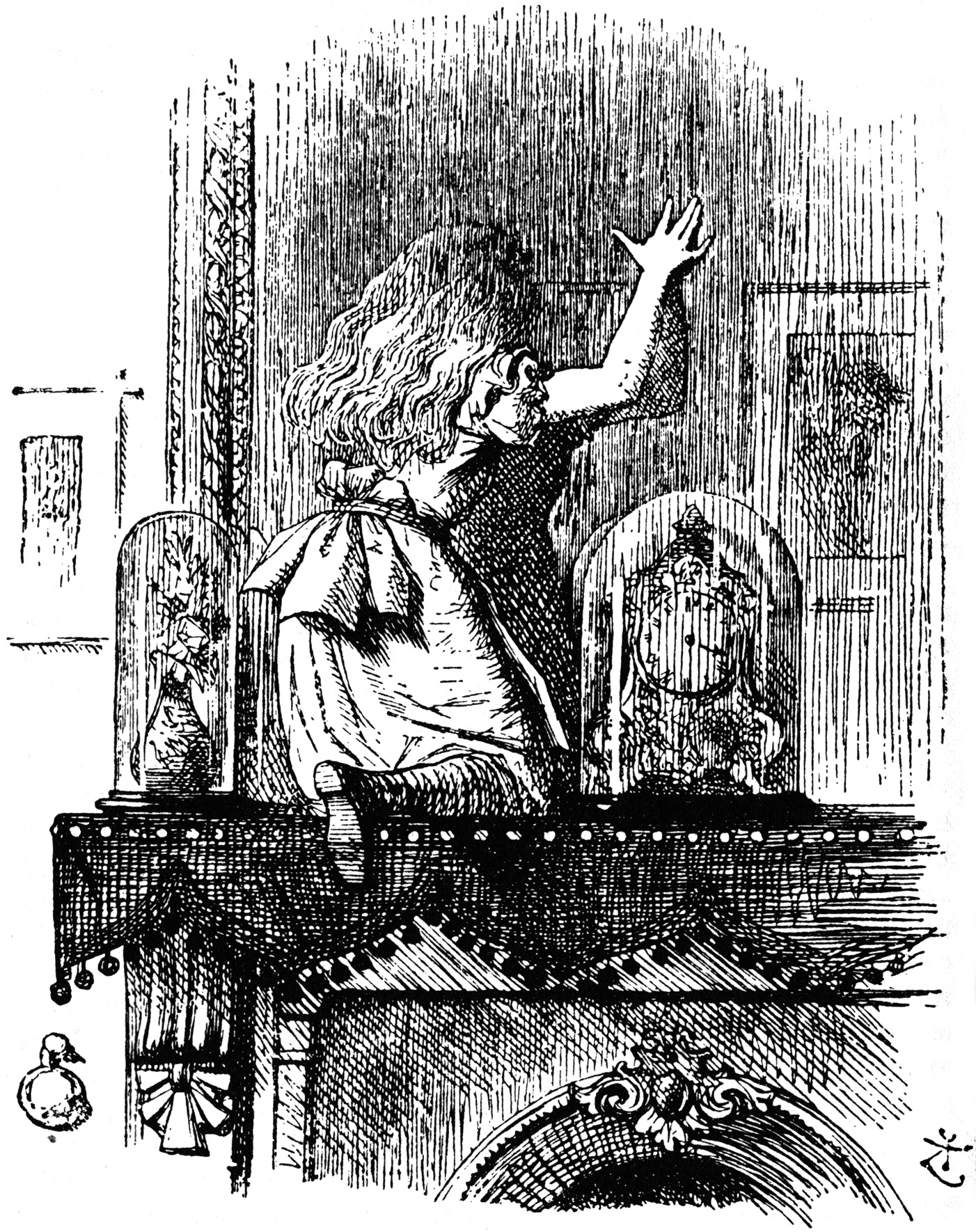
In contemplating those questions—where are we and how did we get here—we are through the postmodern looking glass. The other even more important question—how do we get out of here—is the most important question of the age.