Bob Schwartz

Category: Media

Lesson from The Voice: Caveat Inspector
The Voice
The Voice is now the dominant singing competition on television, having surpassed, probably permanently, American Idol. There is a lesson from The Voice that goes beyond just music, a lesson that goes to the heart of what has become a more media centric/entertainment centric society.

The reasons for the success of The Voice are pretty simple:

A substantial number of solidly talented and interesting contestants.

Panels of likeable and helpful celebrity coaches, with real musical expertise and real chemistry between them: Adam Levine, Cee-Lo Green, Christina Aguilera and Blake Shelton in the fall; Shakira, Usher with Levine and Shelton in the spring.

The show process begins with the uber-concept in the show’s name. The first round is a blind competition, where the panelists can hear but not see the contestants sing. It is, at least in part, all about “the voice.”

This week began the Knockout Rounds, where votes from the TV audience determine who will stay and who will be eliminated. The first of two nights on Monday was peculiar, anomalous for any singing competition. Of the ten singers who performed, not a single one was criticized, even for a tiny misstep—even though a few performances were very good, some were okay, and some were just not quality singing.

American Idol never quite figured out how to deal with judges’ criticism of contestants. Starting with the original panel, and continuing through the revolving door of judges who failed, there were more or less roles for the judges: the more brutal but somewhat constructive one (Simon Cowell), the kind, encouraging and heart-on-the-sleeve, maybe a little ditzy one (Paul Abdul) and whatever one (Randy Jackson).

There was an underlying issue in all that. There is little doubt that the producers of Idol shaded and spun the show so that certain contestants might rise a little higher than others. Whether this amounted to rigging results is unsubstantiated overstatement. But clearly, with all the elements at their command, producers could shine a different light on different singers, light that might affect voting. A judge’s praise or criticism could certainly be one of those elements.

In so many ways, for the better, The Voice is not American Idol. But the toolbox has some of the same tools: heartwarming or heartrending back stories, strategic song choices, etc. If the panelists/coaches criticism could affect the outcome, on Monday the decision seemed to be to have none at all.

And it was weird. At some point, even as the least trained audience ears could sense a musical problem, you could see coaches forcing smiles and faint praise. One big tell is when a panelist begins by telling a singer how good they look or how wonderful a person they are. Which is utterly ironic, since the show is based on the premise that voice matters above all.

If Monday’s absence of criticism was notable, it was even more apparent as soon as the Tuesday Knockout Round began. From the first singer on, many of the performances received what was in all cases deserved small critiques—never devastating, sometimes not as big as it could have been, but critique nonetheless. It was as if someone behind the scenes had noticed and said: our audience may like certain singers for their look, their attitude, their personality, but the audience isn’t deaf or stupid. We have a panel with four eminently talented musicians, and while we don’t want brutality, their credibility as judges of performances—their honesty—is on the line.

Which brings us to the greater lesson that should never be forgotten. From the beginning of advertiser-paid media, newspapers to now, all of those media have dual roles to play. They are whatever they essentially do—report news, entertain us, stage competitions, offer ways to publish short messages to the world, etc. But they are all also ways of delivering eyes, ears, hearts and minds to advertisers. There is nothing wrong with this. Nor is there anything wrong with media not being transparent about this obvious dual role and announcing all the things they do to increase the audience.

So enjoy. Get invested in your favorites (this season: Caroline Pennell, Tessanne Chin and Cole Vosberry, all of whom could be The Voice, all of whom deserve success). But remember that in commercial media, along with caveat emptor (buyer beware), it is caveat lector (reader beware), caveat inspector (viewer beware), and on this day of the Twitter IPO, caveat tweeter.


There Is Still a War in Syria

Paris Hilton As Miley Cyrus
When there was less to people’s news and info lives—a newspaper or two a day, a half-hour network news show, a couple of news magazines a week—there were stories that rose to the top and stayed there, depending on importance. This didn’t mean that second-tier or frivolous stories didn’t get coverage or traction. People always loved celebrities, always loved hearing gossip, and when man bites dog, that’s always news. The down side was a certain provincialism that came with a narrow channel and less worldly attitudes: if millions were suffering in a place nobody heard of, with people unlike us, most readers and viewers might have no idea.

Now we can know anything, though we don’t know everything, or care about everything. This has left news leaders in a delicate position. There are going to be stories that appeal to a journalist sense and a humanist sense, that deserve at least regular mention, if not coverage that might only say, “And in the misery of this place or that war, it’s still happening, with no end in sight.” The dual problem is that people can find and figure that out for themselves, without a multi-billion dollar media enterprise telling them, and those media consumers might just as well pay attention to something else.

Which is why, unlike its predecessors World War II, Korean War and Vietnam War, the Iraq War was not the top story every day of its ten years. Which is why the current violence in Iraq is barely covered, a turning away that in part must come from some profound but unspoken embarrassment.

For a few moments a few months ago, Syria was a bright shiny object. Red lines, chemical warfare, threats of military action, etc. After some erratic movement, slight progress is being made. But that progress does not include ending the civil war.

The New York Times, still possibly the world’s greatest news enterprise, has an ongoing section devoted to the Crisis in Syria. The increasing numbers stupefy: 6.5 million Syrians displaced from their homes, more than 2 million of them seeking refuge in other countries. Now we hear about a cluster of polio cases among Syrian children.

We have plenty of our own problems, individually and as a country. Some of those are not small at all. But there is no polio. And the entire population of the state of Tennessee or Indiana has not had to leave their homes behind, dodging mayhem, unsure if they will ever return, or if there will be anything to return to.

We shouldn’t expect ourselves to be exhausted or crushed by the miseries of the world; that’s what keeping track of all the problems all the time would do. So yes, you can argue that it is important to learn from the news today that Paris Hilton has spent $5,000 on Halloween costumes so that she can dress up as Miley Cyrus. But for a change of pace, a regular, maybe daily, reminder that there is still a war in Syria might be of value.

John Kerry’s Munich Moment: Is Political Reporting Too Polite?

Fear and Loathing on the Campaign Trail
When the going gets weird, the weird turn pro.
Hunter S. Thompson

About a week ago, President Obama said that if Syria’s Bashar Assad was not stopped from using chemical weapons, we might find those same weapons used against America. When asked about this days later, a presidential spokesman ignored the question. This weekend Secretary of State John Kerry said that the decision to stop Assad’s use of the weapons was a “Munich moment.” Meaning: Just as the Munich Agreement of 1938 condoned Hitler’s occupation of Czech territory, emboldening and enabling his vision of global conquest, so would our failure to respond to Assad’s use of chemical weapons further his insidious master plan.

Experts who have bothered to talk about the prospect of these chemical weapons being used against America have dismissed it out of hand. As for the “Munich moment,” that requires a bit more nuance. Nobody claims, at least not yet, that Assad has any extra-territorial plans or delusions of regional grandeur. His plan seems to be simply to punish any Syrians who stand in the way of him and his family fiercely holding on to power. Garden variety despotry; Assad is no Hitler. If “Munich” means appeasing his inhumanity, that is also silly. The bulk of Assad’s inhumanity is also garden variety: guns, bombs, etc. Nothing that Obama has proposed is intended to take care of that.

The region really did have a Munich moment in 1990. Saddam Hussein invaded and annexed Kuwait. A thirty-four nation coalition, led by the U.S., pushed him back to his own borders. Both the history of the Gulf War and its aftermath—including the decision by Bush 1 to go no further and the decision by Bush 2 to finish the job—are beyond the scope of this note. This is just to say that if you want to know what a Munich moment looks like, that was it.

The authenticity and civility of our political life are always in question. We ask whether politicians and their supporters are speaking truth, saying what they mean, meaning what they say, and saying it all in a way that is reasonably respectful and polite. That’s a lot to ask of them, and our expectations are right now pretty low. It’s also a lot to ask of political pundits and commentators. Unconstrained by the limitations of office or election, some of them, left to right, go wherever their opinions take them. Fish gotta swim, birds gotta fly.

Then there are political journalists. This is where things get tricky. Calling a political statement a lie or stupid, or calling a politician a liar or stupid, is supposed to fail the professional standard on a few scores. It supposedly puts a journalist’s objectivity in question; that sort of discourse is best left to political minions and commentators. And if not carefully couched or softened, it can come off as inappropriately impolite and uncivil, another professional faux pas.

We should all miss Hunter S. Thompson right about now. His suicide in 2005 left a gap in political journalism that hasn’t been filled and probably never will be. He didn’t begin as a political reporter. He came up as a writer during the time of the so-called “new journalism” in the 1960s (Tom Wolfe, Gay Talese, et al), when the lines between the factual, the personal and the expressive broke down. By his own admission, Thompson was crazy, formally or informally; he was also a stunningly talented observer and writer. When he hit the political beat, it was right place, right time, right writer. If politics was an exercise in duplicity, venality and near-insanity, it needed a professional journalist just as insane. The collection of his Rolling Stone coverage of the 1972 presidential election, Fear and Loathing on the Campaign Trail, is not just on another planet from the classic campaign coverage up to then; it is in another solar system.

Thompson had a special relationship with Richard Nixon. He ended up respecting and applauding Nixon’s brilliant mind as an expert football strategist, but otherwise Thompson despised him. He wrote a 1994 obituary of Nixon.  In it he continues the case for that untempered loathing, but in this excerpt also explains why it is an appropriate attitude for a journalist:

Kissinger was only one of the many historians who suddenly came to see Nixon as more than the sum of his many squalid parts. He seemed to be saying that History will not have to absolve Nixon, because he has already done it himself in a massive act of will and crazed arrogance that already ranks him supreme, along with other Nietzschean supermen like Hitler, Jesus, Bismarck and the Emperor Hirohito. These revisionists have catapulted Nixon to the status of an American Caesar, claiming that when the definitive history of the 20th century is written, no other president will come close to Nixon in stature. “He will dwarf FDR and Truman,” according to one scholar from Duke University.

It was all gibberish, of course. Nixon was no more a Saint than he was a Great President. He was more like Sammy Glick than Winston Churchill. He was a cheap crook and a merciless war criminal who bombed more people to death in Laos and Cambodia than the U.S. Army lost in all of World War II, and he denied it to the day of his death. When students at Kent State University, in Ohio, protested the bombing, he connived to have them attacked and slain by troops from the National Guard.

Some people will say that words like scum and rotten are wrong for Objective Journalism — which is true, but they miss the point. It was the built-in blind spots of the Objective rules and dogma that allowed Nixon to slither into the White House in the first place. He looked so good on paper that you could almost vote for him sight unseen. He seemed so all-American, so much like Horatio Alger, that he was able to slip through the cracks of Objective Journalism. You had to get Subjective to see Nixon clearly, and the shock of recognition was often painful.

It’s not that we don’t have good and great political journalists working today; we may have more than ever. And it’s not that there aren’t plenty of partisans pointing out gaps in someone else’s facts and reasoning.

It’s just that an amazing amount of stuff gets said and seems to get by far too unchallenged or challenged too narrowly or politely. It wasn’t so long ago that the Republican party produced a nominating spectacle that is widely characterized as a circus or a clown car. But at the time, journalists were unwilling to even hint at how ridiculous some of it was, as the party of Lincoln earnestly considered nominating Herman Cain or Donald Trump as their standard bearer.

Sure we need objectivity, maybe now more than ever in a social media enriched/poisoned environment. What we shouldn’t do is confuse objectivity with comity and politeness. If Hunter Thompson was shockingly blunt—and so much fun to read—it was to wake people up from the soporific effect of treating truth and lies, intelligence and stupidity, as rhetorical equivalents, in the name of objectivity, politeness and respect. In the name of keeping the peace. That would be the media Munich moment.

Update: Rereading this post, I have to add that the closest we come to Hunter S. Thompson’s “gonzo” political journalism is The Daily Show on Comedy Central. This revelation came watching the first few days of Jon Stewart’s return after his summer away, coming back to a grim and arguably ridiculous political crisis. The Daily Show’s trick is to protest (too much) that it is a “fake” news show, which gives it total license to completely get its facts straight while speaking truth to absurdity. And when, as this week, vicious jokes aren’t quite enough, Stewart vents his frustration directly and straight, no humor. Oh, to see what The Daily Show would have made of the Nixon Years.

Kate’s Baby

Rosemary's Baby

Meaning no disrespect (and if in any way disrespectful, hopefully less so than ten thousand other privacy-invading media sources). For some reason, the frenzy surrounding every detail of the birth of Kate Middleton’s baby, heir to the British throne, brought to mind the final scene of the movie Rosemary’s Baby.

For those who haven’t seen Roman Polanski’s masterful study of subtle scariness—as good as any Hitchcock—the simple plot explanation is that Rosemary’s husband has made a deal with the devil. He will succeed as an actor and his wife will, unwittingly, give birth to the devil’s baby. The entire local satanic coven dotes on her pregnancy, and when the baby is born, they show up en masse to take photos and rejoice at the prospect of a new leader.

Once again, no disrespect, no suggestion that Prince William is the devil or that Kate is implicated in any arcane and complex birth ritual that goes back centuries. This is a bright, happy and hopefully healthy occasion. It’s just a thought.

Duran Adam in Turkey

Duran Adam
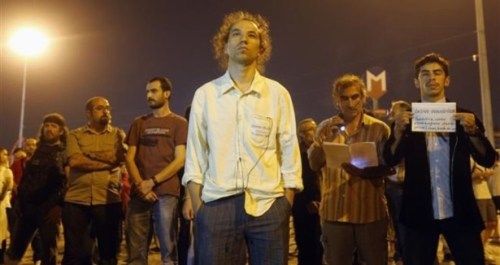
He is “duran adam”—the standing man. On Monday, Erdem Gunduz stood still for hours in Istanbul’s Taksim Square, staring at a public portrait of Kemal Ataturk, to protest the latest ban on demonstrations. Others joined him, as the image went national and then global. Police moved in: he was able to walk away and escape arrest, others didn’t.

As pointed out in a previous post, we should pay attention to Turkey because it is so special and so different than our preconceptions of what the world is and how it works. It is certainly a democracy today, but has not always been, and not quite what we think of as a democracy. It is certainly a Muslim country, but has not always been, and not quite what we think of as a Muslim country.

Whether Prime Minister Erdogan has been too long in office, whether he is taking Turkey in directions that defy many citizens and the ideals of Ataturk, whether he is truly a democrat, are things to be determined.

It is clear that he has crossed the line between firm response and heavy-handed overreach. It is clear that he is facing the quandary of all reformers, real or putative: your practice of reform is never the only game in town, and others have very different ideas. Most of all, Erdogan, like many leaders, seems to have no idea what he is dealing with, so he is under the impression that power is always the trump card.

He is half right. Power is always the trump card, but it is hard to know exactly which kind of power you are talking about or having to deal with. Is one man standing a power? What about a thousand people, or a million? History tells us that you can jail the thousands and even kill the millions. But as long as there are witnesses, might still is forced to co-exist with right, even when might wins.

The difference between witnessing and watching is a fine line. As this spreads, we will see if the media have the courage to cover a bunch of people just standing still. The media seem to like their reality shows with a little more action. Fortunately, the people’s media, the social media, may have more tolerance and a longer attention span. If you look long enough, standing still starts looking like moving forward, and that gets people really excited. It is how for millennia, from Christian origins through Gandhi through the civil right movement and on and on, nothing seemed to turn into something—because it was always something.

It was a standing man, that would not be moved.

Mountains or Molehills: How to Unflatten the News

Mt Everest - Justin Bieber
Digital access has made the news world flat. Flat as in if you use a news aggregator, there is some attempt on the site to stack the most important stories within a category, but since all categories have the same dignity, you really wouldn’t know, being from another planet, whether the civil war in Syria is more or less significant than Justin Bieber racing his Maserati through his exclusive California neighborhood (hint: it’s not Bieber).

Just as digital has created this unsortable mess and mass of news, such that Hamlet, who insane or not could tell a hawk from a handsaw/heron, would have trouble telling an important story from an inconsequential one (hint: your uncle killing your father to marry your mother is an important story).

Here is a solution. Since it is very easy to adjust type size digitally, stories that aggregators, editors or writers are willing to admit are not earthshaking might be presented in a smaller font, while those that are vital could use a larger one. This was always a convention of print news, and there is no reason that the capabilities of digital information shouldn’t be used to bring this approach up to date. As in:

Top Stories

Civil war in Syria threatens regional and global stability and peace.

Justin Bieber continues to race his Maserati around his neighborhood, despite complaints from neighbors.

Pepsi and the Line between Stupid and Clever

Mountain Dew
You’ve got to love the movie Spinal Tap. Below the surface of this hilarious fake “rockumentary”, beyond the wisdom of lines such as “It’s such a fine line between stupid and, uh…clever”, is a genuine commentary about what happens when popular art meets commerce.

When the band tries to revive its fading fortunes with an album called “Smell the Glove”, the record label rejects a cover photo of a woman on a leash being forced to, well, smell a glove. Instead, the album is released with a plain black cover.

Pepsi has long looked at its Mountain Dew brand as the edgiest of its beverages, with potential youth appeal. That would explain why it hired a 22-year-old hip-hop artist and music producer known as Tyler the Creator to create a series of videos for the brand. The storyline is that a goat named Felicia, voiced by Tyler, is obsessed with Dew and angry at its being in short supply. The goat brutally attacks a white waitress. In the third video, the injured waitress is at a police station, looking over a lineup of four black men and the goat. The goat threatens her, among other things reminding her that “snitches get stitches.” She is scared off and will not “dew” it.

After complaints about its being the most racist commercial ever, PepsiCo removed it from the web (you may still be able to see it here).

PepsiCo said, “We understand how this video could be perceived by some as offensive, and we apologize to those who were offended. We have removed the video from all Mountain Dew channels and have been informed that Tyler is removing it from his channels as well.”

Tyler’s manager said:

“It was never Tyler’s intention to offend, however offense is personal and valid to anyone who is offended. Out of respect to those that were offended, the ad was taken down. For those who know and respect Tyler, he is known for pushing boundaries and challenging stereotypes thr[ough] humor. This is someone who grew up on David Chappelle. This situation is layered with context and is a discussion that Tyler would love to address in the right forum as he does have a point of view. As someone who hasn’t had the experience of being discriminated against I choose to respect the opinion of those who have. What I can speak to is Tyler, who represents much more than the current narrative this story suggests.”

“Contrary to what many may discern from this, Tyler is the embodiment of not judging others, his delivery may not be for everyone (which is true for anyone who pushes boundaries) but his voice is nonetheless important to the conversation since his demographic understands what he ultimately stands for and sees the irony of it all. Context may or not help those who are offended and I wholly respect that, but for those who are interested, I can offer the following and leave the rest to Tyler.

“1. This spot was part of an overall admittedly absurd storyline about a crazy goat who becomes obsessed with Mountain Dew, 2. The lady in front of the line-up is the waitress from the first spot, 3. The line-up consists of Tyler’s friends and Odd Future members who were available that day. (L-Boy, Left Brain, Garret from Trash Talk and Errol) 4. He absolutely never intended to spark a controversy about race. It was simply an…admittedly absurd story that was never meant to be taken seriously. Again, we apologize if this was taken out of context and would never trivialize racism, especially now in America where voting and civil rights are being challenged at the highest level. I can however stand firmly by someone I have believed in since we met, only because I know him and I know all of this was never his intent.”

It’s not clear who this “David Chappelle” that the manager mentions is, but Dave Chappelle is one of the funniest, strangest, most boundary-pushing comic artists of recent times. Chappelle created one great piece after another, including a bit where a blind black man is a vicious anti-black racist, because he thinks he is white. That’s brilliant, so let’s start with the fact that Tyler has a long way to go.

Artists are supposed to do whatever their vision tells them, and we shouldn’t be stopping them. Sometimes it works, sometimes it doesn’t, and sometimes the art is behind or ahead of its times.

But that doesn’t mean that those who pay for the work have to go along with everything that artists conceive and produce. There is actually a bit of cleverness here, but it is plagued by so much troubling text, context and subtext that it could not possibly have passed any feasibility test that any mainstream corporate advertiser might apply.

One thing that makes this even a little more troubling is PepsiCo’s quasi-apology. We are supposed to have gotten used to cleverly crafted statements that are meant to sound like apologies but aren’t quite. That is now the norm. We are not that stupid. “We apologize to those who were offended” is a defensive or even condescending posture: if you are among those who don’t get it (or as Tyler’s manager says, not part of “his demographic [that] understands what he ultimately stands for and sees the irony of it all”), then we are sorry. Mass media have mass audiences, and if you want to put something out there that is likely to cause trouble but you believe will help you, either stand behind it or don’t. Apologize or don’t. It may turn out to be commercially smart or stupid. But at least you’re brave.

Crime and Punishment

Crime and Punishment
It is just like a movie, some are saying.

No, like a novel.

Two brothers. The older one dead, run over by the younger. The younger on the run—maybe caught or even dead by the time this is read.

In the media, fragments of information are spun into explanations, like Rumplestiltskin’s straw into gold. It is the job of experts to provide answers, and when pieces are missing, to speculate. Can they be blamed?

Writers are the real experts at helping us on this. In 1962, when Truman Capote applied his considerable skill as storyteller to a pair of real-life cold-blooded killers, the book In Cold Blood became something new: the non-fiction novel. Critics celebrated, but others complained that the humanizing of evil made the author an accomplice.

A century earlier, Fyodor Dostoyevsky took an even deeper look at the mind of the killer, a fictional one, in Crime and Punishment. He did not minimize the horror of the crime or humanize the killer for purposes of sympathy, empathy or excuse. He instead set the standard for psychological depth and ambiguity that is the hallmark of modern literature since.

Standard or simplistic explanations and labels fit many needs, including the need of broadcasters to fill dead air while an extended manhunt and its aftermath proceed. But Dostoevsky demanded a trip on the subtle dark seas of family, society and the mind. That’s not just a way we understand the bad actors. It’s how we understand ourselves, even when our own seas are not nearly so dark.

From Crime and Punishment, as Rodion Raskolnikoff  pursues his plan to kill the moneylender Alena Ivanovna. He walks down the street, when someone remarks about his unusual hat:

“I knew it,” he muttered in confusion, “I thought so! That’s the worst of all! Why, a stupid thing like this, the most trivial detail might spoil the whole plan. Yes, my hat is too noticeable…. It looks absurd and that makes it noticeable….With my rags I ought to wear a cap, any sort of old pancake, but not this grotesque thing. Nobody wears such a hat, it would be noticed a mile off, it would be remembered…. What matters is that people would remember it, and that would
give them a clue. For this business one should be as little conspicuous as possible….Trifles, trifles are what matter! Why, it’s just such trifles that always ruin everything….”

He had not far to go; he knew indeed how many steps it was from the gate of his lodging house: exactly seven hundred and thirty. He had counted them once when he had been lost in dreams. At the time he had put no faith in those dreams and was only tantalizing himself by their hideous but daring recklessness. Now, a month later, he had begun to look upon them differently, and, in spite of the monologues in which he jeered at his own impotence and indecision, he had involuntarily come to regard this “hideous” dream as an exploit to be attempted, although he still did not realize this himself. He was positively going now for a “rehearsal” of his project, and at every step his excitement grew more and more violent.

Arguments on Marriage Equality, Part 1

Supreme Court
The audio and transcript of the Supreme Court arguments in Hollingsworth v. Perry, the Proposition 8 marriage equality case, are now available.

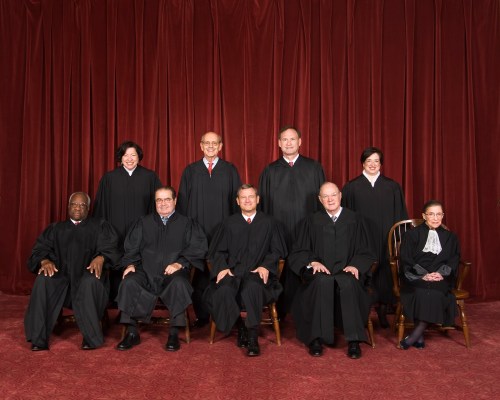
Without video, the best way to review these is to read and listen to them at the same time. Otherwise, you may not know which Justice is talking—though some of them have such distinctive voices, styles or insights that they are instantly recognizable. Hint: Justice Clarence Thomas is the one who is not talking; he never does.

The news channels deal with the lack of video (not permitted) by playing the audio, identifying the speaker on screen, and showing an artist’s sketch. You can do this yourself, creatively if you want. You might use a photo instead of a sketch, or you can just select a random picture of another distinguished Justice or lawyer, present or past.

The odds of correctly predicting outcomes in difficult Supreme Court cases like this are better than winning the Powerball lottery or picking all the NCAA brackets right, but not much. So here are some first impressions.

Standing

The path of this case is complicated. The California Supreme Court enabled same-sex marriage and for a few months couples did marry. Almost immediately, a group sponsored an initiative to reverse that decision by banning same-sex marriage in the state. The initiative passed, but the U.S. Ninth Circuit Court of Appeals declared the ban on same-sex marriage unconstitutional, thus allowing same-sex marriage to proceed. The sponsor of the initiative appealed and the Supreme Court agreed to hear the case.

That is where the standing issue comes in. The State of California refused to appeal the overturning of the initiative. This left the initiative sponsor as the closest thing to an interested party for purposes of appeal.

But maybe not legally close enough. The Supreme Court did agree to hear the case, but now appears to wonder whether the proponents of the initiative have legal standing to have brought the appeal in the first place. The Court is free at this point to reconsider the question and rule that their initial agreement to hear the case was “improvidently granted.”

The Justices spent a substantial amount of time during arguments on this standing question. If standing is denied, the Court won’t be deciding any of the other issues. The appeal is over, the decision of the Ninth Circuit will stand, and same-sex marriage will once again be the law of California. There is some discussion that for the moment, the Court would like to narrow whatever they have to say about same-sex marriage to California, and let the legal questions mature. If they don’t have to say anything, that narrowing takes place automatically.

How likely is that? If this was the only same-sex marriage case before the Court this term, it would be an easier route for them to take. It would allow more cases to move up the appeal chain, more Courts of Appeal to be heard from.

But it isn’t the only case like it this term, or even this week. Today the Court will consider the constitutionality of the Defense of Marriage Act (DOMA), passed by Congress and signed by Bill Clinton in 1996. DOMA prohibits the federal government from recognizing same-sex marriage, which among other things means that same-sex spouses enjoy no federal benefits. (This has proved to be an embarrassment for Democrats. Scores of Senators and Representatives submitted a brief in which they apologized for being wrong, and Bill Clinton has done the same thing in a recent op-ed piece.)

Procreation

Charles Cooper is the attorney representing the proponents of Proposition 8. Good lawyers get stuck with bad positions in tough cases, and this is that.

The primary argument for the constitutionality of a ban on same-sex marriage—aside from moral arguments, which are not legal ones—is that the tradition and essence and supreme societal value of marriage is procreation. You get married, above all, to have babies; if you can’t have babies, your right to marry is questionable or non-existent. Same-sex couples have no possibility of having children, at least the old-fashioned way (adoption being one of those modern, new-fangled techniques, like in vitro fertilization). Ergo, they have no right to marry.

The above is not hyperbole or sarcasm. For endless minutes, punctuated by occasional laughter, this is the argument that Cooper made, and that various Justices endorsed or, more frequently, questioned.

This part of the arguments has been widely covered, so there are no excerpts here. Listen and read for yourself. The discussion about the fertility of 55-year-old couples and of Strom Thurmond are worth the price of admission.

“The Experiment”

There was discussion of same-sex marriage being some sort of “experiment.” We supposedly have to wait for “scientific evidence” and “data” to determine how well it works.

The discussion of procreation was sad but silly, leavened by laughter. On this point, it is hard to laugh.

For the record, if marriage of any kind is an experiment, the results are in. Sometimes it goes blissfully right, sometimes it goes horribly wrong. Sometimes the children—who arrive in all sorts of ways and are raised in all sorts of permutations—turn out well, and once in a while they don’t. Some people like to go wild with the experiment, trying serial marriage and divorce (and marriage and divorce and marriage and divorce). It’s not an experiment for any of these couples. It’s just marriage. It’s life. It’s love. It’s being human connected.

Justice Antonin Scalia

[This space intentionally left blank.]

The Briefs on Marriage Equality

Amicus Brief
Today begins two days (March 26 and 27) of arguments before the Supreme Court on two related cases about marriage equality. One concerns Proposition 8, California’s voter-passed initiative to ban same-sex marriage.

The question presented on appeal in that case is this:

Whether the Equal Protection Clause of the Fourteenth Amendment prohibits the State of California from defining marriage as the union of a man and a woman.

The other case concerns the Defense of Marriage Act (DOMA), which prevents extension of various federal benefits to same-sex couples.

The question presented on appeal in that case is this:

Section 3 of the Defense of Marriage Act (DOMA) defines the term “marriage” for all purposes under federal law, including the provision of federal benefits, as “only a legal union between one man and one woman as husband and wife.” It similarly defines the term “spouse” as “a person of the opposite sex who is a husband or a wife.”

Whether Section 3 of DOMA violates the Fifth Amendment’s guarantee of equal protection of the laws as applied to persons of the same sex who are legally married under the laws of their State

It is usual in important cases to have non-parties submit position papers to the Court, known as amicus curiae (friend of the court) briefs. The more significant or contested the controversy, the greater the number of individuals and organizations who want to offer their views—legal, social and otherwise—to help the Court decide. These briefs may be of various value to the Court, but they are all offered in friendship. These friends are often giving a bit of unsolicited advice, as friends do.

Whatever their value, these briefs are fascinating reading. Not unexpectedly, the number of amicus briefs in these cases is extraordinary: 96 in the Proposition 8 case, 80 in the DOMA case.

We will not be able to watch these historic arguments live, or even listen to them live. For reasons surpassing all understanding (something about tradition or about dignity or about lawyers—or even Justices—showboating for the media), cameras are not permitted in the U.S. Supreme Court. With all due respect—lawyers are bound to say that, since the First Amendment will not protect us from punishment for bringing disrepute on our judicial biggers and betters—there are probably plenty of calendars in and around the Supreme Court to indicate the year and century (2013, 21st).

Even if we are stuck only getting reports from the front line, there is something to do in the meantime. In fact, even after we do get the transcripts and audio of the arguments (remember, no cameras, ever), we can read all of the briefs in the case. There are the briefs from the parties to the cases and there are the 176 briefs from helpful friends. These friends include, among many of the prominent, famous and infamous, 50 U.S. Senators and 172 U.S. House members.

You can find the Proposition 8 briefs online

Dennis Hollingsworth, et al., Petitioners v. Kristin M. Perry, et al.

You can find the DOMA briefs online

United States v. Edith Schlain Windsor, in Her Capacity as Executor of the Estate of Thea Clara Spyer, et al.

In case you have decided not to dip a toe into the amicus waters, following is a list of all the briefs. But please do give it a try. Some of it will be a tough legal slog for non-lawyers, so you might skip those parts. But some will be essential historical, political, social and cultural analysis and commentary. Whether or not you agree with all these “friends”, you will come away with an informed view of all the positions, from the most solid to the wildest.

Browse the list of briefs below. It might be educational and fun. And if you do read a few of them, you might have even more fun. Maybe even legal fun. Yes, there is such a thing. Just ask the Justices.

Dennis Hollingsworth, et al., Petitioners v. Kristin M. Perry, et al. (Proposition 8)

Merit Briefs

  • Brief for Petitioners, Dennis Hollingsworth, et al
  • Brief for Respondents, Kristin M. Perry
  • Brief for Respondent, City and County of San Francisco
  • Reply Brief for the Petitioner, Dennis Hollingsworth, et al

Amicus Briefs

  • Brief for the American Civil Rights Union in Support of Hollingsworth and Bipartisan Legal Advisory Group Addressing the Merits and Supporting Reversal
  • Brief for the American Psychological Association, the American Medical Association, the American Academy of Pediatrics, the California Medical Association, the American Psychiatric Association, the American Psychoanalytic Association, the American Association for Marriage And Family Therapy, the National Association of Social Workers and its California Chapter, and the California Psychological Association in Support of Affirmance (Addressing the Merits)
  • Brief for the Becket Fund for Religious Liberty in Support of Hollingsworth and the Bipartisan Legal Advisory Group (Addressing The Merits) (Also Filed in 12-307)
  • Brief for Catholics for the Common Good and the Marriage Law Project in Support of Petitioners
  • Brief for Center for Constitutional Jurisprudence in Support of Petitioner
  • Brief for the Citizens United’s National Committee for Family, Faith and Prayer, Citizens United Foundation, U.S. Justice Foundation, Gun Owners Foundation, The Lincoln Institute for Research and Education, Public Advocate of the United States, Declaration Alliance, Western Center for Journalism, Institute on the Constitution, Abraham Lincoln Foundation for Public Policy Research, Inc., Conservative Legal Defense and Education Fund, English First, and Protect Marriage Maryland PAC in Support of Petitioners
  • Brief for the Coalition of African American Pastors USA, the Center for Urban Renewal and Education, the Frederick Doublass Foundation, Inc., and Numerous Law Professors in Support of Petitioners and Supporting Reversal
  • Brief for David Boyle in Support of Petitioners, on the Non-Jurisdictional Issues
  • Brief for Eagle Forum Education & Legal Defense Fund, Inc., in Support of Petitioners in Support of Reversal
  • Brief for the Ethics and Public Policy Center in Support of Petitioners and Supporting Reversal or Vacatur
  • Brief for Equality California in Support of Respondents
  • Brief for the Family Research Council in Support of Petitioners Addressing the Merits and
  • Supporting Reversal
  • Brief for Foundation for Moral Law in Support of Petitioner
  • Brief for GLMA: Health Professionals Advancing LGBT Equality (Gay And Lesbian Medical Association) Concerning the Immutability of Sexual Orientation in Support of Affirmance (Addressing the Merits)
  • Brief for David Benkof, Robert Oscar Lopez, and Doug Mainwaring in Support of Petitioners and Supporting Reversal
  • Brief for Helen M. Alvaré in Support of Hollingsworth and Bipartisan Legal Advisory Group Supporting Reversal (Addressing the Merits) (Also Filed in 12-307
  • Brief for the High Impact Leadership Coalition in Support of Petitioners
  • Brief for International Jurists and Academics in Support of Petitioner Hollingsworth and Respondent Bipartisan Legal Advisory Group Addressing The Merits And Supporting Reversal (also filed in 12-307)
  • Brief for Judicial Watch, Inc. and Allied Educational Foundation in Support of Petitioners
  • Brief for Leon R. Kass, Harvey C. Mansfield and the Institute for Marriage and Public Policy in Support of Petitioners
  • Brief of Liberty Counsel, Inc. and Campaign for Children and Families in Support of Petitioners
  • Brief for the Lighted Candle Society in Support of Petitioners
  • Brief for Marriage Anti-Defamation Alliance in Support of Petitioners
  • Brief for Matthew B. O’Brien in Support of Hollingsworth and Bipartisan Legal Advisory Group of the U.S. House of Representatives Addressing The Merits and Supporting Reversal (Also Filed in 12-307)
  • Brief for Minnesota For Marriage in Support of Petitioners
  • Brief for National Association of Evangelicals; The Ethics & Religious Liberty Commission of the Southern Baptist Convention; the Church of Jesus Christ of Latter-Day Saints; the Lutheran Church-Missouri Synod; the Union of Orthodox Jewish Congregations of America; the Romanian-American Evangelical Alliance of North America; and Truth In Action Ministries in Support of Petitioners
  • Brief for Patrick Henry College in Support of Petitioners
  • Brief for Professor Daniel N. Robinson, Ph.D. in Support of Petitioners and Supporting Reversal
  • Brief for Scholars of History and Related Disciplines in Support of Petitioners
  • Brief for the States of Indiana, Virginia, Alabama, Alaska, Arizona, Colorado, Georgia, Idaho, Kansas, Montana, Nebraska, North Dakota, Oklahoma, South Carolina, South Dakota, Texas, Utah, West Virginia and Wisconsin in Support of the Petitioners (Addressing the Merits)
  • Brief for Social Science Professors in Support of Hollingsworth and Bipartisan Legal Advisory Group Addressing the Merits and Supporting Reversal (also filed in 12-307)
  • Brief for the State Of Michigan in Support of Petitioners
  • Brief for Thirty-Seven Scholars of Federalism and Judicial Restraint in Support of Petitioners
  • Brief for the Thomas More Law Center and Chuck Storey, Imperial County Clerk, in Support of Petitioners (Addressing the Merits)
  • Brief for United States Conference of Catholic Bishops in Support of Petitioners and Supporting Reversal
  • Brief for Utah Pride Center, Campaign for Southern Equality, Equality Federation and Twenty-Five State-Wide Equality Organizations (also filed in 12-307)
  • Brief for Catholic Answers, Christian Legal Society, and Catholic Vote Education Fund in Support of Petitioner Hollingsworth and Respondent Bipartisan Legal Advisory Group and Supporting Reversal (Addressing the Merits) (also filed in 12-307)
  • Brief for Coalition for the Protection of Marriage in Support of Hollingsworth and Bipartisan Legal Advisory Group Addressing the Merits and Supporting Reversal (also filed in 12-307)
  • Brief for Dr. Paul Mchugh in Support of Hollingsworth and Bipartisan Legal Advocacy Group Addressing the Merits and Supporting Reversal (Also Filed in 12-307)
  • Brief for Liberty, Life and Law Foundation and North Carolina Values Coalition in Support of Hollingsworth and Bipartisan Legal Advisory Group Addressing the Merits and Supporting Reversal (also filed in 12-307)
  • Brief for Pacific Legal Foundation, Ward Connerly, Ron Unz, Glynn Custred, and the Howard Jarvis Taxpayers Association in Support of Neither Party
  • Brief for Parents and Friends of Ex-Gays & Gays in Support of Hollingsworth and Bipartisan Legal Advisory Group of the U.S. House of Representatives Addressing the Merits and Supporting Reversal (also filed in 12-307)
  • Brief for Concerned Women for America in Support of Reversal (Addressing the Merits)
  • Brief for Robert P. George, Sherif Girgis, and Ryan T. Anderson in Support of Hollingsworth and Bipartisan Legal Advisory Group Addressing the Merits and Supporting Reversal (also filed in 12-307)
  • Brief for American Anthropological Association, American Academy of Pediatrics, California, and Robert M. Galatzer-Levy, M.D., in Support of Respondents and Affirmance, Addressing California Proposition 8’s Stigmatizing Effects
  • Brief for Adoption and Child Welfare Advocates in Support of Respondents
  • Brief for the American Academy of Matrimonial Lawyers, the Northern California Chapter of the American Academy of Matrimonial Lawyers, and the Association of Certified Family Law Specialists in Support of Respondents
  • Brief for California Assembly Speaker John A. Pérez and Law Professors Concerned with Representative Democracy in Support of Respondents
  • Brief for American Companies in Support of Respondents
  • Brief for American Federation of Labor and Congress of Industrial Oranizations and Change To Win in Support of Respondents and Suggesting Affirmance
  • Brief for the American Humanist Association and American Atheists, Inc., American Ethical Union, the Center for Inquiry, Military Association of Atheists and Freethinkers, Secular Coalition for America, Secular Student Alliance, and Society for Humanistic Judaism, in Support of Respondents (Addressing the Merits)
  • Brief for the American Jewish Committee in Support of the Individual Respondents on the Merits (also filed in 12-307)
  • Brief for American Sociological Association in Support of Respondent Kristin M. Perry and Respondent Edith Schlain Windsor (Also Filed in 12-307)
  • Brief for Anti-Defamation League Et Al. in Support of Respondents
  • Brief for Bay Area Lawyers for Individual Freedom, Et Al., in Support of Respondent
  • Brief for Beverly Hills Bar Association, et al., in Support of Respondents
  • Brief for Bishops of the Episcopal Church in the State of California, et al in Support of Respondents and Affirmance
  • Brief for California Assembly Speaker John A. Pérez and Law Professors Concerned With Representative Democracy in Support of Respondents
  • Brief for California Council of Churches, et-al in Support of Respondents and Urging Affirmance
  • Brief for the California Teachers Association and the National Education Association in Support of Respondents
  • Brief for California Professors of Family Law in Support of Respondents
  • Brief for the Cato Institute and Constitutional Accountability Center in Support of Respondents
  • Brief for Chris Kluwe and Brendon Ayanbadejo in Support of Respondents
  • Brief for Columbia Law School Sexuality & Gender Law Clinic and the Society of American Law Teachers in Support of Respondents
  • Brief for Constitutional Law and Civil Procedure Professors Erwin Chemerinsky and Arthur Miller in Support Of Plaintiffs-Respondents Urging Affirmance
  • Brief for Dr. Maria Nieto in Support of Respondents
  • Brief for Edward D. Stein, Joanna L. Grossman, Kerry Abrams, Holning Lau, Katharine B. Silbaugh and 32 Other Professors of Family Law and Constitutional Law in Support of Respondents
  • Brief for Family Equality Council; Colage; Our Family Coalition; Gay, Lesbian, and Straight Education Network; the Center on Children and Families; the Child Rights Project; and Sarah Gogin in Support of Respondents Perry, Stier, Katami, Zarrillo, City and County of San Francisco, and Edith Schlain Windsor, in her Capacity as Executor of the Estate of Thea Clara Spyer, Addressing The Merits And Supporting Affirmance (also filed in 12-307)
  • Brief for Garden State Equality in Support of Respondents
  • Brief for Gary J. Gates in Support of Respondents (On the Merits)
  • Brief for Foreign and Comparative Law Experts Harold Hongju Koh, Sarah H. Cleveland, Laurence R. Helfer, and Ryan Goodman in Support of Respondents
  • Brief for Hon. Judith S. Kaye (Ret.), Profs. Stephen Gillers, Charles G. Geyh, and James J. Alfini, and Mark I. Harrison in Support of Respondents
  • Brief for Howard University School of Law Civil Rights Clinic in Support of Respondents (On The Merits)
  • Brief for International Human Rights Advocates in Support of Respondents
  • Brief for Jonathan Wallace, Meri Wallace and Duncan Pflaster in Support of Respondents
  • Brief for Kenneth B. Mehlman in Support of Respondents
  • Brief for Lambda Legal Defense and Education Fund, Inc. and Gay & Lesbian Advocates & Defenders in Support of Respondents
  • Brief for Leadership Conference on Civil and Human Rights, Bar Associations and Public Interest and Legal Service Organizations in Support of Respondents
  • Brief for Marriage Equality USA in Support of Respondents
  • Brief for Massachusetts, Connecticut, Delaware, District Of Columbia, Illinois, Iowa, Maine, Maryland, New Hampshire, New Mexico, New York, Oregon, Vermont and Washington in Support of Respondents
  • Brief for National Center for Lesbian Rights in Support of Respondents
  • Brief for the National Organization for Women Foundation and the Feminist Majority Foundation in Support of Respondents
  • Brief for National Women’s Law Center, Williams Institute Scholars of Sexual Orientation and Gender Law, and Women’s Legal Groups in Support of Respondents (On The Merits)
  • Brief for the Organization of American Historians and the American Studies Association in Support of Respondents
  • Brief for Parents, Families and Friends of Lesbians and Gays, Inc. in Support of Respondents
  • Brief for Political Science Professors in Support of Respondents and Affirmance Addressing Political Power of Gay Men and Lesbians
  • Brief for Rev. Rick Yramategui, Rev. Herb Schmidt, and Rev. Darrell W. Yeaney in Support of Respondents’ Position on the Merits
  • Brief for the Southern Poverty Law Center in Support of Respondents
  • Brief for the State of California in Support of Respondents
  • Brief for Survivors of Sexual Orientation Change Therapies in Support of Respondents Kristin M. Perry, Et Al., and City and County of San Francisco, Urging Affirmance
  • Brief for the United States in Support of the Respondents
  • Brief for Walter Dellinger in Support of Respondents on the Issue of Standing
  • Brief for William N. Eskridge Jr., Rebecca L. Brown, Daniel A. Farber, and Andrew Koppelman in Support of Respondents
  • Brief for the Women’s Equal Rights Legal Defense and Education Fund on the Issue of the Special Interest of Women as a Gender in Support of Respondents
  • Brief for Constitutional Law Scholars Bruce Ackerman, Ash Bhagwat, Lee Bollinger, Erwin Chemerinsky, Michael C. Dorf, Lee Epstein, Barry Friedman, John C. Jeffries, Jr., Lawrence Lessig, William Marshall, Frank Michelman, Jane S. Schacter, Suzanna Sherry, Geoffrey R. Stone, David Strauss, Laurence Tribe, And William Van Alstyne Addressing The Merits And Supporting Affirmance (also filed in 12-307)
  • Brief for Matthew B. O’Brien in Support of Hollingsworth and Bipartisan Legal Advisory Group of the U.S. House of Representatives Addressing the Merits and Supporting Reversal (also filed in 12-307)
  • Brief for Westboro Baptist Church in Support of Neither Party Suggesting Reversal

United States v. Edith Schlain Windsor, in Her Capacity as Executor of the Estate of Thea Clara Spyer, et al. (DOMA)

Merit Briefs

  • Brief for Petitioner United States (On the Jurisdictional Question)
  • Brief for Petitioner United States (On the Merits)
  • Brief for Respondent the Bipartisan Legal Advisory Group of the U.S. House of Representatives (On the Jurisdictional Question)
  • Brief for Respondent the Bipartisan Legal Advisory Group of the U.S. House of Representatives (On the Merits)
  • Brief for Court-Appointed Amica Curiae (On the Jurisdictional Question)
  • Brief for Respondent Edith Schlain Windsor (On the Jurisdictional Question)
  • Brief for Respondent Edith Schlain Windsor (On the Merits)
  • Reply Brief for Court-Appointed Amica Curiae (On the Jurisdictional Question)
  • Reply Brief On Jurisdiction for Respondent The Bipartisan Legal Advisory Group Of The U.S. House of Representatives
  • Reply Brief on the Merits for Respondent the Bipartisan Legal Advisory Group of the United States House of Representatives
  • Reply Brief for Respondent Edith Schlain Windsor (On the Jurisdictional Question)
  • Reply Brief for the United States (on the Jurisdictional Questions)

Amicus Briefs

  • In Support of Petitioner United States and Respondent Edith Schlain Windsor
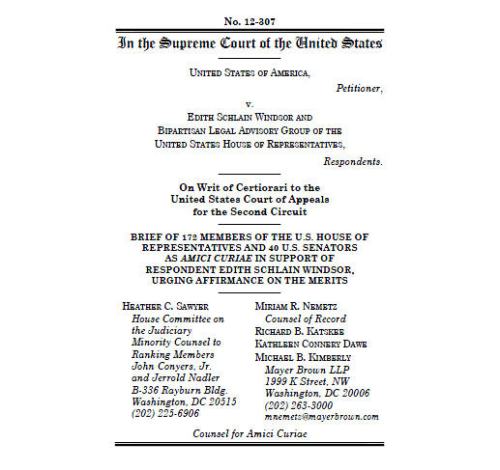
  • Brief for 172 Members of the U.S. House of Representatives and 40 U.S. Senators in Support of Respondent Edith Schlain Windsor (On the Merits)
  • Brief for 278 Employers and Organizations Representing Employers in Support of Respondent Edith Schlain Windsor (On the Merits)
  • Brief for the American Bar Association in Support of Respondent Edith Schlain Windsor (On the Merits)
  • Brief for the American Federation of Labor and Congress of Industrial Organizations, Change to Win, and the National Education Association in Support of Respondent Edith Schlain Windsor
  • Brief for the American Humanist Association and American Atheists, Inc., American Ethical Union, the Center for Inquiry, Military Association of Atheists and Freethinkers, Secular Coalition for America, Secular Student Alliance, and Society for Humanistic Judaism in Support of Respondents (On the Merits)
  • Brief for the American Jewish Committee in Support of Edith Schlain Windsor (On the Merits) (Also filed in 12-144)
  • Brief for the American Psychological Association, the American Academy of Pediatrics, the American Medical Association, the American Psychiatric Association, the American Psychoanalytic Association, the California Medical Association, the National Association of Social Workers And its New York City and State Chapters, And the New York State Psychological Association in Support of Respondent Edith Schlain Windsor (On the Merits)
  • Brief for American Sociological Association in Support of Respondent Kristin M. Perry and Respondent Edith Schlain Windsor (Also Filed in 12-144)
  • Brief for the Anti-Defamation League in Support of Respondent Edith Schlain Windsor (On the Merits)
  • Brief for Bishops of the Episcopal Church in California, Connecticut, Iowa, Maine, Maryland, Massachusetts, New Hampshire, New York, Vermont, and Washington and the District Of Columbia; the Jewish Theological Seminary of America; Manhattan Conference of the Metropolitan New York Synod of the Evangelical Lutheran Church in America; the Rabbinical Assembly; the Reconstructionist Rabbinical Association; Reconstructionist Rabbinical College; Rabbi Akiva Herzfeld of Shaarey Tphiloh; the Union for Reform Judaism; Unitarian Universalist Association; United Church of Christ; the United Synagogue of Conservative Judaism; Affirmation; Covenant Network of Presbyterians; Friends for Lesbian, Gay, Bisexual, Transgender, and Queer Concerns; Methodist Federation for Social Action; More Light Presbyterians; Presbyterian Welcome; Reconciling Ministries Network; Reconciling Works: Lutherans for Full Participation; and Religious Institute, Inc. in Support of Respondent Edith Schlain Windsor (On the Merits)
  • Brief for the Cato Institute and Constitutional Accountability Center in Support of Respondent Edith Schlain Windsor
  • Brief for the Center for Fair Administration of Taxes (CFAT) in Support of Respondents
  • Brief for Citizens for Responsibility and Ethics in Washington in Support of Respondent Edith Schlain Windsor (On the Merits)
  • Brief for Constitutional Law Scholars in Support of Petitioner United States (On the Jurisdictional Questions)
  • Brief for Constitutional Law Scholars Bruce Ackerman, Ash Bhagwat, Lee Bollinger, Erwin Chemerinsky, Michael C. Dorf, Lee Epstein, Barry Friedman, John C. Jeffries, Jr., Lawrence Lessig, William Marshall, Frank Michelman, Jane S. Schacter, Suzanna Sherry, Geoffrey R. Stone, David Strauss, Laurence Tribe, and William Van Alstyne in Support of Respondent Edith Schlain Windsor (On the Merits) (Also filed in 12-144)
  • Brief for Dr. Donna E. Shalala, Dr. Louis W. Sullivan, Togo D. West Jr., Kenneth S. Apfel, Sheldon S. Cohen, Rudy F. Deleon, Jamie S. Gorelick, Michael J. Graetz, Dr. John J. Hamre, Benjamin W. Heineman Jr., Kathryn O. Higgins, Constance Berry Newman, and Harriet S. Rabb in Support of Respondent Edith Schlain Windsor
  • Brief for the Empire State Pride Agenda, Equality California, Equal Rights Washington, One Iowa, Equality Maryland, Vermont Freedom to Marry, Massequality, New Hampshire Freedom to Marry Coalition and Equality Maine in Support of Respondent Edith Schlain Windsor (On the Jurisdictional Question)
  • Brief for Family Equality Council; Colage; Our Family Coalition; Gay, Lesbian, and Straight Education Network; the Center on Children and Families; the Child Rights Project; and Sarah Gogin in Support of Respondent Edith Schlain Windsor (On the Merits)(Also filed in 12-144)
  • Brief for Family Law Professors and the American Academy Of Matrimonial Lawyers in Support of Respondent Edith Schlain Windsor (On the Merits)
  • Brief for Federalism Scholars in Support of Respondent Edith Schlain Windsor
  • Brief for Former Federal Election Commission Officials in Support of Respondent Edith Schlain Windsor (On the Merits)
  • Brief for Former Federal Intelligence Officer in Support of Petitioner United States and Respondent Edith Schlain Windsor (On the Merits)
  • Brief for Former Senators Bill Bradley, Tom Daschle, Christopher J. Dodd, and Alan K. Simpson on the Merits in Support of Respondent Edith Schlain Windsor (On the Merits)
  • Brief for Former Senior Justice Department Officials and Former Counsels to the President in Support of Petitioner United States (On the Jurisdictional Question)
  • Brief for GLMA: Health Professionals Advancing LGBT Equality Concerning the Immutability of Sexual Orientation in Support of Affirmance (On the Merits)
  • Brief for Gary J. Gates in Support of Respondent Edith Schlain Windsor (On the Merits)
  • Brief for Gay & Lesbian Advocates & Defenders and Lambda Legal Defense & Education Fund, Inc. in Support of Petitioner Unite States and Respondent Edith Schlain Windsor (On the Merits)
  • Brief for Historians, American Historical Society, et al. in Support of Respondent Edith Schlain Windsor (On the Merits)
  • Brief for the Honorable John K. Olson in Support of Respondent Edith Schlain Windsor (On the Jurisdictional Question)
  • Brief for the Honorable John K. Olson in Support of Respondent Edith Schlain Windsor (On the Merits)
  • Brief for Honorable Lawrence J. Korb, Radm. Thomas F. Atkin, Bg. Roosevelt Barfield, Dr. Coit D. Blacker, Gen. Wesley K. Clark, Richard Clarke, Hon. William Cohen, Cdr. Beth Coye, Hon. Russell D. Feingold, Bg. Evelyn Foote, Ltg. Robert G. Gard, Jr., et al. in Support of Respondent Edith Schlain Windsor (On the Merits)
  • Brief for Institute for Justice in Support of Respondent Edith Schlain Windsor (On the Merits)
  • Brief for Los Angeles County Bar Association and Armed Forces Committee of the Los Angeles County Bar Association in Support of Respondent Edith Schlain Windsor
  • Brief for Family and Child Welfare Law Professors in Support of Respondent Edith Schlain Windsor (On the Merits)
  • Brief for Leadership Conference on Civil and Human Rights, Bar Associations and Public Interest and Legal Service Organizations in Support of Respondent Edith Schlain Windsor
  • Brief for NAACP Legal Defense & Educational Fund, Inc. in Support of Respondent Edith Schlain Windsor (On the Merits)
  • Brief for National Women’s Law Center, Williams Institute Scholars of Sexual Orientation and Gender Law, and Women’s Legal Groups in Support of Respondent Edith Schlain Windsor (On the Merits)
  • Brief for New York, Massachusetts, California, Connecticut, Delaware, Illinois, Iowa, Maine, Maryland, New Hampshire, New Mexico, Oregon, Rhode Island, Vermont, and Washington, and the District of Columbia, in Support of Respondent Edith Schlain Windsor (On the Merits)
  • Brief for the Organization of American Historians and the American Studies Association in Support of Respondent Edith Schlain Windsor
  • Brief for OutServe-SLDN Inc. in Support of Respondent Edith Schlain Windsor (On the Merits)
  • Brief for the Partnership for New York City in Support of Respondent Windsor and Affirmance of the Second Circuit (on the Merits)
  • Brief for Political Science Professors in Support of Respondent Edith Schlain Windsor (On the Merits)
  • Brief for Professors Nan D. Hunter, Suzanne B. Goldberg, Kathryn Abrams, Katherine M. Franke, Burt Neuborne, and Angela P. Harris Addressing The Merits in Support of Respondent Edith Schlain Windsor
  • Brief for Scholars of the Constitutional Rights of Children in Support of Respondent Edith Schlain Windsor (On the Merits)
  • Brief for Services and Advocacy for Gay, Lesbian, Bisexual and Transgender Elders (Sage), the National Senior Citizens Law Center, the American Society on Aging, the National Hispanic Council on Aging, the Southeast Asia Resource Action Center, and the National Organization of Social Security Claimants’ Representatives in Support of Respondent Edith Schlain Windsor (On the Merits)
  • Brief for Survivors of Sexual Orientation Change Therapies in Support of Petitioner United States of America and Respondent Edith Schlain Windsor


  • In Support of Respondent Bipartisan Legal Advisory Group of the U.S. House of Representatives
  • Brief for the American Civil Rights Union in Support of Respondent Bipartisan Legal Advisory Group (On the Merits)
  • Brief for the Becket Fund for Religious Liberty in Support of Respondent Bipartisan Legal Advisory Group (On the Merits) (Also filed in 12-144)
  • Brief for the Beverly Lahaye Institute and the National Legal Foundation In Support of Respondent Bipartisan Legal Advisory Group (On the Merits)
  • Brief for Catholic Answers, Christian Legal Society, and Catholic Vote Education Fund in Support of Respondent Bipartisan Legal Advisory Group (On the Merits) (Also Filed in 12-144)
  • Brief for Center for Constitutional Jurisprudence in Support of Respondent Bipartisan Legal Advisory Group (On the Jurisdictional Question)
  • Brief for Chaplain Alliance for Religious Liberty, et al., in Support of Respondent the Bipartisan Legal Advisory Group (On the Merits)
  • Brief for Citizens United’s National Committee for Family, Faith and Prayer, Citizens United Fdn., U.S. Justice Fdn., Gun Owners of America, Inc., Gun Owners Fdn., The Lincoln Institute, Public Advocate of the U.S., Declaration Alliance, Western Center for Journalism, Institute on the Constitution, Abraham Lincoln Foundation, English First, English First Fdn., CLDEF, Protect Marriage MD PAC, Delegate Bob Marshall, and Senator Dick Black in Support of Respondent Bipartisan Legal Advisory Group (On the Jurisdictional Question)
  • Brief for Citizens United’s National Committee for Family, Faith and Prayer, Citizens United Foundation, U.S. Justice Foundation, Gun Owners Foundation, The Lincoln Institute, Public Advocate of the U.S., Declaration Alliance, Western Center for Journalism, Institute on the Constitution, Abraham Lincoln Foundation, Conservative Legal Defense and Education Fund, English First, Protect Marriage Maryland PAC, Delegate Bob Marshall, and Senator Dick Black in Support of Respondent Bipartisan Legal Advisory Group (On the Merits)
  • Brief for Coalition for the Protection of Marriage in Support of Respondent Bipartisan Legal Advisory Group (On the Merits) (Also filed in 12-144)
  • Brief for Concerned Women for America in Support of Respondent Bipartisan Legal Advisory Group (On the Merits)
  • Brief for David Boyle in Support of Respondent Bipartisan Legal Advisory Group (On the Merits)
  • Brief for Dovid Z. Schwartz in Support of Respondent Bipartisan Legal Advisory Group
  • Brief for Dr. Paul McHugh in Support of Respondent Bipartisan Legal Advocacy Group (On the Merits) (Also filed in 12-144)
  • Brief for Eagle Forum Education & Legal Defense Fund, Inc., in Support of Respondent Bipartisan Legal Advisory Group (On the Merits)
  • Brief for the Family Research Council in Support of Respondent Bipartisan Legal Advisory Group (On the Merits)
  • Brief for Foundation for Moral Law in Support of Respondent Bipartisan Legal Advisory Group
  • Brief for Helen M. Alvaré in Support of Hollingsworth and Bipartisan Legal Advisory Group (On the Merits) (Also Filed in 12-144)
  • Brief for Indiana and 16 Other States in Support of Respondent the Bipartisan Legal Advisory Group (On the Merits)
  • Brief for International Jurists and Academics in Support of Respondent Bipartisan Legal Advisory Group (On the Merits) (Also filed in 12-144)
  • Brief for Law Professors in Support of Respondent Bipartisan Legal Advisory Group (On the Merits)
  • Brief for Liberty Counsel in Support of Respondent Bipartisan Legal Advisory Group (On the Merits)
  • Brief for Liberty, Life and Law Foundation and North Carolina Values Coalition in Support of Respondent Bipartisan Legal Advisory Group (On the Merits) (also filed in 12-144)
  • Brief for Manhattan Declaration in Support of Respondent Bipartisan Legal Advisory Group (On the Merits)
  • Brief for Matthew B. O’Brien in Support of Hollingsworth and Bipartisan Legal Advisory Group (On the Merits)(Also filed in 12-144)
  • Brief for National Association of Evangelicals; the Ethics & Religious Liberty Commission of the Southern Baptist Convention; the Church of Jesus Christ of Latter-Day Saints; the Lutheran Church-Missouri Synod; the Romanian-American Evangelical Alliance of North America; and Truth in Action Ministries in Support of Respondent Bipartisan Legal Advisory Group (On the Merits)
  • Brief for National Organization for Marriage in Support of Respondent Bipartisan Legal Advisory Group (On the Merits)
  • Brief for Parents and Friends of Ex-Gays & Gays in Support of Respondent Bipartisan Legal Advisory Group (On the Merits) (Also filed in 12-144)
  • Brief for Robert P. George, Sherif Girgis, and Ryan T. Anderson in Support of Respondent Bipartisan Legal Advisory Group (On the Merits) (Also filed in 12-144)
  • Brief for Social Science Professors in Support of Respondent Bipartisan Legal Advisory Group (On the Merits) (Also filed in 12-144)
  • Brief for the United States Conference of Catholic Bishops in Support of Respondent Bipartisan Legal Advisory Group (On the Merits)
  • Brief for United States Senators Orrin G. Hatch, Saxby Chambliss, Dan Coats, Thad Cochran, Mike Crapo, Charles Grassley, Lindsey Graham, Mitch McConnell, Richard Shelbe and Roger Wicker in Support of Respondent Bipartisan Legal Advisory Group (On the Merits)
  • Brief for Utah Pride Center, Campaign for Southern Equality, Equality Federation and Twenty-Five State-Wide Equality Organizations (Also filed in 12-144)
  • Brief for Westboro Baptist Church in Support of Neither Party Suggesting Reversal (On the Merits)