Bob Schwartz

Category: Literature

Robert Stone

Robert Stone

Author Robert Stone (1937-2015) died a couple of weeks ago. You may not know of him, but do celebrate his career by reading a little of his extraordinary work.

If you write, and if you read (which you should do, often and well, if you write), you may find yourself reading certain authors and saying: wow, I wish I could sound like that. Stone was one of those who had a voice so good that even when one of his many novels didn’t hit the mark, you still wanted to listen.

His most celebrated novel was his second, Dog Soldiers (1974), which Time magazine named to its list of the Best English-language Novels from 1923 to 2005. It may be the best novel written about the Vietnam War in America. It is a short, sharp, and compulsively readable take on the craziness and morality of it all. Compare to Francis Ford’s Coppola’s film Apocalypse Now, also great, but big and spectacular, taking millions of dollars to do what Stone did in a few thousand words. (Speaking of movies, the film version of Dog Soldiers, called Who’ll Stop the Rain, is worth seeing only as evidence of the how great novels can and do go wrong on screen.)

Stone was interested in politics and government, particularly in the last quarter of the twentieth century, when those seemed to become unhinged and unmoored. People were becoming unhinged and unmoored too, but Stone never used his characters as mere stand-ins for ideas. He drew full-blooded, complex people.

He seemed to genuinely love people, even as they, and he, were at loose ends. If you like cultural history, read the memoir of his life and times in the early 1960s, Prime Green: Remembering the Sixties. It is a sketch of his role as a writer and traveler in the early counterculture, and while it is a very small picture, his honesty and self-awareness are refreshing and appealing.

Back to novels, if you do read Dog Soldiers and want more, try A Flag for Sunrise (1981). While the general topic of this political thriller is turbulent military and foreign policy in Latin America at that time, the subtext is timeless and global—as in, none of the issues has gone away, or will.

Notes on Interstellar

Interstellar

1

Christopher Nolan’s movie Interstellar is more interesting than it is imperfect. See it if you like space movies, sci-fi movies, intellectually curious movies, spectacular movies, etc.

It is filled with wonders. It is like the car trunk stuffed with luggage for a vacation, so much colorful and significant luggage creatively crammed in that when you open it on arrival you say: Wow, I wonder how we ever got all that stuff in there?

No spoilers here, but a couple of things.

Look for all the tiny (and not so tiny) echoes of space and sci-fi movies past. Star Wars, Close Encounters, etc., but most of all 2001. Why not? Right now, “they” are probably having a good 5th dimensional laugh watching Stanley Kubrick’s proto-human apes tossing that bone.

Interstellar has the most subtly cool robots ever. TARS doesn’t sing like HAL, but he has moves like Jagger and is great with the snappy patter.

2

The movie is much about cosmology—the origin and nature of existence. Cosmology is the domain of all kinds of people, including religionists and philosophers. But in greater part, we have handed over many of those considerations, as in this movie, to theoretical physicists—Einstein, Hawking, etc. I am a big fan of cosmology.

It is not a spoiler to mention that plenty of people, including some in this movie, believe that the Apollo 11 moon landing was faked. Which raises this way-out-there question: What if the moon landing was real but all the cosmological theoretical physics is faked? Going back before Einstein, theoretical physics spends much of its time (as we understand it) looking for physical proof of those theories. What if all the theory is so utterly astounding and enlightening that when the evidence failed to support it, all the scientists engaged in the study conspired to make it seem as if those theories are supported?

Faking the moon landing mission has never been put entirely to rest because, in fact, only three people experienced it first-hand. Everyone else was second-hand or more distanced from the actuality. But the basic elements of it are well within our understanding: astronauts, rocket, spaceship, lunar lander, moon, television pictures. The cosmological speculation and supporting discoveries are so far beyond anything that most of us can fully—or slightly—grasp that we could easily be fooled into taking it for “reality.”

By the way, for those wondering about the earnestness of all that, be assured that I am just playing. Or am I?

3

We don’t have to be space pilots to experience cosmology, or be theoretical physicists or movie directors to think about it. Cosmology is ordinary. Interstellar and other movies and thousands of works of art and literature point to this. Everybody is a cosmologist, like it or not.

Cosmology is an excellent topic that does not necessarily require specialized knowledge. You may not know a worm hole from a black hole. But you already know a ton about time, space, being, and gravity. You just have to know how to know and that you know.

This is from an essay almost 800 years old. No more or less spectacular than Interstellar, it is no more or less a non-theoretical description:

Do not think that time merely flies away. Do not see flying away as the only function of time. If time merely flies away, you would be separated from time. The reason you do not clearly understand the time being is that you think of time only as passing.

In essence, all things in the entire world are linked with one another as moments. Because all moments are the time being, they are your time being….

You may suppose that time is only passing away, and not understand that time never arrives. Although understanding itself is time, understanding does not depend on its own arrival.

People only see time’s coming and going, and do not thoroughly understand that the time being abides in each moment. Then, when can they penetrate the barrier? Even if people recognized the time being in each moment, who could give expression to this recognition? Even if they could give expression to this recognition for a long time, who could stop looking for the realization of the original face? According to an ordinary person’s view of the time being, even enlightenment and nirvana as the time being would be merely aspects of coming and going….

Mountains are time. Oceans are time. If they were not time, there would be no mountains or oceans. Do not think that mountains and oceans here and now are not time. If time is annihilated, mountains and oceans are annihilated. As time is not annihilated, mountains and oceans are not annihilated.

Dogen
The Time Being (1240)
Treasury of the True Dharma Eye

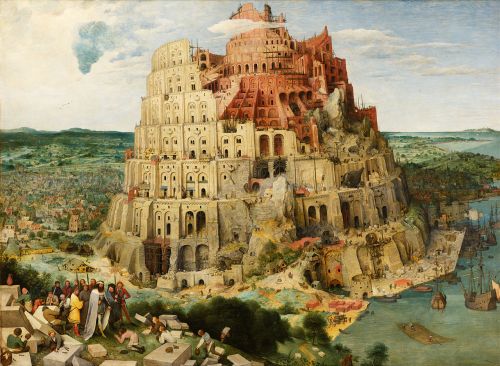
The Tower of Babel and Technological Humility

Tower of Babel - Bruegel the Elder

This week’s Torah reading, Genesis 6:9-11:32, includes two very different STEM achievements.

The first is the story of Noah, with a boat big enough to hold representatives of everything that lives (but does not swim). The ark’s purpose is to save all life in the face of an ultimate disaster. It works.

The other story is the Tower of Babel, with an immensely tall structure that has no obvious or express practical purpose. It is an early and elegant literary example of “because we can” philosophy. Think of it as a giant cosmic finger by some very arrogant builders.

Giving the finger is always rude and dangerous. Here, though, there is no violent retribution and no smiting by flood or fire. Instead, the result of that technological arrogance is eternal confusion and failure to communicate.

The Hebrew Bible has lots to say about human behavior, psychology, and spirituality. But no story may have more to tell us about life today than the Tower of Babel, especially when read in conjunction with Noah.

If we think we can build a boat big enough to save us from a particular catastrophe, maybe we can. But even then, as the rest of the post-Noah biblical stories and the rest of world history demonstrate, staying dry in the flood is just the beginning of our problems.

And if we think we can just show how smart we are by concocting a bunch of oversized technological wonders, monuments of pride, we may find ourselves, as the saying goes, too clever by half.

Consequences are inevitable. Purposes are necessary. Really big towers are awesomely cool. Just be sure you know, more or less, what you’re doing and why.


And all the earth was one language, oe set of words. And it happened as they journeyed from the east that they found a valley in the land of Shinar and settled there. And they said to each other, “Come, let us bake bricks and burn them hard.” And the brick served them as stone, and bitumen served them as mortar. And they said, “Come, let us build us a city and a tower with its top in the heavens, that we may make us a name, lest we be scattered over all the earth.” And the LORD came down to see the city and the tower that the human creatures had built. And the LORD said, “As one people with one language for all, if this is what they have begun to do, now nothing they plot to do will elude them. Come, let us go down and baffle their language there so that they will not understand each other’s language.” And the LORD scattered them from there over all the earth and they left off building the city. Therefore it is called Babel, for there the LORD made the language of all the earth babble. And from there the LORD scattered them over all the earth.

Genesis 11:1-9
The Five Books of Moses: A Translation with Commentary
Robert Alter

The Zen Teaching of Homeless Kodo

Zen Teachings of Homeless Kodo

Even if you are not interested in Zen or Buddhism, this is your invitation to discover one of the most fascinating and overlooked figures in 20th century religion.

If you are a student of Zen, and think you have a broad overview of Zen in the last century, you may wonder why you’ve never heard of Kodo Sawaki Roshi (1880-1965), let alone read any of his work. Up to now, circumstances worked against that. But that has changed with the just-published The Zen Teaching of Homeless Kodo from Wisdom Publications. You owe it to yourself to fill that gap.

Lineage is an essential element of Zen, a tracing of the conceptual DNA that reaches back to Bodhidharma, who in the 5th or 6th century BCE legendarily brought Buddhism from India to China. Thus begins the story of Chinese Ch’an (later Japanese Zen) Buddhism.

In the modern Western incarnations of Zen, some lineages are well-known. Arguably the most popular of all teachers in the West is Shunryu Suzuki Roshi, who founded the San Francisco Zen Center. The first collection of his teachings, Zen Mind, Beginner’s Mind, remains the bestselling introduction to Zen practice in English. It is clear and captivating, and it captured many, including me years ago.

Maybe not as well-known, but equally important, is the work of Kosho Uchiyama Roshi. Published at about the same time as Zen Mind, Uchiyama Roshi’s Approach to Zen lacked the design and print sophistication of Suzuki’s book. Instead of Zen Mind’s colorful cover, calligraphy, and fine typesetting, Approach to Zen is plain brown, with simple illustrations hand-drawn by Uchiyama Roshi.

Approach to Zen

Proving that you can’t judge a book by its cover or color, Approach to Zen is an excellent primer on practice and philosophy. It was later expanded into the even more valuable Opening the Hand of Thought: Foundations of Zen Buddhist Practice (where happily a few of the original drawings are kept). If you are Zen-curious, you could do no better than starting with the pair of Zen Mind and Opening the Hand of Thought.

Opening the Hand of Thought

Sawaki Roshi was Uchiyama Roshi’s teacher. Uchiyama Roshi’s best-known student is Shohaku Okumura, whose practice includes being one of the premier translators of Zen texts—now including the work of Sawaki Roshi. In this new book, these three teachers, three points on an extraordinary line, come together.

Zen masters often have complex lives, but more than most, Sawaki Roshi’s story defies quick summary. The emblematic thing to know about his life and teaching is that he was an iconoclast. It is conventional for great teachers to take over a temple, so that they can effectively (and perhaps comfortably) transmit their teachings. Sawaki refused that possibility; he was, as a teacher for decades, without a home.

People call me Homeless Kodo, but I don’t think they particularly intend to disparage me. They say “homeless” probably because I never had a temple or owned a house. Anyway, all human beings without exception are in reality homeless. It’s a mistake to think we have a solid home.

Zen is renowned for straight talk, even when that talk seems to be crooked, wandering around so that the undeniable point remains out of easy reach or reason. In these excerpts, Kodo Sawaki employs the straightest of straight talk—no less philosophically deep than the most puzzling of messages, but as punishing and sometimes sarcastic as a punch in the face.

When people are alone, they’re not so bad. However, when a group forms, paralysis occurs; people become totally foolish and cannot distinguish good from bad. Their minds are numbed by the group. Because of their desire to belong and even to lose themselves, some pay membership fees. Others work on advertising to attract people and intoxicate them for some political, spiritual, or commercial purpose.

I keep some distance from society, not to escape it but to avoid this kind of paralysis. To practice zazen is to become free of this group stupidity.


Some opinions have passed their prime and lost relevance. For instance, when grownups lecture children, they often simply repeat ready-made opinions. They merely say, “Good is good; bad is bad.” When greens go to seed, they become hard and fibrous. They aren’t edible anymore. We should always see things with fresh eyes!

Often people say, “This is valuable!” But what’s really valuable? Nothing. When you die, you have to leave everything behind. Even the national treasures in Kyoto and Nara will sooner or later perish. It’s not a problem even if they all burn down.

Equal to the value of these teachings is the layering of commentary on Sawaki Roshi by his student Uchiyama Roshi and by Uchiyama Roshi’s student Shohaku Okumura. Layered commentary is common not only to Zen, but to many religious and philosophical traditions. Yet this is remarkable for combining erudite exposition about the teachings and Zen with what can only be described as filial respect and affection—that is, love. Though two of the three participants have died, you feel as if you are present for an enlightened three-way conversation among grandfather, father, and son.

You will wish that it would never end. In a sense, it never does or has to. You can take the treasures you find here and incorporate them into your life, your thinking, and, if you are inclined that way, into your practice.

A horse and a cat once discussed the question, “What is happiness?” They couldn’t reach any agreement.

In the Beginning, Again

Genesis Illustrated Cover

This Sabbath, the annual cycle of Torah readings starts all over again. Again. Back to the beginning. Genesis (Breisheit), Chapter 1.

In the beginning….Well, you probably know how it goes. But don’t be jaded by familiarity. And don’t avoid it or be put off by belief that this and all the Genesis stories that follow are neither history nor science. So what? These are big stories and we need big stories. Not to be used as clubs to beat us up (though there is that), but as invitations and portals to bigger things. If not, then why are so many watching Hunger Games or Downtown Abbey?

Instead of learned discourse, here is something much more fun. R. Crumb, one of the great comic artists (beginning with his classic underground comics in the 1960s—Mr. Natural, etc.), published his Book of Genesis Illustrated in 2010.

Genesis Illustrated Back Cover

(If you don’t like pictures or Crumb’s illustrations, you might just try the excellent translation of Genesis that Crumb used, by Robert Alter)

Take a moment, whatever your inclinations, and allow yourself to be awed. Whatever you think is awesome, the sudden appearance of everything is more awesome than that, however you explain it. And for those who are waiting to see the Big Guy with the long beard–you know you’ve just gotta have it–here it is.

Genesis Illustrated Page 1

Why I Read the Qur’an This Yom Kippur

Qur'an

There comes a time on Yom Kippur, the holiest day on the Jewish calendar, when the official proceedings pause. In the space between morning and afternoon services, lunch on a fast day not being an option, some people engage in group discussions of matters biblical and theological. A sort of hungry High Holy Days Torah study.

This year, I read the Qur’an.

At Yom Kippur services, the Book of Jonah is read. I made that the topic of my High Holy Days blog post, writing that Jonah is a tale we tell to the youngest children, as if, literally, a five-year-old would get it. In fact, Jonah is unique among all Old Testament prophetic books, and may be one of the most variously interpreted texts in the Hebrew Bible. So if you or that five-year-old think it is the simple story of obedience to God and the power of repentance, you might think twice.

Then a few days later, it was reported that an Iranian psychotherapist had just been hanged for, among other things, misinterpreting the Qur’an and insulting the prophet Jonah. For those unfamiliar with the Qur’an, many of the major figures of the Bible—Abraham, Noah, Moses, Jesus, and others—make appearances there. Sometimes it is a quick mention, but they are important links in the chain leading to Mohammed. Jonah among them.

This then became for me the Yom Kippur of Jonah. The Book of Jonah is so short, four brief chapters, that it can be read in minutes. While I have read many of the suras (chapters) in the Qur’an, I had never focused on the role of Jonah.

My interest in Qur’an began years ago with an extraordinary 3-volume set, Judaism, Christianity, and Islam by Professor F. E. Peters. Peters is one of the leading scholars on the shared foundations of these faiths, and this work offers parallel scriptural excerpts from each on a range of themes. I was well-versed in the Bible, Jewish and Christian, but had never read a single word of Qur’an. This began my still-ongoing attempt to fill that gap.

Literacy and familiarity with Abrahamic scriptures—reading them, being aware of structure and content, knowing some of the theological and interpretive issues—might run from 0 (no knowledge) to 10 (comprehensive knowledge). On that scale, many if not most Jews would probably score a 2 for the Hebrew Bible (maybe higher if limited to Torah and assorted familiar books of the Tanach), 0 for the New Testament, and a negative number for the Qur’an, that is, a studied and sometimes antagonistic ignorance. No blame for any of that, though we hope that those who engage in discussion or offer opinions about them might do it with some measure of knowledge.

The sura Jonah (Yonus) in the Qur’an is not what a non-Muslim might expect. Jonah is mentioned only once in it at verse 98:

If only a single town had believed and benefited from its belief! Only Jonah’s people did so, and when they believed, We relieved them of the punishment of disgrace in the life of this world, and let them enjoy life for a time.

The next verse of the sura encourages the Prophet (Mohammed) to be patient in waiting for unbelievers to come around:

Had your Lord willed, all the people on earth would have believed. So can you [Prophet] compel people to believe?

The more familiar biblical story is found at verse 139 of the sura Al-Saffat (37). As with many of the Qur’an’s recaps of these stories, it is very condensed:

Jonah too was one of the messengers. He fled to the overloaded ship. They cast lots, he suffered defeat, and a great fish swallowed him, for he had committed blameworthy acts. If he had not been one of those who glorified God, he would have stayed in its belly until the Day when all are raised up, but We cast him out, sick, on to a barren shore, and made a gourd tree grow above him. We sent him to a hundred thousand people or more. They believed, so We let them live out their lives.

It isn’t clear from the reports how the psychotherapist, who was leading a Qur’an study, insulted Jonah. It is true that much of official Islam “discourages” unorthodox translation and interpretation (in some cases with fatwas, imprisonment, and death). It is also true that translators, scholars, and teachers have continued to push the boundaries anyway, shaking up the tradition and risking it all.

If you have an interest in seeing what the modern generation of Qur’an translations reads like, see M.A.S. Abdel Haleem’s The Qur’an: A New Translation (2005)
(from which the above excerpts are taken).

Don’t wait until next Yom Kippur. You don’t even need a holiday, Jewish or Christian. If you are of the non-Muslim Abrahamic persuasion, or even if you’re not persuaded at all, have a look at the Qur’an. You may believe in many respects besides religious—historical, social, cultural—that the Bible is one of the most important books in the world. You may also have to admit that in its impact, the Qur’an is its equal.

We hear regularly about how there are people killing for the Qur’an, or at least for their often misguided interpretations of it. Remember that there are also those trying to correct those interpretations, and they are dying for it.

Jonah and the New Year

Jonah

“Like Jonas himself I find myself traveling toward my destiny in the belly of a paradox.”
Thomas Merton
The Sign of Jonas

The Jewish High Holy Days begins this evening, starting with Rosh Hashanah (New Year 5775) and ending on the tenth day with Yom Kippur (Day of Atonement). So it is a good time to talk about Jonah.

On Yom Kippur, the Book of Jonah is read at services. It is supposedly so simple a story that we tell it to the youngest children. It isn’t that simple.

Prof. Barry Bandstra writes:

The book of Jonah has been interpreted in many different ways: as a satire on prophetic calling and the refusal of prophets to follow God’s call; as a criticism of Israelite prophets who were insincere in preaching repentance (because they really wanted to see destruction); as a criticism of the Jewish community’s unwillingness to respond to prophetic calls to repentance (in contrast with Nineveh); as a criticism of an exclusive view of divine election (God only cares about “chosen people”); as an assertion of God’s freedom to change God’s mind over and against prophets who would limit that freedom; as emphasizing the problem with true and false prophecy (even true prophets have words that do not come true); or as an allegory of Israel in exile (both Jonah and Judah look to God for destruction of an evil empire). De La Torre argues for an interpretation of the book that views Jonah as a marginalized person frustrated with God for not punishing those who have brutally oppressed people. Person reads the book of Jonah as a conversation between author and reader, focusing on the implied verbal rejection of God’s command by Jonah in 1:3.

The entire very brief Book of Jonah is at the end of this post. It goes something like this:

God tells Jonah to preach to the wicked city of Nineveh.
Jonah runs away from this assignment and gets on a ship.
A storm batters the ship and the sailors figure out Jonah is the cause.
The sailors say they don’t want to throw him overboard to appease God, but then they do anyway.
Jonah is swallowed by a big fish.
After three days, the fish disgorges Jonah on land.
Jonah finally preaches repentance to Nineveh.
Nineveh does repent.
God has mercy and doesn’t destroy Nineveh.
Jonah complains that he went through a lot of trouble, so God should have destroyed Nineveh.
God gives Jonah a special plant and then destroys it, as an example of how a prophet has nothing to do with what happens and shouldn’t care how God ultimately deals with things. God explains:

“You are concerned for the castor-oil plant which has not cost you any effort and which you did not grow, which came up in a night and has perished in a night. So why should I not be concerned for Nineveh, the great city, in which there are more than a hundred and twenty thousand people who cannot tell their right hand from their left, to say nothing of all the animals?”

So for the New Year, among the many things you may ask yourself:

Was God too lenient? Was Jonah not compassionate enough, taking joy in the misfortune of others? Am I or should I be more like God? Like Jonah? Like the sailors on the ship? Like the people of Nineveh? Like the fish? Can I tell my right hand from my left?

Whatever your faith or no-faith, you can never have enough New Years and new starts. Please have a happy one.


Book of Jonah from the Jerusalem Bible (J.R.R. Tolkien)

Selecting a Catholic translation of the Book of Jonah on Rosh Hashanah may seem odd. There are two reasons. The Jerusalem Bible is the best English-language combination of literary style and scholarship. And this particular book has a very special translator/editor: J.R.R. Tolkien.

The original Jerusalem Bible, published in English in 1966, was conceived as a very modern Catholic Bible—modern in terms of both language and scholarship. A French edition had already been published, and for the English version, a number of English-language scholars and writers were enlisted. Some texts were translated from original languages (Hebrew, Greek) while other texts were re-translations of the French. Tolkien was brought on as an editor, but he did create one book in English, taken from the French: The Book of Jonah.

Jonah 1

1. The word of Yahweh was addressed to Jonah son of Amittai:
2. ‘Up!’ he said, ‘Go to Nineveh, the great city, and proclaim to them that their wickedness has forced itself upon me.’
3. Jonah set about running away from Yahweh, and going to Tarshish. He went down to Jaffa and found a ship bound for Tarshish; he paid his fare and boarded it, to go with them to Tarshish, to get away from Yahweh.
4. But Yahweh threw a hurricane at the sea, and there was such a great storm at sea that the ship threatened to break up.
5. The sailors took fright, and each of them called on his own god, and to lighten the ship they threw the cargo overboard. Jonah, however, had gone below, had lain down in the hold and was fast asleep,
6. when the boatswain went up to him and said, ‘What do you mean by sleeping? Get up! Call on your god! Perhaps he will spare us a thought and not leave us to die.’
7. Then they said to each other, ‘Come on, let us draw lots to find out who is to blame for bringing us this bad luck.’ So they cast lots, and the lot pointed to Jonah.
8. Then they said to him, ‘Tell us, what is your business? Where do you come from? What is your country? What is your nationality?’
9. He replied, ‘I am a Hebrew, and I worship Yahweh, God of Heaven, who made both sea and dry land.’
10. The sailors were seized with terror at this and said, ‘Why ever did you do this?’ since they knew that he was trying to escape from Yahweh, because he had told them so.
11. They then said, ‘What are we to do with you, to make the sea calm down for us?’ For the sea was growing rougher and rougher.
12. He replied, ‘Take me and throw me into the sea, and then it will calm down for you. I know it is my fault that this great storm has struck you.’
13. The sailors rowed hard in an effort to reach the shore, but in vain, since the sea was growing rougher and rougher.
14. So at last they called on Yahweh and said, ‘O, Yahweh, do not let us perish for the sake of this man’s life, and do not hold us responsible for causing an innocent man’s death; for you, Yahweh, have acted as you saw fit.’
15. And taking hold of Jonah they threw him into the sea; and the sea stopped raging.
16. At this, the men were seized with dread of Yahweh; they offered a sacrifice to Yahweh and made vows to him.

Jonah 2

1. Now Yahweh ordained that a great fish should swallow Jonah; and Jonah remained in the belly of the fish for three days and three nights.
2. From the belly of the fish, Jonah prayed to Yahweh, his God; he said:
3. Out of my distress I cried to Yahweh and he answered me, from the belly of Sheol I cried out; you heard my voice!
4. For you threw me into the deep, into the heart of the seas, and the floods closed round me. All your waves and billows passed over me;
5. then I thought, ‘I am banished from your sight; how shall I ever see your holy Temple again?’
6. The waters round me rose to my neck, the deep was closing round me, seaweed twining round my head.
7. To the roots of the mountains, I sank into the underworld, and its bars closed round me for ever. But you raised my life from the Pit, Yahweh my God!
8. When my soul was growing ever weaker, Yahweh, I remembered you, and my prayer reached you in your holy Temple.
9. Some abandon their faithful love by worshipping false gods,
10. but I shall sacrifice to you with songs of praise. The vow I have made I shall fulfil! Salvation comes from Yahweh!
11. Yahweh spoke to the fish, which then vomited Jonah onto the dry land.

Jonah 3

1. The word of Yahweh was addressed to Jonah a second time.
2. ‘Up!’ he said, ‘Go to Nineveh, the great city, and preach to it as I shall tell you.’
3. Jonah set out and went to Nineveh in obedience to the word of Yahweh. Now Nineveh was a city great beyond compare; to cross it took three days.
4. Jonah began by going a day’s journey into the city and then proclaimed, ‘Only forty days more and Nineveh will be overthrown.’
5. And the people of Nineveh believed in God; they proclaimed a fast and put on sackcloth, from the greatest to the least.
6. When the news reached the king of Nineveh, he rose from his throne, took off his robe, put on sackcloth and sat down in ashes.
7. He then had it proclaimed throughout Nineveh, by decree of the king and his nobles, as follows: ‘No person or animal, herd or flock, may eat anything; they may not graze, they may not drink any water.
8. All must put on sackcloth and call on God with all their might; and let everyone renounce his evil ways and violent behaviour.
9. Who knows? Perhaps God will change his mind and relent and renounce his burning wrath, so that we shall not perish.’
10. God saw their efforts to renounce their evil ways. And God relented about the disaster which he had threatened to bring on them, and did not bring it.

Jonah 4

1. This made Jonah very indignant; he fell into a rage.
2. He prayed to Yahweh and said, ‘Please, Yahweh, isn’t this what I said would happen when I was still in my own country? That was why I first tried to flee to Tarshish, since I knew you were a tender, compassionate God, slow to anger, rich in faithful love, who relents about inflicting disaster.
3. So now, Yahweh, please take my life, for I might as well be dead as go on living.’
4. Yahweh replied, ‘Are you right to be angry?’
5. Jonah then left the city and sat down to the east of the city. There he made himself a shelter and sat under it in the shade, to see what would happen to the city.
6. Yahweh God then ordained that a castor-oil plant should grow up over Jonah to give shade for his head and soothe his ill-humour; Jonah was delighted with the castor-oil plant.
7. But at dawn the next day, God ordained that a worm should attack the castor-oil plant — and it withered.
8. Next, when the sun rose, God ordained that there should be a scorching east wind; the sun beat down so hard on Jonah’s head that he was overcome and begged for death, saying, ‘I might as well be dead as go on living.’
9. God said to Jonah, ‘Are you right to be angry about the castor-oil plant?’ He replied, ‘I have every right to be angry, mortally angry!’
10. Yahweh replied, ‘You are concerned for the castor-oil plant which has not cost you any effort and which you did not grow, which came up in a night and has perished in a night.
11. So why should I not be concerned for Nineveh, the great city, in which there are more than a hundred and twenty thousand people who cannot tell their right hand from their left, to say nothing of all the animals?’

MUJI to Sleep: Minimalist Essential Wonderful Free App

MUJI Waterfall

Japanese retailer MUJI has a free gift for you. A tiny gift that will delight you and transform your phone or tablet into an instrument of wonder. MUJI for Sleep.

MUJI sells minimalist furniture, home goods, apparel, and other personal products—online and in a small number of stores in New York and California.

On their U.S. website, MUJI explains its philosophy:

MUJI is not a brand whose value rests in the frills and “extras” it adds to its products.
MUJI is simplicity – but a simplicity achieved through a complexity of thought and design.
MUJI’s streamlining is the result of the careful elimination and subtraction of gratuitous features and design unrelated to function.
MUJI, the brand, is rational, and free of agenda, doctrine, and “isms.” The MUJI concept derives from us continuously asking, “What is best from an individual’s point of view?”
MUJI aspires to modesty and plainness, the better to adapt and shape itself to the styles, preferences, and practices of as wide a group of people as possible. This is the single most important reason people embrace MUJI.

MUJI sells a successful line of sleep products for travel. Which explains the MUJI to Sleep campaign, featuring their Neck Pillow and the MUJI to Sleep app to go with it.

Simplicity and minimalism hardly describe the app. It has five screens to swipe through, each a different color, each with a brushstroke sketch of a scene, each scene with a flow of continuous sound: a river, a bird, a waterfall, a fire, a forest. There is a timer to keep it running for 30, 60, or 90 minutes. Touch on, touch pause. That’s it. As simple as a flashlight app. And more valuable.

You can fall asleep to MUJI of course, which is what it intends. Or you can play it as background for your activities or non-activities, a sort of aural incense. It will contribute to your life in ways unexpected and wonderful.

The MUJI to Sleep app currently has less than 100,000 downloads on Google Play. It should have millions.

When you have true practice, then valley sounds and colors, mountain colors and sounds, all reveal the eighty-four thousand verses. When you are free from fame, profit, body, and mind, the valleys and mountains are also free. Through the night the valley sounds and mountain colors do and do not actualize the eighty-four thousand verses. When your capacity to talk about valleys and mountains as valleys and mountains is not yet mature, who can see and hear you as valley sounds and mountain colors?

Zen Master Dogen
Treasury of the True Dharma Eye
Valley Sounds, Mountain Colors (1240)

Newark and Detroit: The Long Hot Summer of 1967

Newark 1967

The last post about James Baldwin’s The Fire Next Time (1963) skipped a beat about what happened next. What happened in America was the race riots between 1964 and 1966 (including Watts in Los Angeles), culminating with the so-called Long Hot Summer of 1967. During that summer, among the many cities affected, the two disturbances that stand out are Newark and Detroit.

Baldwin did not overstate any prophetic intention in his book. Instead, he simply opened with this epigraph, from which he took the book’s title:

God gave Noah the rainbow sign,
No more water, the fire next time!

Newark, July 12-17, began with the arrest of a black cabdriver for passing a police car. The riots left 26 dead and hundreds injured.

Detroit, July 23-27, began with a police raid of a black drinking club. The riots left 43 dead, 1,189 injured, over 7,200 arrests, and more than 2,000 buildings destroyed.

There are at least three reasons we don’t hear much or talk much about that summer in the context of Ferguson.

We are abysmally ahistorical. If it isn’t in the latest Twitter feed, it may already be old news. Things that happened forty or fifty years ago might as well be from the Middle Ages.

We want to highlight and not overshadow the clear progress that has been made. Progress to be sure, as reflected in the photo of a black President talking to a black Attorney General about the events in Ferguson.

We are afraid. Afraid that the progress we have made may be as illusory as it is real. Afraid that we solved the easier problems, leaving us with stubborn, intractable ones that are beyond comfortable solutions. Afraid that we may not be as good as we think we are. Mostly afraid that history is TMI, telling us way more than we want to know, showing us images not from the distant past but from tomorrow.

Ferguson and The Fire Next Time

James Baldwin - The Fire Next Time

James Baldwin’s The Fire Next Time may be the best and most eloquent statement of relations between whites and blacks in America ever written. From the publisher:

The appearance of The Fire Next Time in 1963, just as the civil rights movement was exploding across the American South, galvanized the nation and continues to reverberate as perhaps the most prophetic and defining statement ever written of the continuing costs of Americans’ refusal to face their own history. It became a national bestseller, and Baldwin was featured on the cover of Time magazine. Critic Irving Howe said that The Fire Next Time achieved “heights of passionate exhortation unmatched in modern American writing.”

Baldwin was one of the great writers of his or any other American generation. He shouldered the burden of being a triple threat to America of the 1960s—a black man, a brilliant and outspoken intellectual, and gay. This he did with unequaled prose grace, and this work and others are required reading for anyone who wants or claims to be a writer.

The first of the two essays is My Dungeon Shook: Letter to My Nephew on the One Hundredth Anniversary of the Emancipation. Brief and unforgettable, it is a summary of how things are and why his teenage namesake cannot give up and in. It does no justice to this book to excerpt it; it stands as a whole that must be read—not the least of all because with the real progress we have made, we are foolish and destructive to over-measure how far we have come. But here is how the essay closes:

And if the word integration means anything, this is what it means: that we, with love, shall force our brothers to see themselves as they are, to cease fleeing from reality and begin to change it. For this is your home, my friend, do not be driven from it; great men have done great things here, and will again, and we can make America what America must become. It will be hard, James, but you come from sturdy, peasant stock, men who picked cotton and dammed rivers and built railroads, and, in the teeth of the most terrifying odds, achieved an unassailable and monumental dignity. You come from a long line of great poets, some of the greatest poets since Homer. One of them said, “The very time I thought I was lost, My dungeon shook and my chains fell off.”

You know, and I know, that the country is celebrating one hundred years of freedom one hundred years too soon. We cannot be free until they are free. God bless you, James, and Godspeed.

Your uncle,
James