Bob Schwartz

Category: Judaism

Beresheet: The Beginning

bereshit

Today the annual Torah reading cycle begins again with the portion Beresheet (also transliterated as Bereshit, Genesis 1:1-6:8).

It is a big Torah, a bigger Jewish Bible (Tanakh), and an even bigger Christian Bible. In all that expanse, nothing compares to the way it begins.

Bereshit: “When God Created …” This first word of the first book of the Bible serves both as the Hebrew name for the book Genesis and as an idiom for “Creation.” Because of its pride of position at the “start” of creation, as well as its uniqueness (the word never appears again in Scriptures), the word is subjected to intensive and varied exegetical analysis. Many, many meanings are derived from this one six-letter word….Jewish tradition has also held the six letters contain secrets that the wise will understand. (The Encyclopedia of Jewish Myth, Magic and Mysticism, Geoffrey W. Dennis)

In English, it goes like this:

When God began to create heaven and earth—the earth being unformed and void, with darkness over the surface of the deep and a wind from God sweeping over the water—God said, “Let there be light”; and there was light. God saw that the light was good, and God separated the light from the darkness. God. (New Jewish Publication Society translation)

Or this:

In the beginning when God created the heavens and the earth, the earth was a formless void and darkness covered the face of the deep, while a wind from God swept over the face of the waters. Then God said, “Let there be light”; and there was light. And God saw that the light was good; and God separated the light from the darkness. (New Revised Standard Version translation)

Or this:

When God began to create heaven and earth, and the earth then was welter and waste and darkness over the deep and God’s breath hovering over the waters, God said, “Let there be light.” And there was light. And God saw the light, that it was good, and God divided the light from the darkness. (Robert Alter translation)

Unformed. Void. Darkness. Wind. Welter. Waste. Light. When God began to create.

Maybe you once read or studied the Bible, in any of its versions. Maybe you still do. Maybe you don’t anymore or maybe you never did. Maybe you had deep discussions about God, about creation, and about whether there was something out of which creation was made or whether there was nothing and then there was something (ex nihilo). Then again, maybe not.

No matter your beliefs, consider this first portion, the first words, and the very first of the first words consisting of six Hebrew letters. Are there “secrets the wise will understand”? Are you that wise one?


Treasure Rooms

treasure-room

Being Jewish, or Buddhist, or Christian, or Muslim, or part of any tradition, is not primarily an identity, though it is used that way so that community can be established and maintained.

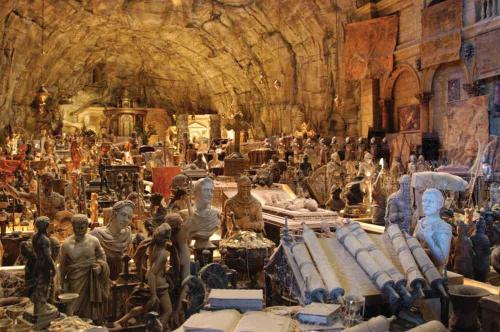
It is a key to a treasure room, different rooms for different traditions. In that room are items whose true value is not inherent or obvious, despite others putting price tags on these items. These, they say, are the most valuable, while these others are less important or completely unimportant.

If you are invited into the treasure room, or invite yourself in, you can look at the price tags, but should also explore and discover for yourself. Keep your eyes and mind open.  Just calling something treasure does not make it so. And what is dismissed or little noticed may be the greatest treasure of all. You are not there just to find treasure, though there is plenty of it. You are there to learn about treasure and about yourself.

For ER, at a special moment on his treasure hunt.

Yom Kippur Lesser Hits

I see that a few of my older posts about the Days of Awe/High Holy Days are being read now. This is a gratifying, considering that when I read them myself, I am not all that happy with them (the writer’s curse).

It gave me the idea that maybe instead of writing something new about this Yom Kippur, which begins this evening, I would instead include links to some of the past posts.

For those who are Jewish and fasting, may you have an easy fast. For those who are not Jewish or not fasting, no worries. The opportunity to contemplate our lives is open every day to everyone, no matter who you are, no matter what you eat, or don’t.

Yom Kippur and Job

“Whether this is a day of reflection and fasting, reciting centuries-old prayers, or an ordinary day of work or study, managing others or being managed; whether you are Job beset by unexplained misfortune, or Job’s wife, ready to kill him if he doesn’t kill himself, or Job’s friends so quick with advice; whether you are being punished by God, Satan, or whatever other forces you believe are working against you; whether you are the smartest person in the room or not; this is what we can do, even if there is seemingly no comfort in it: Be awed. Be humble.”

Yom Kippur: A Serious Day for a Serious Man

“The movie closes with a note taken straight from the Book of Job. A tornado approaches. Will it be the voice of God out of the whirlwind? Or will it just be one more inexplicable disaster, one more serious touch of uncertainty? Who knows? Yom Kippur and every day, listen to Rabbi Marshak: Be a good girl or boy.”

Yom Kippur: Beyond the Self

“The tradition says that the Book of Life is open during the Ten Days of Awe. When the holy days end with Yom Kippur, the Day of Atonement, when the shofar sounds, the book closes and our lives will have been written for the next year. But the book is always open.”

Jonah, Yom Kippur, Iran and Irony

“Last week, Iranian psychotherapist Mohsen Amir-Aslani was hanged for, among other things, insulting the prophet Jonah.”

Why I Read the Qur’an This Yom Kippur

“You may believe in many respects besides religious—historical, social, cultural—that the Bible is one of the most important books in the world. You may also have to admit that in its impact, the Qur’an is its equal.”

The Book of Life (Days of Awe)

The Book of Life (Days of Awe)

Who writes
Who reads
The sentences
In careful paragraphs and chapters
That follow ancient codes?
Or the disjointed scrawl,
Random and indecipherable,
No system at all?
The contest is closing in days.
Who judges the book,
By what rules?
How will we know
If we win or lose?
Another new year growing old,
Another life on the shelf.

Days of Random Awe – Day 4: Koheleth/Ecclesiastes 11

Utter futility!—said Koheleth—
Utter futility! All is futile!
Koheleth/Ecclesiastes 1:2 (New Jewish Publication Society translation)

The random chapter of Tanakh for this Day 4 of the Days of Awe is from the Book of Ecclesiastes, known in Hebrew by the name of the sage it is attributed to, Koheleth.

This book is unique in the Tanakh and uniquely troublesome for some rabbis and biblical interpreters. The conventional system of rewards and punishments seems, to a certain extent, to have been thrown out the window. Or at least put in perspective.

Here is Chapter 11:

Send your bread forth upon the waters; for after many days you will find it. Distribute portions to seven or even to eight, for you cannot know what misfortune may occur on earth.

If the clouds are filled, they will pour down rain on the earth; and *if a tree falls to the south or to the north, the tree will stay where it falls. If one watches the wind, he will never sow; and if one observes the clouds, he will never reap. Just as you do not know how the lifebreath passes into the limbs within the womb of the pregnant woman, so you cannot foresee the actions of God, who causes all things to happen. Sow your seed in the morning, and don’t hold back your hand in the evening, since you don’t know which is going to succeed, the one or the other, or if both are equally good.

How sweet is the light, what a delight for the eyes to behold the sun! Even if a man lives many years, let him enjoy himself in all of them, remembering how many the days of darkness are going to be. The only future is nothingness!

O youth, enjoy yourself while you are young! Let your heart lead you to enjoyment in the days of your youth. Follow the desires of your heart and the glances of your eyes—but know well that God will call you to account for all such things—1and banish care from your mind, and pluck sorrow out of your flesh! For youth and black hair are fleeting.

The Jewish Study Bible explains:

His [Koheleth’s] observations are bound together by certain fundamental themes. The first is expressed by the term “futility” (hevel). For Koheleth, this is foremost the inability of humans to make sense of the world around them—to see a coherent pattern, a plan to their lives and to nature, in the sense of a movement toward lasting goals, a line of development or progress….

But the human ability to discern what these all are is frustrated, he argues, again and again, as evident by the fact that the traditional doctrine of reward and punishment for the good and the wicked does not appear to work. In this regard, Koheleth is arguing against the sort of position evident in the book of Deuteronomy or the bulk of Proverbs, for which the covenant tradition and experience provide certainty about what God demands of humans and so about His reward and punishment justice.

The one thing that is clear for Koheleth is death. It is the final point in each one’s maʿaseh, the one immutable event in life that every human, animal, and other organism must succumb to, and that cuts across, therefore, all categories of morality, class and being. If there is any survival beyond death, either physically or in terms of memory and influence, humans cannot know this, and so cannot rely on it. What is left to humans, then, as Koheleth sees it—though he does raise an occasional doubt—is principally to enjoy their toil while they are alive….

The capacity to discern all of this—to understand what can be known and what cannot—is for Koheleth the task of wisdom. Wisdom, therefore, is most effective when it is used to clarify its own limits.

This does not suggest some sort of libertine, hedonistic nihilism. In this respect, Koheleth reflects a very modern perspective that, as with the Book of Job, offers something like divine existentialism. Just because you stop trying to make sense, there is still meaning. But that meaning may be inherently hidden in the phenomena, and very different from the external order and programs others try to impose on that meaning—and on us. Compassion and generosity may be required of us, and we may seemingly be rewarded for their doing and punished for their lack, but it is ultimately the facts of life and death, and of futility, that are their source.

Days of Awesome: Day 1 (Rosh Hashanah)


I brought them out of the land of Egypt and I led them into the wilderness. I gave them My laws and taught them My rules, by the pursuit of which a man shall live. Moreover, I gave them My sabbaths to serve as a sign between Me and them, that they might know that it is I the Lord who sanctify them.
Ezekiel 20:10-12 (New Jewish Publication Society translation)

Note from The Jewish Study Bible:

The Sabbath is the foundational sign of the covenant (Exod. 20.8–11; 31.12–17). Scholars have suggested that the Sabbath became particularly significant in the exile, as holy time replaced the vacuum of holy space (the Temple); this might explain why the Sabbath plays such a significant role here. As in Exod. 31.13, 17 (from the Priestly tradition), it is viewed as a sign, namely a symbol acknowledging God as Creator.

Here we are confronted with the phenomenon at the heart of this holiday. At the heart of every holiday. At the heart of religion and reality itself. We are concerned with space. We are concerned with being. We are concerned with time too. But we may not be properly concerned, in a balanced way that accounts for time, space and being.

We can rule space, or at least pretend to. If you visit New York or other great cities, you see how people have shaped space to their liking and purposes. But where in New York or elsewhere have even the richest and most powerful ultimately shaped time? We can mark time, but do we understand? To help us understand, time is set aside. It may be by God, it may be by our society or community, it may be by and for those close to us.

The Sabbath each week, and the Days of Awe each year, are set aside to be different than the other days of the week or of the year. Different in fact than any other days of eternity. In part to remind us of present eternity.

For more, see The Sabbath by Abraham Joshua Heschel and The Time-Being by Zen Master Dogen, which can be found in Enlightenment Unfolds.

This is the first post in a very small project/experiment in random wisdom I call The Days of Awesome. In addition to the standard and traditional forms of worship and contemplation associated with the Jewish High Holy Days (also known as Days of Awe), each day of the holiday I will be studying a randomly selected chapter of the Tanakh (also known as the Jewish Bible or the Old Testament), which has 39 books containing a total of 929 chapters.

Among other things, this is inspired by the I Ching and by social theorist and philosopher Gregory Bateson, who is quoted as saying “I am going to build a church someday. It will have a holy of holies and a holy of holy of holies, and in that ultimate box will be a random number table.”

Live Streaming: High Holy Days at Central Synagogue

Central Synagogue

Central Synagogue in New York is one of the great synagogues and congregations in America.

If you are not attending High Holy Days services in-person anywhere, for whatever reason (don’t usually attend, not convenient, not Jewish, etc.), here is your opportunity to join in the services at Central Synagogue. Without leaving the comfort of wherever you have your PC, tablet or phone. For as little or as long a visit as you like.

Central Synagogue live streams its services. Here is just a partial schedule. (You can see the complete schedule here.) All times Eastern Time.

Erev Rosh Hashanah
Sunday, October 2, 8:00pm

Rosh Hashanah
Monday, October 3
Morning Service 9:30am

Kol Nidrei
Tuesday, October 11
6:00pm or 8:00pm

Yom Kippur
Wednesday, October 12
Morning Service 10:45am
Afternoon Service 3:30pm

No prayer books? No problem. You can download those from Central Synagogue too.

Rosh Hashanah Prayer Book

Kol Nidrei and Yom Kippur Morning Prayer Book

Yom Kippur Afternoon Prayer Book

These are the highest of all Jewish services with the highest of all Jewish music and prayer on the highest of all Jewish holidays at one of the most extraordinary Jewish congregations with one of the most extraordinary rabbis. And all you need is a browser.

Selichot and Angels


Selichot

Do Jews pray to angels? Do all of us need all the help we can get?

The Jewish Days of Awe begin soon, starting with Rosh Hashanah on the evening of October 2, ending with Yom Kippur on the evening of October 11.

It is a time of teshuvah, often translated as “repentance”, but more precisely “turning”—that is, turning away from ourselves and our ways and to God and godly ways. To start the process of reflection, on a Saturday night before Rosh Hashanah a special set of preparatory prayers begin to be recited, known as Selichot. This year, Selichot begins tonight, on the night of Saturday, September 24.

The conventional cast of characters in the soulful dialogue of teshuvah and the Days of Awe are yourself, the people and world around you, and God. But Rabbi Geoffrey W. Dennis, in the fascinating Encyclopedia of Jewish Myth, Magic and Mysticism, adds an unexpected player:

Machnisei Rachamim (Conveyors of Compassion)

This is a prayer petitioning the angels to intervene with God:

Conveyers of compassions, obtain our mercy before the Master of compassion,
Makers of prayer, make our prayer heard before the Hearer of prayer.
Makers of wailing, make our wail heard, before the Hearer of wailing.
Conveyers of tears, convey our tears before the King who yields to tears.
Strive to raise up supplication, raise up supplication and plea,
Before the King, high and exalted. The King, high and exalted.

This prayer is only recited at Selichot, a penitential service recited prior to the coming of Rosh Hashanah.

This prayer is anomalous in that the rule that Jews should pray only to God, and not to intermediaries, extends back to Talmudic times: “If troubles come upon a person, do not entreat the angel Michael or the angel Gabriel. Rather, entreat Me alone and I will help you immediately” (J. Ber. 9:1). Maimonides makes this normative, “It is only fitting to pray to God and it is not fitting to pray to any other.”

The Maharal of Prague was sufficiently troubled by the appearance of this prayer that he amended the wording (Netivot Olam, Netiv Ha’Avodah no.12), an innovation that did not catch on. In modern times, no less an ultra-Orthodox authority than the Hatam Sofer wrote that at Selichot he personally skips over this prayer (Orach Chaim no. 166), a shocking confession from the leader of a community that insists ALL of the tradition is sanctified and obligatory. The prayer has been entirely edited out of Selichot liturgy in the modernist Reform movement.

And yet at least one Midrash exists that endorses the idea of angels as intermediaries of our prayers (S of S R. 2:7). And many Jews worldwide recite the words barchuni l’shalom … (“bless me with peace”), when they sing the popular Shabbat hymn, Shalom Aleichem. This prayer is found only in the Ashkenazi (northern European) tradition, suggesting it was written when Jews were surrounded by a Christian culture that emphasized the use of divine intermediaries (saints) and even had services in honor of specific angels (Michaelmas).

Praying for Everybody. Even Trump.

I ran into a neighbor this morning, someone who goes to morning prayers every day.

Me: How was davening (prayer) today?

Him: Good. I prayed for everybody. Even Trump.

Me: Thank you. That’s the Yiddishe (Jewish) way.

And so it is.

Poem: My Night with the Sages

Talmud

My Night with the Sages

I found their numbers
Six, sixty-three.
Dispensing wisdom
Demanding action
Citing authority.
Talking
And talking
And talking.
How could they possibly
Help with the night?
Lost in loud logic
Where is the comfort or distraction?
But I called anyway
And they came.
To uneasy free floating
In the bleak
They added gravity
And light
Not quite
In reach
But there.
To sleep.