Bob Schwartz

Category: History

Why We Should Teach and Learn Ancient History First

Children in America who attend some sort of religious school, even before going to secular school, may learn some limited sort of ancient history. Ancient in that it concerns purported people and events from millennia ago. Limited in that some number of those people and events, however instructional and enlightening, may be of some historical question.

There is other ancient history worth teaching our kids early, and catching up with ourselves, just in case we missed it in our own education. There are continuous civilizations all around the world that have been ongoing, in the same place, also for millennia.

China, for example. Or India. Or the native populations in the Americas. This is where education should start, before we start talking about admittedly important people arriving on these North American shores and establishing an admittedly important nation just a few centuries ago.

Why? Because it would give us a sense of perspective on what we have, or have not, achieved so far. And because it would give us a missing sense of the scope of history, in that everything comes and goes. Which you could learn from the history of China. Or you could learn from reading the I Ching, the book about things changing, written in China millennia ago. Or if you prefer something more Western and familiar, from reading the Bible itself. A time for every purpose, it says. And so it goes.

A Visual Vacation in Fun and Relevant History: WPA Posters

WPA - Shall the Artist Survive

In case you think that government has no positive role to play in our lives, society or culture, especially in times of national stress, please have a look at the WPA posters from 1936 to 1943.

The Library of Congress has the largest collection:

The Work Projects Administration (WPA) Poster Collection consists of 907 posters produced from 1936 to 1943 by various branches of the WPA. Of the 2,000 WPA posters known to exist, the Library of Congress’s collection of more than 900 is the largest. The posters were designed to publicize exhibits, community activities, theatrical productions, and health and educational programs in seventeen states and the District of Columbia, with the strongest representation from California, Illinois, New York, Ohio, and Pennsylvania. The results of one of the first U.S. Government programs to support the arts, the posters were added to the Library’s holdings in the 1940s.

Here is a description of the WPA:

Of all of Roosevelt’s New Deal programs, the Works Progress Administration (WPA) is the most famous, because it affected so many people’s lives. Roosevelt’s vision of a work-relief program employed more than 8.5 million people. For an average salary of $41.57 a month, WPA employees built bridges, roads, public buildings, public parks and airports.

Under the direction of Harry Hopkins, an enthusiastic ex-social worker who had come from modest means, the WPA would spend more than $11 million in employment relief before it was canceled in 1943. The work relief program was more expensive than direct relief payments, but worth the added cost, Hopkins believed. “Give a man a dole,” he observed, “and you save his body and destroy his spirit. Give him a job and you save both body and spirit”….

When federal support of artists was questioned, Hopkins answered, “Hell! They’ve got to eat just like other people.” The WPA supported tens of thousands of artists, by funding creation of 2,566 murals and 17,744 pieces of sculpture that decorate public buildings nationwide. The federal art, theater, music, and writing programs, while not changing American culture as much as their adherents had hoped, did bring more art to more Americans than ever before or since.

It would be lovely to include dozens of the posters here. Instead, here are just a few more. Please visit and enjoy the entire collection.

WPA - Yellowstone

WPA - Mural Studies

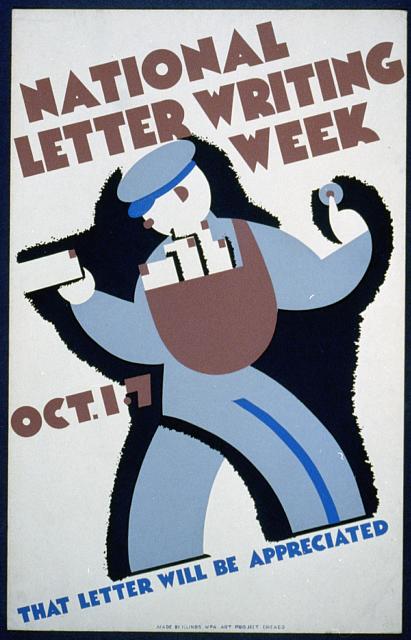
WPA - Letter Writing

WPA - Music Project

WPA - Lack of Funds

U.S. voter turnout is very low. But what if something is happening here?


U.S. Voter Turnout

Pew Research reports that “U.S. voter turnout trails most developed countries.” But what if something is happening here?

What if U.S. voter turnout was more like Belgium (89% of voting age population)? Or Australia (82%)? Or Israel (76%)? To name just a few of the countries where people vote in great numbers.

Instead, U.S. voter turnout is mired at 54% of voting age population, just a few places from the bottom.

There are about 235 million Americans of voting age. If turnout increased to the top of the list (89%), that would increase the number of voters by 35% (89%-54%). Thirty-five percent of 235 million is about 82 million more voters.

82 million more voters. To put that in perspective, the winner of the last presidential election received about 66 million votes.

82 million more votes. Many young. Many not white. Many open to new ideas and proposals, as the old ones don’t seem to work so well. Many not committed to maintaining the status quo, which has not been all that good to and for them.

This is what should worry all the established political parties and politicians. And the establishments that depend on them and on predictable stability rather than change, radical or even incremental.

Except that the parties, politicians and establishments don’t seem, at least publicly, to be worried. They appear to believe that non-voting Americans won’t suddenly show up at the polls in great numbers to vote their own views and interests. And just in case, some of those establishments are ready to deploy tools to help keep those numbers down.

Sometimes history is a bending arc. Sometimes it’s a runaway train. Votes are the fuel. That train may already be rolling slowly. Getting ready to speed up.

Because something is happening here
But you don’t know what it is
Do you, Mister Jones?

Bob Dylan, Ballad of a Thin Man

“Wrong Direction” Is the Wrong Question: A Nation Lost

GPS

Seventy-five percent of Americans say the country is moving in the wrong direction. But that isn’t the problem they actually perceive. It isn’t that they think we should go East when we’re heading West. It’s that, like an unprogrammed GPS, we have no idea where we want to go.

Americans love their GPS. They love it not because it can tell heading North from South; any compass can do that. They love it because when you put in a particular location, it will, mostly, direct you there. But that presupposes that you have a particular destination in mind.

America was least lost in the years following World War 2. There had been two very specific objectives, both of which had been achieved. We wanted to restore a failed economy and introduce renewed prosperity. Done. We wanted to defeat the most evil threat the world had ever known. Done.

We proceeded on autopilot for decades, though there were bumps on the road. It was about prosperity and freedom. When there were obstacles to either, we eliminated or overcame them. There were recessions here and there, but they passed. There was global Communism, which we fought wherever we found it, and found it sometimes where it wasn’t.

Then some things happened. A new generation was born, which had no native knowledge of any of that. A new economic generation was born, with money machines on a scale that dwarfed anything in history. A new technological generation was born, transforming the nature of human experience. A new threat to freedom and security emerged, though it didn’t much look like the Communism we had come to know, hate, and fight. Whereas only two countries had world-destroying weapons after WW2, the list was now long and growing.

And then, on top of all that, the prosperity we had depended on for more than sixty years was put into question. It wasn’t that it was taking a break. Maybe it would never come back again, ever, at least not the way it had been.

Which brings us back to the ‘wrong direction” question. If we say that 20th century-style prosperity and that freedom and security are what America is living for, is our personal and national direction, there is nothing wrong with that. But what if that is something we can’t program into our national GPS because it is not a destination we can reach, at least not fully and unconditionally?

We can keep saying we are moving in the wrong direction. Politicians and leaders are more than happy to exploit this, telling us who to blame and how they can fix it. But maybe we are lost, and should admit it, and should spend our energy figuring out, very specifically, without vague ideas of “prosperity” and “freedom”, where exactly we want to go, and then how we might get there.

Hanukkah as Game of Thrones

The Hanukkah story of the Maccabees and the Hasmonean dynasty they founded is not for children. The aftermath of the overthrow of the Seleucid overlords is for grown-ups, a history of empire, guerilla wars, massacres, alliances made and betrayed, power marriages, expansionism, hegemony, and subjugation. And of course faith—the right kind, the wrong kind, and none at all.

It is the sort of story that belongs in Game of Thrones. You won’t see that series on HBO. We want simple tales of faith and miracles, for ourselves and especially for the kids. And why not? In troubled times and a troubled world, no one can begrudge any injection of light or miracles we can find or conjure up.

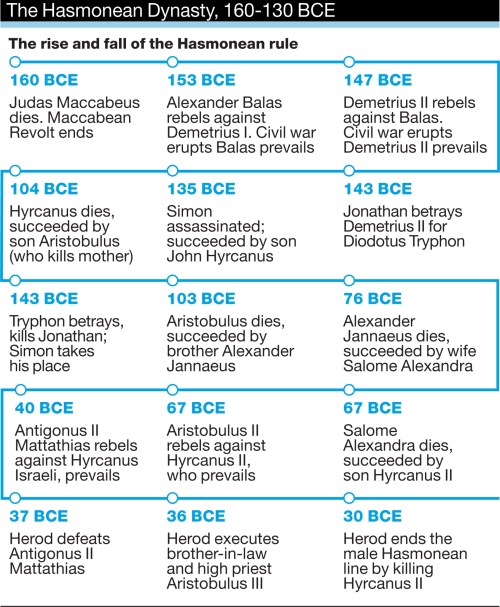
For a summary of this history, see this from the Israeli newspaper Haaretz: A Brief History of a Violent Epoch: Judas Maccabeus’ death would mark the end of the Maccabean revolt against the Greeks – and the start of the extremely unstable Hasmonean dynasty.

Here is a chart that outlines the chronology of the Hasmonean Dynasty:

Hasmonean Dynasty

Hanukkah has never been a major Jewish religious holiday, not on a par with Yom Kippur, Rosh Hashanah, Passover, and the rest. The events celebrated on Hanukkah do not appear in the Jewish bible. The canon of the Tanakh was closed before the Books of Maccabees could be included. Some of those books, though, can be found in Christian versions of the Old Testament.

Hanukkah was elevated, especially in America, as a seasonal companion to Christmas, for Jews living in decidedly Christian cultures. For a complete treatment of this phenomenon, see the book Hanukkah in America: A History.

The comparison to Christmas does suggest why we don’t have an epic series devoted to the Maccabees and their historical legacy.

The Christmas story has an even bigger and more significant and spectacular sequel. The newly born Jesus grows up to become the foundation of the faith and one of the great teachers in world history. The next part of his mission is told in the story of Easter. Sequels don’t get any bigger, clearer or cleaner than that.

The historical follow-up to the story of the Maccabees is more equivocal. It puts that era in Jewish history in a very real, human, political light that may clash with the simple idealized version of candles and dreidels.

This doesn’t mean we shouldn’t light the candles, eat the latkes, spin the dreidels, and commemorate the victory of God’s rule over the rule of the less godly. It’s just that sometime during the holiday, we might leave behind childish things and look at the history with eyes open. Not because it takes away from the holiday, but because it adds to it a fuller sense and understanding.

And because for two millennia, the exact same complexity has been unfolding in the exact same place. Not a children’s game. More like Game of Thrones. Only much more real.

Alternate history: What if the presidential losers were winners?

If you are a fan of alternate history, you should first of all be reading Philip K. Dick’s The Man in the High Castle and watching the series on Amazon (no spoiler: the U.S. lost World War II). For something else different, there’s this:

What if the major party losers for President actually won the election?

There are a few glitches, thanks to an untimely assassination and resignation, a loser later becoming a winner, a winner later becoming a loser, and a seriously messed up vote count. To avoid this, I’ve eliminated those losers who at one time did get to be President, by hook or crook.

Adlai Stevenson
Barry Goldwater
Hubert Humphrey
George McGovern
Walter Mondale
Michael Dukakis
Bob Dole
Al Gore
John Kerry
John McCain
Mitt Romney

Practice saying this, alternate historians. President Stevenson. President Goldwater.

If you really want to get far out, add prominent third-party losers to the mix.

President Wallace? To put that one in perspective, George Wallace got 46 electoral votes in 1968, compared to just 52 for Goldwater in 1964 and 49 for Jimmy Carter in 1980.

And, of course, there’s President Ross Perot. He ran twice, didn’t win any electoral votes, but provided the model for any billionaire third-party candidates in the future. As if such a thing could ever happen again.

If Princeton Expunges Segregationist Woodrow Wilson, Why Not Expunge All Presidential Slave Owners?

Princeton University is considering the demands of activists who want the legacy of Woodrow Wilson expunged from the university.

Woodrow Wilson was President of Princeton, Governor of New Jersey, and President of the United States. He was also a Democratic progressive in many areas. Not as progressive as his presidential opponent in the 1912 presidential election, former President and Progressive Party candidate Teddy Roosevelt. Wilson, for example, was friendly with Wall Street and opposed some financial reforms. (Sound like any current Democratic Party candidate we know?).

Wilson was also a man of his time and place. He was a Southerner and a segregationist, at a time when segregation was legally sanctioned. That isn’t an excuse for maintaining and promoting injustice, just a fact. That he might be less enlightened than current leaders by modern standards goes without saying. But given all the rest, it does not seem the stuff of an indictment.

If there is validity to the demands, then there is no principled reason not to expunge the legacy of all slave-owning Presidents from all settings. After all, slavery is undoubtedly a greater transgression than segregation.

Here’s the list:

Owned slaves while President

George Washington
Thomas Jefferson
James Madison
James Monroe
Andrew Jackson
John Tyler
James K. Polk
Zachary Taylor

Owned slaves but not while President

Martin Van Buren
William Henry Harrison
Andrew Johnson
Ulysses S Grant

Let’s admit that as national leaders, some of these slave-owning Presidents are more historically benign and popular than others. (We are looking at you, Andrew Jackson.) Even so, if you eliminate the ones whose legacy is now considered shady, you’re still left with some pretty worthy and venerated individuals—including, of course, the father of our country.

No one is saying that Woodrow Wilson is a George Washington, a James Madison, or a James Monroe. But if you’re going to start making principled distinctions, trade-offs and excuses, it’s impossible to know where to begin.

And that is the slippery slope we really don’t want to walk near. Which leaves us with the choice of leaving certain appropriately contextualized history behind, and making things better going forward. Or taking down the legacy of all of them, Washington, et al., because we want history to be thoroughly cleansed of its dark stains.

As if, Princeton and its activists. As if.

Defeating ISIS: Lessons from the American and Israeli Wars of Independence

We can’t “defeat” ISIS. Not if that means declaring “victory” over Middle East-based Muslim radicalism and terror.

There are lessons from the American and Israeli Wars of Independence. This isn’t to suggest any moral equivalence comparing those world-changing events to the monstrosity of ISIS. But there are things to learn.

Both Wars of Independence were attempts to upend empire and established order and create a new model (both uprisings, not coincidentally, involving the British). Both were insurgencies by True Believers, one political and economic, one religious. Both are examples of the power of the heart, because the heart not only wants what the heart wants, it will do anything to get what the heart wants. True belief will find a way.

The British thought that their massive and formal force would roll right over the Americans. They did not count on all sorts of stealthy and tricky techniques, on secret communications, on a guerilla war. Mostly, the British didn’t account for the depth of American commitment: hearts and minds and souls. It may not always work that way, but competitions often go, simply, to the side that just wants it more. And that would be the Americans.

The British were never quite sure what they were doing in Palestine. But they did know something about world order and keeping order. Besides, some Brits didn’t much like the Jews anyway. The Zionists believed, literally, that they had God on their side. As far as hearts and minds and souls getting what they want, doing anything to win did mean the occasional act of terror (for example, the 1946 bombing of the King David Hotel in Jerusalem, leaving 96 dead). As far as who wanted it more, the founders of the modern Jewish state not only defeated the British, but turned back all attempts by hate-fueled neighbors to root them out.

In the aftermath of Paris, just as with 9/11 and other recent terrible events, if we keep talking simplistically about “defeating”, “eliminating” or “building American-style democracy”, we are—there’s no other way to say this—fools. We should eliminate and prevent horror, terror and monstrosity wherever and whenever we can. But if we think that the toxic mixture of true belief, grievance and pathology is just going to vanish because we are purer and more powerful, that would be funny if it weren’t so sad and dangerous.

If you don’t think that hearts, minds and souls matter when it comes to extremism, just look at the sorry record of irresolute and wasteful wars when we ignore that. We may feel righteous and superior, and want to vindicate civilization. But that doesn’t relieve us of the responsibility to be smart. Smart about what we face, what we can accomplish and how to accomplish it. So we can do some good, and do less harm.

Netanyahu Scapegoats the Palestinians for Holocaust

The Jews killed Jesus. The Palestinians started the Holocaust. So who’s the scapegoat now?

Israeli Prime Minister Benjamin Netanyahu says that in the early days leading up to World War II, Hitler visited the Grand Mufti of Jerusalem, and it was that Palestinian leader who came up with the idea of the Final Solution:

“Hitler didn’t want to exterminate the Jews at the time, he wanted to expel the Jews. And Haj Amin al-Husseini went to Hitler and said, ‘If you expel them, they’ll all come here.’ ‘So what should I do with them?’ he asked. He said, ‘Burn them.’

Historians have already weighed in heavily on how historically bogus this is, given that, among other things, Hitler published Mein Kampf three years before that meeting. The assertion has been described as “jaw-dropping”, with even friendly politicians “agog” at this dark nonsense.

Just when you thought it was the Jews who have for centuries been scurrilously blamed for every terrible thing, Netanyahu goes and turns the tables and scapegoats somebody else. Not just any somebody else. The enemy within and on the borders, the one that you could happily live without.

It appears that the very unpopular Prime Minister is trying to take lessons from Donald Trump, with whom he shares the kinship of attending Wharton. The strategy: Demonize those unwanted immigrants and/or natives. Say anything, no matter how incendiary, explosive, ridiculous or unrelated to fact about the enemies within, and people will love it. And you.

Just one glitch. Trump doesn’t lead a nation at the center of global conflict; actually he doesn’t lead any nation at all. And if America has a history of scapegoating, which it does (take your pick among religious, cultural, political and ethnic groups), it doesn’t compare in long-term viciousness to what the Jews have endured.

Starting, of course, with the big one. In fact, if you look closely at Netanyahu’s indictment, it is not that the Palestinians actually ran the death camps. They just planted the idea, whispering in the ear of an emperor, who was happy to carry out the deed. This time a German emperor, instead of Roman one.

Who’s the scapegoat now?

August 17, 1998: Clinton Admits to Misleading People

Bill Clinton

Exactly seventeen years ago, on August 17, 1998, Bill Clinton admitted that, under oath, he had not told the truth about his relationship with Monica Lewinsky.

Why mention this now, other than the anniversary? To understand that, you might check out the most famous quote from American philosopher George Santayana—one of the most often repeated quotes in modern times.

On that day in August, President Clinton gave a brief television address to admit: “While my answers were legally accurate, I did not volunteer information….I know that my public comments and my silence about this matter gave a false impression. I misled people.”

Clinton was subsequently impeached by the House of Representatives on charges including perjury and obstruction of justice, but retained his office when the Senate failed to convict by a two-thirds majority.

Note in passing that his lead counsel in the impeachment trial was Cheryl Mills, who went on to become Hillary Clinton’s Chief of Staff at the Department of State. And that another Bill Clinton lawyer in the proceedings was David Kendall, who is currently one of Hillary Clinton’s lead attorneys in the matter of her e-mail server. For what it’s worth.

Here is an excerpt from Bill Clinton’s address to the nation:

This afternoon in this room, from this chair, I testified before the Office of Independent Counsel and the grand jury.

I answered their questions truthfully, including questions about my private life, questions no American citizen would ever want to answer.

Still, I must take complete responsibility for all my actions, both public and private. And that is why I am speaking to you tonight.

As you know, in a deposition in January, I was asked questions about my relationship with Monica Lewinsky. While my answers were legally accurate, I did not volunteer information.

Indeed, I did have a relationship with Miss Lewinsky that was not appropriate. In fact, it was wrong. It constituted a critical lapse in judgment and a personal failure on my part for which I am solely and completely responsible.

But I told the grand jury today and I say to you now that at no time did I ask anyone to lie, to hide or destroy evidence or to take any other unlawful action.

I know that my public comments and my silence about this matter gave a false impression. I misled people, including even my wife. I deeply regret that.