Bob Schwartz

Category: Health

The Most Significant Shutdown Front Pages

El Diario

Republicans should pay close attention to the front pages of America’s newspapers this morning, the first day of the government shutdown prompted by their obsessive opposition to Obamacare.

Most papers carry some version of “shutdown” or “gridlock,” with photos of John Boehner and Harry Reid, or John Boehner and Barack Obama (it’s all about John Boehner).

But the big story on two front pages is the opening of the Affordable Care Act insurance exchanges. These two papers just happen to be two of the largest Spanish-language dailies—El Diario in New York (above) and La Opinion in Los Angeles (below).

La Opinion

Why is this significant for Republicans? Because they claim (but in their heart of hearts still may not believe) that here in the second decade of the 21st century, they can’t become an American national party without broad Latino support. That is true, but the fact is that a large part of that constituency is uninsured and is deeply interested in the benefits of Obamacare. This is reflected in those front pages. But the Republicans are sworn enemies of Obamacare, so committed that they are willing to put people out of work to do it. How can the Republicans be a party attractive to Latinos under that circumstance?

The answer is that they can’t. It is a circle Republicans cannot square. And no matter how much lip service they pay to underserved populations, everything they do says something else. Actions, like front pages, speak louder than words.

Some Little Truths About Obamacare

Affordable Care Act

You may not want to think or talk about the Affordable Care Act. Who can blame you? Politicos and talking heads are doing enough for all of us.

And yet, October 1 marks the start of people reading the menu of health insurance options and deciding which way to go. Which is why the volume of debate is once again up to 11 and why it is harder than ever, even after all this time, to make sense of any of it.

Previous posts have covered the process: how ACA is based on a Republican proposal, how Republicans ran screaming away from their own proposal, how the Supreme Court narrowly allowed it to proceed, etc. Now is the time to consider the substance and the merits, reluctantly. Reluctant because some kind of truly broad and truly affordable health coverage really is necessary for a civilized, modern and (in some segments) wealthy society, so a critique should not appear to deny that. Reluctant because, under the circumstances, ACA may really be the best we can do, even if that is not saying much.

But here are a few truths.

1. This is the most complicated, Rube Goldberg-like social program in American history. Comparisons to Social Security and Medicare—as in “people were skeptical or opposed to Social Security and now these programs are an integral part of American life”—are inapposite. Think: one concept, one law. That may be oversimplifying, but not much. Social Security was and is a way to create a fund to help older and disabled Americans who can’t help themselves. The way it’s evolved may be complicated and not to all tastes, but the basic concept remains. The same can be said about Medicare.

The single concept of ACA is more elusive, despite the name making clear it is about affordability. Separate from the execution and success in that regard, ACA is also about the reach and availability of coverage. More properly, it might be called the Market-Based Universally Available Affordable Care Act, a name that would hint at its complexity.

2. It may be too complicated to manage. To get to the truth of this, we have to look bigger. Bigger, as in the manageability or not of the American government. The loud complaint from some corners is that the government is “too big.” This is a misplaced critique. The problem is that very big enterprises are very hard to manage effectively. Just shrinking an unoptimally managed enterprise lessens the damage and the cost, but it doesn’t change the fact of ill management. Scientific management tells us that in theory any enterprise of any size can be managed, by discovering or devising the appropriate principles and executing soundly. But there is a cousin to “too big to fail” that is “too big to run.” Maybe the government is that.

Maybe the ACA is that also, too big and too complicated. Which touches back to the idea of its not having one single concept. It seems clear, as it did to the ACA proponents, that so-called universal, single-payer health care would never be accepted in “free market” America. If that wasn’t always clear, the debacle of the Clintoncare proposal, engineered by Hillary during the Clinton administration, put it out of reach for a generation. The only way to get anything, rather than nothing, was to patch together components that were variously consistent with popular ideas, market mechanisms, federalism, healthy business and industry interests, along with political and legal constraints. The wonder isn’t that a combination car/boat/plane gets designed and built. The wonder is that it can drive or float or fly.

3. The American political environment is distrustful, skeptical and toxic. Social Security was born during the worst economic crisis ever. So the building of an historic safety net was fitting. But on top of that, even with virulent opposition, there was a widespread understanding that we were all Americans, and part of that was caring for others, and part of that care was trusting that the government would, within the limits of human fallibility and self-interest, do the right thing.

We can pray for the return of that context, but it isn’t today. Today we have an unprecedented spectacle of a small but powerful segment of the country working desperately, and maybe effectively, to make sure that ACA is repealed or at least fails miserably. The reasons are as complex as the act itself, a bit about the shortcomings of the law, but, not surprisingly, mostly about politics. Proponents find themselves in the position of defending the act, promising to improve it, and trying to make it work—all the while perhaps harboring doubts in the places they can’t talk about that it won’t, not entirely.

Let’s hope it does work, a little. Because American health care is so broken, and for the moment, this is what we’ve got.

One Child Born

Newborn
And when I die
And when I’m gone
There’ll be one child born
And a world to carry on.
Laura Nyro, And When I Die

Had enough of just about everything in the news? Had enough of hearing and reading about Syria, including right here?

If you visit random.org, home of all sorts of randomness tools, you will discover a way to generate random places on earth. Find an online newspaper from one of the random places. Check the newspaper for a record of recent births.

There, for example, you will find the randomly selected Pueblo, Colorado Chieftain, with the important news that on September 8, a daughter, Boone, was born to Michelle and Andrew Bischoff.

Around 365,000 babies are born every day in the world. They are born into so many different circumstances of comfort and discomfort, ease and disease, bright and shaded prospects. But here they are, and if we are able to better the worst of those circumstances, here they will be after we are gone.

Maybe that’s not news. Maybe that’s the only news that matters.

The Republican Health Care Plan Is Obamacare

National Health System for America - Heritage Foundation (1989)

Say something once, why say it again?
Talking Heads, Psycho Killer

Sometimes making a point means repeating yourself and not saying you’re sorry.

The current situation is that Newt Gingrich yesterday criticized attempts by some Republicans to repeal the Affordable Care Act, saying that the party had to offer alternative plans and unfortunately had not one idea.

He is of course wrong. As pointed out in an earlier post Heritagecare, the Republicans at one time did have a big idea about health care reform. It was developed at the conservative Heritage Foundation in 1989, as a market-based alternative to any sort of single-payer national health plan. The centerpiece of this reform was a national mandate requiring everybody to have insurance. With some refinement, this Heritage plan is at the heart of the Affordable Care Act. Obamacare is a version of Heritagecare.

Following the development of the Heritage plan, this is what happened.

Bill Clinton was elected President. First Lady Hillary Clinton promoted the adoption of national single-payer universal health care. This proved to be a political disaster and embarrassment. Health care was taken off the table for years.

Mitt Romney was elected Governor of Massachusetts. He used the Heritage plan—a Republican idea— as the basis for a state health care program. By all accounts, it was a success.

Barack Obama was elected President. He made health care reform a priority, but with single-payer dead in the water—maybe forever—he promoted a program based on the Heritage plan. As proof of concept for the Affordable Care Act, he could point to Massachusetts, where such an idea had worked.

Republicans intent on eviscerating Obama and his presidency used what they called “Obamacare” as a prime example of totalitarian socialism in action. They ignored the conservative origins of the plan. These Republicans were aghast when the Supreme Court narrowly allowed the plan to proceed as constitutional, but continue to do whatever they can to thwart it, including the dozens of attempts to repeal it—the same useless attempts that Gingrich criticized.

Mitt Romney ran for President. He could no longer embrace Heritagecare/Romneycare/Obamacare. He explained that while the plan might be good for Massachusetts, it is no good for America. He was never directly confronted with a version of the question: Are you serious?

Newt Gingrich is a very complicated man and politician, but he should be given his due. He is joining a chorus of mostly old-school Republicans trying to tell the Young Turks to get real. In this case, getting real could actually work to the Republican advantage, though they seem to be too ideology-blinded (and Obama-hate blinded) to see it.

People really do have some serious and legitimate qualms about the Affordable Care Act, and its implementation is bound to be a rocky road. If the Republicans looked back to their own Heritage plan, and if they took seriously the lip service of “compassionate conservatism”, they might actually be able to offer some constructive, earnest and enlightened adjustments—all for the sake of the general welfare of the country. As it is, that won’t be happening now or anytime soon.

Should We Test Our Elected Officials?

IQ Curve
There is currently a right to have an abortion in America during the first trimester of pregnancy. This is one of the most divisive moral and legal controversies of our time. Some who support that right make clear that it is not necessarily a right they would exercise personally. Many who oppose the right would like to see it disappear entirely, whether through reconsideration by the Supreme Court or by constitutional amendment.

In the absence of constitutional reinterpretation or change, a number of states have passed laws to circumscribe that right, or at the very least to reduce its exercise. One of the most common laws, signed a few days ago in Wisconsin, requires pregnant women seeking abortions to undergo an ultrasound. This is aimed at emphasizing to these women that they are carrying a fetus—as if they had forgotten—in hopes of deterring them from going through with an abortion. The states just want to be sure these women are well and fully informed.

Great examples of conditioning a right are the sorts of literacy tests that were used in the Jim Crow South to keep black people from voting. Questions were often so difficult that even government officials would have trouble passing. From the Alabama literacy test of 1965 (68 questions):

19. Who passes laws dealing with piracy?
30. Of the original 13 states, the one with the largest representation in the first Congress was _____________.
39. If it were proposed to join Alabama and Mississippi to form one state, what groups would have to vote approval in order for this to be done?
41. The Constitution limits the size of the District of Columbia to _____________.
66. After the presidential electors have voted, to whom do they send the count of their votes?

The use of these sorts of literacy tests for voter suppression was challenged and ultimately outlawed.

Still, there may be the germ of a good idea here. A correlate of the right to vote is the right to hold public office. Sometimes, just sometimes, it seems that this right is being taken for granted by our elected officials. Perhaps there are some of the executives and legislators, at the state and national level, who might benefit from having their ability to hold office tested. Maybe they need to be tested on the arcane intricacies of how government works. Maybe they need to be better informed.

So the proposal is for all public officials to be tested before they are allowed to take office. No ultrasounds. Just the sort of knowledge assessment that prospective black voters had to undergo in 1965. Just the sort of test to see if these officials really understand what rights are and how, in America, we allow change to happen, and what to do lawfully if we don’t like the direction (we don’t terrorize people to make rights painful or impossible to exercise). We will see just how many of them can pass that test.

Answers to above questions:

19. Congress
30. Virginia
39. Congress and the legislatures of both states
41. 10 miles square
66. Vice President (President of the Senate)

Walt Whitman Helps Launch Consumer Electronics Show in Las Vegas

Walt Whitman
First it was Abraham Lincoln in the new television campaign for the Lincoln Motor Company (the founder of that firm was a fan of the president, back when the company was started in 1917).

Lincoln Motor Company

Now Walt Whitman, the father of modern American poetry and, coincidentally, a big fan of Lincoln himself, is helping to launch this year’s Consumer Electronics Show in Las Vegas (January 8-11).

Whitman will probably not be seen emerging from a mysterious fog as Lincoln does in the commercial, although that would be unspeakably cool.

Instead, Whitman’s most famous line of poetry is quoted (without attribution) in the official description of the very first CES SuperSession

The Digital Health Revolution: Body, Mind and Soul
January 8, 2013, 9:30-10:30 a.m.

“I sing the body electric” takes on new meaning in our brave new digital world, where devices let us monitor everything from our stress levels to our genetic sequences, and devices with 100 real-time biosensors loom on the horizon. Join moderator Arianna Huffington as she leads four digital health leaders in conversation — on the latest innovations in the field, how those innovations have the potential to change lives, and what the digital revolution means for the body, mind, and soul.

The literarily perspicacious will notice that the first line of copy includes allusions to two groundbreaking writers—not just Whitman, but also Aldous Huxley. Huxley’s Brave New World vision is actually much closer to what is going on at CES than Whitman’s. Unfortunately, Huxley will not be coming out of the mist either, though the thought of his joining up with Whitman in Las Vegas to look at the latest gadgets is mind-blowing—even without Huxley’s Soma or LSD. Add Lincoln, and it is the stuff that dream movies are made of (Steven Spielberg, are you listening?).

Back to Whitman, I Sing The Body Electric is included in his Leaves of Grass (1855). Whitman’s work was a sensation, in part because of his unabashed celebration of the splendor and wonder of the human body and sexuality. The poem is just such a celebration, a spiritual anatomy lesson that is like a painting, whose message is: be not ashamed.

It isn’t clear that is what the CES copywriter had in mind, though writers generally deserve much more credit than they get. If the point is that digital pioneers plan to touch every part of our bodies, that works too.

Meanwhile, Whitman—whose use of the term “electric” was itself quite pioneering—would probably be happy to see his poem alive and well in the context of keeping and making people healthy, head to toe, organ to organ. See you in Vegas, Walt.

For the digiterati and literati, here is the closing section of the poem:

O my body! I dare not desert the likes of you in other men and women, nor the likes of the parts of you,
I believe the likes of you are to stand or fall with the likes of the soul, (and that they are the soul,)
I believe the likes of you shall stand or fall with my poems, and that they are my poems,
Man’s, woman’s, child’s, youth’s, wife’s, husband’s, mother’s, father’s, young man’s, young woman’s poems,
Head, neck, hair, ears, drop and tympan of the ears,
Eyes, eye-fringes, iris of the eye, eyebrows, and the waking or sleeping of the lids,
Mouth, tongue, lips, teeth, roof of the mouth, jaws, and the jaw-hinges,
Nose, nostrils of the nose, and the partition,
Cheeks, temples, forehead, chin, throat, back of the neck, neck-slue,
Strong shoulders, manly beard, scapula, hind-shoulders, and the ample side-round of the chest,
Upper-arm, armpit, elbow-socket, lower-arm, arm-sinews, arm-bones,
Wrist and wrist-joints, hand, palm, knuckles, thumb, forefinger, finger-joints, finger-nails,
Broad breast-front, curling hair of the breast, breast-bone, breast-side,
Ribs, belly, backbone, joints of the backbone,
Hips, hip-sockets, hip-strength, inward and outward round, man-balls, man-root,
Strong set of thighs, well carrying the trunk above,
Leg fibres, knee, knee-pan, upper-leg, under-leg,
Ankles, instep, foot-ball, toes, toe-joints, the heel;
All attitudes, all the shapeliness, all the belongings of my or your body or of any one’s body, male or female,
The lung-sponges, the stomach-sac, the bowels sweet and clean,
The brain in its folds inside the skull-frame,
Sympathies, heart-valves, palate-valves, sexuality, maternity,
Womanhood, and all that is a woman, and the man that comes from woman,
The womb, the teats, nipples, breast-milk, tears, laughter, weeping, love-looks, love-perturbations and risings,
The voice, articulation, language, whispering, shouting aloud,
Food, drink, pulse, digestion, sweat, sleep, walking, swimming,
Poise on the hips, leaping, reclining, embracing, arm-curving and tightening,
The continual changes of the flex of the mouth, and around the eyes,
The skin, the sunburnt shade, freckles, hair,
The curious sympathy one feels when feeling with the hand the naked meat of the body,
The circling rivers the breath, and breathing it in and out,
The beauty of the waist, and thence of the hips, and thence downward toward the knees,
The thin red jellies within you or within me, the bones and the marrow in the bones,
The exquisite realization of health;
O I say these are not the parts and poems of the body only, but of the soul,
O I say now these are the soul!

Victims of the Federalist Laboratories


This morning, a pundit again tried to square the circle by explaining how Mitt Romney can be both the heroic father of Romneycare in Massachusetts and the sworn enemy of Obamacare in the U.S. It goes like this: the states are political/social/economic “laboratories” in which 50 different experiments can produce 50 different solutions. (It isn’t clear why the District of Columbia, Puerto Rico, etc., are not capable of conducting these experiments too.)

This is nonsense. Not as political theory or as Constitutional interpretation. It is nonsense because it makes no sense, or at best, tragic sense.

America’s most notorious state-by-state experiment was slavery. And if an experiment is judged by its results, slavery was in some ways an excellent economic solution for the states that tried it. No matter how much other states tried to convince them that it was flawed, those slavery laboratories kept on operating—right until the time that they were forced to close them down in a bloody war.

This is how experimental laboratories work. Different scientists race to solve essential problems. When one comes up with an effective solution, that doesn’t necessarily stop the others from continuing their work on better answers, or from criticizing competitors. But in the meantime, if the problem is critical, the solution is rolled out widely to relieve the situation, at least until something better comes along.

Let’s say that the Massachusetts laboratory developed a cure for cancer. After some clinical trials, it was deemed worthy to be given to the whole state. The benefit was positive and obvious. One of the developers went out of his way to make a high-profile public case for its success and his role in it.

But the other 49 states said: not so fast. They believed that there was a better solution to cancer, if not right around the corner, then soon. All they needed was more time, and in the meantime, they didn’t want the people of their state subjected to these wild experimental solutions.

That is a much more apt metaphor than merely talking about laboratories in general. Call it what you want—Heritagefoundationcare, Romneycare, Obamacare, Affordable Care Act—we have a proven solution. Standing in the way of it, promising to repeal it, simultaneously owning and disowning it, is unconscionable in the face of knowing that with it, people who are well can be kept well and that people who are sick can get better.

Anyone, from a Presidential candidate on down, who can look at people and tell them that they will just have to suffer a little longer while the political scientists of the 49 states tinker in their laboratories needs to look elsewhere. They need to look at themselves, and see where the real problem is.

Pete Rose And The Healthcare Decision

It looks as if the Supreme Court will issue its decision on the Affordable Care Act (aka Heritagecare) this week. An unreported story is the relationship of this to baseball legend Pete Rose.

There has probably been more betting on the outcome of this legal question than any before, at venues such as Intrade. Presumably the bettors include some number of lawyers; with more than a million lawyers in the U.S., what are the odds of that?

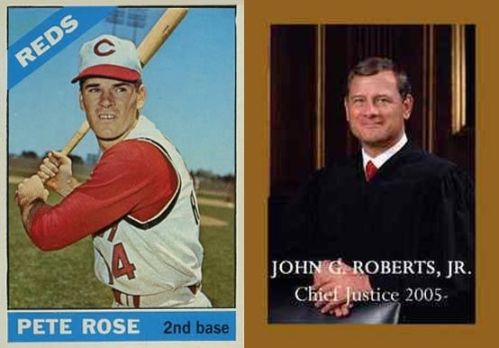
Major League Baseball has so far banned Pete Rose from the Hall of Fame because he bet on games. Not games he or his team were involved in, just games. Ever since the Black Sox scandal almost a century ago, baseball has had a zero tolerance rule on gambling by anyone in the sport.

The courts and the bar associations that regulate the practice of law have well developed and strict rules of conduct for lawyers. Obviously illegal gambling is just that— illegal—and clearly out of bounds. Gambling addictions that affect practice have also taken a prominent place in the rules of professional responsibility.

But it doesn’t appear that reasonable and prudent legal gambling of any kind is an ethical problem for lawyers. Unless, that is, there is some kind of Pete Rose issue about it. Specifically: Can lawyers responsibly and ethically bet on court decisions with which they have absolutely no relationship? The answer awaits investigation, and maybe some law review articles.

As for the case itself, they say that only fools predict difficult Supreme Court decisions. So a fool rushes in:

1. The Court will have the law stand or fall as a whole and not pick and choose. There is no severability clause. The court can appropriately say that with such an integrated and complex piece of legislation, if Congress got it wrong constitutionally, it is up to Congress to get it right.

2. If it falls on the basis of the mandate, as widely expected, the reasoning of the majority is going to be a sight to behold and study. A principle of jurisprudence at every level is to decide legal issues as narrowly as possible, unless there is an intention to make a bold legal statement. When the Supreme Court speaks, the bolder the statement, the more far-reaching the impact. In a three-branch democracy, any statement about the limits of powers is very loud and long-echoing.

3. We may not have nine opinions, but we may have an almost complete set of concurring and dissenting opinions. For those who have never read dissents in Supreme Court opinions, be aware that in difficult and controversial cases, it is not unheard of or inappropriate for dissenting Justices to politely but clearly state that the majority is in all respects wrong (see the four dissents in Bush v. Gore).

And now, the bottom line. Intrade traders have placed their bets, and they say the chances of “The US Supreme Court to rule individual mandate unconstitutional before midnight ET 31 Dec 2012” are 76.5%. Judging by the comments on the site, the bettors are some combination of knowledgeable thinkers and anti-Obama ideologues. Intrade and those analysts willing to go out on a limb are right. The mandate will be found wanting, with strenuous disagreement among the Justices. And on the basis of non-severability, so will the entire Affordable Care Act.

Or, then again, maybe not.

Breathing and Relaxing with the Department of Defense

The U.S. Department of Defense might seem an unlikely place to look for cutting edge technology to relieve stress and promote psychological well-being. That is exactly what you find at The National Center for Telehealth and Technology (T2):

Our mission is to lead the development of telehealth and technology solutions for psychological health and traumatic brain injury to improve the lives of the Nation’s Warriors, Veterans, and their Families. T2 seeks to identify, treat, and minimize or eliminate the short and long-term adverse effects of TBI and mental health conditions associated with military service.

Out of this work, T2 has developed some remarkable mobile apps , aimed at military communities, but available and valuable for anyone. Two of these will be of particular interest to those who believe that simple breathing techniques are a primary key to psychological health.

Tactical Breather and Breate2Relax are simple yet sophisticated tools for an instant, easy-to-follow exercise of breathing for stress reduction and relaxation.

Tactical Breather is the much simpler of the two apps and techniques, involving just a four-count system of inhale, hold, exhale, hold. Along with the onscreen prompts and guiding voice, there is an introduction and tutorial.

Breathe2Relax is more comprehensive in terms of supporting text, videos, and UI, offering a host of options for the interface: beautiful background images (including photos from NASA and NOAA),  relaxing background music (with titles such as Ambient Evenings and Evosolutions), and more. The deep breathing exercise is simply inhale/exhale, and you can change the length of each breath (default is 7 seconds) and the number of cycles for the exercise (default is 16). Coolest of all is a floating body scan animation about the effects of stress, showing a virtual human with highlights about organs and systems that are compromised by stress—with all the flash and special effects you would expect from the Pentagon.

At some points, the apps reflect their military origins and mission. In Breathe2Relax, a Wellness Tip suggests that “Problems with drinking and drugs can be tough to work through on your own. Talk to a chaplain or health care professional.” On the one hand, this gives a non-military user—no matter how beneficial the app is for everyone—the feeling of intruding someplace where civilians don’t belong. But then again, using the apps may be a strangely good reminder of a price we ask our military members to pay. These and the other interesting apps from T2 are twenty-first century ways of making their situations a little better. That others of us get to share in the benefit is a bonus.

Heritagecare

In 1989, Stuart Butler and others at the conservative Heritage Foundation laid the groundwork for Obamacare/Romneycare in the publication A National Health System for America. Chapter 2 by Butler, A Framework for Reform, outlines and explains “the key elements of a consumer-oriented, market-based, comprehensive health system for America.” Element #1 is “Every resident of the U.S. must, by law, be enrolled in an adequate health care plan to cover major health care costs.” (page 51):

The requirement to obtain basic insurance would have to be enforced. The easiest way to monitor compliance might be for households to furnish proof of insurance when they file their tax returns. If a family were to cancel its insurance, the insurer would be required to notify the government. If the family did not enroll in another plan before the first insurance lapsed and did not provide evidence of financial problems, a fine might be imposed.

In other words, a mandate.

Agree or disagree with the Heritage Foundation or this proposal, Butler deserves credit for putting together a cogent, well-written primer on health care history, a report on the shortcomings of the current system, and a set of well-reasoned and creative proposals.

But no good or at least well-intentioned deed goes unpunished. In the time since, and especially in the past year, Butler and others have taken pains to explain how this Heritage Foundation proposal isn’t Obamacare and, in any case, how the proposal has been misunderstood and misapplied. The document itself can still be found on the Heritage Foundation website, though it is not shown and linked as one of Stuart Butler’s documents.

No matter what is argued to the Supreme Court today, no matter what the Justices ultimately decide about the constitutionality of mandates, and no matter how the complicated political dance involving Obama, Romney, Obamacare, and Romneycare turns out, Heritagecare was there first. It is essential reading.