Bob Schwartz

Category: Government

Trump and the Pusher Man: Easy Rider or Mean Girls?

“We must get much tougher on drug dealers and pushers if we are going to succeed in stopping this scourge.”
Donald Trump, State of the Union Address (2018)

In real life, I haven’t heard the term “drug pusher” used seriously in a long time. Which means that Trump is living in the past or is a big fan of either Easy Rider or Mean Girls.

For the record, the term “drug pusher” likely originated as prison slang in the 1930s, and maintained some fading currency for a few decades. Not so much today, at least not in my circles.

Easy Rider (1969)

Hoyt Axton’s song The Pusher, as recorded by Steppenwolf, was featured in the soundtrack of the movie Easy Rider:

You know I’ve smoked a lot of grass
Oh Lord, I’ve popped a lot of pills
But I never touched nothin’
That my spirit could kill
You know, I’ve seen a lot of people walkin’ ’round
With tombstones in their eyes
But the pusher don’t care
Ah, if you live or if you die

You know the dealer, the dealer is a man
With the love grass in his hand
Oh but the pusher is a monster
Good God, he’s not a natural man
The dealer for a nickel
Lord, will sell you lots of sweet dreams
Ah, but the pusher ruin your body
Lord, he’ll leave your, he’ll leave your mind to scream

God damn, the pusher
God damn, I say the pusher
I said God damn, God damn the pusher man

Well, now if I were president of this land
You know, I’d declare total war on the pusher man

Mean Girls (2004)

One of the iconic scenes in the movie Mean Girls has the teacher Ms. Corbury (Tina Fey) explaining herself to her student Cady Heron (Lindsay Lohan):

“I’m a pusher Cady. I push people….And now I’m gonna push you because I know you’re smarter than this.”

Leading to this conversation:

I hate her! I mean, she’s really failing me on purpose, just because I didn’t join that stupid Mathletes! She was so queer, she was like, “I’m pusher Cady, I’m a pusher.”

Hahaha! What does that even mean?

Like a drug pusher?

Probably. She said she works three jobs. You know, I bet she sells drugs on the side to pay for her pathetic divorce.

Yes, like a drug pusher, and yes Cady, for somebody’s pathetic divorce(s). If he were president of this land, you know, he’d declare total war on the pusher man.

Note: It is probably not necessary to say this, but I will. This is not to minimize the serious problem America has with opioids and other tragically destructive drugs. It is just to point out how out of touch and out of time Trump, Sessions and others are about the problem, its causes and its solutions. And since I’m adding this note, I will mention that the song The Pusher (a Trump favorite?) makes a clear distinction between the dealer of marijuana (“love grass in his hand”) and the pusher of deadly drugs (“a monster”).

How Democracies Die

“The electoral road to breakdown is dangerously deceptive. With a classic coup d’état, as in Pinochet’s Chile, the death of a democracy is immediate and evident to all. The presidential palace burns. The president is killed, imprisoned, or shipped off into exile. The constitution is suspended or scrapped. On the electoral road, none of these things happen. There are no tanks in the streets. Constitutions and other nominally democratic institutions remain in place. People still vote. Elected autocrats maintain a veneer of democracy while eviscerating its substance.”
How Democracies Die


From the newly published book How Democracies Die by Steven Levitsky and Daniel Ziblatt, Professors of Government at Harvard University:

But there is another way to break a democracy. It is less dramatic but equally destructive. Democracies may die at the hands not of generals but of elected leaders—presidents or prime ministers who subvert the very process that brought them to power. Some of these leaders dismantle democracy quickly, as Hitler did in the wake of the 1933 Reichstag fire in Germany. More often, though, democracies erode slowly, in barely visible steps….

This is how democracies now die. Blatant dictatorship—in the form of fascism, communism, or military rule—has disappeared across much of the world. Military coups and other violent seizures of power are rare. Most countries hold regular elections. Democracies still die, but by different means. Since the end of the Cold War, most democratic breakdowns have been caused not by generals and soldiers but by elected governments themselves….

The electoral road to breakdown is dangerously deceptive. With a classic coup d’état, as in Pinochet’s Chile, the death of a democracy is immediate and evident to all. The presidential palace burns. The president is killed, imprisoned, or shipped off into exile. The constitution is suspended or scrapped. On the electoral road, none of these things happen. There are no tanks in the streets. Constitutions and other nominally democratic institutions remain in place. People still vote. Elected autocrats maintain a veneer of democracy while eviscerating its substance.

Many government efforts to subvert democracy are “legal,” in the sense that they are approved by the legislature or accepted by the courts. They may even be portrayed as efforts to improve democracy—making the judiciary more efficient, combating corruption, or cleaning up the electoral process. Newspapers still publish but are bought off or bullied into self-censorship. Citizens continue to criticize the government but often find themselves facing tax or other legal troubles. This sows public confusion. People do not immediately realize what is happening….

We know that extremist demagogues emerge from time to time in all societies, even in healthy democracies. The United States has had its share of them, including Henry Ford, Huey Long, Joseph McCarthy, and George Wallace. An essential test for democracies is not whether such figures emerge but whether political leaders, and especially political parties, work to prevent them from gaining power in the first place—by keeping them off mainstream party tickets, refusing to endorse or align with them, and when necessary, making common cause with rivals in support of democratic candidates. Isolating popular extremists requires political courage. But when fear, opportunism, or miscalculation leads established parties to bring extremists into the mainstream, democracy is imperiled.

Once a would-be authoritarian makes it to power, democracies face a second critical test: Will the autocratic leader subvert democratic institutions or be constrained by them? Institutions alone are not enough to rein in elected autocrats. Constitutions must be defended—by political parties and organized citizens, but also by democratic norms. Without robust norms, constitutional checks and balances do not serve as the bulwarks of democracy we imagine them to be. Institutions become political weapons, wielded forcefully by those who control them against those who do not. This is how elected autocrats subvert democracy—packing and “weaponizing” the courts and other neutral agencies, buying off the media and the private sector (or bullying them into silence), and rewriting the rules of politics to tilt the playing field against opponents. The tragic paradox of the electoral route to authoritarianism is that democracy’s assassins use the very institutions of democracy—gradually, subtly, and even legally—to kill it….

How serious is the threat now? Many observers take comfort in our Constitution, which was designed precisely to thwart and contain demagogues like Donald Trump. Our Madisonian system of checks and balances has endured for more than two centuries. It survived the Civil War, the Great Depression, the Cold War, and Watergate. Surely, then, it will be able to survive Trump.

We are less certain. Historically, our system of checks and balances has worked pretty well—but not, or not entirely, because of the constitutional system designed by the founders. Democracies work best—and survive longer—where constitutions are reinforced by unwritten democratic norms. Two basic norms have preserved America’s checks and balances in ways we have come to take for granted: mutual toleration, or the understanding that competing parties accept one another as legitimate rivals, and forbearance, or the idea that politicians should exercise restraint in deploying their institutional prerogatives. These two norms undergirded American democracy for most of the twentieth century. Leaders of the two major parties accepted one another as legitimate and resisted the temptation to use their temporary control of institutions to maximum partisan advantage. Norms of toleration and restraint served as the soft guardrails of American democracy, helping it avoid the kind of partisan fight to the death that has destroyed democracies elsewhere in the world, including Europe in the 1930s and South America in the 1960s and 1970s.

Today, however, the guardrails of American democracy are weakening. The erosion of our democratic norms began in the 1980s and 1990s and accelerated in the 2000s. By the time Barack Obama became president, many Republicans, in particular, questioned the legitimacy of their Democratic rivals and had abandoned forbearance for a strategy of winning by any means necessary. Donald Trump may have accelerated this process, but he didn’t cause it. The challenges facing American democracy run deeper. The weakening of our democratic norms is rooted in extreme partisan polarization—one that extends beyond policy differences into an existential conflict over race and culture. America’s efforts to achieve racial equality as our society grows increasingly diverse have fueled an insidious reaction and intensifying polarization. And if one thing is clear from studying breakdowns throughout history, it’s that extreme polarization can kill democracies.

There are, therefore, reasons for alarm. Not only did Americans elect a demagogue in 2016, but we did so at a time when the norms that once protected our democracy were already coming unmoored. But if other countries’ experiences teach us that that polarization can kill democracies, they also teach us that breakdown is neither inevitable nor irreversible. Drawing lessons from other democracies in crisis, this book suggests strategies that citizens should, and should not, follow to defend our democracy.

Many Americans are justifiably frightened by what is happening to our country. But protecting our democracy requires more than just fright or outrage. We must be humble and bold. We must learn from other countries to see the warning signs—and recognize the false alarms. We must be aware of the fateful missteps that have wrecked other democracies. And we must see how citizens have risen to meet the great democratic crises of the past, overcoming their own deep-seated divisions to avert breakdown. History doesn’t repeat itself. But it rhymes. The promise of history, and the hope of this book, is that we can find the rhymes before it is too late.

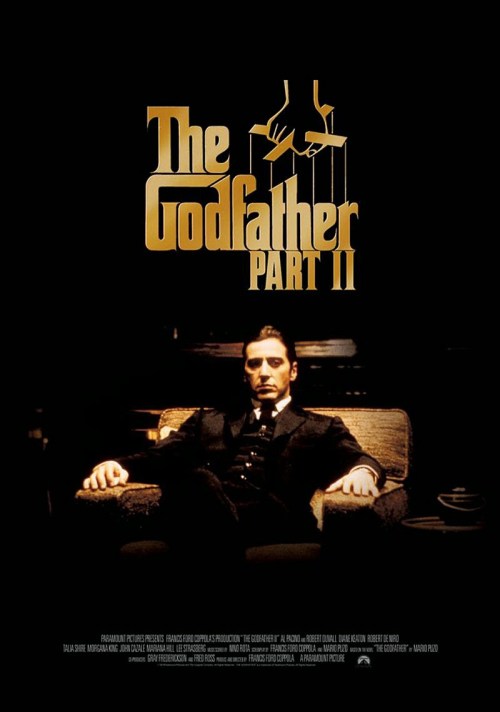
The Godfather Part II Presages the Trump Presidency

“All my people are businessmen; their loyalty is based on that…and on that basis, anything is possible.”

“Free to make our profits without the Justice Department, the FBI…looking for a man who desperately wants to be President of the United States.”

The Godfather Part II

The Godfather Part I and Part II are more than near-perfect movies, two of the most critically-acclaimed films of all time. They are compelling pictures of the unrestrained grab for power and money, fueled by mutual self-interest and governed by no other values.

These two quotes from The Godfather Part II (1974), more than forty years old, encapsulate where America finds itself today:

MICHAEL CORLEONE
“All my people are businessmen; their loyalty is based on that. One thing I learned from my father is to try to think as the people around you think…and on that basis, anything is possible.”

HYMAN ROTH
“If only I could live to see it, kid; to be there with you. How beautifully we’ve done it, step by step. Here, protected, free to make our profits without the Justice Department, the FBI; ninety miles away in partnership with a friendly government. Ninety miles, just a small step, looking for a man who desperately wants to be President of the United States, and having the cash to make it possible.”

Shutdown Shabbat

Whatever the disparate historical origins of the two [creation] accounts, the redaction gives us first a harmonious cosmic overview of creation and then a plunge into the technological nitty-gritty and moral ambiguities of human origins.
Robert Alter, The Five Books of Moses

Much of the federal government has shut down today—it has ceased from its work. And it is Shabbat when, based on the story of creation in the Torah, people are asked to cease from their everyday work because this day is different and set apart.

It is an opportunity to see if that story of creation offers any insights into the government situation. (It is tempting but ungracious to suggest that one particular person who could use those insights—any insights—turn to the Bible for wisdom—any wisdom. But that’s not happening, even on Shutdown Shabbat.)

The creation story in Genesis 2 radically switches focus. When the six days of cosmic creation are over, there is the familiar seventh day break:

And God completed on the seventh day the task He had done, and 3 He ceased on the seventh day from all the task He had done. And God blessed the seventh day and hallowed it, for on it He had ceased from all His task that He had created to do. (Genesis 2:3-4)

But with the big picture, high-concept work done, the detailed tasks begin. God, as they say, is in the details:

On the day the LORD God made earth and heavens, no shrub of the field being yet on the earth and no plant of to cease from their everyday the field yet sprouted, for the LORD God had not caused rain to fall on the earth and there was no human to till the soil, and wetness would well from the earth to water all the surface of the soil, then the The LORD God fashioned the human, humus from the soil, and blew into his nostrils the breath of life, and the human became a living creature. And the LORD God planted a garden in Eden, to the east, and He placed there the human He had fashioned. And the LORD God caused to sprout from the soil every tree lovely to look at and good for food, and the tree of life was in the midst of the garden, and the tree of knowledge, good and evil. Now a river runs out of Eden to water the garden and from there splits off into four streams. The name of the first is Pishon, the one that winds through the whole land of Havilah, where there is gold. And the gold of that land is goodly, bdellium is there, and lapis lazuli. And the name of the second river is Gihon, the one that winds through all the land of Cush. And the name of the third river is Tigris, the one that goes to the east of Ashur. And the fourth river is Euphrates. And the LORD God took the human and set him down in the garden of Eden to till it and watch it. (Genesis 2:5-15)

Robert Alter notes:

As many modern commentators have noted, the first Creation account concludes with the summarizing phrase in the first half of this verse: “This is the tale [literally, these are the begettings] of the heavens and the earth when they were created,” these two paired terms, “heavens” and “earth,” taking us back in an envelope structure to the paired terms of the very first verse of the Creation story. Now, after the grand choreography of resonant parallel utterances of the cosmogony, the style changes sharply….In this more vividly anthropomorphic account, God, now called YHWH ’Elohim instead of ’Elohim as in the first version, does not summon things into being from a lofty distance through the mere agency of divine speech, but works as a craftsman, fashioning (yatsar instead of bara’, “create”), blowing life-breath into nostrils, building a woman from a rib. Whatever the disparate historical origins of the two accounts, the redaction gives us first a harmonious cosmic overview of creation and then a plunge into the technological nitty-gritty and moral ambiguities of human origin. (emphasis added)

This, on Shutdown Shabbat, is a root of the problem. The story suggests that even God, who could reportedly talk his way into any grand scheme, had to stop talking, roll up his sleeves, and do the difficult work, “plunge into the technological nitty-gritty and moral ambiguities.”

Those who have somehow ended up in exalted positions of power are urged to use Shabbat, especially this one, to contemplate morality, their actions, and the effect those actions have on human beings. The powerful might rather be golfing, but there’s plenty of other time to do that. This is Shutdown Shabbat.

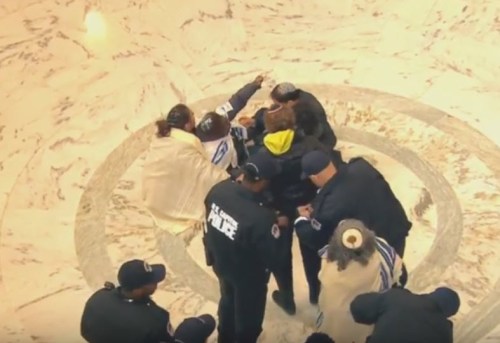
“Dozens of U.S. Jewish Activists Stage Sit-in on Capitol Hill in Protest of Trump’s Threat to Deport Dreamers”

It was starting to appear that many faith communities might not be taking their place in standing up and resisting the daily assault on the deepest American, Judeo-Christian and human values. In fact, it appeared that some of those communities were not only silent but hypocritically complicit.

This morning’s protest at the Capitol is one of the latest rays of light. From Haaretz:

Dozens of U.S. Jewish Activists Stage Sit-in on Capitol Hill in Protest of Trump’s Threat to Deport Dreamers

‘Let my people go,’ chant a group of Dreamers alongside coalition of Jewish groups and members of Congress

WASHINGTON – Dozens of Jewish American activists demonstrated on Capitol Hill Wednesday calling on Congress to pass legislation in protection of “Dreamers,” undocumented immigrants who arrived to the United States as children.

A coalition of Jewish groups organized the demonstration, including the Religious Action Center of the Reform movement, Bend the Arc, the Anti-Defamation League and others.

A group of Dreamers also joined the demonstration, chanting “Let my people stay.” Members of Congress Ted Deutch (D-FL) and Debbie Wasserman Schultz (D-FL), who are both Jewish, also arrived at the scene to express their support as activists were arrested….

After handing a petition signed by over 5,000 people thus far to members of Congress, the protesters sat on the floor of the Russel Senate Office Building and chanted “we will not be moved.”

“As Jews, we recognize the dangers of President Trump’s inhumane policies and scapegoating of immigrants,” the petition states. “We’ve seen this before. We stand with our immigrant neighbors on the side of justice, not oppression, of liberation, not deportation.”

A number of protesters, including Reform rabbis, were arrested by Capitol Hill Police officers.

Barbara Weinstein of the Reform Movement’s Religious Action Center told Haaretz that dozens of the protesters were arrested, but that most of them are being released. “It’s long past time for Congress to pass legislation for the Dreamers,” she stated. “We need this bill immediately. We had a lot of members of Congress, from the House and Senate side, who told us they were determined to solve the crisis. It’s important to Democrats and Republicans alike.”

Weinstein added that “welcoming the stranger is an important part of our identity. We are all descendants of immigrants. It’s on all of us to support these Dreamers. They grew up here, this is the only country they’ve ever known, many of them serve in the military, this is their home. We’re going to remain focused on this issue until we see a bill reach the president’s desk and signed by him. This is not over today.”


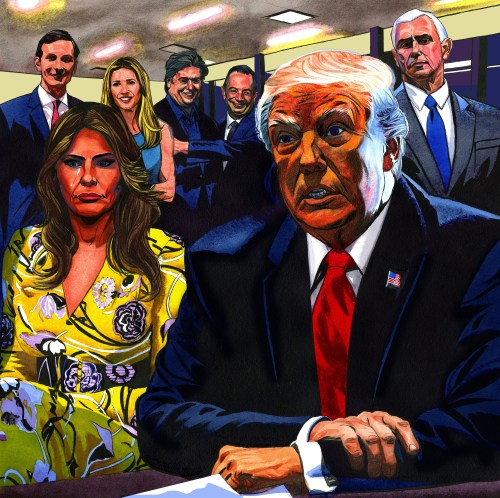
Fire and Fury: Inside the Trump White House

Veteran journalist Michael Wolff’s Fire and Fury: Inside the Trump White House won’t be officially published until next week. Its revelations are already the biggest news story of the day, and will continue to be for a while. (Trump’s response to Steve Bannon’s incendiary quotes in the book is to say that after he fired Bannon, Bannon “lost his mind.”)

If you’d like to read extended excerpts before it is published, see New York Magazine. Plus, the magazine illustrations by Jeffrey Smith  are as extraordinarily dramatic as the content.

Umberto Eco: Ur-Fascism

Celebrated Italian author and scholar Umberto Eco (1932-2016)  published an article in 1995 entitled Ur-Fascism .

Eco grew up during the time of Mussolini. In the article, he jumps from memories of that experience to describe some varieties of fascism and other types of totalitarianism. Not all are well-defined fascism, he says, but he does identify the core characteristics of what he calls Ur-Fascism.

I think it is possible to outline a list of features that are typical of what I would like to call Ur-Fascism, or Eternal Fascism. These features cannot be organized into a system; many of them contradict each other, and are also typical of other kinds of despotism or fanaticism. But it is enough that one of them be present to allow fascism to coagulate around it.

Eco goes on to list 14 features of Ur-Fascism. This is the excerpted list; please read the article for an expanded explanation. And as you read it, please consider which of those features you might be seeing now.

1. The first feature of Ur-Fascism is the cult of tradition….As a consequence, there can be no advancement of learning.

2. Traditionalism implies the rejection of modernism….In this sense Ur-Fascism can be defined as irrationalism.

3. Irrationalism also depends on the cult of action for action’s sake. Action being beautiful in itself, it must be taken before, or without, any previous reflection.

4. No syncretistic faith can withstand analytical criticism. The critical spirit makes distinctions, and to distinguish is a sign of modernism.

5. Besides, disagreement is a sign of diversity. Ur-Fascism grows up and seeks for consensus by exploiting and exacerbating the natural fear of difference.

6. Ur-Fascism derives from individual or social frustration. That is why one of the most typical features of the historical fascism was the appeal to a frustrated middle class, a class suffering from an economic crisis or feelings of political humiliation, and frightened by the pressure of lower social groups.

7. To people who feel deprived of a clear social identity, Ur-Fascism says that their only privilege is the most common one, to be born in the same country. This is the origin of nationalism.

8. The followers must feel humiliated by the ostentatious wealth and force of their enemies….Thus, by a continuous shifting of rhetorical focus, the enemies are at the same time too strong and too weak.

9. For Ur-Fascism there is no struggle for life but, rather, life is lived for struggle.

10. Elitism is a typical aspect of any reactionary ideology, insofar as it is fundamentally aristocratic, and aristocratic and militaristic elitism cruelly implies contempt for the weak. Ur-Fascism can only advocate a popular elitism.

11. In such a perspective everybody is educated to become a hero. In every mythology the hero is an exceptional being, but in Ur-Fascist ideology, heroism is the norm.

12. Since both permanent war and heroism are difficult games to play, the Ur-Fascist transfers his will to power to sexual matters. This is the origin of machismo (which implies both disdain for women and intolerance and condemnation of nonstandard sexual habits, from chastity to homosexuality). Since even sex is a difficult game to play, the Ur-Fascist hero tends to play with weapons—doing so becomes an ersatz phallic exercise.

13. Ur-Fascism is based upon a selective populism, a qualitative populism, one might say. In a democracy, the citizens have individual rights, but the citizens in their entirety have a political impact only from a quantitative point of view—one follows the decisions of the majority. For Ur-Fascism, however, individuals as individuals have no rights, and the People is conceived as a quality, a monolithic entity expressing the Common Will. Since no large quantity of human beings can have a common will, the Leader pretends to be their interpreter….Because of its qualitative populism Ur-Fascism must be against “rotten” parliamentary governments.

14. Ur-Fascism speaks Newspeak.

Eco closes with this:

Ur-Fascism is still around us, sometimes in plainclothes. It would be so much easier, for us, if there appeared on the world scene somebody saying, “I want to reopen Auschwitz, I want the Black Shirts to parade again in the Italian squares.” Life is not that simple. Ur-Fascism can come back under the most innocent of disguises. Our duty is to uncover it and to point our finger at any of its new instances—every day, in every part of the world.

American Nazi Rally, Madison Square Garden

This post was drafted a month ago, but I decided that maybe I had been mentioning Nazi Germany too frequently. If you’ve read some of those earlier posts (here and here, for example), you see that I have never made an explicit connection between the current situation and that one.

Now President Obama has been bold enough to speak of this expressly:

“We have to tend to this garden of democracy or else things could fall apart quickly.…That’s what happened in Germany in the 1930s, which despite the democracy of the Weimar Republic and centuries of high-level cultural and scientific achievements, Adolph Hitler rose to dominate. Sixty million people died. . . .So, you’ve got to pay attention. And vote.”

Naturally, the reaction has been swift from Trump apologists—who already hate Obama—claiming that it is heinous to compare Trump to Hitler, and no such death of democracy is in the offing. On the contrary, they say, we are finally on our way to reviving our past glory.

The message in a democracy is inarguable: know your history, pay attention, and vote. Part of not knowing and not paying attention is the delusion that “it can’t happen here.”

Above is a picture of the American Nazi Rally at Madison Square Garden on February 20, 1939. It was a full house of 22,000 “patriots”, with a giant god-like image of George Washington on stage, thought of as the father of their White Christian America.

Those who tried to disrupt the Madison Square Garden rally were arrested. Which is worse: being silent knowing that something is horribly wrong, or not being believed—actually being arrested—when you speak up?


Age of Folly: America Abandons Its Democracy

A frivolous society can acquire dramatic significance only through what its frivolity destroys.
—Edith Wharton

I am tempted to include the entire Preface to Lewis Lapham’s Age of Folly in this post. Instead, I include excerpts and then encourage you to buy the ebook for just $2.99. As with all lucid insights into the current situation, it will not make you happier, but it will provide enlightening perspective.

The book is a collection of Latham’s essays, “essays arranged in order of their composition and stepping off on a march of folly with America’s 1991 invasion of Iraq—a reality TV show armed with self-glorifying high explosives and a nonsensical casus belli—and ending with Donald Trump’s 2016 presidential campaign, a self-glorifying photo-op bursting star-spangled bombast in air.”


Preface

A frivolous society can acquire dramatic significance only through what its frivolity destroys.
—Edith Wharton

It’s been six months since Donald Trump moved into the White House with his Twitter account, but I’m still talking to people unable or unwilling to believe he is president of the United States. Eager to bring late-breaking reports of Trump’s uncivil and unconstitutional behavior, they come bearing gifts of high-minded outrage and condescending mockery soon followed by variations on the question, How can such things be?

The short answer is Edith Wharton’s. A longer answer is the one spread across the pages of this book, essays arranged in order of their composition and stepping off on a march of folly with America’s 1991 invasion of Iraq—a reality TV show armed with self-glorifying high explosives and a nonsensical casus belli—and ending with Donald Trump’s 2016 presidential campaign, a self-glorifying photo-op bursting star-spangled bombast in air. Over the course of the twenty-five years from point A to point B, a weakened but still operational democracy gives way to a stupefied and dysfunctional plutocracy.

To regard Trump as an amazement beyond belief is to give him credit where none is due. He is undoubtedly a menace, but he isn’t a surprise. Product and mirror of an age distinguished by its extravagant displays of vanity and greed, Trump’s positioning of government as trivial pursuit is the way things are and have been in Washington and Wall Street for the last quarter of a century….

The camera doesn’t do democracy. Democracy is the holding of one’s fellow citizens in respectful regard not because they are beautiful or rich or famous, but because they are one’s fellow citizens and therefore worth the knowing what they say and do. The work is difficult and slow; too many words with too little action doesn’t move the merchandise. The cameras on the road with the biggest name on earth weren’t covering a play of ideas; they were attracted to the splendor and flash of money, to the romance of crime and the sweet decaying smell of overripe celebrity.

Because the camera sees but doesn’t think, it makes no meaningful distinction between a bubble bath in Las Vegas staffed by pretty girls and a bloodbath in Palmyra staffed by headless corpses. The return on both investments is the bankable flow of wish and dream drawn from the bottomless wells of human ignorance and fear, from the always rushing river of mankind’s limitless desire. It didn’t matter what Trump said or didn’t say, whether he was cute and pink or headless.

Trump pitched his campaign on the storyline the movie-going American electorate loves beyond all others—the one about the knight errant up against the system and the odds, the lonesome-pine hero in the trail-weary saddle riding into town to gun down the degenerate sheriff and rescue the God-fearing settlers, to set the crooked straight, restore civic virtue, distribute a fair share of the loot to the schoolteacher, the shepherd, and the store-keep.

It didn’t matter that Trump was a prosperous fool. He sold newspapers, boosted television ratings. He was maybe short on sense and sensibility, but he was long on market share. The infotainment media in all of its factions and instrumentations (CNN and the New York Times as well as Fox News and Rush Limbaugh’s dittoheads) recognized Trump as a preposterous clown and transparent fraud but nevertheless framed him in the gilt-edged cliché of the underdog outlaw—up there in lights with robber barons Rockefeller and Vanderbilt, gunslingers Eastwood and Stallone, Mafia dons Corleone and Soprano. The unifying and all-purpose product placement won the election for Trump, rewarded the media with a Rumpelstiltskin spinning straw into gold. Already in the first months of the primary season the numbers moving up in the opinion poll leaderboards encouraged Leslie Moonves, chief executive officer of CBS, to assure the network’s bankers at JPMorgan Chase that “Trump’s candidacy may not be good for America, but it’s damn good for CBS.”…

In office as president of the United States, Trump presents himself as signature endorsement of concentrated wealth, a camera-ready product placement promoting money as the hero with a thousand faces, all of them the face of Trump. Trump at the top of every hour on the networks and cable channels, on page one in every morning’s newspaper. Trump overruling the rule of law, under investigation for obstructing justice, withdrawing from the Paris climate accords, firing FBI director James Comey, ordering fifty-seven cruise missiles into Syria, dropping the Mother Of All Bombs on Afghanistan, signing executive orders lifting regulation of the oil, gas, coal, and banking industries. Trump embodying the Time magazine sales promotion of America, dominant power in the world, more dominant than any since Rome, reshaping norms and creating new realities, saying and doing whatever it takes to discredit government by the people, of the people, and for the people—to nullify it in theory and dispose of it in practice.

The self-glorifying opposition to Trump is as foolish as the man itself. The “Resistance” composed of outraged sensibilities unable or unwilling to believe that Trump is president of the United States—Hillary Clinton voters, Democratic Party nomenclatura and crowd-sourced Pussy Hats, NeverTrump reactionaries, Bernie or Bust revolutionaries, sit-down protesters and stand-up comics—devotes its efforts to the project of Trump’s impeachment. Impeachment will be sought on whatever grounds (yet to be discovered or manufactured) can be cultivated to yield political scandal and tabloid entertainment.

Meanwhile in the White House gilded cage the unscripted and overweight canary sings his ferocious songs of sixpence, and on all sides of every story the voices of objection and dissent rise to near hysteria. Trump accuses former President Barack Obama of tapping his telephones, denounces the news media as “the enemy of the people”; the news media liken Trump to the Devil, accuse him of treason, hear in his frivolous noise the sound of Nazi boots marching into Poland.

The consequence is the destruction of a credible political discourse without which democracy cannot exist. James Fenimore Cooper, author of The Last of the Mohicans, made the point in his 1838 political essay, The American Democrat. The vitality of America’s democracy, said Cooper, is the capacity of its citizens to tell the truth, speak and think without cant….

Age of Folly fills in at least some of the backstory behind President Donald Trump’s appearance as Time magazine’s 2016 “Man of the Year.” The essays in Part I proceed in the order of their composition as monthly columns in Harper’s Magazine; the essays in Part II, all but one written to introduce issues of Lapham’s Quarterly, construe history as means rather than end, a hedge against the despairing of the present and a weapon to defend the hope of the future against the inertia of the past. History doesn’t save the day or provide a PowerPoint presentation of a new and better world. It is the fund of energy and mind that makes possible the revolt against what G. K. Chesterton once called “the small and arrogant oligarchy of those who only happen to be walking about.” We have less reason to fear what might happen tomorrow than to beware what happened yesterday.

July 4, 2017

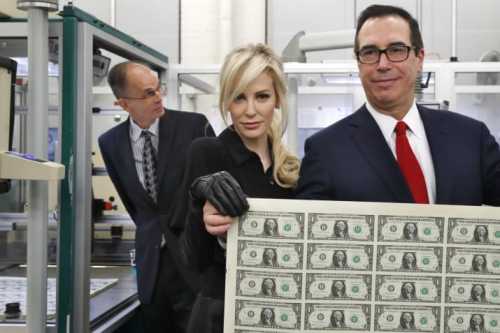
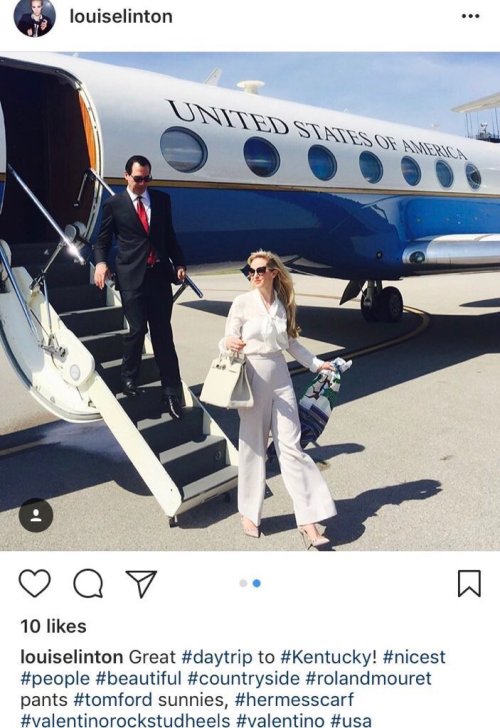
We Welcome You to Munchkin Land (aka The Treasury)

Above, Treasury Secretary Steve Munchkin and his wife proudly inspecting the first newly printed money carrying his signature.

From this past summer, here is the same deliriously happy couple returning from Fort Knox, with fashion annotations by Mrs. Munchkin.

Tra la la la la la la la la.