Bob Schwartz

Category: Government

All Politicians Are Progressives

Horse Carriage - Lincoln
Either you embrace innovation or you don’t. And so all politicians who use an iPhone or love the NFL are progressives.

Innovation has two faces. One is the innovation that solves problems. The other is innovation that just does stuff—even if you didn’t ask for it, even if you never knew you wanted it or needed it. Moving from horse transport to self-contained mechanical carriages solved a basic problem, but over time added features some of which are useful and practical for the central function, others of which are just enjoyment that becomes essential. Because times change, as do human expectations and aspirations. Innovation feeds that.

So unless you are a politician who doesn’t have a smartphone, or who doesn’t use a phone or computer at all, or doesn’t drive a tricked-out luxury car (it counts even if you have a driver), you are the beneficiary and tacit endorser of innovation. Which is why when some politicians hearken back to the comprehensive goodness of 18th century America—or 19th or 20th, depending on the issue—it is dangerously silly. This economic Drecession requires an embrace of 360 degree innovation, not just untaxing and unburdening ourselves to prosperity. Not just churning out a generation of STEMers to magically bring us back to former glory. And not just putting digital devices in the hands of every school child either.

This is not the exclusive purview of any political party. There is a tendency, even among the most well-meaning, to take pages from a beloved playbook that are no longer viable. When the legendary coach Sid Gillman changed pro football forever in the 1950s by making the forward pass the centerpiece of the game, it was scoffed at—until he started winning championships and opponents had to permanently rethink the defensive game.

If politicians want to ride around in fancy horse-drawn carriages and send their messages by horse-carried post (if they haven’t made the Post Office disappear), that’s okay. But chances are they’ve embraced innovation in practically every minute of their lives (they love their Twitter!) because, well, it is 2013. It is 2013, everywhere, in every facet, and pretending otherwise is just horse-and-buggy policy. Or maybe just a convenient way to get elected.

Republicans Miss Another Opportunity to Be a Popular National Party

Goat
The shortcomings of the ACA website during its high-profile first weeks could have been a gift to the struggling Republicans. A softball to hit out of the park. While Democrats are understandably busy trying to make the best, to explain how complex systems are frequently troubled when they go live (true), to be, in essence, apologists, the Republicans could have been that thing that Americans of all stripes ache for: problem solvers.

Instead they heard the fire bell/dog whistle (or is it an elephant call?) and marched fiercely into battle mode. The current House hearings on the website seem more like a trial: at one point, one Republican member asked all the testifying contractors whether they had discussed their testimony with anyone from the government team beforehand. (Answer: no.)

What a missed opportunity. If the Republicans as a single voice had said that this is, from their perspective, still an awful program, but that we are all Americans, and if we are going to do something, we don’t do it half-assed, and let us today find a way to solve the problem. In earnest. That would have made any defensive positions by the Democrats more glaringly apologist, and would have made the Republicans not just heroes but responsible, reasonable heroes who don’t deserve to be despised by large parts of America, including some people in their own party.

But to some, this would have made these problem-solving heroes EINO—Elephants in Name Only—that is, goats. Watching this kangaroo court, some others might think that goats might be an improvement.

This Modern World by Tom Tomorrow

This Modern World
Tom Tomorrow (Dan Perkins) is just about the best editorial cartoonist in America. He won this year’s Herblock Prize, named for the dean of modern editorial cartoonists.

Here is the current edition of This Modern World

TMW Current

If you would like to be delighted by a collection of all from this past year or so, visit The Nation.

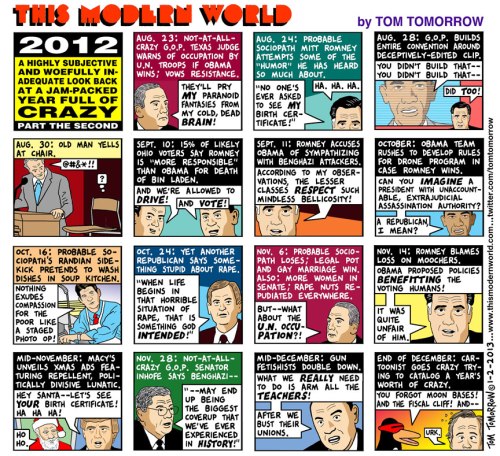
It’s hard to pick out just one more to show off. This is Tom Tomorrow’s review of 2012
TMW 2012 1TMW 2012 2

The Man Who Could Kill Democracy

McCutcheon v FEC

Today the Supreme Court hears arguments in the case of McCutcheon and Republican National Committee v. Federal Election Commission, an attack on the constitutionality of limits on individual contributions to federal elections. Just as the Court found in Citizens United that corporations have a First Amendment right to unlimited campaign contributions, so Alabama businessman Shaun McCutcheon would have that extended to people (since, as Mitt Romney pointed out, corporations are people too, ergo, people are corporations—at least for election money).

Mr. McCutcheon seems to be a decent and hardworking person, a loyal American, and he is of course entitled not only to his opinion but to his pursuit of it in the courts. But Mr. McCutcheon could conceivably be known as the man who killed American democracy, or at least the one nominally identified with its murder. Yes, he would have the heirs to Abraham Lincoln as his accomplices or co-conspirators, but his fingerprints would be on the weapon.

Is that hyperbole? Before Citizens United, it might have seemed so. But beyond theory, we now have proof that Big Money has a distorting effect on Big Democracy. A contortionate, twisted beyond recognition effect. There is reason to believe that if individual limits are lifted, the effect might go beyond injury to mortal blow.

You can read the submitted briefs here. After the arguments, you can listen to them here.

The questions presented on appeal are these:

Federal law imposes two types of limits on individual political contributions. Base limits restrict the amount an individual may contribute to a candidate committee ($2,500 per election), a national-party committee ($30,800 per calendar year), a state, local, and district party committee ($10,000 per calendar year (combined limit)), and a political-action committee (“PAC”) ($5,000 per calendar year). 2 U.S.C. 441a(a)(1) (current limits provided). Biennial limits restrict the aggregate amount an individual may contribute biennially as follows: $46,200 to candidate committees; $70,800 to all other committees, of which no more than $46,200 may go to non-national-party committees (e.g., state parties and PACs). 2 U.S.C. 441a(a)(3) (current limits provided) (see Appendix at 20a (text of statute)). Appellants present five questions:

1. Whether the biennial limit on contributions to non-candidate committees, 2 U.S.C. 441a(a)(3)(B), is unconstitutional for lacking a constitutionally cognizable interest as applied to contributions to national-party committees.

2. Whether the biennial limits on contributions to non-candidate committees, 2 U.S.C. 441a(a)(3)(B), are unconstitutional facially for lacking a constitutionally cognizable interest.

3. Whether the biennial limits on contributions to non-candidate committees are unconstitutionally too low, as applied and facially.

4. Whether the biennial limit on contributions to candidate committees, 2 U.S. C. 441a(a)(3)(A), is unconstitutional for lacking a constitutionally cognizable interest.

5. Whether the biennial limit on contributions to candidate committees, 2 U.S.C. 441a(a)(3)(A), is unconstitutionally too low.

Without going into the arguments so well-developed in the written briefs, and in the oral arguments today, one point should be stressed. The First Amendment is central to American democracy, but it has never been absolute. It could be of course, and we would be free to destroy the reputations of others, or talk freely about overthrowing the government, or republish the words of others without penalty, or yell fire in that crowded theater. Instead, as an exercise in social priorities, we argue about balance, though sometimes the argument for the good of the many and “democracy” is cover for what’s good for me and mine.

If the Court agrees that both the base limits (the per election money) and the aggregate limits (cumulative over two years) are unconstitutional on their face, anyone with money can attempt to influence public opinion and the action of public officials to the full extent that money can. And it can. Some say that this would simply level the playing field—the same way that everybody having guns would level the playing field, insuring that only the bad guys would get shot. Funny how the First and Second Amendments can work so well together.

In the worst case, where we may be speaking about McCutcheon as we do about Citizens United, only more so, there is still an answer. Simple but not easy:

Get smart.
Vote.

Without casting aspersions too wide, it does seem that a number of Americans really don’t do their homework on public issues. As far as voting, our abysmal turnout numbers tell the tale. But if Americans did do their homework and did vote, we really could have a pragmatic, centrist, reasonable and successful country—instead of an extremist-obstructed one based more on blustery ideology and vaguely-veiled self-interest. We can hope.

How Much Is That in Harvard Years?: Why Ted Cruz Thinks He Is Leader of the Senate

Ted Cruz - Double Harvard
One of the puzzles of the current political situation is how a U.S. Senator with less than a year in Congress believes he is the leader of his party—if not of the nation.

One theory is that Ted Cruz was born in Canada, and therefore doesn’t completely understand the American political system. But that would make him more reasonable, conciliatory and polite, so that has been rejected.

Another possibility is that the sudden disappearance of Senate Republican leader Mitch McConnell has left a vacuum that the party is scrambling to fill. In the chaos of the relentless search for the Kentucky Senator, Sen. Cruz has leapt into the breach.

The best explanation is a bit esoteric, but if you attended one of the “major” Ivy League colleges, as Ted Cruz did, you should have no trouble following. (Note: This writer, as a graduate of what Ted Cruz considers a “lesser” Ivy, is still struggling with the theory. Hopefully there is a Harvard, Princeton or Yale grad out there to help.)

Just as there are “dog years,” there are also, at least in the mind of Ted Cruz, “Harvard Years.” The exact numbers aren’t clear, but on a one-for-one basis, this means that the seven years he spent at Harvard (College and Law School) is the equivalent of seven years in Congress. If it is two-for-one, he has been there for fourteen years. And if it is a canine calculus, Ted Cruz has been in Congress for 49 years! That is a near record achievement that should put complaints of his inexperience to rest, though other concerns won’t go away so easily.

Note: The Ivy League colleges are famous (at least among their attendees) for their mottos. These are in Latin, because at the time the schools were founded, Latin was the lingua franca of the intelligentsia. (And yes, of course, Ted Cruz probably speaks Latin, along with French and Spanish.)  For all his Haravardian pride, he should pay closer attention to the motto of his alma mater: Veritas (truth).

Even closer to home for Ted Cruz, if he would deign to consider the motto of one of those lesser Ivies, is this: Leges Sine Moribus Vanae—laws without morals are in vain.

History’s Goat

John Boehner
If, as expected, the government shutdown is protracted, bleeding into the debt ceiling crisis, the cool eyes of history will judge Speaker of the House John Boehner to be the goat. Not the President, not extremist Republicans in the House, not Ted Cruz or anyone in the Senate. Almost everyone on both sides of the aisle either knows it is John Boehner’s fault or believes in any case that he will be blamed and take the fall.

It is his responsibility because he could have brought a “clean” Continuing Resolution to a vote in the House—and he still can. All indications are that enough Republicans would vote for it—and still would. This would not solve any other crises or disagreements, but all those could then proceed under the simple everyday circumstance of the government running. That would be a good thing by almost all lights.

The reasons John Boehner doesn’t do this are many and complex. He is appropriately loyal to what was, and will hopefully be again, a great political party. The demands on his Speakership are as difficult as any in modern history; it is possibly a job that no one could do perfectly or even well. The extremist Republicans in the House have not so much discovered political extortion—an ancient practice—as fallen in love with it, become obsessed with it. They have aimed their threats at the nation, the President, and reasonable members of their own party in primary after primary.

The extremist threat against John Boehner is not that he will lose his secure Ohio House seat—he won’t—or even that he will lose his Speaker post—he probably will, if they can find anybody else courageous or stupid enough to try to “lead” these House Republicans. The threat hanging over John Boehner, a man who loves his country and his Congress, is that he will be humiliated by failing miserably, rather than just not succeeding.

John Boehner is making a classic mistake, one that competitors in all fields, including sports, business and politics, should know. To win, you have to play aggressively and by the rules, but you have to play to win according to your best inner guidance. Because when you play not to lose, you already have.

Right now, John Boehner knows he isn’t winning, but he could, if he would just end this shutdown. Instead, he has retreated to a haven of rhetoric and finger-pointing that he knows is not right. That’s why every evaluation of his performance, even by some friends and moderate Republicans, begins with “He is a nice guy, a good man, but…”

Right now, whatever the consequences, he could do the right thing, pay whatever price there is to pay, and be a hero. But right now, and in the historian’s rear view mirror, that isn’t how it looks.

Patents: Just One More Shutdown Victim

Election Game

You have heard stories, but you may not be directly affected by the shutdown at the moment, or know anyone who is. The shutdown may end tomorrow, but it may go on for weeks, as the last one did in 1996.

You understand the human misery that begins today. But maybe you don’t realize the legitimate, non-controversial things that the federal government does—things that are actually required by the U.S. Constitution, which even the most radical and extreme government haters say they respect.

The United States Patent and Trademark Office is one of those functions. It is an engine of innovation, which is one of those buzzwords that everyone across the political specturms like to throw around. How busy and important is the USPTO? Right now, there is a backlog of 1,000,000 patent applications in the pipeline

The USPTO site features this:

USPTO Operation Status

During the general government shutdown that began October 1, 2013, the United States Patent and Trademark Office will remain open, using prior year reserve fee collections to operate as usual for approximately four weeks. We continue to assess our fee collections compared to our operating requirements to determine how long we will be able to operate in this capacity during a general government shutdown. We will provide an update as more definitive information becomes available.

Should we exhaust these reserve funds before the general government shutdown comes to an end, USPTO would shut down at that time, although a very small staff would continue to work to accept new applications and maintain IT infrastructure, among other functions. (Should it become necessary for USPTO to shut down, details of the agency’s plan for an orderly shutdown are available on page 78 of the United States Department of Commerce’s shutdown plan, available here.)

Any new or updated public information related to USPTO operations during the government shutdown will be placed on this page.

The mentioned shutdown plan includes 87 pages and obviously took many hours to create and will take many more to execute.

While there, a search of the patent database found numerous political games (above). Unfortunately, there did not seem to be any patents for helping political extremists understand that government is not a game, and that the extraordinary founders of the nation who they claim to love never meant it to be one. Those founders believed in government, and could never imagine any representatives irresponsible enough to believe otherwise.

The Most Significant Shutdown Front Pages

El Diario

Republicans should pay close attention to the front pages of America’s newspapers this morning, the first day of the government shutdown prompted by their obsessive opposition to Obamacare.

Most papers carry some version of “shutdown” or “gridlock,” with photos of John Boehner and Harry Reid, or John Boehner and Barack Obama (it’s all about John Boehner).

But the big story on two front pages is the opening of the Affordable Care Act insurance exchanges. These two papers just happen to be two of the largest Spanish-language dailies—El Diario in New York (above) and La Opinion in Los Angeles (below).

La Opinion

Why is this significant for Republicans? Because they claim (but in their heart of hearts still may not believe) that here in the second decade of the 21st century, they can’t become an American national party without broad Latino support. That is true, but the fact is that a large part of that constituency is uninsured and is deeply interested in the benefits of Obamacare. This is reflected in those front pages. But the Republicans are sworn enemies of Obamacare, so committed that they are willing to put people out of work to do it. How can the Republicans be a party attractive to Latinos under that circumstance?

The answer is that they can’t. It is a circle Republicans cannot square. And no matter how much lip service they pay to underserved populations, everything they do says something else. Actions, like front pages, speak louder than words.

The Government Shutdown and Masturbating Fetuses

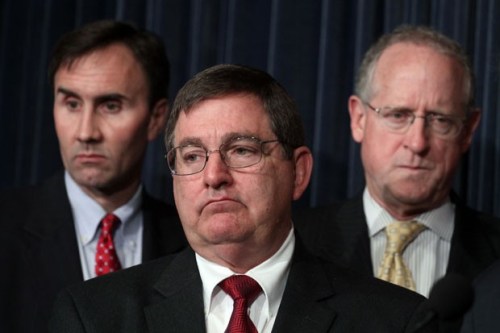
Rep. Michael Burgess
In the contentious Saturday night House debate on the Continuing Resolution to fund the federal government—a resolution that guts Obamacare and will almost certainly lead to a partial government shutdown—Republican Rep. Michael Burgess of Texas revealed a little known fact about the Affordable Care Act: it was “never intended to be law,” even though it obviously is. How so?

And here’s the real crux, Mr. Speaker. Here’s what’s really wrong and why Washington is in such a lather right now: The Affordable Care Act was never intended to become law. It was a vehicle to get the Senators home on Christmas Eve before the snowstorm. It was never intended to be law. The law that was passed by the Senate was a rough draft. It’s equivalent to saying the dog ate my homework so I turned in the rough draft; and, unfortunately, the rough draft got signed into law the following March, and that’s why there’s so much difficulty with this.
Congressional Record, September 28, 2013

Who is Rep. Burgess and why is he saying these things? He is a medical doctor, an ob/gyn, and has become one of the Republican Congressional experts on health care. Research shows that he has some other interesting views. This from U.S. News on June 18 of this year:

Rep. Michael Burgess, R-Texas, said Monday he is opposed to abortion because fetuses masturbate in the womb, and so can feel both pleasure and pain.

“Watch a sonogram of a 15-week baby, and they have movements that are purposeful,” said Burgess, citing his experience as an OB/GYN, during a House Rules Committee hearing on a GOP bill that would ban abortions after 20 weeks. “They stroke their face. If they’re a male baby, they may have their hand between their legs. If they feel pleasure, why is it so hard to think that they could feel pain?”

His comments were first reported by women’s health site RH Reality Check.

But Burgess’s argument isn’t based in science, doctors say. “We certainly can see a movement of a fetus during that time, but in terms of any knowledge about pleasure or pain – there are no data to assess,” says Jeanne Conry, president of the American College of Obstetricians and Gynecologists, a professional association for OB/GYNs. “We don’t know enough about the biology and the science.”

One more medical opinion from Rep./Dr. Burgess on the country’s sickness: President Obama must be impeached. Burgess said to a Tea Party questioner in 2011: “It needs to happen, and I agree with you it would tie things up. No question about that.”

Barbara Jordan v. Ted Cruz

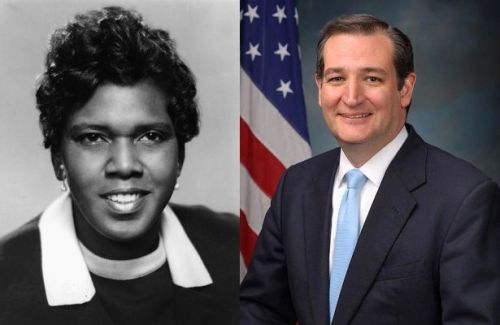
Barbara Jordan - Ted Cruz
Regular readers of this blog know about the late Representative Barbara Jordan, one of the great speakers in modern American history, and one of the most distinguished members of Congress in her generation. We have seen few like her in recent years—because there have been few like her at all.

She shares one thing and one thing only with Ted Cruz: both represented Texas citizens in Congress. Besides that, they might as well be from different planets—politically, morally, intellectually, rhetorically, in just about any category you can name.

Barbara Jordan was born and raised in a black district of Houston. To say that she transcended any challenges she faced is saying nothing: her talents and compassion took her to the height of American political respect and significance. Ted Cruz was born in Canada, an apparent embarrassment for him, given that he has renounced his Canadian citizenship. He was raised somewhere, though there is no way to tell that he is “from” Texas other than the designation on his office. He has probably visited Houston, though it doesn’t seem his kind of place.

While at Harvard Law School, Ted Cruz reportedly refused to study with students who did not have undergraduate degrees from Harvard, Princeton or Yale. Even the “minor” Ivy League schools like Penn or Columbia weren’t good enough. Barbara Jordan attended Texas Southern University and then Boston University Law School. Well below minor status. However, she was a national champion debater at Texas Southern, where she beat Yale and Brown, and tied Harvard. And, presumably, would beat Ted Cruz in debate too.

Barbara Jordan was a model of intelligent political pragmatism, toughness tempered by compassion. She believed that character was paramount. Her rhetoric, rated in the range of FDR, JFK and MLK, could be uplifting or withering. She never spoke for twenty-one hours straight because she never had to. But if she had, it might be mesmerizing, start to finish. Ted Cruz is the model of something.

A Senate filled with one hundred Barbara Jordans would not be to everyone’s ideological taste, but no one would worry that they were being hoodwinked or being used as part of someone’s ambitious scheme, or that the country was in existential peril. The nation would be better for it. A Senate filled with one hundred Ted Cruzes is something else—perhaps a sign that beyond just shutting down the government, we should just close the doors on the American enterprise entirely.

We miss you Barbara. And we need you.