Bob Schwartz

Category: Elections

Impeaching Donald Trump As Nominee

The majority of the Republican Party has finally decided to take on the very loud, engaged and energetic Trump minority. To do it, they’ve devised the strategic approach of all those who are behind the curve and in the hole: they are gambling. Here is the strategy you may not hear about from many of the talking heads.

The Republicans aren’t sure they can stop Trump from getting the numbers he needs to secure the nomination by the time of the convention. They hope so. But whether he does have the numbers or whether it is instead a brokered convention doesn’t matter.

The point of the current movement is only partly to deny Trump the numbers. It is partly—mostly—to build a case to deny him the nomination, whether he has the numbers or not. Just walking into the convention and offering opinions about how bad Trump is and how bad he is for the party and the country won’t do.

Instead, they are going to essentially put him on trial. They are going to impeach him as a nominee. At that point, they will have evidence from Republican leaders of all kinds, from experts of all kinds, from friendly foreign leaders of all kinds, etc. Mostly, they will have Trump’s own words and behaviors. When it is all over, when all the evidence is in, a majority of the party will agree to convict and to disqualify him from any possibility of nomination.

A minority of the party will protest. The result will be that Trump, after threatening to sue (which is what he does), will walk, take his supporters with him, and run as an independent candidate.

This is where the gamble comes in.

The Republicans have to be confident that they have somebody to run who can beat Trump and the Democratic nominee (likely to be Hillary Clinton) in a three-way race. If they lose that gamble, both alternative outcomes are disastrous for them.

If you think things are strange so far, just wait until you see the impeachment trial of Donald Trump at the Republican National Convention.

The Revival of Enlightened and Transformative Politics

Talking about the revival of enlightened and transformative politics is bound to be imprecise.

That concept has never actually been dead. Looking at Christianity, a recent post about Jim Wallis and Sojourners highlights just one instance. A bigger and much more famous current example is Pope Francis. And it is nothing new. The Social Gospel movement, which is still represented (though not always appreciated), aimed to see the realization of the highest Christian principles in everyday practical society.

Keeping with the Christian theme, this is not about what Jesus would say about abortion or gay marriage or prayer in schools or any of these specific arguments—though all have a certain significance. It is about politics as a tool of overall transformation, beyond sectarian concerns.

This is not limited to Christianity. Every one of the traditions has a core of enlightenment and large scale transformation. But each of those traditions has found a way to occasionally devolve that mission into movements and policies and tactics that diverge and even contradict the higher principles and aspirations. It isn’t necessary to point out the wrong turns that, for example, Judaism and Islam have taken along the way to supposedly establish heaven on earth.

In the era of what was affectionately, or for some derisively, known as the New Age movement, this concept of politics as a transformative tool was central. There was the idea that if we kept our eyes on the prize—not just a country but a world elevated above our baser selves—we could together create something better. Politics was one of the tools that would serve that end, instead of enabling smaller personal ambitions and selfish, possibly pernicious, goals.

So here we are. Enlightened and transformative politics is not dead. But it may be missing in action. Each political choice we make—each donation, each tweet, each vote and, yes, each post—might help us find it. Or kill it. It’s up to us.

You Can Stop Worrying About Trump Being the Republican Nominee. But You Can’t Stop Worrying.

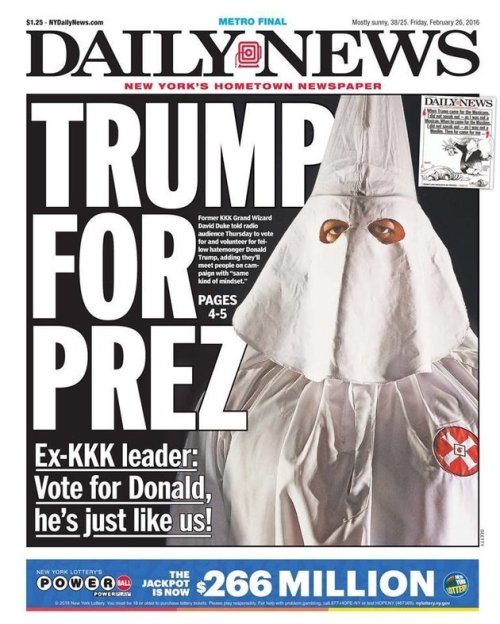
New York Daily News - Trump for Prez

If you were worrying about Donald Trump being the official nominee of the Republican Party, you can stop worrying about that, no matter what the results of Super Tuesday voting.

I have predicted for months that the GOP would never allow him to be its standard bearer, no matter what the delegate numbers. Whether that means changing the nominating rules, or splitting the party, or whatever, that part isn’t as clear. But the party of Lincoln and Reagan was never going to be Trump’s to represent.

The party will find a way to deny him its blessing. And then Trump will execute what has always been his contingency plan: amass as much support and publicity as possible, and then run as an independent candidate. Or maybe run as the candidate of a portion of the split Republican Party. And then win the presidency with a plurality of votes.

That’s where your worrying shouldn’t stop. Forget all the talk about people flocking to Trump because of their frustration and anger about political gridlock and ineffectiveness. You don’t have to take a deep dive into the research to see that tens of million Americans want to roll back progress not to the Reagan years, but to the years before civil rights and other modern principles of tolerance and equality. (My sad favorite remains the Trump supporter wearing a baseball cap saying “Make Racism Great Again!”).

These people may not be your friends, but they are your neighbors and fellow voters. Whether there are enough of them to elect a President of the United States is an open question. It certainly would be easier if they had the passive imprimatur of the Republican Party. But it finally appears they will not. Which is a good thing.

Unless we do have a multi-candidate election. And one of them is Donald Trump. Because one of them will win.

The Year America Gets Politically Sober

There are endless stories about people whose wild and self-destructive behaviors, addictions and obsessions careen out of control. Some of those stories are in books and movies. A lot more of them, millions of them, are in real life.

The stories sometimes end very badly. But sometimes, after a lost weekend, or a lost year, or a lost decade, something happens. Nearing bottom, or hitting bottom, people wake up. They realize that the path they are on—or the lack of a path—can only lead to bad times getting worse. And so they ask for help. Or they find the help within themselves. They recover. They get sober.

All the talking heads have explanations of how “we” got into this political chaos, with many people not particularly pleased with the choices they have, many people appalled at the choices other people are making, and a government—which is after all the point of politics—basically frozen and irrational.

“We” are not the victims. “We” created this mess ourselves. The forms of behaviors, addictions and obsessions are too many to list here. Let’s just say that if we choose not to be broadly informed, choose not to vote, choose to leave it up to other people, choose to be more interested in style than in substance, choose to be selfish, choose to divide by identity, choose to overlook serious problems, and make many other questionable choices, what do you expect?

All hope is not lost.

Just as with addicts and others who find themselves out of control, maybe this is our lost election, and maybe we are going to have to suffer its consequences, but maybe as we near bottom, or hit bottom, we will change our ways.

That’s a happy thought.

Jim Wallis: Evangelical Voters Have Some Explaining To Do

Embarrasing to Be an Evangelical

Jim Wallis says that some Evangelical voters should be embarrassed.

Wallis is President and Founder of the Christian social justice organization Sojourners. It is impossible in short form to explain what treasures Jim Wallis and Sojourners are. So please visit the links to read the descriptions.

Wallis is a stubborn reminder of what he believes Jesus would expect from American Christians, in the face of some of their shortcomings, hypocrisy and grandstanding. No matter what your own faith preference, he is admirable as a brave and insistent conscience for America.

Please read today’s piece, “It’s Embarrassing to Be an Evangelical This Election:
The So-Called ‘Evangelical Vote’ Has Some Explaining to Do.

U.S. voter turnout is very low. But what if something is happening here?


U.S. Voter Turnout

Pew Research reports that “U.S. voter turnout trails most developed countries.” But what if something is happening here?

What if U.S. voter turnout was more like Belgium (89% of voting age population)? Or Australia (82%)? Or Israel (76%)? To name just a few of the countries where people vote in great numbers.

Instead, U.S. voter turnout is mired at 54% of voting age population, just a few places from the bottom.

There are about 235 million Americans of voting age. If turnout increased to the top of the list (89%), that would increase the number of voters by 35% (89%-54%). Thirty-five percent of 235 million is about 82 million more voters.

82 million more voters. To put that in perspective, the winner of the last presidential election received about 66 million votes.

82 million more votes. Many young. Many not white. Many open to new ideas and proposals, as the old ones don’t seem to work so well. Many not committed to maintaining the status quo, which has not been all that good to and for them.

This is what should worry all the established political parties and politicians. And the establishments that depend on them and on predictable stability rather than change, radical or even incremental.

Except that the parties, politicians and establishments don’t seem, at least publicly, to be worried. They appear to believe that non-voting Americans won’t suddenly show up at the polls in great numbers to vote their own views and interests. And just in case, some of those establishments are ready to deploy tools to help keep those numbers down.

Sometimes history is a bending arc. Sometimes it’s a runaway train. Votes are the fuel. That train may already be rolling slowly. Getting ready to speed up.

Because something is happening here
But you don’t know what it is
Do you, Mister Jones?

Bob Dylan, Ballad of a Thin Man

Bernie Sanders Is Barry Goldwater

Bernie Sanders for the Democrats is what Barry Goldwater was for the Republicans.

In the short run that might make the current generation of Democrats unhappy. In the long run, they should ask the Republicans how that turned out.

This is how it turned out. An unlikely, marginalized, and idealistic candidate tried to remind a party of its deepest philosophical roots. He won the party’s nomination for President, against all odds and against the wishes of many in the party, who believed he would lead them to total and inglorious defeat. Which he did.

Barry Goldwater also won. It is understandable that the Republican Party lionizes Ronald Reagan as its hero, model and godfather, since Reagan went on to serve two inspiring terms as President. But it was Goldwater, that embarrassment to some in 1964, who inspired Reagan himself and that first young generation of modern Republican conservatives (including Hillary Clinton, who began her political involvement as a Goldwater Girl).

We don’t know how the Bernie Sanders adventure turns out, either in the upcoming caucuses and primaries or at the convention. He is just as unlikely, marginalized and idealistic as Goldwater, and maybe less likely to win the nomination.

But in the long run, progressives who have been sidelined by the siren song of unwavering pragmatism—politics as the art of the possible—may be the winners. A new generation of genuine and fearless progressives may be born, even as the unlikely messenger is pushed aside.

In the words of Barry Goldwater, and as Bernie Sanders might also say:

“And let me remind you also that moderation in the pursuit of justice is no virtue!”

Why should the President be born in the United States anyway?

We are asking the wrong and less interesting question about the Constitution and presidential qualification.

A lot of people are talking about Ted Cruz’s birth (the place, not the biological event). The better question is whether the requirement, however interpreted, is in our best interest.

It isn’t. There are plenty of brilliant and capable non-native American citizens who would be terrific at trying to run this country with some vision and imagination. (Though most of them are too smart to want to get involved in the thankless insanity we are now witnessing.)

We have rules, and if any rules deserve respect, the constitutional ones do. But just because it’s in the Constitution doesn’t mean it’s the best idea.

I am not suggesting that we amend the Constitution, especially not for Ted Cruz. But we should at least be talking about maybe expanding the talent pool. Because if most of the current crop of candidates is what we get when we limit ourselves to natural born Americans, we could definitely do much better.

Alternate history: What if the presidential losers were winners?

If you are a fan of alternate history, you should first of all be reading Philip K. Dick’s The Man in the High Castle and watching the series on Amazon (no spoiler: the U.S. lost World War II). For something else different, there’s this:

What if the major party losers for President actually won the election?

There are a few glitches, thanks to an untimely assassination and resignation, a loser later becoming a winner, a winner later becoming a loser, and a seriously messed up vote count. To avoid this, I’ve eliminated those losers who at one time did get to be President, by hook or crook.

Adlai Stevenson
Barry Goldwater
Hubert Humphrey
George McGovern
Walter Mondale
Michael Dukakis
Bob Dole
Al Gore
John Kerry
John McCain
Mitt Romney

Practice saying this, alternate historians. President Stevenson. President Goldwater.

If you really want to get far out, add prominent third-party losers to the mix.

President Wallace? To put that one in perspective, George Wallace got 46 electoral votes in 1968, compared to just 52 for Goldwater in 1964 and 49 for Jimmy Carter in 1980.

And, of course, there’s President Ross Perot. He ran twice, didn’t win any electoral votes, but provided the model for any billionaire third-party candidates in the future. As if such a thing could ever happen again.

War on ISIS: You Can’t Ask About Boots on the Ground Without Asking About the Draft

No poll about sending ground troops to fight ISIS—or anywhere else—is complete without asking questions about the military draft.

A recent NBC News poll taken after the events in Paris asked:

Would you support or oppose the United States sending additional ground troops to fight ISIS (Islamic militants) in Iraq and Syria?

Strongly support: 33%
Somewhat support: 32%
Somewhat oppose: 18%
Strongly oppose: 13%
DK/NA: 3%

The following questions should be added:

Do you have any family members in the eligible age range for Selective Service registration, between ages 18 and 25?

If a military draft was put in place by Congress, would you support or oppose the United States sending additional ground troops to fight ISIS in Iraq and Syria?

If your representative in Congress voted in favor of a military draft, would you be more likely or less likely to vote for them in the next election?

(That age range is based on the current requirement for men between 18 and 25 to register with Selective Service. At various times, the draft has covered a much wider range, all the way up to age 45.)

If a military draft was in place, the support for ground troops would likely plummet, if respondents were honest (which they sometimes aren’t). If the mandatory service included women—as it does in Israel, the darling of conservatives—the support number might approach zero. Especially if respondents/voters weren’t sure they could pull strings to get their loved ones out of serving.

Any member of Congress who voted in favor of a military draft, men only or men and women, is almost assured of losing the next election.

This is no way diminishes regard and thanks for the extraordinary valor and service of those who voluntary choose to serve in any military action. This is simply to suggest that those who righteously support such actions in the abstract might have a very different opinion when they, to put it bluntly, crudely and literally, have precious skin in the game.