Bob Schwartz

Category: Crime

Crime and Punishment
Crime and Punishment
It is just like a movie, some are saying.

No, like a novel.

Two brothers. The older one dead, run over by the younger. The younger on the run—maybe caught or even dead by the time this is read.

In the media, fragments of information are spun into explanations, like Rumplestiltskin’s straw into gold. It is the job of experts to provide answers, and when pieces are missing, to speculate. Can they be blamed?

Writers are the real experts at helping us on this. In 1962, when Truman Capote applied his considerable skill as storyteller to a pair of real-life cold-blooded killers, the book In Cold Blood became something new: the non-fiction novel. Critics celebrated, but others complained that the humanizing of evil made the author an accomplice.

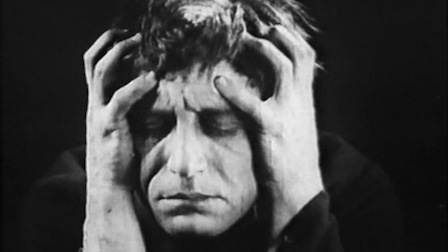
A century earlier, Fyodor Dostoyevsky took an even deeper look at the mind of the killer, a fictional one, in Crime and Punishment. He did not minimize the horror of the crime or humanize the killer for purposes of sympathy, empathy or excuse. He instead set the standard for psychological depth and ambiguity that is the hallmark of modern literature since.

Standard or simplistic explanations and labels fit many needs, including the need of broadcasters to fill dead air while an extended manhunt and its aftermath proceed. But Dostoevsky demanded a trip on the subtle dark seas of family, society and the mind. That’s not just a way we understand the bad actors. It’s how we understand ourselves, even when our own seas are not nearly so dark.

From Crime and Punishment, as Rodion Raskolnikoff  pursues his plan to kill the moneylender Alena Ivanovna. He walks down the street, when someone remarks about his unusual hat:

“I knew it,” he muttered in confusion, “I thought so! That’s the worst of all! Why, a stupid thing like this, the most trivial detail might spoil the whole plan. Yes, my hat is too noticeable…. It looks absurd and that makes it noticeable….With my rags I ought to wear a cap, any sort of old pancake, but not this grotesque thing. Nobody wears such a hat, it would be noticed a mile off, it would be remembered…. What matters is that people would remember it, and that would
give them a clue. For this business one should be as little conspicuous as possible….Trifles, trifles are what matter! Why, it’s just such trifles that always ruin everything….”

He had not far to go; he knew indeed how many steps it was from the gate of his lodging house: exactly seven hundred and thirty. He had counted them once when he had been lost in dreams. At the time he had put no faith in those dreams and was only tantalizing himself by their hideous but daring recklessness. Now, a month later, he had begun to look upon them differently, and, in spite of the monologues in which he jeered at his own impotence and indecision, he had involuntarily come to regard this “hideous” dream as an exploit to be attempted, although he still did not realize this himself. He was positively going now for a “rehearsal” of his project, and at every step his excitement grew more and more violent.


If We Could See the Children of Sandy Hook

Sandy Hook School
Early in the Iraq War, President Bush tried to block taking pictures of the arrival of the coffins of fallen soldiers at Dover Air Force Base. The proposal was couched as a gesture of respect to the families, but the real point was to shield citizens from the ultimate cost of war.

There are different opinions on the impact of viewing carnage, fictional and real. Does constant exposure immunize us from taking violence seriously? Would we pursue wars so readily, or at least try to better distinguish the necessary from the chosen, if we were bombarded by those images? If we saw footage of the early days of the camps in real time, would we have allowed the Holocaust to proceed?

The images of the children killed at Sandy Hook School in Newtown are blocked from us. This choice is almost beyond argument. We have heard the reaction of those who did witness the aftermath, and even those who have participated in war said that scene was worse. We are protecting the dignity of those lives unlived and respecting the immeasurable grief of the families. Our imaginations are already enough to rend our hearts.

And so instead we have pictures of those children as they are remembered, beautiful angels, joy and potential, and we have the testimony and imploring of their parents. But somehow, this doesn’t seem to be quite enough to stop abstract arguments about the essential value of the Second Amendment, how it must continue unconditioned even by sensible restrictions that meet moral, practical and constitutional muster. First they come for my AR-15, this line goes, and next the deer and the police will be hunting me.

There is a way to end this argument, though for good reasons we will not do it. If we ever get to see the killing field at Sandy Hook, there will be little more talk of a free trade in assault weapons and big ammunition clips. There may be talk, but it will be silenced by a new and more powerful outrage. The NRA might try to keep repeating a mantra that is already falling on more deaf ears, and some of their political operatives will follow. But the vast majority of Americans will move from just saying the right thing to a pollster to demanding that the right thing be done. Now.

If we could, as we won’t, see the children.

The Untouchables: No Justice On Wall Street

The Untouchables
This week, PBS Frontline aired a follow-up to its powerful documentary Money, Power & Wall Street, which covered the origins and aftermath of the 2008 financial meltdown. The Untouchables is an equally scathing and disturbing story about the failure of the Justice Department to prosecute any Wall Street executives for fraud, in the wake of their apparently knowing securitization and sale of worthless mortgages.

For those who wonder whether investigative journalism still matters, this happened yesterday:

Lanny Breuer, the head of the DOJ Criminal Division featured in the documentary, resigned. Questions about why criminal prosecutions have taken so long—and whether there will ever be any—linger like a bad odor.

Mary Jo White, a former federal prosecutor, was nominated to be the next chairwoman of the Securities and Exchange Commission. Richard Cordray, another former prosecutor, was renominated to be director of the Consumer Financial Protection Bureau. The president said these nominations would help prevent a financial crash like the one he inherited four years ago.

People say that the new movie Zero Dark Thirty serves as a thought-provoking wake-up call about the role of torture and, ultimately, the effectiveness and judgment of President Obama. It has been said that those who support the president might find the film unnerving.

The Untouchables is much more unnerving, not just in looking at the president, but in looking at Attorney General Holder, at overseers,  and at all the others who seem to be strangely—or not so strangely—beholden to Wall Street.

Watch The Untouchables, then go back and watch Money, Power & Wall Street. Like all great investigative journalism, it is darkly entertaining, and like all unvarnished views of how government works, it is profoundly discouraging. But necessary.

Fish and Assault Weapons

Fish Head Bullet Weights
Tomorrow, Barack Obama unveils a series of proposals to curb gun violence. Among them is likely to be a reintroduction of a federal ban on the sale of assault weapons, a ten-year prohibition that expired in 2004. Many are pessimistic, believing that such a measure might pass the Senate, but will certainly not make it through the House.

There is a fair amount of discussion about whether people hunt with assault weapons, and if they do, whether they should. It’s a good question, but not nearly as fascinating as the eccentric question of whether people fish with assault weapons.

The short answer is that up until a few years ago, two states did allow fishing with guns. New York State has since repealed its law, leaving Vermont as the only state where you can legally shoot fish (in a lake, but presumably still not in a barrel—except in the privacy of your own home).

Spring hunting for pike is in fact a Vermont tradition. Here is the law:

Vermont Statutes
Title 10: Conservation and Development
Chapter 111: FISH

§ 4606. Taking fish by unlawful means

(e) In Lake Champlain pickerel, northern pike, carp, garfish, bowfin, mullet, shad, suckers, bullhead, and other cull fish may be taken from March 25 to May 25 by shooting and spearing in other than spawning areas designated under section 4140 of this title. For the purposes of this subsection, Lake Champlain includes all connected waters at the same level.

Gun experts do not generally advise shooting in water at all, for the safety of bystanders. But if you do plan to set your sites on Lake Champlain fish, it is likely that assault weapons will still be legal this spring, so nothing other than a sense of fairness, or good sense in general, should be stopping you.

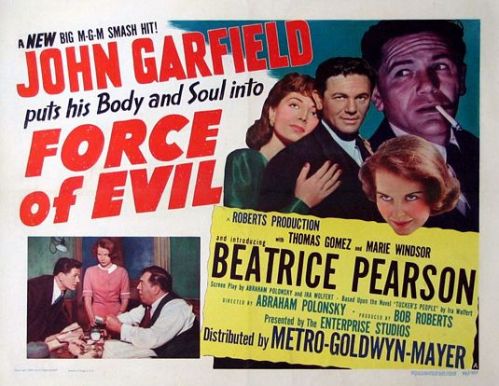
Movies: Force of Evil


The overlooked movie Force of Evil (1948)  is one of the most striking creative critiques of big business in any medium. It was produced by the major, decidedly capitalistic studio MGM, and it featured one of Hollywood’s biggest stars at the time, John Garfield, in what many consider his greatest performance. A standout of intelligent film noir, it has a brilliant and poetic script, written and directed by Abraham Polonsky.

Garfield is still a celebrated name in movies. Polonsky is more narrowly known, mostly among film historians. Shortly after Force of Evil, both Polonsky and Garfield were blacklisted in the craze of anti-Communist McCarthyism that swept the movie industry. Polonsky would not work again for twenty-one years.

There are two kinds of political movies. One is expressly and directly about political issues. The other kind—the one that so worried Commie-hunters—are films that look entertaining on the surface, but have a subversive and counter-cultural subtext. Force of Evil is a sort of third wave. You can watch it as a well-acted and engaging melodrama, which it is. But at some points, the politics explicitly but gracefully rises above subtext, in a way that is mostly undidactic, so it doesn’t get in the way of enjoying and appreciating the movie. It is quite a trick that Polonsky pulls off.

One of the archetypes of storytelling is the two brothers who end up on opposite sides of the law—Cain and Abel, the cop and the gangster. In this movie, both brothers are on the wrong side, just on a different scale. Leo is small-time, running a modest numbers betting business. (Numbers, sometimes called the policy racket, is an illegal lottery, long popular in low-income neighborhoods. Small bets are placed on the last three digits of the daily betting take at a race track; the odds are thus 1000 to 1.)  Joe (John Garfield), the younger brother who Leo helped put through Harvard Law, works for Ben, one of the biggest racketeers in New York.

Joe wants to make his first million, and he believes he will thanks to an ingenious plan to rig the outcome of the numbers on the Fourth of July. Since bettors often pick the numbers 776 on Independence Day, when that number comes up, the bettors will win for a change, but all the small-time numbers operators will go out of business, and be taken over by Ben. It is a strategy of forced, one-sided, underhanded mergers. (That’s right, the corrupt big business will play its dirty tricks on the slightly less corrupt small businesses—and on the innocent poor people—on the Fourth of July.)

Joe tries to save his brother by bringing him over to the bigger, richer and slightly darker side. But there are few heroes here. Events overtake characters, and in the end everyone, including a rival boss, is dead—except for Joe and the young woman he loves. While not exactly a happy ending, this outcome led some to complain that this sort of redemption was inconsistent with the rest of the movie. Maybe so, but this was made by one of the world’s biggest movie studios, and anyway, we all deserve a break in the face of this bleakness.

Bleak it may be, but Force of Evil is not some sort of dull lesson in ideology. It is a great, entertaining and rarely-seen film that deserves attention, whatever your politics.

Why Compassion Matters


On August 4, in a hospital just a few miles from where this post is being written, John Wise, 66, snuck into the room where his wife Barbara, 65, was lying. They had been married for 45 years. She was suffering, reports indicate, from a triple aneurysm, and her prognosis appears to have been poor. He ended her life, shooting her in the head, though she did not die until the next day. His plan to shoot himself immediately after that was thwarted when his gun jammed. This week, he was charged with aggravated murder and faces life in prison without parole.

This has raised, not for the first or last time, the issue of mercy killing in the face of untreatable illness and declining quality of life. With an aging and ailing population, whether it is our family or ourselves, this goes each passing day from the abstract to the very real.

You can deal with this on an intellectual and practical level, weighing moral and legal issues, determining what you might do or ask others to do under a variety of circumstances. But hearing this story, the most natural thing is to cry. Not out of any failure to resolve those issues, but out of sheer compassion.

Compassion is what matters. All of our spiritual traditions commend it, but maybe none makes it more plainly central than Buddhism. The first truth of Buddhism is the reality of suffering; all else in how we are to live stems from this.

The story is told of a woman whose child had died. She came to the Buddha, who instructed her to visit neighbors and to return with a mustard seed from a house that had not been touched by death. She came back empty handed. This wasn’t to make her feel “better,” which it couldn’t. This was to help her see herself where she was, a living drop in the sea of suffering.

Compassion is more than walking in another’s shoes, more than the Golden Rule, more than “no man is an island.” It is the deepest possible recognition, beyond words, of the need that universal suffering creates. The need to care unconditonally.

If compassion is present in our lives and our politics, whatever we do cannot be completely wrong. If compassion is absent, nothing we do can be right, no matter how good it is meant to seem.

Penn State: Worse Than Death

There is a theme in crime and horror fiction in which someone is not killed, but is instead punished by being allowed to live and witness the degradation and demise of all that he has loved and built.

That is exactly what happened for alumni, fans and boosters, with this morning’s announced sanctions against Penn State. In advance of the announcement, some speculated that the NCAA would be creative in its punishments and that in the end Penn State might actually wish for the “death penalty” of a cancelled season of football.

Done and done.

Every current Penn State football player is free to play elsewhere this season and in future. If he is on scholarship, he can choose to stay at school but never play, and he will still receive his scholarship. Current recruits are free to commit to other colleges. Four years of no post-season play assures that first-rank players are unlikely to play at Penn State. Scholarships will be cut back. And the all-time winning record of Joe Paterno has been toppled, just like his statue, by the vacating of all team wins from 1998 to 2011.

When Penn State fields a team this year, it will be a spectacle. The team will be bereft of talent, a ghost of its gloried self. Lose or win, it will perform under fifty shades of ignominy. Even now, there may be someone at the school thinking that Penn State might be better off volunteering to take the one year break that the NCAA did not impose. That dramatic step won’t happen, but it might help convince the very skeptical—who believe that the reprioritizing of college football is beyond the reach of the most well-meaning and contrite—that Penn State really gets the magnitude of what is wrong, and that it can be a reluctant role model for a better next generation of college athletics.