Bob Schwartz

Category: Business

The iBrain and gBrain Devices

My Favorite Martian

With the release of the iWatch, both Apple and Google realize a challenge they face. There has been a bit of pushback to Google Glass, and there will no doubt be a similar issue for the iWatch. Even the most avant garde people may have second thoughts about just how cool they don’t look wearing and using those devices.

Which is why Apple and Google are working on devices that are innovatively powerful but completely inconspicuous. These are brain implants that will function as smartphones—and more. Working names for these devices might be iBrain and gBrain. No one will know you are wearing them. No more pulling your smartphone out of your pocket, or putting on a pair of glasses, or bringing your wrist up to your face.

Ironically, the problem that Apple and Google have is precisely that: nobody will know you are using it. That is, there is no badge. Which is why, on a parallel track, marketers are working on an actual badge that tells the world that you are wearing an iBrain or gBrain. Another thought that marketers have is to encourage jewelry or tattoos that bring attention to the implant site. One product manager has even suggested a non-working antenna that could attach to the implant, giving the user the look of an old-fashioned Martian. Futuristic glasses and watches might not be cool, but that sure would be.

The NFL and Ferguson

Roger Goodell NFL

NFL player Ray Rice beat his then-fiancée/now-wife unconscious inside an elevator in Atlantic City. Police officer Darren Wilson shot dead an unarmed teenager in the middle of a street in Ferguson, Missouri.

(To Rice’s credit, he had the courtesy to drag her body out of the elevator, while the Ferguson police left Michael Brown’s body on that street for hours.)

These two incidents are so much the same and so different. They tell us things we don’t want to hear, know, or think about. They also tell us one surprisingly good thing. The establishment interests can be just as committed to privileging a black American as killing him ruthlessly, under the right circumstances. Especially if there’s big money at stake. So we learn that ignominy is race neutral at last.

Until yesterday there was no publicly available video of the beating, though it was apparently available and seen by various authorities. The only public video until then was from the outside of the elevator, merely showing Rice dragging the body, not beating it. As one journalist now explains his defense of Rice’s mere two-game NFL suspension and not being charged with a felony:

The inside-the-elevator video shows Rice, a running back for the Baltimore Ravens, provoking, brutally assaulting and then casually and callously standing over his knocked-out fiancée (who is now his wife). His actions are sickening in their depravity and confirm a worst-case-scenario narrative I was reluctant to believe after seeing only the previously released, outside-the-elevator video.

I thought the full video would explain why: Why police originally charged Ray and Janay with simple assault. Why the prosecutor allowed Ray to enter a diversion program. Why Janay apologized for her role. Why Janay chose to marry Ray. Why the Ravens enthusiastically supported Rice and used their facilities in helping him rehabilitate his image. Why Goodell suspended Rice for only two games.

I wrongly and naively thought that she was the aggressor in the attack, that Rice reflexively shoved her to fend her off and she slipped, fell and hit her head [emphasis added]. I did not think a man could sucker-punch a woman on tape and have the police, a prosecutor, the victim and the image-conscious NFL all work to treat the assaulter in a sympathetic fashion.

Fell and hit her head. That reminds us of nothing so much as the stories reported by battered children (and wives and girlfriends) who “run into doors.” Except this is a journalist using his best investigative and inferential skills to draw an “obvious” circumstantial conclusion. He could be forgiven for drawing the same ridiculous conclusion as law enforcement, the NFL, and the Baltimore Ravens. Except that some or all of them had the inside the elevator video or at least more detail, and still came to the same conclusion, at least publicly.

There is no video of exactly what happened to Michael Brown in Ferguson, though there are witnesses to pieces of it, an audio recording, and more than one autopsy. There the instinct on the part of vested interests and the establishment was to wait and see, but really to stonewall, cover up, and put the best light on the situation. That turned out to be a disastrous approach, but at least it got people talking about former unmentionables. Small consolation.

How is this any different than what is going on with Ray Rice? The vested interests tried to put the best light on his situation, and despite outrage, almost got away with it. How are the people who up until yesterday circled the wagons around Ray Rice, giving him the benefit of the doubt and a slap on the wrist, any different than those who have been circling the wagons around Darren Wilson, giving him the benefit of the doubt?

One difference is that Ferguson is a small predominantly black town with a small almost entirely white police force that appears to have some race issues, while the NFL is a huge enterprise predominantly owned and run by white people with a pro game substantially played by black men that appears to have some race issues. It’s those issues, along with other social, legal and moral ones, that have us all talking. About policing. About the NFL. About race.

The victims were both black, one a kid possibly involved in petty crime (there’s a video of that), the other a woman engaged to a professional warrior who could have easily killed her, rather than just beating her senseless after she “provoked” him (there’s now video of that).

Maybe from the first, Ray Rice should have taken the approach that will certainly be at the center of Darren Wilson’s defense, assuming he is charged: I was in fear for my life. Up until yesterday, lots of people would apparently have been willing to accept a story like that, if it served their interests. Thankfully, they now all have to stop pretending, and we can start asking what it all means.

MUJI to Sleep: Minimalist Essential Wonderful Free App

MUJI Waterfall

Japanese retailer MUJI has a free gift for you. A tiny gift that will delight you and transform your phone or tablet into an instrument of wonder. MUJI for Sleep.

MUJI sells minimalist furniture, home goods, apparel, and other personal products—online and in a small number of stores in New York and California.

On their U.S. website, MUJI explains its philosophy:

MUJI is not a brand whose value rests in the frills and “extras” it adds to its products.
MUJI is simplicity – but a simplicity achieved through a complexity of thought and design.
MUJI’s streamlining is the result of the careful elimination and subtraction of gratuitous features and design unrelated to function.
MUJI, the brand, is rational, and free of agenda, doctrine, and “isms.” The MUJI concept derives from us continuously asking, “What is best from an individual’s point of view?”
MUJI aspires to modesty and plainness, the better to adapt and shape itself to the styles, preferences, and practices of as wide a group of people as possible. This is the single most important reason people embrace MUJI.

MUJI sells a successful line of sleep products for travel. Which explains the MUJI to Sleep campaign, featuring their Neck Pillow and the MUJI to Sleep app to go with it.

Simplicity and minimalism hardly describe the app. It has five screens to swipe through, each a different color, each with a brushstroke sketch of a scene, each scene with a flow of continuous sound: a river, a bird, a waterfall, a fire, a forest. There is a timer to keep it running for 30, 60, or 90 minutes. Touch on, touch pause. That’s it. As simple as a flashlight app. And more valuable.

You can fall asleep to MUJI of course, which is what it intends. Or you can play it as background for your activities or non-activities, a sort of aural incense. It will contribute to your life in ways unexpected and wonderful.

The MUJI to Sleep app currently has less than 100,000 downloads on Google Play. It should have millions.

When you have true practice, then valley sounds and colors, mountain colors and sounds, all reveal the eighty-four thousand verses. When you are free from fame, profit, body, and mind, the valleys and mountains are also free. Through the night the valley sounds and mountain colors do and do not actualize the eighty-four thousand verses. When your capacity to talk about valleys and mountains as valleys and mountains is not yet mature, who can see and hear you as valley sounds and mountain colors?

Zen Master Dogen
Treasury of the True Dharma Eye
Valley Sounds, Mountain Colors (1240)

Shoes Required and Guns Permitted in Stores

No Gun

Target today “respectfully requested” that customers not bring guns into their stores, even where it is permitted by law. It joins other shops and restaurants in responding to new state laws that are allowing firearms, including automatic weapons, to be carried just about everywhere in public.

Every day at Target, in everything we do, we ask ourselves what is right for our guests? We make all of our decisions with that question in mind. Questions have circulated in recent weeks around Target’s policy on the “open carry” of firearms in its stores. Today, interim CEO, John Mulligan, shared the following note with our Target team members. We wanted you to hear this update from us, too.

The leadership team has been weighing a complex issue, and I want to be sure everyone understands our thoughts and ultimate decision.

As you’ve likely seen in the media, there has been a debate about whether guests in communities that permit “open carry” should be allowed to bring firearms into Target stores. Our approach has always been to follow local laws, and of course, we will continue to do so. But starting today we will also respectfully request that guests not bring firearms to Target – even in communities where it is permitted by law.

We’ve listened carefully to the nuances of this debate and respect the protected rights of everyone involved. In return, we are asking for help in fulfilling our goal to create an atmosphere that is safe and inviting for our guests and team members.

This is a complicated issue, but it boils down to a simple belief: Bringing firearms to Target creates an environment that is at odds with the family-friendly shopping and work experience we strive to create.

Let’s not talk about whether the legal situation, or messages such as Target’s, or video of people walking around American cities gleefully brandishing semi-automatic rifles are insane. There are plenty of other places where ordinary citizens are walking around exactly the same way. Think Syria. Think Iraq. Think dozens of other countries which we aspire to emulate.

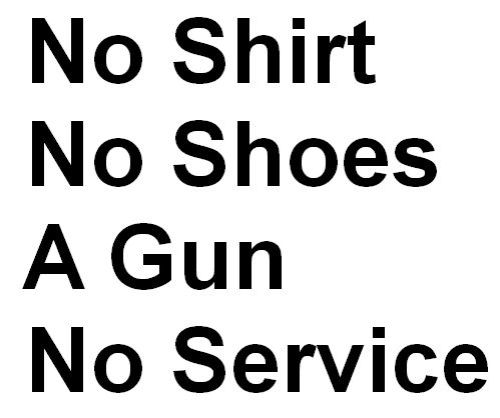
Let’s talk about the fact that across the country, virtually all establishments reserve the right to refuse you service and ask you to leave if you show up without a shirt or shoes. Yet some of the biggest businesses in the country are having trouble telling some customers to leave if they show up with weapons. Now that is insane.

But also rational. This is business. If even a small number of Second Amendment zealots turn their sites on a chain, there is no doubt it will hurt the bottom line. The shoeless and the shirtless have no lobby. The gun advocates do.

Maybe what’s needed is another line item added to the classic “No Shirt, No Shoes, No Service” sign. Or maybe stores will choose to engage a little more forcefully than a simple respectful request.

Hobby Lobby and Peyote

Peyote

Peyote is at the heart of today’s Supreme Court decision in the Hobby Lobby case.

Hobby Lobby does not sell peyote. When Hobby Lobby attends church, its religious practices don’t include eating peyote. Its Christian beliefs do include opposition to certain forms of contraception, and therefore it opposed having to provide health insurance under ACA that includes such contraception.

Hobby Lobby’s objections reached the Supreme Court. In today’s 5-4 decision, the Court found that the entity that is Hobby Lobby has a claim to religious freedom from that requirement, grounded in the First Amendment and in the Religious Freedom Restoration Act of 1993 (RFRA). And that is where peyote comes in.

This begins with the case of Employment Division, Department of Human Resources of Oregon vs. Smith (1990). Two employees of the State of Oregon were members of the Native American Church, and ingested peyote as a sacrament. They failed a drug test and were fired. The Supreme Court found that despite their claim of religious freedom, Oregon had the right to terminate them.

In response to this and other decisions, activists from the left and right, religiously and politically, came together to push for a legislative remedy. How universal was support for a fix? The House vote for RFRA was unanimous, the Senate 97-3, and President Clinton signed it.

More than twenty years later, what hath God and Congress and the Court wrought? Characterizing this new allowance for religious exceptions to laws as narrow seems wishful, hopeful, or just plain wrongheaded. There will be more attempts than before to see just how big this hole is and what sort of company policy vehicle can be driven through it on the basis of religious freedom.

Quite possibly, the next big test will be to see exactly what closely held companies that have religious objections will be permitted to do about homosexual employees. We have no federal law on employment discrimination against gay people, and in a country where we can’t even pass equal-pay for equal-work for women legislation, that isn’t likely any time soon.

God apparently doesn’t endorse IUDs but approves of peyote. His judgment on Hobby Lobby and the Supreme Court is still out.

Fortune Magazine Pleads: Heed the Authentic Cry of Our Youth

Youth in Turmoil Cover

It is January 1969. Fortune, one of the world’s most conservative business magazines, publishes a special issue about Youth in Turmoil. It then adapts the issue into a book, with an image of a flame on the cover.

The message is not, as you might expect, about how these ungrateful long-haired drug-addled rebels are destroying the country. On the contrary, the message is that these young people are trying to tell us something important and we should listen—before it’s too late.

Here is the introduction:

American youth is trying to tell us something important. The brightest of our young men and women are telling us that as far as they are concerned the choices for our society are narrowing rapidly. We can, at worst, look ahead to a future, very near, in which they lose all heart for our national effort, thus robbing it of its nerve, vitality, and point—a state of affairs in which they range themselves against us either in violence or in withdrawal. Or we can heed the cry of these young adults. Though often marred by shrillness, arrogance, and negativism, that cry is authentic and valid in its central message. It tells us that in our rush to well-being we have left much undone at the same time we have made so much more do-able. It tells us that we should rechannel our enormous energies to deal with the lengthening list of environmental and social grievances. If we can enlist these young idealists and they can enlist us, the nation will evolve toward a life style that once again sets a new standard for the world. I hope that this book, adapted from the January, 1969, special issue of FORTUNE, will contribute to that mutual enlistment.

LOUIS BANKS,
MANAGING EDITOR, FORTUNE

Please read this word-for-word. It is extraordinary. This is a bible of the establishment, during one of our most anti-establishment times, acknowledging that many things are wrong—including environmental and social problems—and admitting that young people are trying to remind us of our responsibilities to make it right. If the establishment fails, Fortune says, “We can, at worst, look ahead to a future, very near, in which they lose all heart for our national effort, thus robbing it of its nerve, vitality, and point—a state of affairs in which they range themselves against us either in violence or in withdrawal.”

Consider how far we have come. Youth seems to be somewhat disaffected, maybe even having lost heart and been robbed of its nerve—but not exactly in turmoil. Much of the conservative establishment would now never dream of agreeing that we have justifiable environmental and social grievances, let alone that these should be aggressively addressed.

The Sixties are variously celebrated, trivialized, and even laughed at. Maybe it’s funny to see a Big Business publication like Fortune willing to open its eyes, look around, and decide that these kids just might have a point and we can do a whole lot better. Or maybe it’s a little sad that we don’t see more of that today.

Honeywell Kitchen Computer and the Delights of Old Tech

Kitchen Computer - Menu Selection

Some people love old cars. Others of us delight in old digital tech.

We are not alone. The latest episode of Mad Men on AMC includes the installation of a computer at the agency. And the new AMC series Halt and Catch Fire is (coincidentally?) about the early days of personal computing. (Halt and Catch Fire is a real/apocryphal/funny code instruction that might send a computer into an endless loop, resulting in its ultimately stopping or bursting into flames.)

This is a page from the Neiman-Marcus Christmas 1969 catalog. The impeccably dressed N-M housewife is standing next to what appears to be an unusual table, but is actually the Honeywell Kitchen computer, which can be purchased for $10,000. (The apron will cost you another $28.) “If she can only cook as well as Honeywell can compute.” Indeed.

Kitchen Computer

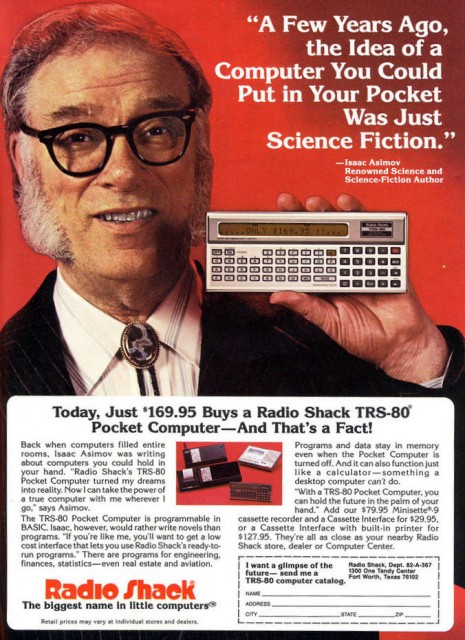
Here is something completely different from the era, prophetic rather than silly. It is Isaac Asimov, a science fiction great, advertising Radio Shack’s TRS-80.

Asimov - TRS-80

Note that in the spirit of what goes around comes around, this is a pocket computer almost exactly the size of a smartphone—or is a smartphone a pocket computer exactly the size of a TRS-80? Either way, Neiman-Marcus and Honeywell were clueless, but Asimov and Radio Shack were not.

That would be a pretty good close for this post. Except that the following ad is irresistible, telling us something else about the early days of computing.

TSP Plotter

Just as cars were, and to some extent still are, sold by using sex, sometimes so were computers. This is an ad for a plotter, possibly the least sexy of all peripherals. The copy is mostly bone-dry and technical. But then there’s the trio of the model with her dress open to her navel, the headline “New, Fast, and Efficient!”, and the lead “The TSP-212 Plotting System is a real swinger.” $3,300 COMPLETE. Well, almost complete, as the model is presumably not included. But you know, that cool plotter just might attract one.

The Aereo Case and Media Reality

Aereo

Today the Supreme Court hears arguments in the case of ABC, et al. v. Aereo. Some characterize it as the most important media case in decades, one which could destroy broadcasting as we know it.

That is both overstated and understated. The big broadcasters who claim this is the apocalypse won’t go out of business; they will continue, though they might make a little less money or have to work a little harder for it. On the other hand, nothing less than the nature of modern reality is being considered, which is what makes the case so interesting and ultimately so hard to decide.

In a nutshell, this is what Aereo does:

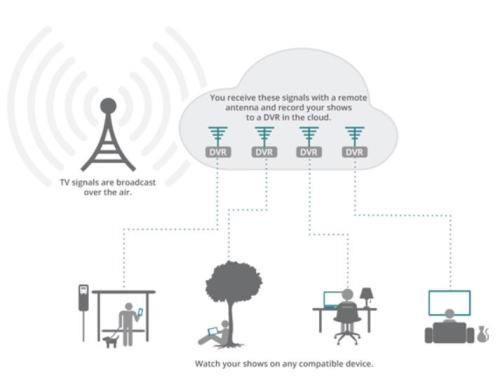
Aereo sets up lots of tiny (thumbnail) antennas in your locality.

The antennas pick up the same over-the-air (OTR) TV signals you would if you had an antenna at your home (but you probably don’t).

You subscribe to Aereo for as little as $8 a month.

When you want to watch something from the stations that are on the air in your locality, Aereo assigns you an antenna, collects and records the signal from that antenna in its cloud, and streams that signal the way you want to the device you want, now or later.

The question is whether Aereo is retransmitting copyrighted content to subscribers, cleverly skirting retransmission fees that cable systems and others must pay, which would be stealing. Or whether Aereo is simply enabling you to do something you are legally entitled to do: receive OTR TV and then watch it, record it, or redistribute it to your own devices for your own personal use.

The Second Circuit Court of Appeal decided in favor of Aereo, with a vigorous dissent and with other Circuit Courts disagreeing, and now the Supreme Court will decide. If you read the briefs you can get an idea of the difficulty and the possible impacts.

One can say, as the big broadcasters do, that Aereo may be trying to fit through a loophole in the law, but that isn’t quite right. Aereo is taking advantage of a reality so profoundly new and so newly understood that every medium and every media business is just barely beginning to come to grips.

When you reduce things to information and can move that information around infinitely and frictionlessly and at relatively low cost, the processes and regulations meant to handle grosser things are of limited value.

First a book was a thing made of paper, then there was a copier which could copy pages on paper, then there was a scanner that could turn paper pages into digital images and, with OCR, characters, then there were entire books that never had anything to do with paper, ever, just pure arranged information. The same goes, with slightly different details, for every medium. The solution for the producers who wanted to control things (often with legitimate interests, such as creators being compensated), was to put the information in some kind of box, which to some looked like an information jail. It was and is this simple: once it gets out of the box, catching it and catching up with it is quite a chore. Because, as Stewart Brand famously said, information wants to be free.

If you had to characterize the actors in this case as good guys or bad guys, it does look like ossified old school versus new school, mega-corporations versus insurgents, or as one of the briefs says, David versus Goliath. Any way you put it though, and wherever your opinion lies, this is a hard case, and the maxim is that hard cases make bad law. In this case, bad law would mean that even if progressive principles are maintained, more looking forward than back, we are still in an astonishing mess when it comes to dealing with all this. One case at a time won’t do, and the expectation that Congress will seize the reins and lead us boldly into an enlightened future on digital intellectual property is, at least for the moment, not in the cards or the cloud.

Record Store Day 2014

Record Store Day 2014
That’s not a record store:

Spotify

This is a record store:

Amoeba Records

Record Store Day
Saturday, April 19, 2014

“I think it’s high time the mentors, big brothers, big sisters, parents, Guardians, and neighborhood ne’er do wells, start taking younger people That look up to them To a real record store and show them what an important part of life music really is. I trust no one who hasn’t time for music. What a shame to Leave a child, or worse, a generation orphaned from one of life’s great beauties. And to the record stores, artists, labels, dj’s, and journalists; we’re all in this together. Show respect for the tangible music that you’ve dedicated your careers and lives to, and help It from becoming nothing more than disposable digital data.”
– Jack White

Republican Jewish Coalition and the Sabbath

Republican Jewish Coalition Spring Leadership 2014

It’s Saturday, the Sabbath in Jewish communities. Why is this Sabbath different than all other Sabbaths?

Because on this Sabbath Sheldon Adelson’s Republican Jewish Coalition is continuing its three-day Spring Leadership Meeting, including a galaxy of political and policy stars looking for support, prestige, power, and money, including:

New Jersey Governor Chris Christie
Ohio Governor John Kasich
Wisconsin Governor Scott Walker
Vice President Dick Cheney
Israeli Ambassador Ron Dermer
Ambassador John Bolton

It’s true that the majority of American Jews don’t fully honor the Sabbath as a time for rest, reflection, and study. It’s also true that some number of those do try in small ways to live in the spirit of the Sabbath. Where Sheldon Adelson and the RJC sit on this spectrum of Sabbath observance and honor is between them and their God and their party.

One of the things that most non-Jews and many Jews don’t recognize is the complex significance of the Sabbath. The year is filled with special days, some regarded as very serious, very important and, in the case of the High Holidays, literally awesome. The Sabbath, though, stands apart, characterized as a beloved or royalty, as a bride or queen.

The great, deep and inspiring Jewish theologian Abraham Joshua Heschel wrote an incomparable work on the nature and meaning of this. The Sabbath presents a spiritual picture of what he calls sacred time. The book is considered by readers of all faiths and even no faith an uplifting view of how we are to live in the context of such a powerful reality.

It would be presumptuous to say whether the late Dr. Heschel, who among his many achievements marched with Martin Luther King in Selma almost fifty years ago, would attend the RJC Spring Leadership Meeting. In any case, most likely not the RJC on the Sabbath.

Although the RJC will be holding its political beauty pageant today, they still might have a moment to squeeze in some Heschel. This passage from the Epilogue of The Sabbath is out of context, and not so easy to appreciate on its own. It does have something to say about space, which can be owned and fought over, and time, sacred time, in which we are all joined and connected and sharing—no matter who you are, no matter how many casinos you own, no matter how big your PAC:

Time, then, is otherness, a mystery that hovers above all categories. It is as if time and the mind were a world apart. Yet, it is only within time that there is fellowship and togetherness of all beings.

Every one of us occupies a portion of space. He takes it up exclusively. The portion of space which my body occupies is taken up by myself in exclusion of anyone else. Yet, no one possesses time. There is no moment which I possess exclusively. This very moment belongs to all living men as it belongs to me. We share time, we own space. Through my ownership of space, I am a rival of all other beings; through my living in time, I am a contemporary of all other beings. We pass through time, we occupy space. We easily succumb to the illusion that the world of space is for our sake, for man’s sake. In regard to time, we are immune to such an illusion.