Bob Schwartz

Category: Buddhism

Light the Icicle

icicles

Happy Hanukkah. Happy Christmas.


The Icicle

A zaddik told:

“On a winter’s day, I went to the bath with the master. It was so cold that icicles hung from the roofs. We entered and as soon as he did the Unification, the bath grew warm. He stood in the water for a very long time, until the candle began to drip and gutter. ‘Rabbi,’ I said, ‘the candle is guttering and going out.’

‘Fool,’ he answered, ‘take an icicle from the roof and light it! He who spoke to the oil and it leaped into flame, will speak to this too, and it will kindle.’ The icicle burned brightly for a good while, until I went home, and when I got home there was a little water in my hand.”

Martin Buber,  Tales of the Hasidim


“People ask, ‘What is the Buddha?’ An icicle forming in fire.”

Dogen Zenji

Bodhi Day Riddle: Fig Newtons

Fig Newtons

Here is a riddle for Buddhists, scientists, cookie lovers or anyone else who likes a challenge:

Why should Fig Newtons be the official cookie of Bodhi Day, the day of the Buddha’s enlightenment?

(For more serious posts about Bodhi Day, see here and here.)

Bodhi Day: The Ancient Path

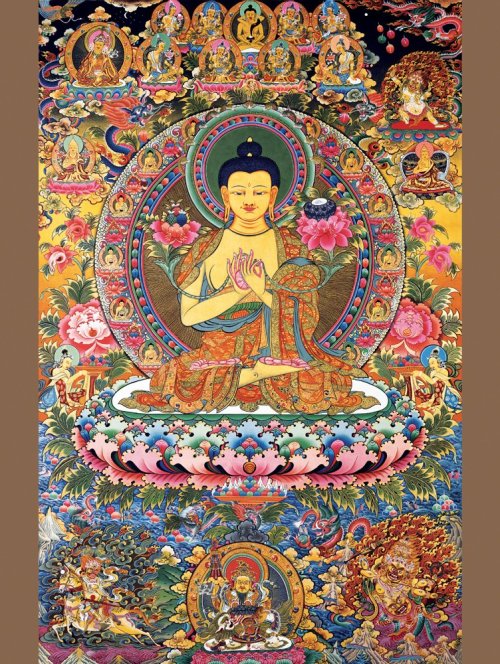
buddhas-of-the-celestial-gallery

“This was the third true knowledge attained by me in the last watch of the night. Ignorance was banished and true knowledge arose, darkness was banished and light arose, as happens in one who dwells diligent, ardent, and resolute.”

“Suppose, monks, a man wandering through a forest would see an ancient path, an ancient road traveled upon by people in the past. He would follow it and would see an ancient city, an ancient capital that had been inhabited by people in the past, with parks, groves, ponds, and ramparts, a delightful place. Then the man would inform the king or a royal minister: ‘Sire, know that while wandering through the forest I saw an ancient path, an ancient road traveled upon by people in the past. I followed it and saw an ancient city, an ancient capital that had been inhabited by people in the past, with parks, groves, ponds, and ramparts, a delightful place. Renovate that city, sire!’ Then the king or the royal minister would renovate the city, and some time later that city would become successful and prosperous, well populated, filled with people, attained to growth and expansion.”

“So too, monks, I saw the ancient path, the ancient road traveled by the Perfectly Enlightened Ones of the past. And what is that ancient path, that ancient road? It is just this Noble Eightfold Path; that is, right view, right intention, right speech, right action, right livelihood, right effort, right mindfulness, right concentration. I followed that path and by doing so I have directly known aging-and-death, its origin, its cessation, and the way leading to its cessation. I have directly known birth … existence … clinging … craving … feeling … contact … the six sense bases … name-and-form … consciousness … volitional formations, their origin, their cessation, and the way leading to their cessation. Having directly known them, I have explained them to the monks, the nuns, the male lay followers, and the female lay followers. This spiritual life, monks, has become successful and prosperous, extended, popular, widespread, well proclaimed among devas and humans.”

Saṃyutta Nikāya 12:65; II 104–7
In the Buddha’s Words: An Anthology of Discourses from the Pali Canon

Right Trees (Bodhi Day)

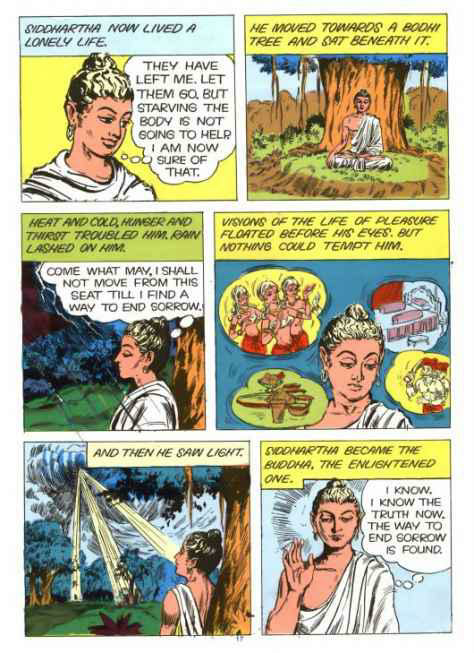
buddha-comic-enlightenment

December 8 is Bodhi Day, known in Japan as Rohatsu, the day of the Buddha’s enlightenment.  

Right Trees (Bodhi Day)

Which tree
To sit under?
Study each one
Counting branches
Inspecting leaves.
Is the ground
Too soft or wet
The shade
Too dark?
Who can deny
The forest
Yet it shrinks
To dust
On a distant shore.
The moon and
The morning star
Are just enough light
To brighten the night
Waking to find
This tree
All trees
Are right.

I wondered how the Buddha knew which tree to sit under for that consequential meditation. An easy answer is that it didn’t matter, that any tree or all trees would do. Another answer is that it didn’t have to be a tree at all. Another of the infinite answers is that there was no tree, no moon or morning star, no sitting. Just waking up.

Healing and Magic: We Are Not Alone

White Tara

All of our religious traditions—Judaism, Buddhism, Christianity, and all others—include an element of healing. Healing of body, heart and mind. The Gospels, for example, contain many important stories about healing, from curing chronic illness to reversing death itself.

We invoke the power to heal in various ways. In Judaism, the Mi Shebeirach is recited:

May the one who blessed our ancestors, Abraham, Isaac and Jacob, Sarah, Rebecca, Rachel and Leah, bless and heal those who are ill. May the Blessed Holy One be filled with compassion for their health to be restored and their strength to be revived. May God swiftly send them a complete renewal of body and spirit, and let us say, Amen.

In Buddhism, White Tara, an important embodiment of compassion, is invoked:

The liberator of suffering shines light upon me to create an abundance of merit and wisdom for long life and happiness.

Is this magic we are engaged in? If you take magic to be a call to illegitimate and evil powers, as some traditions do, then this might have to be classified as something else. If you take magic to be the recognition of a seeming powerlessness in the face of things as they are and an attempt to borrow and employ the power we believe in, then magic it is.

This invocation of the power to heal—by ourselves, in a family, in a community—is a way of practicing that we are not alone. When healing is needed, that is something we want to know.

For JRK.

Readings for the Day of National Healing

Medicine Buddha Mandala

Here are readings for the Day of National Healing from Ocean of Dharma: The Everyday Wisdom of Chogyam Trungpa, a recommended collection of very brief excerpts from his talks and texts. The image above is of the Medicine Buddha.

THE FUTURE IS IN OUR HANDS

We hold the threshold of the future of the world in our hands, on our path. When we say this, we are not dreaming. We are not exaggerating. We hold a tremendous hope, maybe the only hope for the future dark age.

We have a lot of responsibilities, and those responsibilities are not easy to fulfill. They won’t come along easily, like an ordinary success story. They have to be stitched, painted, carved, step by step, inch by inch, minute by minute. It will be manual work. There will be no automatic big sweep, or solution.

When something good is done in the world, it is usually difficult. It is manual, rather than automatic. When something bad is done, usually that is automatic. Evil things are easy to catch, but good ones are difficult to catch. They go against the grain of ordinary habitual tendencies.

PLANNING FOR THE FUTURE

Humans are the only animals that try to dwell in the future. You don’t have to purely live in the present situation without a plan, but the future plans you make can only be based on the aspects of the future that manifest within the present situation. You can’t plan a future if you don’t know what the present situation is. You have to start from now to know how to plan.

CONVERSING WITH OUR NEGATIVITY

You can always count on the fact that our aspect of viciousness or apelike quality will reflect back to us. Then we can either project it onto somebody else or we can reflect and realize the situation within ourselves. Quite precisely, when you are in that particular state of mind, there is a kind of conversation going on. You may try to tell yourself to calm down and not worry. But then the undercurrent of the force of the projection tries to pierce through again and again. There is always this conversation going on with one’s own negativity. The neurotic aspect of mind is always willing to fall into either the extreme of left or right. The right extreme is anger, the masculine extreme. The left is passion, the feminine extreme. This symbolism is true and universal—a cosmic symbol, which happens with all of life. These symbols are not based on Indian, Buddhist, or Tibetan stories at all. These are utterly cosmic principles, as far as the symbolism is concerned.

WORK WITH THE PRESENT SITUATION

The buddhist tradition teaches the truth of impermanence, or the transitory nature of things. The past is gone and the future has not yet happened, so we work with what is here—the present situation. This actually helps us not to categorize or theorize. A fresh, living situation is taking place all the time, on the spot. This noncategorical approach comes from being fully here, rather than trying to reconnect with past events. We don’t have to look back to the past in order to see what people are made out of. Human beings speak for themselves, on the spot.

Laughing at Swallowing a Flaming Iron Ball

Dhammapada - Juan Mascaro

This morning I laughed at a few translated lines from a great and serious spiritual classic. The Dhammapada is a brief (423 verses in 26 chapters) collection of the sayings of the Buddha. For over two thousand years, there may have been no more succinct summary of the heart of Buddhism.

As with the Bible, there are many translations of the Dhammapada from Pali into English, each with its own character. I keep a number of different translations handy, and given that chapters are short, it is possible to easily compare.

I was reading Chapter 25, called variously The Monk, The Practitioner, The Seeker, The Bhikku. In the very loose and poetic translation by Thomas Byrom, the chapter begins:

Master your senses,
What you taste and smell,
What you see, what you hear.

In all things be a master
Of what you do and say and think.
Be free.

You are a seeker.
Delight in the mastery
Of your hands and your feet,
Of your words and your thoughts.

It is at verse 371 that I got my laugh. There the worthy translation by Ven. Balangoda Ananda Maitreya reads:

Do not allow your heart to whirl in the pleasures of senses.
Do not swallow a flaming iron ball and then,
As you burn, cry out, “Oh, that hurts!”

I can’t explain, exactly, what is funny about that last line. It just is. Compared to the other translations of what you might say swallowing this hot iron ball (“This is woe!”, “This is pain!”, “This is suffering!”, “No more!”), “Oh, that hurts!” just tickled me.

Note: Some other translations of the Dhammapada worth looking at:

Juan Mascaro (The first I ever read, excellent, and an awesome bargain as an ebook: $.95 v. $6.38 for the paperback.)

Gil Fronsdal

Glenn Wallis

John Ross Carter

It’s Not for Me to Say

“It’s not for me to say.”

One of the keynotes of Buddhism and Zen is nondiscrimination, that is, not getting trapped by thinking this is better and that’s worse, this is right and that’s wrong. This doesn’t mean that things aren’t by their nature or manufacture different or preferable, or that you can’t or shouldn’t recognize that. It’s just that clinging to that difference is unhelpful and can be the source of unnecessary conflict.

In the wake of some typically silly arguments, I have an idea for a way to remind myself of this, since it can be so easily forgotten in the heat of the moment.

Confronted by the endless opportunities to offer an opinion, to counter another’s opinion, or just to show off how smart and discerning one thinks one is, consider just reciting this, silently or out loud:

“It’s not for me to say.”

This isn’t a magical mantra, but it is meaningful. Of course, if someone asks for the quickest directions, or how to best cook something, or where to live, you will be welcome to offer your practical knowledge and expertise, if you have those. But often, when the difference of opinion is of no consequence, or of less consequence than the conflict is worth, having no opinion can be the best way.

It may be for someone else to say. But not me.

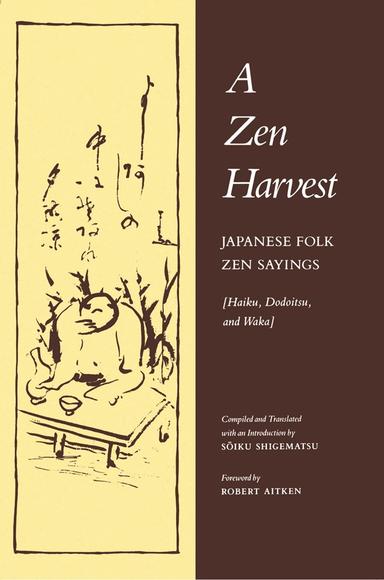
A Zen Harvest: An Essential Zen No Zen Book for No Zen People

A Zen Harvest

While I often write about Zen and Buddhism in this blog, I have never suggested a “where to begin” book. There are a lot of reasons for this, but that’s for another time.

(For those who might be interested, a leading Buddhist publication did a survey of where its readers did get started, and the overwhelming first book was Shunryu Suzuki’s Zen Mind, Beginner’s Mind, pretty clearly the most popular book on Zen in English. It is also where I got started.)

A Zen Harvest: Japanese Folk Zen Sayings (1988), compiled and translated by Soiku Shigematsu, is something different and special. (His first book, A Zen Forest: Sayings of the Masters (1981), is sadly out of print, but you can find a PDF if you go fishing in the Web sea.)

Shigematsu does a lovely job of explaining the text in his excellent Introduction. I actually suggest you not read the Introduction, at least not at first. Robert Aitken Roshi (author of another popular introduction to Zen) offers an appreciative Foreword. You can initially skip that too.

Instead, just browse anywhere in this collection of nearly 800 poem-like sayings. Anywhere. Don’t think of these as Zen. Don’t even think of these as poems. Don’t care about who said it or wrote it.

I am not even going to offer a sample saying, because it would not do the collection justice. Just get it and read in it, a few seconds at a time. You may or may not learn or find out anything about yourself, your life, other people’s lives, the world, the universe, or Zen. Does that really matter?

Vesak: Buddha Day

Sakyamuni Buddha

Today is Vesak, the holiday also known as Buddha Day.

Around the world, especially in Buddhist Asia, Vesak combines a celebration of the Buddha’s birth, enlightenment and passing. This year the holiday was noted by the UN, by President Obama, by Canadian Prime Minister Trudeau, and by many others. This is part of the growing recognition that the world might benefit from even a little bit of Buddhism added to our complex, crazy and chaotic affairs.

Here is the Mangala Sutta (The Sutra on Happiness), a wise and uplifting discourse of the Buddha that is one of the best-loved and most frequently recited texts in the Southeast Asian Buddhist world.  Only twelve verses long, it is a recital of auspicious things, and along with texts such as the Metta Sutta, is believed to bring happiness and good fortune when chanted or heard.

The Sutra on Happiness

I heard these words of the Buddha one time when the Lord was living in the vicinity of Savatthi at the Anathapindika Monastery in the Jeta Grove. Late at night, a deva appeared whose light and beauty made the whole Jeta Grove shine radiantly. After paying respects to the Buddha, the deva asked him a question in the form of a verse:

“Many gods and men are eager to know
what are the greatest blessings
which bring about a peaceful and happy life.
Please, Tathagata, will you teach us?”

(This is the Buddha’s answer):

“Not to be associated with the foolish ones,
To live in the company of wise people,
Honoring those who are worth honoring—
This is the greatest happiness.

“To live in a good environment,
To have planted good seeds
And to realize that you are on the right path—
This is the greatest happiness.

“To have a chance to learn and grow,
To be skillful in your profession or craft,
Practicing the precepts and loving speech—
This is the greatest happiness.

“To be able to serve and support your parents,
To cherish your own family,
To have a vocation that brings you joy—
This is the greatest happiness.

“To live honestly, generous in giving,
To offer support to relatives and friends,
Living a life of blameless conduct—
This is the greatest happiness.

“To avoid unwholesome actions,
Not caught by alcoholism or drugs,
And to be diligent in doing good things—
This is the greatest happiness.

“To be humble and polite in manner,
To be grateful and content with a simple life,
Not missing the occasion to learn the Dharma—
This is the greatest happiness.

“To persevere and be open to change,
To have regular contact with monks and nuns,
And to fully participate in Dharma discussions—
This is the greatest happiness.

“To live diligently and attentively,
To perceive the Noble Truths,
And to realize nirvana—
This is the greatest happiness.

“To live in the world
With your heart undisturbed by the world,
With all sorrows ended, dwelling in peace—
This is the greatest happiness.

“For the one who accomplishes this
Is unvanquished wherever she goes;
Always he is safe and happy—
Happiness lives within oneself.”

Translated by Thich Nhat Hahn