Bob Schwartz

Category: Baseball

The Art Of The Perfect Game


It looks like nothing. A string of zeros. But when you show this picture of a line score to a baseball fan, the pulse races.

Yesterday Felix Hernandez of the Seattle Mariners pitched a perfect game. None of the batters who came to the plate reached first base. It was only the 23rd perfect game in major league history, and the very first for the Seattle Mariners.

Baseball fans, who are notoriously but justifiably obsessed with statistics, have variously calculated the odds of this happening. Variously, because over 113 years, the game and the rules have changed. This calculation also depends on whether you base it on the number of games ever played (something on the order of 200,000) or on the number of opportunities to pitch a perfect game (twice that, since every game includes two starting pitchers). For those who aren’t already lost for lack of interest, and for very rough and illustrative purposes, let’s say the odds are 1 in 20,000.

You have a much better chance of pitching a perfect game than winning the lottery or beating the house at any Las Vegas casino—if you happen to be one of the most skilled and clever athletes on the planet. Standing at a convenience store counter and handing over two bucks doesn’t take much of anything; standing on the mound, and calculating and executing every pitch without fail, takes everything.

Besides expanding the realm of statistics, baseball has also done wonders for language. This includes both great literature and the invention of words and phrases. One of those phrases is “painting the strike zone,” which means the ability to pitch the baseball 60 feet and have it move precisely how you want and place it precisely where you want. Yesterday Felix Hernandez painted the strike zone like one of the old masters.

Museums and art afficianados are sometimes mocked for making a big deal about paintings that for all appearances are mere canvases of a single solid color, big rectangles of all black or all white.

“I could do that,” people say. No you couldn’t. To the unsophisticated eye it may look like nothing. To those who know, it looks like perfection.
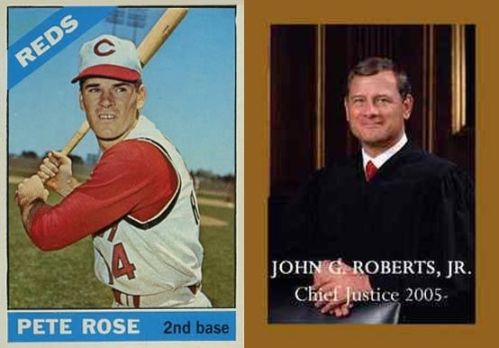
Pete Rose And The Healthcare Decision

It looks as if the Supreme Court will issue its decision on the Affordable Care Act (aka Heritagecare) this week. An unreported story is the relationship of this to baseball legend Pete Rose.

There has probably been more betting on the outcome of this legal question than any before, at venues such as Intrade. Presumably the bettors include some number of lawyers; with more than a million lawyers in the U.S., what are the odds of that?

Major League Baseball has so far banned Pete Rose from the Hall of Fame because he bet on games. Not games he or his team were involved in, just games. Ever since the Black Sox scandal almost a century ago, baseball has had a zero tolerance rule on gambling by anyone in the sport.

The courts and the bar associations that regulate the practice of law have well developed and strict rules of conduct for lawyers. Obviously illegal gambling is just that— illegal—and clearly out of bounds. Gambling addictions that affect practice have also taken a prominent place in the rules of professional responsibility.

But it doesn’t appear that reasonable and prudent legal gambling of any kind is an ethical problem for lawyers. Unless, that is, there is some kind of Pete Rose issue about it. Specifically: Can lawyers responsibly and ethically bet on court decisions with which they have absolutely no relationship? The answer awaits investigation, and maybe some law review articles.

As for the case itself, they say that only fools predict difficult Supreme Court decisions. So a fool rushes in:

1. The Court will have the law stand or fall as a whole and not pick and choose. There is no severability clause. The court can appropriately say that with such an integrated and complex piece of legislation, if Congress got it wrong constitutionally, it is up to Congress to get it right.

2. If it falls on the basis of the mandate, as widely expected, the reasoning of the majority is going to be a sight to behold and study. A principle of jurisprudence at every level is to decide legal issues as narrowly as possible, unless there is an intention to make a bold legal statement. When the Supreme Court speaks, the bolder the statement, the more far-reaching the impact. In a three-branch democracy, any statement about the limits of powers is very loud and long-echoing.

3. We may not have nine opinions, but we may have an almost complete set of concurring and dissenting opinions. For those who have never read dissents in Supreme Court opinions, be aware that in difficult and controversial cases, it is not unheard of or inappropriate for dissenting Justices to politely but clearly state that the majority is in all respects wrong (see the four dissents in Bush v. Gore).

And now, the bottom line. Intrade traders have placed their bets, and they say the chances of “The US Supreme Court to rule individual mandate unconstitutional before midnight ET 31 Dec 2012” are 76.5%. Judging by the comments on the site, the bettors are some combination of knowledgeable thinkers and anti-Obama ideologues. Intrade and those analysts willing to go out on a limb are right. The mandate will be found wanting, with strenuous disagreement among the Justices. And on the basis of non-severability, so will the entire Affordable Care Act.

Or, then again, maybe not.

The Green Fields of the Mind

A. Bartlett Giamatti was the president of Yale University and, for a brief time until his untimely death in 1989, the Commissioner of Major League Baseball.

Besides his commitment to baseball, Giamatti was a man of letters who left behind some remarkable writing about the game. None is more moving and famous than his short essay The Green Fields of the Mind.

On the occasion of a new baseball season, here is an excerpt. Whoever you root for, whatever the season or the game – baseball, politics, art, religion, business, love, life – it offers hard to accept wisdom and the semi-sweet opposite of comfort:

It breaks your heart. It is designed to break your heart. The game begins in the spring, when everything else begins again, and it blossoms in the summer, filling the afternoons and evenings, and then as soon as the chill rains come, it stops and leaves you to face the fall alone. You count on it, rely on it to buffer the passage of time, to keep the memory of sunshine and high skies alive, and then just when the days are all twilight, when you need it most, it stops…

It breaks my heart because it was meant to, because it was meant to foster in me again the illusion that there was something abiding, some pattern and some impulse that could come together to make a reality that would resist the corrosion; and because, after it had fostered again that most hungered-for illusion, the game was meant to stop, and betray precisely what it promised…

And there are others who were born with the wisdom to know that nothing lasts. These are the truly tough among us, the ones who can live without illusion, or without even the hope of illusion. I am not that grown-up or up-to-date. I am a simpler creature, tied to more primitive patterns and cycles. I need to think something lasts forever, and it might as well be that state of being that is a game; it might as well be that, in a green field, in the sun.