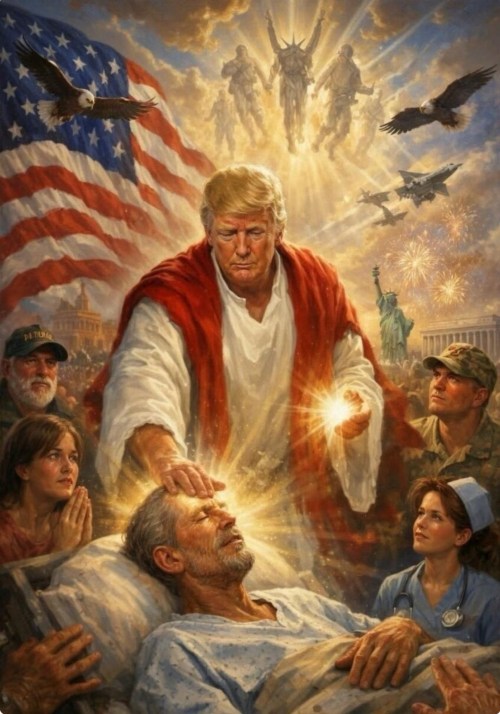
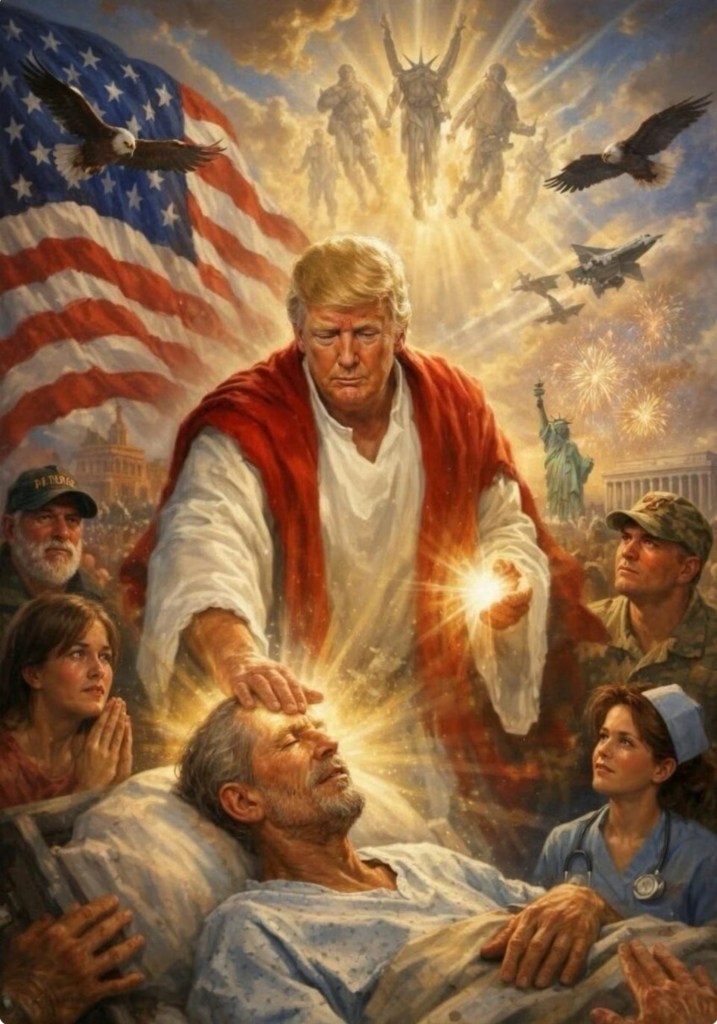
As mentioned in the previous post Trump now says that in the picture he posted, he is a doctor healing that man. This contradicts what everyone sees, a picture of him as a Jesus-like figure.
But looking at it again, it seems clear he is not healing that man with his divine superpower. That man appears to be dead and Trump is bringing him back to life.
Does that make any of this better? I don’t think so. It does make it stranger. Unless you are one who believes the president is capable of that, which makes it stranger still.
After even his biggest supporters criticized the above image posted by Trump today as “disgusting”, the post was taken down.
First saying he would not apologize, he then said “I thought it was me as a doctor.”
Many times over the seemingly endless years of Trump, I’ve referenced the DSM-5, the manual of psychiatric disorders, as applied to him.
Following is from the DSM-5, concerning grandiose delusions, a feature of Paranoid Personality Disorder. There is no clinical diagnosis of “messiah complex”. But professional designations aside, we know it when we see it.
Associated Features of Paranoid Personality Disorder
Individuals with paranoid personality disorder are generally difficult to get along with and often have problems with close relationships. Their excessive suspiciousness and hostility may be expressed in overt argumentativeness, in recurrent complaining, or by hostile aloofness. They display a labile range of affect, with hostile, stubborn, and sarcastic expressions predominating. Their combative and suspicious nature may elicit a hostile response in others, which then serves to confirm their original expectations.
Because individuals with paranoid personality disorder lack trust in others, they need to have a high degree of control over those around them. They are often rigid, critical of others, and unable to collaborate, although they have great difficulty accepting criticism themselves. They may blame others for their own shortcomings. Because of their quickness to counterattack in response to the threats they perceive around them, they may be litigious and frequently become involved in legal disputes. Individuals with this disorder seek to confirm their preconceived negative notions regarding people or situations they encounter, attributing malevolent motivations to others that are projections of their own fears. They may exhibit thinly hidden, unrealistic grandiose fantasies, are often attuned to issues of power and rank, and tend to develop negative stereotypes of others, particularly those from population groups distinct from their own. Attracted by simplistic formulations of the world, they are often wary of ambiguous situations. They may be perceived as “fanatics” and form tightly knit “cults” or groups with others who share their paranoid belief systems. (emphasis added)
Diagnostic And Statistical Manual of Mental Disorders (DSM-5)