Bob Schwartz

Trump: Iranian negotiators are “very different and ‘strange’”

Different and strange Iranian negotiator

In an attempt to explain why nothing is going well and everything is going wrong with his Iran War, including negotiations with Iran that aren’t actually happening, Trump wrote on Truth Social that the Iranian negotiators are “very different and ‘strange’”.

Even for an absurdist yet deadly powerful comic like Trump, this is a statement worth analyzing.

“Different” than whom?

“Strange” in what way?

Different than other Iranians he knows? Different than other negotiators, real or pretend, he has dealt with?

Stranger than what or whom? It is safe to say that nothing and no one around Trump is anything but strange.

Of course, it is possible that in Trump’s mind, which is already challenged and now more challenged by a war he started but can’t control, everything is different and strange. Which might be acceptable and survivable, except if it is the mind of someone capable of setting the world on fire. That would be different and strange.

Melania

Juan Peron became the strongman dictator of Argentina. The driving force that got him there was Eva Peron, a political and cultural figure unlike any in modern history. This inspired one of the great contemporary musicals.

Melania seems to lack many of the characteristics that made Evita so compelling and successful. But what if we have gotten this all wrong? What if Melania is the power behind the throne?

Something to think about as we await the next Melania movie. A New America? Maybe a musical?

Here is a sample of lyrics from A New Argentina, the showstopping number from Evita:


PERÓN
It’s annoying that we have to fight elections for our cause
The inconvenience, having to get a majority
If normal methods of persuasion fail to win us applause
There are other ways of establishing authority…

Then again, I could be foolish not to quit while I’m ahead
I can see me many miles away, inactive
Sipping cocktails on a terrace
Taking breakfast in bed
Sleeping easy
Doing crosswords
It’s attractive

EVA
Don’t think I don’t think like you
I often get those nightmares too
They always take some swallowing
Sometimes it’s very difficult to keep momentum
If it’s you that you are following
Don’t close doors
Keep an escape clause
Because we might lose the Big Apple
But would I have done what I did
If I hadn’t thought
If I hadn’t known, we would take the country


The Mad Dancers

The Mad Dancers


The Baal Shem Tov is the eighteenth-century founder of the Hasidic movement in Judaism. Jews and non-Jews who know the modern versions of the movement often don’t know much about its beginnings. Some of those contemporary manifestations may seem distant from the original spirit.

We have no writings by the Baal Shem Tov, so we rely on the records of his disciples, and on legends and stories that have come down the years—and that still have a remarkable power to inspire. Their authenticity is not in their being a verbatim record of what was said and what happened. Instead, they are an unmistakable reflection of a unique spiritual figure from any age or faith.

The Baal Shem Tov believed in and lived the direct experience of God everywhere in everything. Study and conventional piety took second place, which made him unpopular with the establishment, and would still today. He thought we should be outdoors in the trees, not indoors at the desks. Living in a divine state of optimism, joy and wonder was the ideal. People who live that way, of course, are remarkably hard to control.


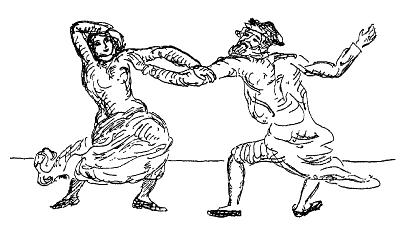
The Mad Dancers

Already the voices of opponents were raised against the Baal Shem’s teaching, for many
rabbis could not understand his ways. Some said of him that he dishonored the Sabbath with singing and freedom, some said that his ways and the ways of those who followed him and called themselves Chassidim were truly the ways of madmen.

One of the scholars asked of the Baal Shem, “What of the learned rabbis who call this teaching false?”

The Baal Shem Tov replied, “Once, in a house, there was a wedding festival. The musicians sat in a corner and played upon their instruments, the guests danced to the music, and were merry, and the house was filled with joy. But a deaf man passed outside the house; he looked in through the window and saw the people whirling about the room, leaping, and throwing about their arms. ‘See how they fling themselves about! ‘ he cried, ‘it is a house filled with madmen! ‘ For he could not hear the music to which they danced.”

Meyer Levin, The Golden Mountain (1932)