Amazing Art of Alejandro Jodoworsky: Art Sin Fin
by Bob Schwartz
Alejandro Jodoworsky is publishing an elaborate two-volume treasury of his decades as an unequaled multifaced artist, Art Sin Fin.
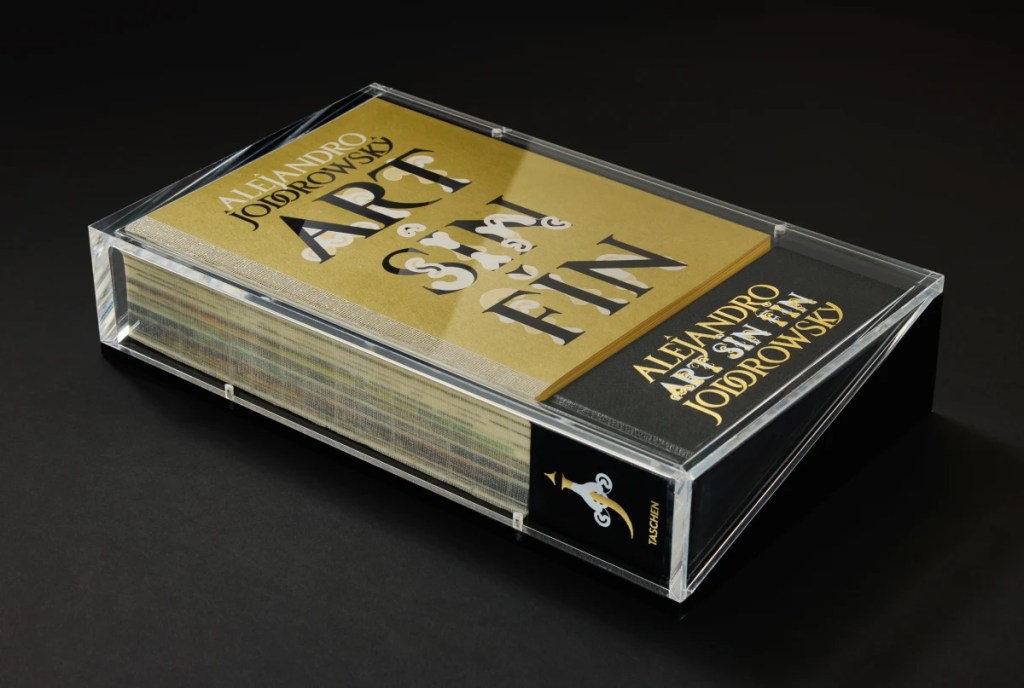
Alejandro Jodorowsky
Art Sin Fin
Taschen
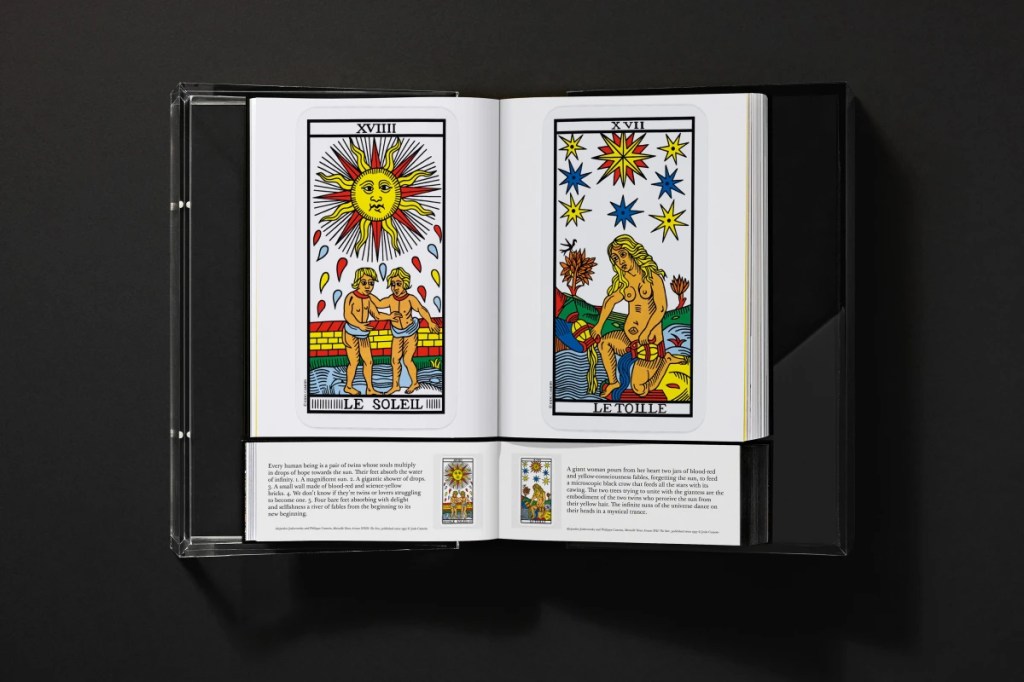
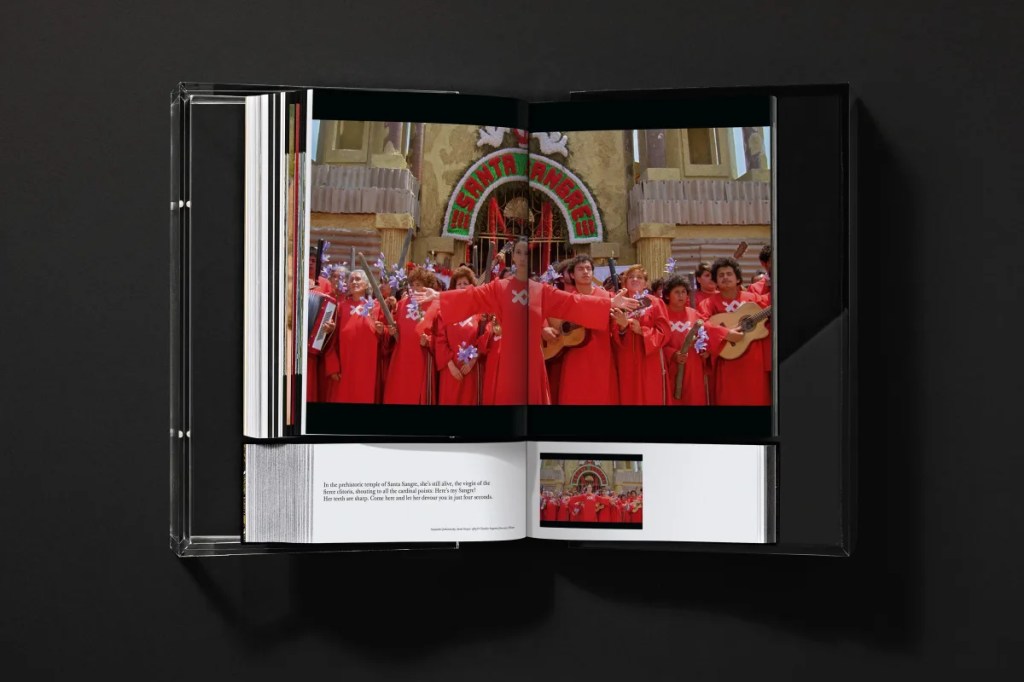
Discover a groundbreaking work of art by visionary Alejandro Jodorowsky. His films have inspired generations of artists across disciplines; his comics have changed the genre; his performances have defined entire aesthetics. His poetry perspires across media. From his performance work of the 1950s to the films in the 1970s such as El Topo and The Holy Mountain, to unrealized projects such as Dune, and up to his most recent work, this book, designed and edited in collaboration with M/M Paris and Donatien Grau, offers a unique insight into Jodorowsky’s artistic process – by the artist himself.
Two volumes in a in a custom-designed Plexiglas box that can be used as a book stand, 25 x 42 x 9 cm; volume 1: Softcover with fold-outs, 8.7 x 11.6 in, 1.096 pages, gilded edges on top and bottom, signing page at location selected by chance; volume 2: hardcover with black gilded edges, 8.7 x 3.34 in, 1.072 pages, total weight 30.86 lbs.
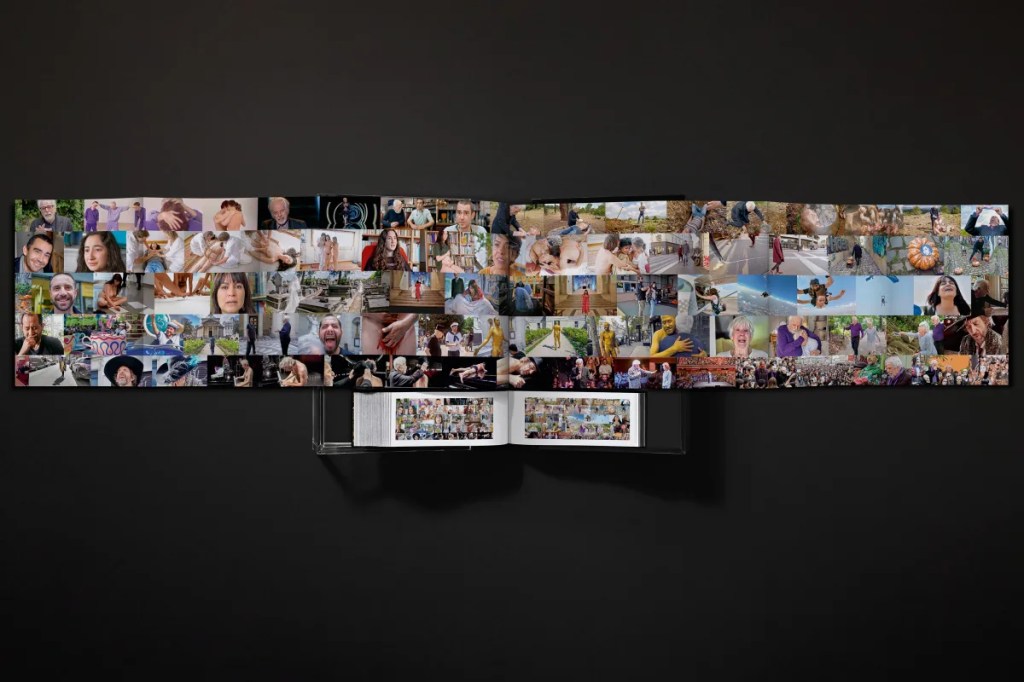
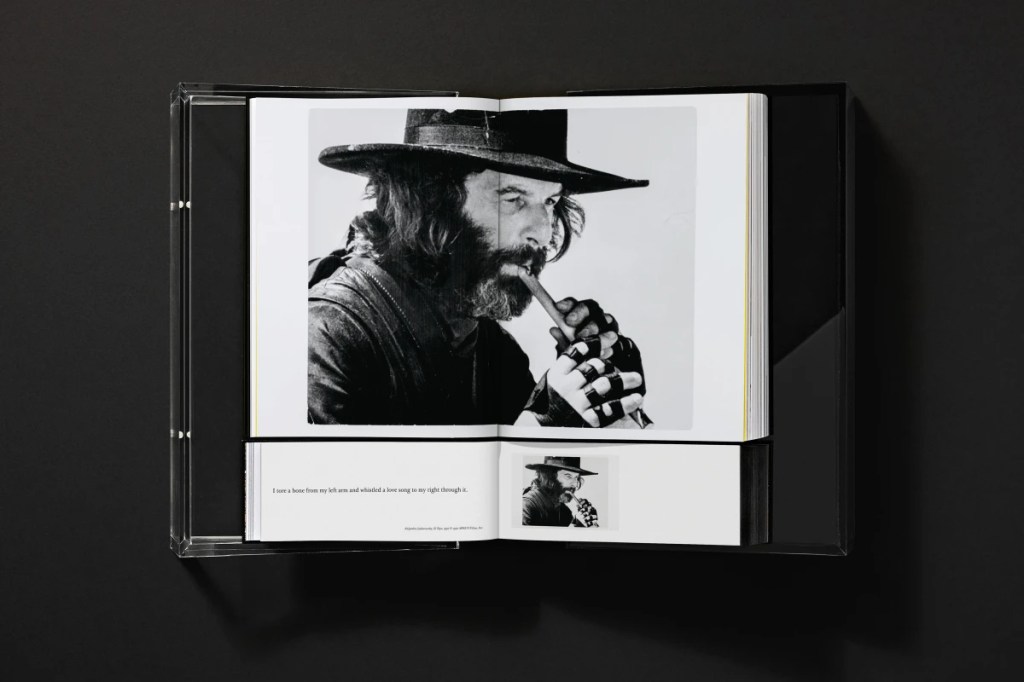
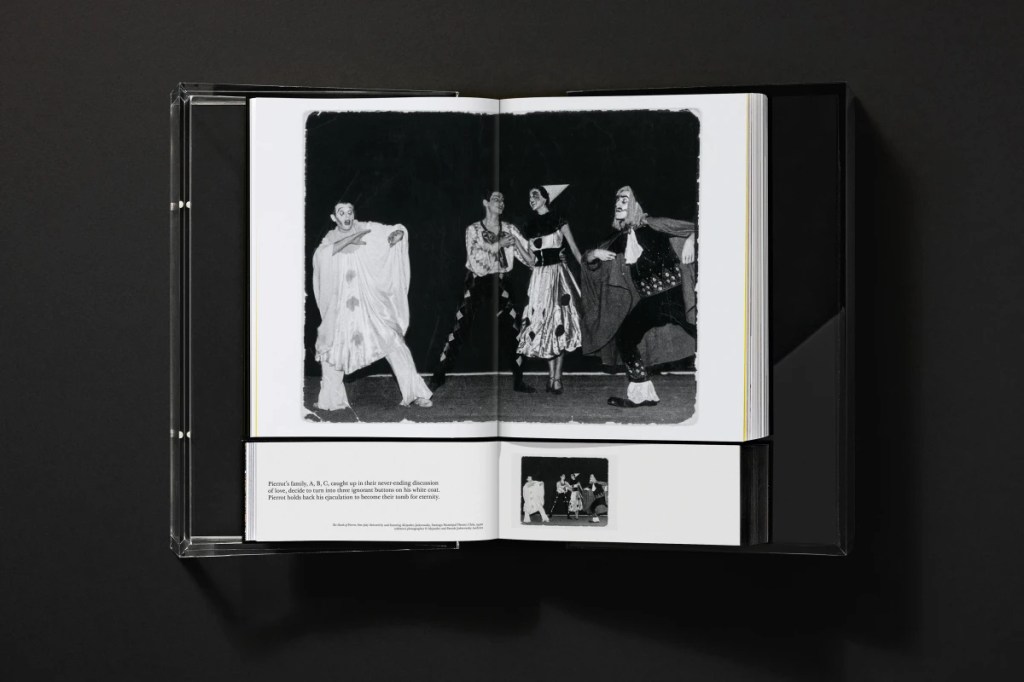
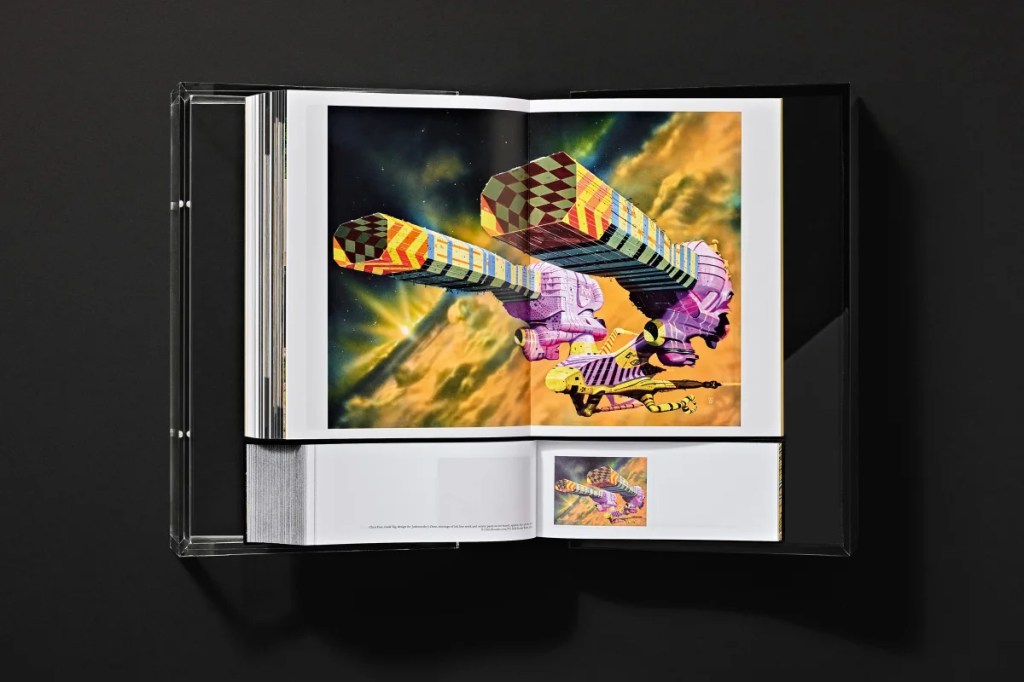
I am not capable of briefly summarizing Jodoworsky, so I am including below a recent interview from The Guardian.
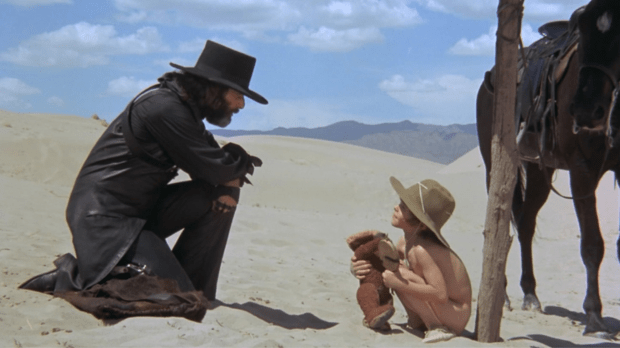
My ineradicable exposure to his work was watching El Topo (1970). You will find many comments to describe the movie and its impact, including calling it an “acid Western”. It is so much more, just as any description of Jodoworsky and his lifetime of work is okay only as far as it goes, but not far at all. To sum up the effect of watching El Topo: This is a strange and wondrous world filled with strange and wondrous things and people and with strange and wondrous creators.
‘Soon I will die. And I will go with a great orgasm’: the last rites of Alejandro Jodorowsky
The Chilean film-maker’s psychedelic work earned him the title ‘king of the midnight movie’, and a fan in John Lennon. Now the 96-year-old is ready for the end – but first there is more
Xan Brooks
Fri 16 Jan 2026
The Guardian
There is an apocryphal story of an ageing Orson Welles introducing himself to the guests at a half-empty town hall. “I am an actor, a writer, a producer and a director,” he said. “I am a magician and I appear on stage and on the radio. Why are there so many of me and so few of you?”
If a fantasy author were to dream up Welles’s psychedelic cousin, he’d likely have the air of Alejandro Jodorowsky: serene and white-bearded with a crocodile smile, presiding over a niche band of disciples. He has been – variously, often concurrently – a director, an actor, a poet, a puppeteer, a psychotherapist, a tarot-card reader, an author of fantasy books. At the age of 96, Jodorowsky estimates that he’s lived 100 different lives and embodied 100 different Jodorowskys. “Because we are different people all the time,” he says. “I died a lot of times but then I’m reborn. Look at me now and you see I’m alive. I am happy about this. It is fantastic to live.”
Jodorowsky recently finished work on a two-volume Taschen monograph, Art Sin Fin. That’s another rebirth, he says, although it also serves as an archive, a repository, a bulging bestiary of counter-cultural weirdness. Naturally, Art Sin Fin covers Jodorowsky’s brief 70s reign as the “king of the midnight movie”, the creator of the head-scrambling cult classics El Topo and The Holy Mountain, beloved by Dennis Hopper and John Lennon alike. But the retrospective roams much farther afield, leading us through riotous stage shows, outlandish comic-book panels and designs for grand productions (such as his long-cherished adaptation of Dune) that never saw the light of day.
People say that I’m the world’s last crazy artist. But I am not mad. I am only trying to save my soul
Jodorowsky chose the images and artwork alongside the book’s editor, Donatien Grau of the Musée du Louvre. But the accompanying prose is inimitably his own and mixes metaphors and similes with a devil-may-care panache. On one page his brain is “like a canary growling like a whale”. On another it has become “two bicycle wheels fighting like dogs”. Jodorowsky’s work can be provocative, outlandish and sometimes wilfully shocking, geared towards themes of sex and death. But it has always carried a top note of outright silliness, too.
In the beginning, before anything, there was Tocopilla, he says; a small port town on the rocky coast of northern Chile. That’s where he was raised, the square-peg son of a Ukrainian-Jewish shopkeeper, constantly dreaming of escaping to somewhere else. “Well,” he says, clarifying. “First I was one cell in the belly of my mother. Then I was working with my father from the age of seven, working behind the counter of this general store. I was the little young genius who was helping him every day. Now I am the little old genius who is talking to you.”
Tocopilla, it turned out, couldn’t contain him for long. He jumped first to Santiago and then on to Paris, where he studied mime with Marcel Marceau and directed Maurice Chevalier in music hall. His 1967 debut feature – the surrealistic Fando y Lis – sparked a riot when it premiered at the Acapulco film festival. “In Mexico they wanted to kill me,” he says. “A soldier marched in and put a gun to my chest.”
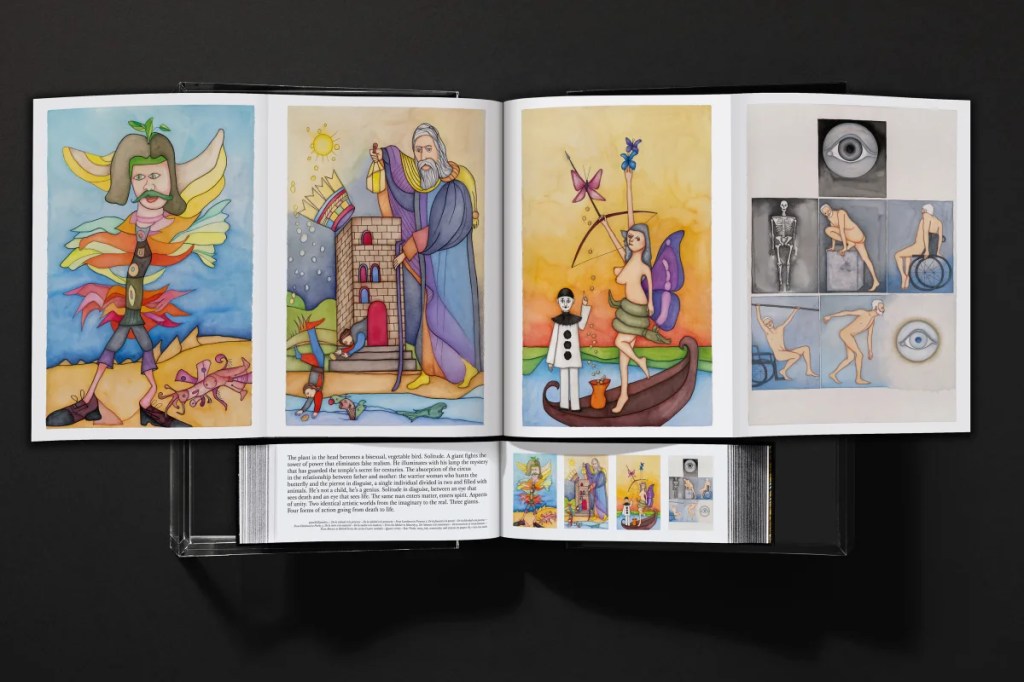
Jodorowsky shares a portion of Art Sin Fin with his second wife, Pascale Montandon. The couple like to paint together under a joint pseudonym, PascALEjandro, producing a series of jubilant watercolours that are one part Dalí to two parts Paula Rego. Montandon joins Jodorowsky on our Zoom call as well, gently chipping in to translate questions or correct her husband’s English.
“This is because I am a very old person,” he says. “Listen to this – I am nearly 100 years old. Soon I will die, that is the law of this planet. Maybe other planets as well. But my wife, she must not die. She is only 50 years old.”
“I’m 54,” Montandon says.
“She is 50,” he repeats. “That means she will live for another 50 years. And she will be here and think about me when I’m gone.”
“You’re not dead yet,” Montandon says. “And I might die before you. People don’t know anything.”
Jodorowsky insists he is an artist not a teacher, which means that there has never been any message or moral to his work. If his multi-hyphenate career is bound to anything, though, it is to the principles of a therapeutic practice that he calls “psychomagic”, which stirs Freud’s theory of the unconscious in with elements of shamanism and the tarot. For years Jodorowsky hosted regular free psychomagic sessions around Paris, where he lives, preaching the gospel and treating the afflicted. Nowadays he mostly counsels his patients via Zoom and sometimes wonders if he’ll have enough time to get through all his bookings. “Today,” he says. “Listen. There are 8 million people who are waiting for my help.”
“Eight million,” echoes Montandon. It is not quite a question.
“Yes,” he says firmly. “Eight million people, it’s true.”
Among the many black-and-white photographs in Jodorowsky’s collection, one shows a wide-eyed teenager with a white-painted face. He is leaning into the arms of a raven-haired woman. “My first pantomime in Chilean theatre,” reads the caption. “Aged 17, made up as an old man of 90, experiencing an orgasm in the arms of death.”
The artist squints at the photo. He is older today than the man he once played as a boy. “Another planet,” he says. “Another Jodorowsky. But maybe I am still the same person, deep inside. Maybe I only look different because I am in a different body.”
He frowns, shakes his head and puts the picture aside. “Soon I will be in the arms of death,” he says. “I am ready to die and I will go with happiness, with a great orgasm. But listen, I will tell you, I have always been this way. Life for me is an adventure. We live in an eternal present. Life is action, action, orgasm, and we experience it all the time.”
Endless art: the ages of Jodorowsky
El Topo
“It’s not a western, it’s an eastern,” Jodorowsky said of his 1970 breakthrough, a phantasmagoric Mexican odyssey that deliberately loses itself in the desert. The director plays the violent gunslinger in search of enlightenment while dragging his infant son, Brontis, along for the ride. El Topo’s US distribution was bankrolled by the former Beatles manager Allen Klein, who, urged on by John Lennon, would later agree to finance Jodorowsky’s 1973 epic, The Holy Mountain.
Endless Poetry
“My father was a monster and my mother was, too,” says Jodorowsky, who fled Chile for Paris and never saw his parents again. In his 80s he belatedly returned to shoot a pair of acclaimed magic-realist memoirs, The Dance of Reality (2013) and Endless Poetry (2016), in which he played the guardian angel of his younger self and arranged for his dad to be captured and tortured by Nazis. “People say that I’m the world’s last crazy artist,” he says. “But I am not mad. I am only trying to save my soul.”
Marseille Tarot Research
Jodorowsky was first turned on to the Tarot de Marseille by the French surrealist André Breton. He went on to produce his own interpretation of the original tarot family alongside designer Philippe Camoin. His 78-card deck is an “alphabet of the soul”, he says, with its major arcana (the Fool, the Juggler, the Devil et al) corresponding to individual human qualities. It is instead “a system for self-discovery and psychological healing”, he says.
Teo Jodorowsky, died of an overdose at 24 years old, 2021.
Teo Jodorowsky, died of an overdose at 24 years old, 2021. Photograph: pascALEjandro
Teo Jodorowsky
Jodorowsky’s son Teo – who played a dancing bandit in 1989’s Santa Sangre – died of an overdose at the age of 24. This family tragedy led to his father’s experiments with tarot-based psychotherapy and was later reframed in PascALEjandro’s jubilant image of an acrobatic Teo sitting astride the Grim Reaper’s shoulders. “Happy, my son goes down to his grave. I weep,” reads Jodorowsky’s accompanying caption.
John Difool & the plant queen from Alejandro Jodorowsky and Moebius’s The Incal, 1980-88.
John Difool & The Plant Queen from Alejandro Jodorowsky and Moebius’s The Incal, 1980-88. Photograph: Humanoids.
The Incal
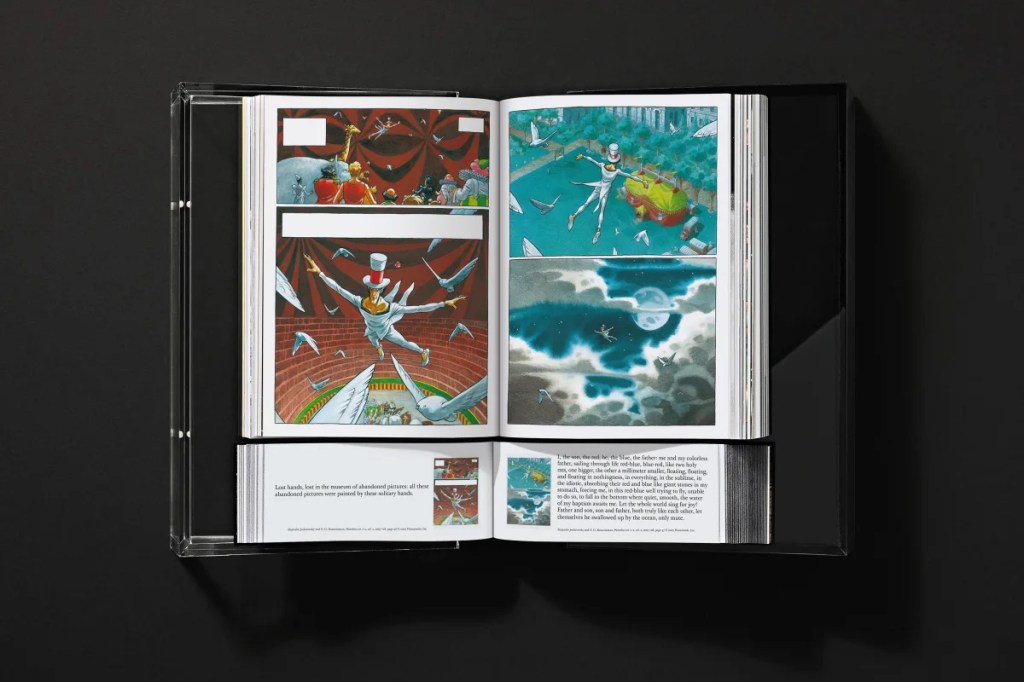
The Incal – the centrepiece of Jodorowsky’s fabulous comic-book sideline – is a sprawling 1980s space opera, cooked up in collaboration with the artist Moebius and charting the adventures of John Difool (‘the Fool”), a feet-of-clay private eye. Its elaborate cyberpunk style influenced The Matrix and Luc Besson’s The Fifth Element. An official big-screen adaptation, to be directed by Taika Waititi, is in development.
 Bob Schwartz