Fascists begin with thugs: Mussolini’s Blackshirts and Hitler’s Brownshirts
by Bob Schwartz
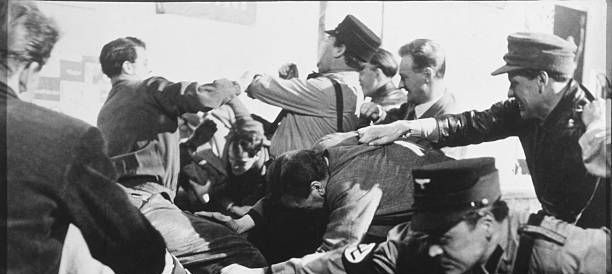
“Hitler’s SA beat up Jews, vandalized Jewish businesses, and intimidated voters and political opponents. This violence helped suppress opposition while the Nazis maintained a veneer of legality.”
Both Mussolini (the inventor of modern fascism) and Hitler began their rise to power with the help of organized thugs. Mussolini had his Blackshirts and Hitler had his Brownshirts (officially the SA, Sturmabteilung, “Storm Detachment).
These are not the only authoritarians, dictators and fascists to enlist thugs to help them. Above is a picture of Hitler’s thugs beating up German citizens in the streets.
Overview:
The Blackshirts (or Squadristi) were paramilitary fascist groups that emerged in Italy after World War I and became essential to Mussolini’s rise to power.
Origins and composition:
The Blackshirts formed around 1919-1920, initially as loosely organized squads of war veterans, unemployed workers, and disaffected young men. They wore black shirts as their uniform, which became their identifying symbol. Many members were ex-soldiers who felt betrayed by Italy’s treatment after WWI despite being on the winning side.
Their role in Mussolini’s rise:
The Blackshirts served as Mussolini’s instrument of violent intimidation and political control:
- Strike-breaking and anti-socialist violence: They attacked socialist organizations, labor unions, and leftist politicians, beating opponents and burning down socialist newspapers, meeting halls, and cooperatives. This earned them support from landowners and industrialists who feared socialist revolution.
- Creating chaos and positioning fascism as the solution: By generating political violence and instability, they helped create conditions where Mussolini could present himself and his fascist movement as the force that could restore order.
- The March on Rome (1922): Tens of thousands of Blackshirts marched on Rome in October 1922 in a show of force. Though it was more political theater than military coup, the threat of violence pressured King Victor Emmanuel III to appoint Mussolini as Prime Minister rather than risk civil war.
The Blackshirts essentially functioned as Mussolini’s private army, using systematic violence to eliminate opposition and intimidate the political establishment into accepting fascist rule.
The Brownshirts, officially called the Sturmabteilung (SA, meaning “Storm Detachment”), were the Nazi Party’s paramilitary organization that played a crucial role in Hitler’s rise to power through street violence and intimidation.
Origins and composition:
Founded in 1921, the SA initially served as security for Nazi rallies. They wore brown uniforms (hence “Brownshirts”) and attracted war veterans, unemployed young men, and working-class Germans during the economic turmoil of the Weimar Republic. Led by Ernst Röhm, the SA grew rapidly during the late 1920s and early 1930s, eventually numbering in the hundreds of thousands.
Their role in Hitler’s rise:
- Street violence and intimidation**: The SA engaged in brutal street fights with communists and socialists, attacked political opponents, and disrupted rival parties’ meetings. They created an atmosphere of chaos and civil conflict that undermined confidence in the Weimar government.
- Projecting strength and inevitability: Through massive rallies, marches, and their visible presence in brown uniforms, the SA made the Nazi movement appear powerful and unstoppable, attracting supporters who wanted to be on the “winning side.”
- Terror tactics: They beat up Jews, vandalized Jewish businesses, and intimidated voters and political opponents. This violence helped suppress opposition while the Nazis maintained a veneer of legality.
- Electoral intimidation: During elections in the early 1930s, the SA’s presence at polling places and their attacks on opponents helped create conditions favorable to Nazi electoral success.
After Hitler became Chancellor in 1933, the SA helped eliminate remaining opposition. However, Hitler later purged the SA leadership in the “Night of the Long Knives” (1934) when they became a political liability.
 Bob Schwartz